A US court order does not automatically cross the Atlantic just because it is written on official stationery. For many international families, the realization that a child support order or a property division decree has no immediate legal weight in the Middle East is a source of significant stress. If you are currently facing the challenge of enforcing us judgment in israel, it’s important to understand that while the Israeli legal system is generally pro-enforcement, the process requires a formal bridge between the two jurisdictions.
It’s natural to feel anxious when assets are hidden or support payments stop because a former spouse believes they are out of reach. You likely feel that the law should be universal, especially when family welfare is at stake. This guide provides a clear roadmap for the enforcement process, detailing the statutory requirements under the Foreign Judgments Enforcement Law and the strategic steps necessary to secure your rights.
We will examine the five essential conditions for recognition, the strict five-year statute of limitations, and the jurisdictional thresholds that determine which court handles your case. This content is published on an independent advisory platform for informational purposes and does not constitute legal advice or an attorney-client relationship. By understanding these procedural realities, you can move from uncertainty to a structured plan for securing assets within the Israeli jurisdiction.
Key Takeaways
- Understand why a US court order is not automatically valid and how the 1958 Law acts as a gateway for recognition within the Israeli legal system.
- Learn the five specific legal criteria required for enforcing us judgment in israel, including proving the original court’s jurisdiction and the finality of the ruling.
- Identify the essential documentation and translation steps, such as obtaining an Apostille, needed to transform a US decree into a binding Israeli order.
- Recognize the strategic importance of bridging the gap between US legal concepts and local practice to avoid costly delays or procedural errors.
- Gain a realistic perspective on timelines and the steps required to secure child support or marital assets held within the Israeli jurisdiction.
Understanding the Reach of US Court Orders within the Israeli Legal System
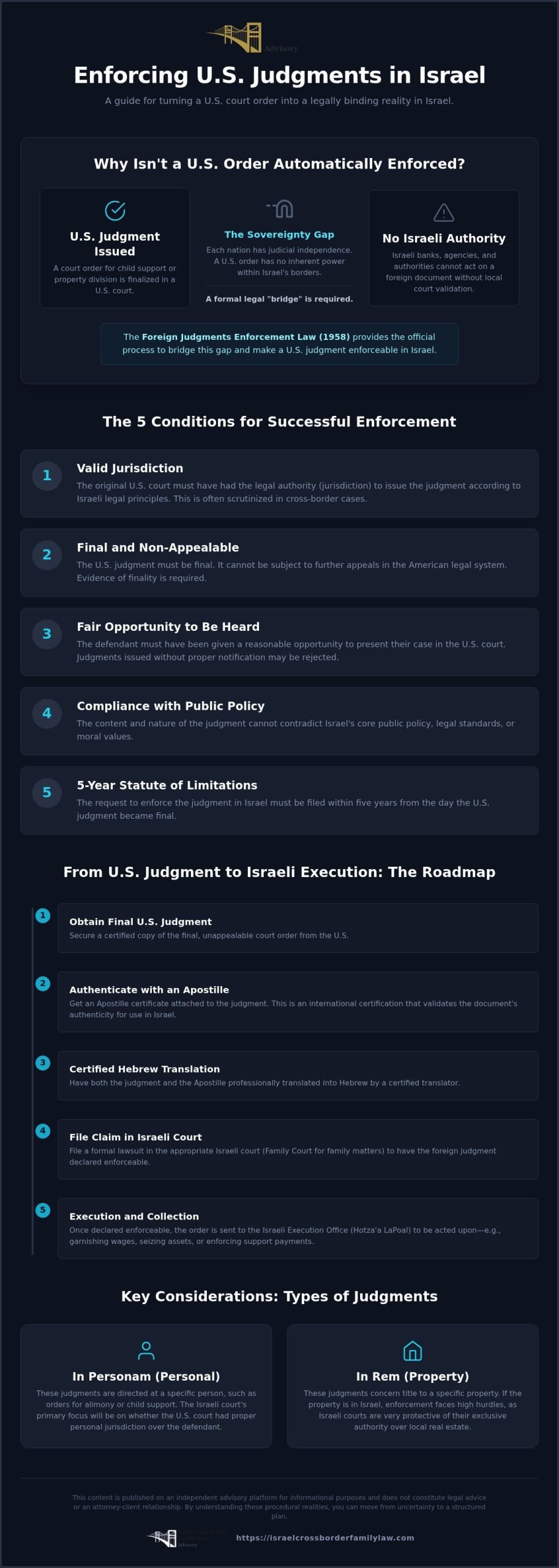
Sovereignty is the fundamental reason a New York or California court order doesn’t immediately freeze a bank account in Tel Aviv. Each nation maintains its own legal boundaries and judicial independence. While the US and Israel share deep cultural and economic ties, their legal systems remain distinct. To make a foreign order binding, you must bridge this gap through a specific legal process that respects the authority of the local court system. Without this bridge, a US judgment is essentially a foreign document with no power to compel action by Israeli banks, police, or government agencies.
Israel maintains a relatively liberal policy toward international comity. This means the courts generally aim to honor foreign decisions to ensure global stability and fairness for international families. This principle is codified in the Foreign Judgments Enforcement Law of 5718-1958. However, a liberal policy doesn’t mean the process is automatic. The Israeli court must first declare the judgment enforceable before any local authority will act on it. This process relies on general principles of foreign judgment enforcement that balance respect for foreign courts with the protection of Israeli public policy and legal standards.
To better understand this concept, watch this helpful video:
When enforcing us judgment in israel, it’s vital to distinguish between recognition and enforcement. Recognition is a declaratory act where the Israeli court acknowledges the US order as a valid legal fact. Enforcement is the actual execution of that order, such as garnishing wages or seizing property. In family law, this distinction is particularly important. A commercial debt is often a one-time transaction. In contrast, child support cross-border enforcement involves recurring obligations that require ongoing monitoring and potential intervention by Israeli execution authorities over many years.
Types of Enforceable Judgments: In Personam vs. In Rem
Most family law matters involve “In Personam” judgments. These are orders directed at a specific person, such as an obligation to pay alimony or return a child. Israel focuses heavily on whether the US court had proper personal jurisdiction over the defendant. “In Rem” judgments, which concern the title to a specific piece of property located in Israel, are treated differently. Israeli courts are often protective of their exclusive right to determine ownership of land within their own borders, meaning a US order regarding Israeli real estate may face higher hurdles than a support order.
The Reality of Cross-Border Jurisdictional Challenges
US courts frequently use “Long-Arm” statutes to claim jurisdiction over individuals living abroad. Israeli judges may scrutinize these claims closely during the enforcement process. If a US court issued an order without the defendant having a fair chance to be heard, or if the connection to the US state was legally insufficient, the Israeli court might refuse enforcement. Many expats mistakenly believe a US divorce decree automatically settles all Israeli property issues. In reality, early strategic decisions in the US court can significantly impact your success when you eventually bring that order to Israel. This content is published on an independent advisory platform for informational purposes and does not constitute legal representation or formal legal advice. Legal services are only provided by licensed attorneys under a separate engagement. Understanding these risks helps families find clarity before they commit to a specific legal path.
The Statutory Framework: Israel’s Foreign Judgments Enforcement Law
The primary legislation governing the process of enforcing us judgment in israel is the Foreign Judgments Enforcement Law, 5718-1958. This statute establishes a clear, structured path for recognition. It’s built on the core principle that a foreign court’s decision doesn’t automatically carry power within Israel. Instead, an Israeli court must first issue a declaration of enforceability. This judicial filter ensures that the foreign order aligns with local legal standards while maintaining respect for the original court’s authority. This content is published on an independent advisory platform and does not constitute legal representation or formal legal advice.
Once the court grants this declaration, the US order gains the same legal weight as a judgment issued by an Israeli court. This means you can use the local execution office (Hotza’a LePoal) to garnish wages, place liens on assets, or enforce support payments. For a deeper look at these procedures, you might consult a Practical Guide to Enforcing Foreign Judgments in Israel which details how these frameworks protect both the creditor and the integrity of the Israeli legal system. Every case is unique, so it’s wise to request a case review to understand how these statutes apply to your specific decree.
The Principle of Comity and Reciprocity
Reciprocity is a cornerstone of this framework. Generally, Israel enforces judgments from countries that would similarly enforce Israeli judgments. Because US courts have a long history of recognizing Israeli orders, this requirement is usually met. However, the law provides flexibility. In matters involving child support cross-border enforcement, the court may waive strict reciprocity to prioritize the welfare of the family. This flexibility demonstrates Israel’s commitment to international comity and legal stability for expats living between two systems.
Why Israel is Considered a ‘Pro-Enforcement’ Jurisdiction
Israel is widely recognized as a pro-enforcement jurisdiction. The Israeli Supreme Court has historically maintained a liberal policy that presumes a foreign judgment should be enforced unless there’s a compelling reason not to. This is based on the Vested Rights theory, which suggests that a right won in a competent US court should be protected globally. You must act quickly, though, as the law requires filing a motion within five years of the original judgment date. This deadline is strictly enforced by the courts, making early preparation essential for a successful outcome in the Israeli District Court.
The Five Essential Criteria for Successful Enforcement in Israel
While the Israeli legal system maintains a pro-enforcement stance, the court doesn’t simply rubber-stamp every foreign decree. To succeed in enforcing us judgment in israel, your petition must satisfy five specific statutory requirements. These criteria act as a quality control mechanism, ensuring that the US order is legally sound and compatible with local standards. This content is published on an independent advisory platform for informational purposes and does not constitute legal representation or formal legal advice.
- Competent Jurisdiction: The Israeli court must be satisfied that the US court had the authority to rule on the matter. This is judged according to Israeli rules of private international law, not just the laws of the US state where the order was issued.
- Finality: The judgment must be final and no longer subject to appeal. In cases involving child support cross-border enforcement, this can be complex because support orders are often modifiable; however, the “finality” usually refers to the arrears or the specific payment obligation currently being enforced.
- Enforceability in the State of Origin: You cannot enforce an order in Israel that has expired or been stayed in the US. The judgment must be currently “executable” in the state where it was rendered.
- Reciprocity: As discussed previously, the US state must generally be one that recognizes Israeli judgments. Most US states meet this requirement through their own versions of uniform foreign money judgment acts.
- Public Policy: The judgment must not contradict the fundamental values or “public policy” of the State of Israel. This is rarely an issue in standard family law cases, but it serves as a final safeguard.
Due Process and The Public Policy Shield
Israeli courts apply a “Natural Justice” test to every foreign application. This means they check if the defendant was given a fair chance to be heard. If an order was obtained through fraud or if the defendant didn’t receive proper legal notice of the proceedings, the Israeli court will likely block enforcement. In family law, this shield is often used when one party claims they weren’t served with divorce papers while living abroad. It’s a high bar to meet, but it’s the most common defense used to challenge the validity of a US order.
The Role of the Apostille and Documentation
The procedural journey begins with document authentication. An Israeli court will only accept a certified copy of the US judgment that bears an Apostille. This is a specialized certificate issued by the Secretary of State in the US that authenticates the signature of the judge or court official. Without it, your application won’t even be considered. Additionally, all documents must be translated into Hebrew by a professional translator. While courts sometimes waive the translation requirement for simple English documents, you shouldn’t rely on this exception for complex decrees. The burden of proof lies with the party seeking enforcement.
The Procedural Roadmap: From US Judgment to Israeli Execution
Moving from a paper judgment to actual recovery requires a structured procedural approach. While the legal theory behind enforcing us judgment in israel is complex, the practical steps follow a logical progression. This content is published on an independent advisory platform for informational purposes and does not constitute legal representation or formal legal advice. Legal services are only provided by licensed attorneys under a separate engagement.
- Step 1: Document Preparation. You must obtain a certified copy of the US judgment with an Apostille. A professional Hebrew translation is typically required to ensure the Israeli court understands the exact terms of the order.
- Step 2: Filing the Motion. Your legal team files a “Motion to Enforce” in the appropriate Israeli District Court. This isn’t a new trial on the merits but a request for the court to recognize the existing US order.
- Step 3: The Response Period. Once served, the defendant has a set window to object. Defenses are limited to the specific criteria discussed in previous sections, such as lack of notice or fraud.
- Step 4: The Court Hearing. The judge reviews the arguments and, if satisfied, issues a declaration of enforceability. This transforms the US order into a domestic Israeli judgment.
- Step 5: The Execution Office. This is the most critical step. You must take the Israeli court’s declaration and open a file with the Execution Office (Hotza’a LaPoal) to begin collection.
Navigating the Israeli District Court
Determining which District Court should hear your motion depends on the defendant’s place of residence or the location of their assets in Israel. The “Motion to Enforce” functions as a summary proceeding. This means the court focuses on the procedural validity of the US judgment rather than re-examining the facts of the original case. To see how this fits into a broader strategy, you can learn more about how our advisory works to guide families through these hurdles.
Execution and Collection: Making the Order ‘Real’
Winning in court is only half the battle. The Execution Office (Hotza’a LaPoal) is the administrative body that actually enforces the debt or obligation. They have the power to seize bank accounts, place liens on property, or even impose travel bans to prevent a debtor from leaving Israel. For families, there are specialized tracks for child support cross-border enforcement that prioritize these payments. These tools are powerful but require precise management to be effective. If you’re ready to move from a US decree to local action, you should contact us to discuss your enforcement strategy.
Strategic Guidance: Navigating Enforcement with a Foreign Lawyer in Israel
Successfully enforcing us judgment in israel is as much about strategy as it is about statutes. While local Israeli attorneys understand the domestic rules, a cross-border practitioner acts as a vital bridge between two distinct legal cultures. This content is published on an independent advisory platform for informational purposes and does not constitute legal representation or formal legal advice. Legal services are only provided by licensed attorneys under a separate engagement.
US legal concepts like “contempt of court” or specific “discovery” rules don’t always have a direct equivalent in the Israeli system. A practitioner who understands both the US state of origin and Israeli law can help frame your petition in a way that resonates with a local judge. This prevents important nuances from being lost in translation. Coordination between your US litigation counsel and your Israeli advisory is essential to ensure that the steps taken in one jurisdiction don’t inadvertently undermine your rights in the other. Pre-evaluating a US judgment before committing to the costs of Israeli litigation is a key part of effective risk mitigation.
Why Seek a Foreign Lawyer in Israel for Enforcement?
The Anglo expat community in Israel often finds the local legal landscape confusing and bureaucratic. A foreign lawyer in Israel who is familiar with the American legal mindset can provide a sense of security and establishment. They are equipped to manage expectations regarding timelines, which can vary significantly between the two countries. In high-stress family law matters, having a calm, authoritative guide who speaks your language and understands your cultural background is often the difference between a chaotic process and a structured resolution.
Get Clarity Before You Commit
The weight of early decisions in the enforcement process cannot be overstated. Choosing the wrong jurisdictional path or failing to properly authenticate a document can lead to expensive delays. It’s important to seek clarity before making major commitments to a specific legal course. A confidential case review is the most prudent first step for any international family. This review provides an opportunity to assess the strengths and risks of your US order before it enters the Israeli court system. By understanding the inherent complexity of cross-border issues early on, you can make more informed decisions about your assets and your family’s future.
Get clarity before you commit. Request a confidential consultation.
Securing Your Cross-Border Interests in Israel
Successfully enforcing us judgment in israel requires a precise bridge between two distinct legal systems. As we’ve explored, the Israeli courts maintain a pro-enforcement stance, yet they demand strict adherence to statutory requirements regarding jurisdiction, finality, and public policy. Navigating this transition from a US decree to local execution involves more than just filing paperwork; it requires a strategic understanding of how assets are secured and support payments are collected within the Israeli jurisdiction.
This advisory platform provides specialized guidance for the Anglo expat community, leveraging expertise in cross-border US-Israel family law matters. By working with practitioners licensed in multiple jurisdictions, families can better manage the inherent complexity of transnational litigation and avoid costly procedural pitfalls. This content is for informational purposes and doesn’t constitute legal advice. Legal services are only provided by licensed attorneys under a separate engagement.
Get clarity before you commit. Request a confidential consultation. You can take the next step toward resolution with confidence and a clear roadmap.
Frequently Asked Questions
Can an Israeli court change the amount of child support set by a US court?
Israeli courts generally won’t modify a recognized US support order retroactively. However, if the child now lives in Israel and there’s a material change in circumstances, the court may have jurisdiction to hear a new claim for support. This doesn’t technically “change” the US order but creates a new local obligation based on the child’s current needs and the parents’ current financial status. It’s a complex area where the timing of your filing matters significantly.
How long does the enforcement process typically take in Israel?
The timeline depends heavily on whether the defendant opposes the motion. The process of enforcing us judgment in israel usually takes about six months if the motion is unopposed. If the other party decides to contest the application, the proceedings can last between two and three years. You should also remember that you must file your motion within five years of the date the US judgment was rendered to avoid statute of limitations issues.
Do I need to travel to Israel to enforce my US judgment?
In most cases, your physical presence in Israel isn’t required to complete the enforcement process. Most of the work involves filing written motions and legal arguments through your representative. While a judge might occasionally request a hearing where testimony is needed, many of these procedural requirements can be handled remotely. This allows international families to manage their legal interests without the stress and expense of frequent cross-border travel.
What happens if the defendant has no assets in Israel?
Collection becomes more challenging without tangible assets like bank accounts or real estate, but legal tools are still available. If the defendant is an Israeli resident, you can use the Execution Office to impose personal sanctions. These include “Stay of Exit” orders, which prevent the person from leaving the country until the debt is settled. These administrative pressures often compel a debtor to find a way to satisfy the judgment even if they’ve hidden their assets.
Is a US prenuptial agreement considered an enforceable judgment in Israel?
A prenuptial agreement is generally treated as a contract rather than an enforceable judgment. To enforce its terms in Israel, you usually need to sue for breach of contract or seek a declaratory judgment from an Israeli court. However, if the prenup was already incorporated into a final US divorce decree, it may then qualify for enforcement under the Foreign Judgments Enforcement Law. It’s vital to distinguish between a private agreement and a court-sanctioned order.
What is an Apostille and why is it required for my US court papers?
An Apostille is a form of international authentication that verifies the signature and seal of the US court official who issued your documents. It’s a requirement under the Hague Convention to prove to Israeli authorities that your papers are genuine. Without this certificate, which is typically issued by the Secretary of State in the state where the judgment was rendered, the Israeli court won’t accept your US order as a valid legal document for enforcement.
Can I enforce a US judgment if it was a ‘default judgment’ where the other party didn’t show up?
You can move forward with enforcing us judgment in israel even if the original order was a default judgment. The Israeli court will scrutinize the case to ensure the defendant was properly served and had a fair opportunity to present their defense. This is known as the “natural justice” test. As long as you can provide proof of service and show that the US court followed due process, the lack of the defendant’s appearance won’t automatically block enforcement.
Are US alimony orders (spousal support) enforceable against an Israeli resident?
US alimony orders are fully enforceable in Israel under the same statutory framework used for other monetary judgments. The court will check if the order meets the five essential criteria, including finality and reciprocity. Because US courts regularly enforce Israeli spousal support orders, the reciprocity requirement is almost always satisfied. Once recognized, these orders can be sent to the Execution Office to begin the collection process against the resident’s local income or property.

Article by
Gabriel Lior
A Personal Journey That Became a Mission
The advisory was founded by an American father Gabriel Lior, LLB, MBA , global entrepreneur, and cross-border advisor who spent more than a decade navigating the Israeli family court system firsthand and now lives in Singapore with his son.
As a divorced parent in a cross-border family, Gabriel faced nearly every legal challenge a foreign parent can encounter in Israel — including child custody disputes, child support proceedings, property matters in Israel and abroad, false accusations, and complex immigration and relocation proceedings.
Over the years, he learned the hard way how difficult it is for non-Israeli parents to understand the system, identify the right legal strategy, and choose the right legal representation — especially when language, culture, and jurisdictional differences are involved. He also witnessed how foreign parents and new immigrants are often disadvantaged or taken advantage of by service providers and institutions simply because they lack local knowledge or fluency.
From Client to Advisor
To truly understand — and survive — the system, Gabriel pursued formal legal education in Israel, completing two Israeli law degrees, alongside a BA and MBA earned in the United States. This was never about becoming a practicing attorney, but about gaining a deep, structural understanding of how the system works — and where it breaks down for foreign parents.
This rare combination of:
Firsthand client experience
Israeli legal and US business education
International business and negotiation training
Decades of commercial execution
created a unique perspective – one that understands both sides of the table.
After years of litigation, persistence, and at times self-representation, he ultimately succeeded in securing custody of his son and relocating abroad through a rare legal victory in the Israeli Supreme Court — becoming one of the first fathers in Israel to do so under these circumstances.
Disclaimer
Important Disclaimer:
The information provided on this website and in its content is for general informational and educational purposes only and does not constitute legal advice, legal opinion, or legal representation.
Gabriel Lior is not licensed to practice law in Israel (nor is he interested in doing so) and does not provide legal services, despite having completed 2 Law Degrees. The services offered are advisory in nature and are intended to provide general guidance, strategic insight, and information regarding cross-border family law considerations.
No attorney-client relationship is formed by accessing this website, reading its content, or communicating with us.
Any decisions made based on this information are at your own discretion and risk. For legal advice specific to your situation, you should consult a licensed attorney in the relevant jurisdiction.
Where appropriate, we may refer clients to independent, licensed attorneys or professionals. Such referrals do not constitute legal representation and no liability is assumed for services provided by third parties.