A final judgment from a US or foreign family court doesn’t automatically carry legal weight the moment it crosses the Israeli border. You might feel a deep sense of uncertainty, wondering if a spouse currently in Israel will simply ignore a hard-won support or custody order. It’s a common fear for international families who find themselves caught between two very different legal systems. Understanding the process of Enforcing Foreign Family Court Orders in Israel is the first step toward ensuring your rights are protected across borders.
This article provides a clear roadmap for domestication, outlining the statutory requirements and procedural steps needed to make your judgment legally binding and executable. We will walk through the essential conditions for enforcement, such as the five year statute of limitations and the mandatory ₪568 family court filing fee, while highlighting the risks you need to understand before moving forward. You’ll learn why enforcement isn’t a simple rubber stamp process, but a strategic bridge between jurisdictions that requires precise attention to Israeli public policy and procedural strictness.
Key Takeaways
- Foreign family court judgments have no inherent power in Israel until they are formally recognized through a “domestication” process under the 1958 Law.
- Learn the four essential statutory conditions for success, including proving the original court held proper jurisdiction and that the order is final.
- Navigate the procedural requirements for Enforcing Foreign Family Court Orders in Israel, including the necessity of an Apostille and filing in the correct metropolitan court.
- Identify potential obstacles early, such as “lack of due process” or “fraud” defenses, that a respondent might use to challenge your filing.
- Understand why early strategic decisions are critical for protecting your interests and ensuring child support or custody orders are upheld across different legal systems.
The Legal Framework: The Foreign Judgments Enforcement Law, 1958
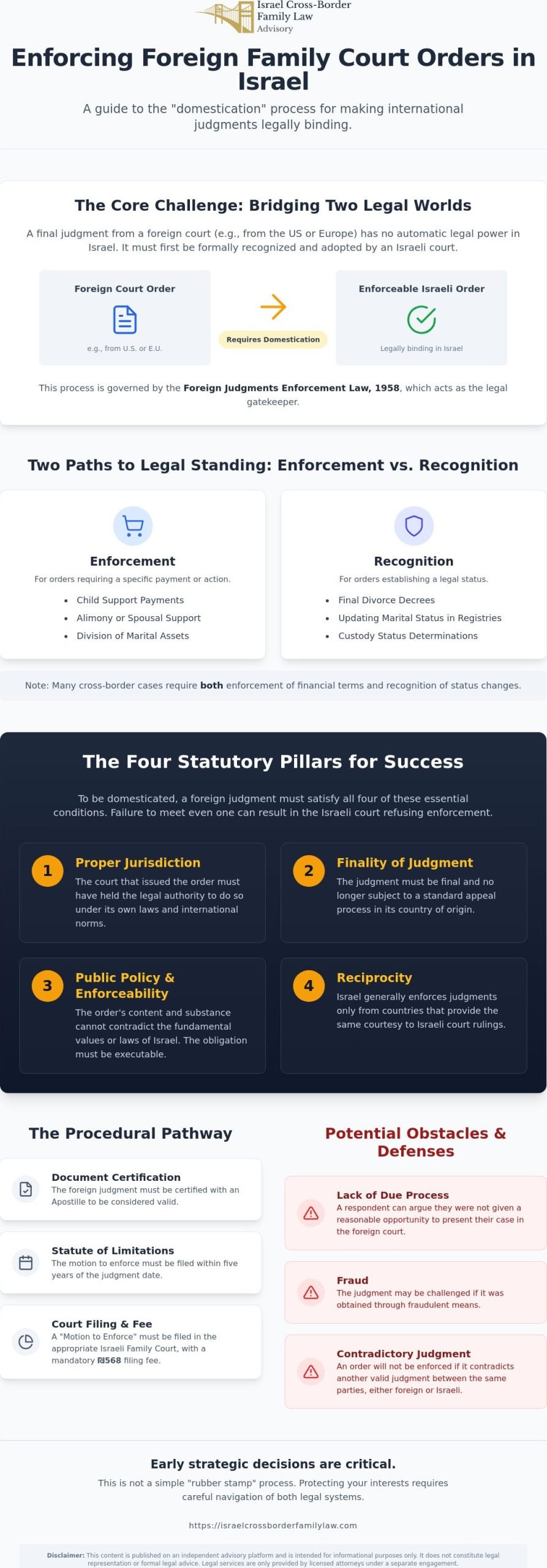
The Foreign Judgments Enforcement Law, 5718-1958, acts as the primary gatekeeper for any international ruling entering the Israeli legal system. While a judgment from a US or European court carries significant weight in its home country, it has no inherent power within Israel. It remains a foreign document until an Israeli court formally “domesticates” it. This process is essential because the Israeli sovereign legal system doesn’t automatically adopt the decisions of foreign powers. Instead, it reviews them to ensure they align with local standards of fairness and public policy. Enforcing Foreign Family Court Orders in Israel requires a deliberate transition from a foreign mandate to a local, executable order.
At its core, the Enforcement of foreign judgments involves a statutory review where the Israeli court examines whether the original ruling meets specific criteria for validity. In the context of family law, these orders are generally treated as civil matters. This means that whether the order concerns child support, alimony, or the division of marital assets, the court applies the same rigorous statutory framework used for international commercial disputes. It’s a structured path designed to provide certainty for families while maintaining the integrity of the local legal environment.
Enforcement vs. Recognition in Family Law
It’s vital to distinguish between two different legal actions: enforcement and recognition. Enforcement applies when an order requires a specific act or payment, such as child support or alimony. Recognition, on the other hand, is used for status-based orders, such as a final divorce decree. A court might recognize a foreign divorce to update a person’s marital status in the population registry without necessarily enforcing the financial clauses within that same decree. In many cross-border cases, an order requires both recognition of the status and enforcement of the obligations to be fully effective in Israel.
The Role of the Israeli Family Court
Unlike general civil disputes, motions regarding family matters are heard in specialized Family Courts. These courts are designed to handle the sensitive nature of domestic relations while balancing international comity with Israeli legal standards. The judges in these courts assess whether the foreign order contradicts local public policy or if it was obtained through a process that respects basic rights. The ‘Motion to Enforce’ serves as the formal legal vehicle required to initiate the domestication process within the Israeli judiciary.
Disclaimer: This content is published on an independent advisory platform and is intended for informational purposes only. It does not constitute legal representation or formal legal advice. Legal services are only provided by licensed attorneys under a separate engagement.
The Four Statutory Conditions for Enforcement in Israel
Israel’s legal system doesn’t grant recognition to foreign orders by default. Instead, the Foreign Judgments Enforcement Law sets out four specific benchmarks that a ruling must clear. These criteria serve as the foundation for Enforcing Foreign Family Court Orders in Israel, ensuring that every domesticated ruling adheres to local standards of justice. If any of these conditions aren’t met, the Israeli court may refuse to grant the order legal standing within its borders.
- Proper Jurisdiction: The court that issued the order must have held the authority to do so under its own domestic laws. Israeli judges will also confirm that the jurisdiction aligns with international norms.
- Finality: The judgment must be final and no longer subject to ordinary appeal in its country of origin.
- Public Policy and Enforceability: An order won’t be enforced if it contradicts the fundamental values of the Israeli legal system or if the obligation itself is impossible to carry out under local law.
- Reciprocity: Israel generally only enforces judgments from countries that offer the same courtesy to Israeli rulings, ensuring a balanced international legal relationship.
It’s helpful to seek a professional assessment of your documents before initiating a formal motion to ensure these hurdles won’t stall your case.
Proving Foreign Jurisdiction and Finality
The Israeli court verifies jurisdiction by reviewing the procedural history of the case. You must demonstrate that the foreign court was the appropriate forum and that the defendant was properly served. Proving finality can be complex in family law because child support or custody orders are often modifiable. However, for enforcement purposes, the specific debt or status must be settled. You’ll typically need to provide a “Certificate of Finality” or a certified statement from the original court clerk. Israel’s commitment to international legal cooperation is visible in the Israel – HCCH Member Profile, which outlines the conventions that help streamline these cross-border interactions.
The Reciprocity Rule (Section 4)
Section 4 of the Law requires “reciprocity.” This means there must be a reasonable expectation that the foreign country would enforce an Israeli judgment. For major jurisdictions like New York, California, and the UK, this is well-established. If you are dealing with a jurisdiction that doesn’t have a clear history of mutual enforcement, the Israeli Attorney General has the power to waive this requirement. This waiver is usually granted if enforcement is deemed essential to the public interest or the welfare of a child.
Disclaimer: This content is published on an independent advisory platform and is intended for informational purposes only. It does not constitute legal representation or formal legal advice. Legal services are only provided by licensed attorneys under a separate engagement.
Navigating the Procedural Path for Family Orders
Moving from the legal theory of the 1958 Law to practical application requires a meticulous administrative approach. Enforcing Foreign Family Court Orders in Israel begins with the filing of a formal “Motion to Enforce” in the specific Israeli Family Court that holds territorial jurisdiction. This is usually the court closest to the respondent’s residence or assets. Unlike general civil filings, family court procedures are strictly controlled. Errors in the initial submission can lead to significant delays or even dismissal of the motion.
A critical first step is obtaining an Apostille for the foreign judgment. This international certification authenticates the signatures and seals on your documents, making them recognizable to Israeli officials. Once authenticated, every document must be translated into Hebrew. Israeli courts maintain a non-negotiable standard: these translations must be certified by an Israeli notary. This ensures the court is working with an accurate and legally binding version of the foreign order without the risk of linguistic ambiguity.
Documentation and Evidence Requirements
The court requires a specific evidentiary package to proceed. Your submission must include a certified copy of the original foreign judgment with the Apostille attached and a notarized Hebrew translation performed by a qualified Israeli professional. You’ll also need to provide a detailed affidavit verifying the facts and the current status of the judgment. In many cases, the court requires an expert opinion on foreign law. This is a formal briefing from a legal professional qualified in the issuing country. It explains how the judgment meets the criteria for finality and jurisdiction under that specific legal system. This U.S. government guide on enforcing orders in Israel provides a helpful overview of how these requirements are managed in practice between the two nations.
Special Considerations for Child Support and Custody
When children are involved, the process carries additional strategic weight. Effective child support cross-border enforcement often relies on the Memorandum of Understanding between the U.S. and Israel, which designates the Ministry of Justice as a central authority. For parents managing international custody and relocation, it’s vital to recognize the interplay with the Hague Convention. While enforcement focuses on making an order binding, the Hague Convention addresses the immediate return of children in abduction cases. These are separate legal tracks that require careful coordination.
Uncontested motions can often be resolved within six months. However, if the respondent opposes the motion, the timeline can extend to two or three years. Understanding these timelines early helps in managing expectations and planning your long-term legal strategy across both jurisdictions.
Disclaimer: This content is published on an independent advisory platform and is intended for informational purposes only. It does not constitute legal representation or formal legal advice. Legal services are only provided by licensed attorneys under a separate engagement.
Common Defenses and Obstacles to Enforcement
While the statutory framework provides a clear path, the process of Enforcing Foreign Family Court Orders in Israel is not a “rubber stamp” procedure. The respondent has the right to challenge the motion, and Israeli courts are obligated to hear these defenses. Understanding these obstacles early allows you to prepare a more robust filing and anticipate potential delays. The burden of proof often shifts depending on the specific defense raised, making the quality of your initial documentation paramount.
The ‘Public Policy’ Shield in Family Law
The concept of “Public Policy” (known in Hebrew as Takant HaTzibur) acts as a final filter for foreign rulings. Israeli courts will not enforce an order that contradicts the fundamental values or moral standards of the state. In family law, this often arises regarding financial awards that appear punitive. While some US jurisdictions allow for punitive damages in domestic disputes, Israeli courts generally view family support as compensatory. If an alimony or child support amount is deemed “unconscionable”, meaning it is so high it would deprive the payer of a basic standard of living, the court may refuse to enforce that specific portion of the order.
Jurisdictional Clashes: Family Court vs. Rabbinical Court
Israel’s dual legal system, where religious courts operate alongside civil Family Courts, introduces a unique risk. A respondent might attempt to open a parallel proceeding in a Rabbinical court to preempt the enforcement of a foreign decree. The “First to File” rule often dictates which court has the authority to hear the case. If a religious court asserts jurisdiction over a matter like divorce or maintenance before the civil court domesticates the foreign order, it can create a complex jurisdictional deadlock. It is vital to speak with a cross-border advisor to ensure your filing strategy accounts for these potential clashes between legal systems.
Disclaimer: This content is published on an independent advisory platform and is intended for informational purposes only. It does not constitute legal representation or formal legal advice. Legal services are only provided by licensed attorneys under a separate engagement.
Strategy and Decision-Making: Protecting Your Interests
Successful Enforcing Foreign Family Court Orders in Israel requires looking beyond the immediate courtroom procedure. It’s a strategic exercise that begins long before a motion is filed. The weight of early decisions can’t be overstated; the first legal step you take in Israel often dictates the entire trajectory of the case. If a filing is made without considering the potential for a jurisdictional clash with religious courts or the specific residency status of the parties, you risk a permanent setback that could have been avoided with foresight.
The Value of Cross-Border Advisory
Dual-qualified practitioners who understand both US and Israeli law provide a critical bridge for expats and international families. They navigate the multi-jurisdictional complexity that often confuses local attorneys who only practice within one system. It’s important to understand how it works when seeking advisory services to clarify your position. This platform operates as an independent advisory service, not a law firm, focusing on strategy, risk assessment, and decision-making guidance. We help you understand the landscape before you engage in formal legal representation, ensuring you have a clear roadmap before committing to a specific course of action.
Next Steps for International Families
Before initiating formal litigation, conducting a confidential case review is a prudent step. This allows for an honest assessment of the risks and the likelihood of success under the 1958 Law without the pressure of an active court date. Transparency is also vital, particularly regarding pricing and fee structures in complex cross-border matters. Knowing the potential costs and timelines upfront allows for better financial planning and reduces the stress of the unknown. Early clarity prevents long-term legal complications and ensures that your family’s interests remain protected throughout the process in Israel.
Disclaimer: This content is published on an independent advisory platform and is intended for informational purposes only. It does not constitute legal representation or formal legal advice. Legal services are only provided by licensed attorneys under a separate engagement.
Get clarity before you commit. Request a confidential consultation.
Strategic Clarity for International Families
Navigating the transition of a legal mandate from a foreign jurisdiction into the Israeli system requires more than just administrative filing; it demands a comprehensive understanding of how two distinct legal cultures interact. By focusing on the statutory conditions of the 1958 Law and anticipating potential defenses like the public policy shield, you can move forward with greater confidence. Enforcing Foreign Family Court Orders in Israel is a process where early strategic decisions carry significant weight, often determining whether a child support or custody order is truly executable on the ground.
Our advisory platform provides authoritative guidance specifically tailored for the Anglo-expat community, focusing on cross-border US-Israel family law strategy and risk mitigation. We bridge the gap between systems, helping you understand the landscape before you commit to formal litigation. Seeking clarity now protects your interests and helps prevent long-term legal complications within the Israeli courts. Understanding the risks and procedural steps today ensures a more secure path for your family tomorrow.
Disclaimer: This content is published on an independent advisory platform and is intended for informational purposes only. It does not constitute legal representation or formal legal advice. Legal services are only provided by licensed attorneys under a separate engagement.
Get clarity before you commit. Request a confidential consultation.
Frequently Asked Questions
Can I enforce a US child support order in Israel if the parent has moved there?
Yes, you can enforce a US child support order in Israel. The process is facilitated by the Foreign Judgments Enforcement Law and a specific Memorandum of Understanding between the US and Israel. This agreement designates the Ministry of Justice as the central authority for these cases. You’ll need to domesticate the order through the Israeli Family Court to begin collection via the local enforcement system.
How long does the enforcement process typically take in the Israeli Family Court?
The timeline for the enforcement process varies based on whether the respondent opposes the motion. Uncontested cases typically reach a conclusion within approximately six months. However, if the other party challenges the motion with defenses like lack of due process, the litigation can extend between two and three years. This highlights the importance of a well-prepared initial filing to avoid unnecessary delays.
Do I need to travel to Israel to enforce my foreign court order?
You generally don’t need to travel to Israel to begin the enforcement process. Most procedural steps, including filing the motion and submitting documentation, are handled by your legal representative. However, if the case becomes heavily contested and the court requires oral testimony, you might need to appear in person or via video link. This depends on the specific requirements of the presiding judge and the complexity of the defenses raised.
Is a US prenuptial agreement automatically enforceable in Israel?
No, a US prenuptial agreement isn’t automatically enforceable in Israel. For the agreement to carry legal weight, it must be validated by an Israeli court or a notary, depending on when it was signed. The court reviews the document to ensure it doesn’t contradict Israeli public policy and that both parties entered into it voluntarily after receiving proper disclosure of assets. Early validation is key to protecting your interests.
What is an Apostille, and why is it required for my court documents?
An Apostille is an international certification that authenticates the signatures and seals on your foreign court documents. It’s required because Israeli officials need a standardized way to verify that your US or foreign judgment is genuine. Without this seal, the Israeli Family Court cannot accept your documents for the purpose of Enforcing Foreign Family Court Orders in Israel. It’s a non-negotiable administrative step in the domestication process.
Can an Israeli court change the amount of child support set by a foreign court?
Israeli courts generally won’t change the amount set by a foreign court during the initial enforcement proceeding. Their primary role is to determine if the order is valid for domestication. However, if there’s a significant change in circumstances after the order is enforced, either party can file a new claim to modify the support amount. This would be based on current needs and income levels within the Israeli economy.
What happens if my foreign order contradicts a previous Israeli ruling?
If a foreign order contradicts a previous Israeli ruling on the same matter, the local judgment will almost always take precedence. The Israeli legal system prioritizes its own sovereign decisions over foreign mandates. This is why the “race to court” is so critical in cross-border family law. It’s essential to check for any existing local orders before initiating the process of Enforcing Foreign Family Court Orders in Israel.
Does Israel enforce ‘no-fault’ divorce decrees from other countries?
Yes, Israel recognizes “no-fault” divorce decrees from other countries for the purpose of updating a person’s civil status. While the religious courts have their own rules for Jewish divorce, the civil Family Court can recognize a foreign decree to update the population registry. This ensures that your status as a divorced individual is legally respected within the Israeli civil system, regardless of the grounds for the divorce in the issuing country.
Disclaimer: This content is published on an independent advisory platform and is intended for informational purposes only. It does not constitute legal representation or formal legal advice. Legal services are only provided by licensed attorneys under a separate engagement.
Get clarity before you commit. Request a confidential consultation.

Article by
Gabriel Lior
A Personal Journey That Became a Mission
The advisory was founded by an American father Gabriel Lior, LLB, MBA , global entrepreneur, and cross-border advisor who spent more than a decade navigating the Israeli family court system firsthand and now lives in Singapore with his son.
As a divorced parent in a cross-border family, Gabriel faced nearly every legal challenge a foreign parent can encounter in Israel — including child custody disputes, child support proceedings, property matters in Israel and abroad, false accusations, and complex immigration and relocation proceedings.
Over the years, he learned the hard way how difficult it is for non-Israeli parents to understand the system, identify the right legal strategy, and choose the right legal representation — especially when language, culture, and jurisdictional differences are involved. He also witnessed how foreign parents and new immigrants are often disadvantaged or taken advantage of by service providers and institutions simply because they lack local knowledge or fluency.
From Client to Advisor
To truly understand — and survive — the system, Gabriel pursued formal legal education in Israel, completing two Israeli law degrees, alongside a BA and MBA earned in the United States. This was never about becoming a practicing attorney, but about gaining a deep, structural understanding of how the system works — and where it breaks down for foreign parents.
This rare combination of:
Firsthand client experience
Israeli legal and US business education
International business and negotiation training
Decades of commercial execution
created a unique perspective – one that understands both sides of the table.
After years of litigation, persistence, and at times self-representation, he ultimately succeeded in securing custody of his son and relocating abroad through a rare legal victory in the Israeli Supreme Court — becoming one of the first fathers in Israel to do so under these circumstances.
Disclaimer
Important Disclaimer:
The information provided on this website and in its content is for general informational and educational purposes only and does not constitute legal advice, legal opinion, or legal representation.
Gabriel Lior is not licensed to practice law in Israel (nor is he interested in doing so) and does not provide legal services, despite having completed 2 Law Degrees. The services offered are advisory in nature and are intended to provide general guidance, strategic insight, and information regarding cross-border family law considerations.
No attorney-client relationship is formed by accessing this website, reading its content, or communicating with us.
Any decisions made based on this information are at your own discretion and risk. For legal advice specific to your situation, you should consult a licensed attorney in the relevant jurisdiction.
Where appropriate, we may refer clients to independent, licensed attorneys or professionals. Such referrals do not constitute legal representation and no liability is assumed for services provided by third parties.