What if the outcome of your family law matter in Israel depended less on the facts of your case and more on which court door you walked through first? For many international families and expats, the Israeli legal landscape feels like a complex puzzle of competing jurisdictions and unfamiliar cultural norms. It’s natural to feel overwhelmed by the “race of jurisdiction” or recent legislative shifts regarding child support authority. This review of Hagit Halevy & Co. provides an independent look at how this boutique firm addresses these specific anxieties, from managing cross-border assets to bridging language gaps in the courtroom.
This content is published on an independent advisory platform and does not constitute an attorney-client relationship or formal legal advice. You’ll gain a clear framework for evaluating local counsel for complex international cases. We also outline the strategic steps you should take before making any formal commitments to ensure your interests are protected across borders. Understanding the weight of early decisions is essential for anyone dealing with the dual legal system. This guide helps you identify the right questions to ask before moving forward with a legal strategy and provides clarity on the next steps for your family.
Key Takeaways
- Understand the boutique model of Hagit Halevy & Co. and how localized expertise in central Israel serves the unique needs of international families.
- Learn how the Israeli court system manages divorce, financial agreements, and child custody within its complex dual legal framework.
- Identify essential criteria for selecting counsel in cross-border cases, where multi-jurisdictional knowledge and professional language fluency are required.
- Explore the importance of certified mediation and professional bar committee standards when resolving family disputes in the local region.
- Gain a framework for making strategic decisions early in your case to avoid common pitfalls and ensure long-term legal clarity.
Understanding Hagit Halevy & Co.’s Role in the Israeli Legal Landscape
Hagit Halevy & Co. is an established boutique Israeli law firm specializing in the intricate fields of family law, divorce, and estate planning. Operating primarily within the central region, the practice emphasizes a high-touch, personal approach to resolving complex family disputes. This model ensures that the lead attorney maintains direct, active involvement in every case, providing a level of continuity that is often absent in larger, multi-disciplinary offices. For international families, this personal oversight is a critical component of a successful legal strategy.
Gaining a clear understanding of the underlying legal framework is essential for anyone entering the Israeli court system. Marriage laws in Israel involve a dual system where religious and civil authorities often overlap, creating a multi-jurisdictional complexity that requires steady guidance. This article is published on an independent advisory platform to help you evaluate local counsel; it’s informational in nature and does not establish an attorney-client relationship or provide formal legal advice.
To better understand how the Israeli legal system manages these disputes, watch this helpful video:
The Boutique Firm Model in Israel
Boutique practitioners in Israel often choose this structure to avoid the impersonal nature of large corporate firms. While large offices might handle everything from finance to technology, a specialized boutique like Hagit Halevy & Co. focuses its resources entirely on family matters. This concentration of expertise allows for a more strategic and commercially aware approach to property division and assets. It also means the lead attorney is the one appearing in court and drafting the core documents, which directly impacts the overall pace and quality of the case. For a client, this provides the reassurance that their matter isn’t being delegated to an inexperienced junior staff member.
Practice Locations and Local Reach
The firm’s physical presence in both Modiin and Tel Aviv is a strategic choice that benefits clients across central Israel. Each family court operates with its own administrative culture and procedural expectations. Familiarity with the specific environment in Tel Aviv or the court in Modiin can influence the efficiency of a case’s progression. For expats and foreign nationals who may be unfamiliar with local logistics, having accessible representation in these regions provides a sense of security. It ensures that the legal team is not just providing remote counsel but is actively engaged with the local judiciary and the unique behavioral norms of the local courts.
Core Practice Areas: From Divorce to Estate Planning
The core of any family law practice in Israel revolves around the protection of assets and the stabilization of family units during periods of transition. Hagit Halevy & Co. structures its practice to address these complexities through specialized services in divorce, custody, and estate planning. It’s essential to recognize that the Israeli Family Courts maintain broad jurisdiction over these disputes, making early strategic planning a necessity rather than an option. This content is published by an independent advisory platform to provide strategic guidance; it does not constitute legal representation.
For international families, the practice areas often overlap. A divorce proceeding in Israel isn’t just about the dissolution of a marriage; it frequently involves the division of global assets and the determination of child support. The firm manages child support calculations according to Israeli standards, which have seen significant legislative changes. For instance, the expansion of rabbinical court authority over child support claims in late 2025 highlights the need for a precise jurisdictional strategy. Without a clear understanding of which court system will handle your case, you risk facing inconsistent rulings on essential financial matters.
Divorce and Financial Agreements
In the Israeli legal system, the “Financial Agreement” (Heskem Mamon) serves as a vital tool for defining property rights before or during a marriage. Early drafting of these agreements is often the most effective way to prevent protracted litigation. The firm prioritizes “Divorce by Mutual Agreement” (Gerushin BeHaskama), a process that allows couples to bypass the adversarial nature of traditional court proceedings. This approach is particularly beneficial for international families who wish to maintain privacy and control over their financial outcomes. If you’re unsure how these local requirements apply to your specific situation, you may want to speak with a professional advisor to clarify your options.
Wills and Inheritance in Israel
Managing local assets like real estate or bank accounts requires a valid Israeli will. Israeli probate laws apply to both residents and non-residents, and the process can be significantly more efficient when a local professional handles the distribution. Hagit Halevy & Co. assists in navigating these requirements, ensuring that family assets are protected according to the testator’s wishes. Key considerations for inheritance include:
- Drafting clear, legally binding wills that comply with the Israeli Inheritance Law.
- Managing the probate process for heirs living outside of Israel.
- Ensuring the smooth transfer of local bank accounts and property titles.
- Coordinating with international legal teams to ensure cross-border estate consistency.
The weight of early decisions in these areas cannot be overstated. Whether you’re drafting a will or entering a divorce agreement, the choices you make today will define your family’s financial security for years to come.
The Cross-Border Lens: Evaluating Firms for International Cases
When a family law matter involves participants or assets in different countries, the legal strategy must account for more than just local Israeli statutes. For international families, evaluating a firm like Hagit Halevy & Co. requires looking at how they manage multi-jurisdictional complexity. It isn’t simply a matter of knowing the law; it’s about the ability to coordinate seamlessly with foreign counsel in the United States or Europe on transnational operations and assets. This content is published on an independent advisory platform and focuses on strategy and risk management rather than providing formal legal representation; it’s important to understand that legal services are only provided by licensed attorneys under a separate engagement.
Effective representation for expats also hinges on a deep level of language proficiency. It’s one thing to speak English socially; it’s quite another to translate the nuances of the Israeli rabbinical system into concepts a common-law client can understand. Misunderstandings in these areas can lead to significant errors in judgment or missed opportunities during the early stages of a case. A firm must act as a translator for both the language and the legal culture itself.
Jurisdictional Complexity for Expats
The “Race to Court” is a defining characteristic of Israeli family law that carries even greater weight in international scenarios. This refers to the competition between filing in the civil Family Court or the religious Rabbinical Court, where the first to file often determines the venue. If one spouse initiates proceedings in an Israeli court while the other files in a US court, the resulting jurisdictional conflict can take years to resolve. This is particularly sensitive in matters of International Custody and Relocation. International treaties, such as the Hague Convention, provide a framework for these disputes, but their application requires a firm that understands the specific evidentiary standards used in IL.
Cultural Nuance in Legal Representation
Anglo clients often find the pace and style of Israeli litigation to be starkly different from what they expect in their home countries. The Israeli system can feel more informal yet more aggressive simultaneously. Managing these expectations is a core part of the advisory role. Adv. Hagit Halevy’s background is often cited as a bridge in these situations, helping clients translate their foreign expectations into the reality of the Israeli courtroom. By providing this cultural context, Hagit Halevy & Co. helps ensure that clients are never surprised by the procedural differences between jurisdictions or the unique behavioral norms of the local courts.
Professional Standards: Mediation and Arbitration Credentials
Adv. Hagit Halevy’s membership in the Israel Bar Association’s Family Committee is a clear indicator of professional standing and influence. This role involves active engagement with the evolving standards of family law in Israel, providing a direct link to the latest legislative developments and procedural shifts. For clients of Hagit Halevy & Co., this level of involvement suggests a practice that is not just reactive but is deeply integrated into the professional community that shapes local legal policy. This content is published on an independent advisory platform and is intended for informational purposes; it does not constitute formal legal representation or advice.
The Role of Mediation in Israeli Divorce
In 2016, the “Dispute Settlement Law” significantly altered the landscape of family law in IL. It requires most couples to attend mandatory mediation sessions, known as Gishur, before they can proceed to active litigation in the family courts. An attorney who is also a certified mediator, such as those at Hagit Halevy & Co., approaches conflict with a focus on sustainable resolution rather than purely adversarial tactics. This perspective is invaluable for international families who wish to avoid the public exposure and the long-term emotional toll of a courtroom battle. Reaching a settlement through Gishur often provides more flexible outcomes for property division and custody, allowing for tailored arrangements that a judge might not have the authority to grant.
Arbitration for High-Net-Worth Cases
For families with complex cross-border assets or a high public profile, arbitration offers a private and efficient alternative to the state court system. Unlike court proceedings, which are generally part of the public record, arbitration is confidential. This makes it a preferred choice for high-net-worth cases where financial privacy is paramount. Arbitration awards in the Israeli system are binding and enforceable under the Arbitration Law, providing a level of finality that is comparable to a court judgment. However, this process is often achieved in a fraction of the time because it bypasses the significant backlog of the state courts. When evaluating a lawyer’s experience as an arbitrator, it’s important to look for a practitioner who understands the commercial realities of cross-border financial structures.
Choosing a firm with these specific credentials ensures that your case is handled with a sophisticated understanding of both the law and the alternative paths to resolution. If you are considering these options for your case, you can request a confidential consultation to discuss your strategy.
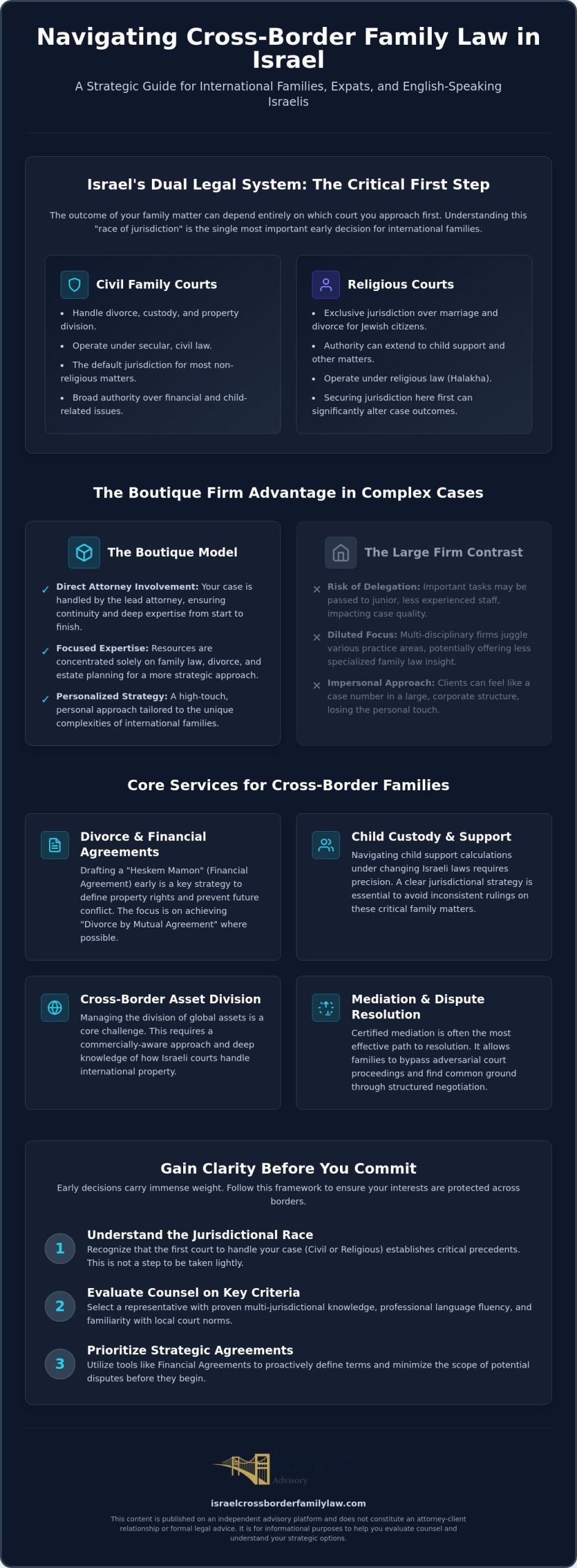
Making the Right Choice for Your Family Law Matter
Decisions made at the onset of a family law dispute in Israel carry immense weight. For international families, the complexity of the dual legal system means that a single misstep in jurisdictional strategy can lead to years of unnecessary litigation. Seeking clarity before making any formal legal commitments is essential. When evaluating a firm like Hagit Halevy & Co., you should prioritize a clear understanding of how local procedures will intersect with your global interests. The strategy you choose today will define your family’s financial and personal landscape for the foreseeable future.
Beyond technical legal expertise, the chemistry and communication style of your representative are critical. You need a partner who can translate the nuances of the Israeli system into terms that make sense within your specific cultural context. Transparency regarding fee structures and the specific scope of work is equally important. Ensure you have a clear understanding of the engagement before signing, as this prevents unexpected complications during an already stressful period. A well-structured professional relationship is built on mutual trust and a shared understanding of commercial and personal goals.
Questions to Ask During a Consultation
To ensure a firm is the right fit for your specific needs, come prepared with targeted questions. Use the following checklist to evaluate their experience with cross-border matters:
- How many cross-border cases involving my specific home country have you handled recently?
- Who will be my primary point of contact for day-to-day updates and strategy adjustments?
- How do you coordinate communication with my foreign legal advisors to ensure consistency across jurisdictions?
- What is your specific experience with the “race of jurisdiction” between civil and rabbinical courts?
The Advisory Path Forward
This content is published on an independent advisory platform and is not a law firm. It’s intended to provide strategic guidance and risk management rather than formal legal representation. Legal services are only provided by licensed attorneys under a separate, formal engagement. Because the differences between legal systems and cultures are significant, we recommend starting with an independent assessment of your situation. A Confidential Case Review can help you gain the necessary perspective before you commit to a long-term legal strategy. Get clarity before you commit. Request a confidential consultation.
Strategic Steps for Your Family’s Future in Israel
Navigating the dual court system in Israel requires more than just local knowledge; it demands a comprehensive strategy that accounts for international assets and jurisdictional nuances. We’ve explored how a boutique firm like Hagit Halevy & Co. provides the personal oversight necessary to manage these complexities. From understanding the strategic “race to court” to leveraging mediation for private resolutions, the early decisions you make will determine the long-term stability of your family. It’s essential to recognize that legal cultures differ significantly, and what works in your home country may not apply in the Israeli family courts.
This independent advisory platform focuses on cross-border strategy and provides tailored guidance for expats and foreign nationals. We offer specific expertise in US-Israel jurisdictional conflicts to help you identify risks before they become permanent legal hurdles. By seeking an independent review of your case, you ensure that every move is calculated and every asset is protected across multiple borders. Get clarity before you commit. Request a confidential consultation. Taking these strategic steps now provides the security and peace of mind your family deserves during a period of transition.
Frequently Asked Questions
Is Hagit Halevy & Co. a large law firm?
Hagit Halevy & Co. operates as a boutique law firm that focuses exclusively on family law and inheritance matters. This model is designed to provide high-touch service where the lead attorney remains directly involved in the strategy and execution of each case. For international families, this personal oversight ensures that the unique challenges of cross-border assets and jurisdictional conflicts are handled with the necessary expertise and continuity.
Does Hagit Halevy speak English for international clients?
The firm provides services in English to accommodate the needs of Anglos, expats, and international families. Effective communication is vital in cross-border cases to ensure that the nuances of the Israeli legal system are clearly understood. This proficiency helps bridge the gap between foreign expectations and local court procedures, minimizing the risk of misunderstandings during critical legal proceedings where every detail matters.
Can Hagit Halevy & Co. represent me in both Civil and Rabbinical courts?
Representation is available in both the civil Family Courts and the religious Rabbinical Courts throughout the central region. Navigating these two systems is a core component of family law in Israel, particularly regarding the “race of jurisdiction.” A firm familiar with both venues can help you develop a strategic approach based on where your specific claims, such as property division or child custody, are filed first.
What is the advantage of a boutique firm for a divorce in Israel?
The primary advantage of a boutique firm is the high level of specialized focus and direct access to the lead practitioner. In a divorce, early decisions carry significant weight and require a strategic, commercially aware approach. A boutique setting often results in a more integrated professional environment where the legal strategy is tailored to the specific needs of international families rather than following a standardized corporate process.
Does the firm handle Hague Convention child abduction cases?
Hagit Halevy & Co. handles cases involving international child abduction under the Hague Convention. These matters require a sophisticated understanding of both local Israeli law and international treaties. Because relocation and custody disputes involve strict legal requirements and potential criminal implications, having counsel experienced in multi-jurisdictional complexity is essential for protecting the best interests of the child and the rights of the parents.
How much does a consultation with an Israeli family lawyer typically cost?
Consultation fees for family law matters in Israel vary based on the complexity of the case and the practitioner’s experience level. You should request a clear fee structure before scheduling a meeting to understand the scope of the service provided. While this advisory platform does not set pricing, it’s standard practice for reputable firms to provide clarity on their billing methods during the initial engagement process to ensure transparency.
Can this firm help with enforcing a US child support order in Israel?
The firm assists with the cross-border enforcement of child support orders, including those originating from the United States. Israel has reciprocal arrangements and legal frameworks that allow for the recognition and collection of foreign support payments. Success in these cases often depends on coordinating with foreign legal advisors to ensure that the documentation meets the specific evidentiary standards required by the Israeli court system for enforcement.
Is Hagit Halevy a certified mediator?
Adv. Hagit Halevy is a certified mediator (Gishur) and a member of the Israel Bar Association’s Family Committee. This certification is particularly relevant given the “Dispute Settlement Law,” which mandates mediation as an initial step in most family disputes. A mediator’s perspective allows for a more collaborative approach to conflict resolution, which can often lead to faster and more private outcomes than traditional courtroom litigation for international families.

Article by
Gabriel Lior
A Personal Journey That Became a Mission
The advisory was founded by an American father Gabriel Lior, LLB, MBA , global entrepreneur, and cross-border advisor who spent more than a decade navigating the Israeli family court system firsthand and now lives in Singapore with his son.
As a divorced parent in a cross-border family, Gabriel faced nearly every legal challenge a foreign parent can encounter in Israel — including child custody disputes, child support proceedings, property matters in Israel and abroad, false accusations, and complex immigration and relocation proceedings.
Over the years, he learned the hard way how difficult it is for non-Israeli parents to understand the system, identify the right legal strategy, and choose the right legal representation — especially when language, culture, and jurisdictional differences are involved. He also witnessed how foreign parents and new immigrants are often disadvantaged or taken advantage of by service providers and institutions simply because they lack local knowledge or fluency.
From Client to Advisor
To truly understand — and survive — the system, Gabriel pursued formal legal education in Israel, completing two Israeli law degrees, alongside a BA and MBA earned in the United States. This was never about becoming a practicing attorney, but about gaining a deep, structural understanding of how the system works — and where it breaks down for foreign parents.
This rare combination of:
Firsthand client experience
Israeli legal and US business education
International business and negotiation training
Decades of commercial execution
created a unique perspective – one that understands both sides of the table.
After years of litigation, persistence, and at times self-representation, he ultimately succeeded in securing custody of his son and relocating abroad through a rare legal victory in the Israeli Supreme Court — becoming one of the first fathers in Israel to do so under these circumstances.
Disclaimer
Important Disclaimer:
The information provided on this website and in its content is for general informational and educational purposes only and does not constitute legal advice, legal opinion, or legal representation.
Gabriel Lior is not licensed to practice law in Israel (nor is he interested in doing so) and does not provide legal services, despite having completed 2 Law Degrees. The services offered are advisory in nature and are intended to provide general guidance, strategic insight, and information regarding cross-border family law considerations.
No attorney-client relationship is formed by accessing this website, reading its content, or communicating with us.
Any decisions made based on this information are at your own discretion and risk. For legal advice specific to your situation, you should consult a licensed attorney in the relevant jurisdiction.
Where appropriate, we may refer clients to independent, licensed attorneys or professionals. Such referrals do not constitute legal representation and no liability is assumed for services provided by third parties.