This article is published by an independent advisory platform and provides strategic information rather than formal legal advice. What if the biggest obstacle to your divorce isn’t the religious court itself, but the common misconception that you’re automatically required to use it? For many expats, ending a marriage in Israel feels like a daunting trek through an unfamiliar landscape. You likely worry about being pulled into a religious process that doesn’t reflect your values, or you might feel anxious about how an Israeli ruling will affect your assets in the United States.
The answer to “can i get a civil divorce in israel” depends on your status and the strategic steps you take early on. This guide provides a roadmap for the “Dissolution of Marriage” process, a civil framework designed for those who fall outside traditional religious jurisdiction. You’ll learn how to identify if your marriage qualifies for this path and how to manage the complexities of cross-border legal issues.
We’ll examine jurisdictional risks, the impact of 2026 legislative shifts, and the essential steps to ensure your interests are protected both in Israel and abroad.
Key Takeaways
- Understand that a civil divorce in Israel is legally termed a “Dissolution of Marriage” and serves as the primary path for those whose marriages are not governed by religious law.
- Learn the specific legal criteria that determine if you can i get a civil divorce in israel and how to navigate the Family Court system as a foreign national.
- Recognize the critical importance of the “Race of Jurisdiction” and how early filing decisions can prevent your civil matters from being bound to a religious court.
- Explore how an Israeli decree affects your international interests, specifically regarding the recognition of assets like US-based 401ks and Social Security.
- Gain a strategic framework for reviewing settlements before signing to ensure your long-term legal and financial security across both jurisdictions.
Understanding Civil Divorce and the Israeli Legal Landscape
In the Israeli legal system, the term “divorce” is often inextricably linked to religious ritual. For Jewish couples, this typically refers to the “Gett” ceremony. For others, it involves their respective religious authorities. However, if you’re an expat or a foreign national, your primary concern is likely the civil recognition of your separation. When people ask “can i get a civil divorce in israel,” they’re usually referring to a process known as Hatarat Nisuin, or the Dissolution of Marriage.
This process exists because of a unique legal paradox. While Israel doesn’t perform domestic civil marriages, it recognizes those performed in other countries. This recognition is a cornerstone of the Israeli Legal Landscape for Divorce. Because the state recognizes the marriage, it must also provide a mechanism to end it. This applies even when the parties don’t belong to a recognized religious community or were married under secular laws abroad.
To better understand this concept, watch this helpful video:
Religious vs. Civil Jurisdiction: Who Decides?
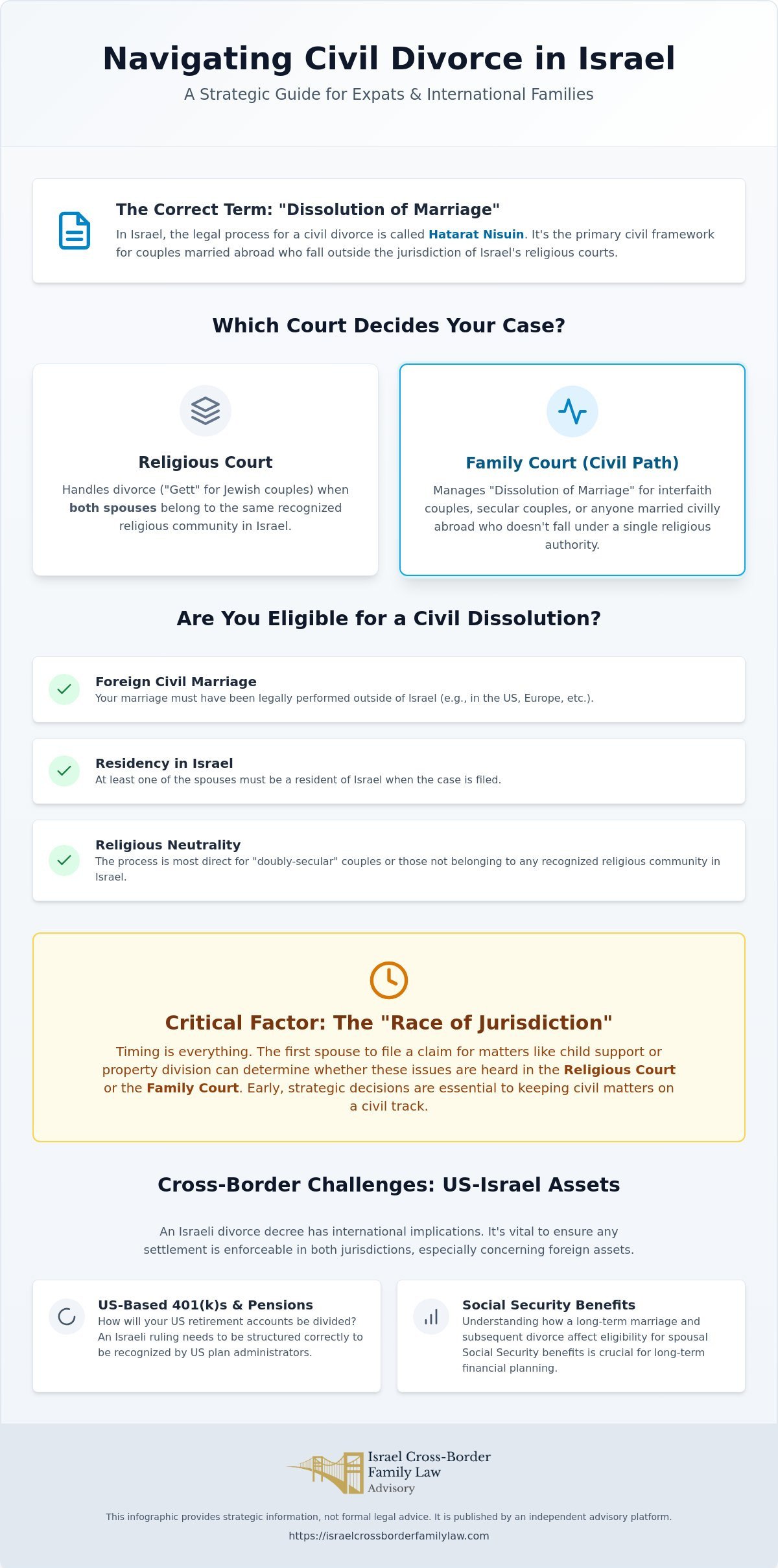
The starting point for any marital dissolution is the religious affiliation of the spouses. Israel uses a system where religious courts hold exclusive authority over “matters of status.” If both spouses are Jewish, the Rabbinical Court typically handles the divorce itself, even if the marriage was a civil one performed in the United States or Europe. For interfaith couples or those where neither party is registered with a recognized religious group, the Family Court takes the lead. This distinction is vital. The rules of evidence and the factors considered can vary significantly between a religious tribunal and a civil court.
Who is Eligible for a Civil Dissolution?
Eligibility for a civil dissolution isn’t automatic. It requires meeting specific criteria that bridge the gap between international law and local regulations. Generally, you must meet the following requirements:
- Foreign Marriage: The marriage must have been performed civilly outside of Israel.
- Residency: At least one spouse must be a resident of Israel at the time of filing.
- Religious Neutrality: The process is most straightforward for “doubly-secular” couples. These are individuals who don’t belong to any of the recognized religious communities in Israel, such as the Jewish, Muslim, or specific Christian denominations.
Understanding where you fit into this framework is the first step in determining if you can i get a civil divorce in israel without being drawn into a religious legal process. Early clarity on your status prevents unexpected jurisdictional claims that could complicate your case later.
The Process of Marriage Dissolution (Hatarat Nisuin) in 2026
This article is published on an independent advisory platform and focuses on strategic guidance rather than providing formal legal representation. For those navigating the complexities of an international separation, the dissolution process serves as a critical civil alternative. It’s a procedural framework designed to clarify which judicial body possesses the authority to end a marriage. When you ask “can i get a civil divorce in israel,” you aren’t just looking for a decree; you’re initiating a multi-stage verification of your legal status. This path is essential for couples who married in civil ceremonies abroad and don’t fit into the traditional religious court categories.
Preparation is the most significant factor in a successful dissolution. You must gather precise documentation, including your original marriage certificate from the United States or another foreign jurisdiction. These documents require an apostille to be recognized by Israeli authorities. Furthermore, the strategy behind your filing hinges on the “No Religion” declaration. This document informs the court that you aren’t a member of a recognized religious community in Israel, which helps keep your case within the civil Family Court system rather than being diverted to a religious tribunal.
Step-by-Step Pathway to Dissolution
The process begins with a formal petition for the Dissolution of Marriage filed in the Family Court. Once submitted, the case is referred to the President of the Family Court, who determines whether the civil court has the sole jurisdiction to proceed. A unique requirement in these cases is the “Expert Opinion” on foreign law. For example, if you were married in New York, the Israeli court may require a written analysis from a qualified professional explaining how New York law views the marriage and its termination. This ensures the Israeli decree will be respected internationally. If you’re unsure how these requirements apply to your specific situation, you can speak with an advisor to gain clarity.
The Role of the Religious Courts in Civil Cases
Even in a civil dissolution, the shadow of the religious system remains. The Family Court is often required to “consult” with the relevant religious court to confirm they don’t claim authority over the spouses. This step is a primary example of the challenges of Israel’s divorce laws, where secular couples can still find themselves momentarily entangled in religious bureaucracy. If one spouse is Jewish, the Rabbinical Court may still require a “Gett” (a religious divorce document) to ensure the individual is free to remarry within the Jewish community, even after the civil marriage is dissolved. Managing these overlapping requirements is vital for expats and foreign nationals who want to ensure their status is clear both in Israel and their home country.
The “Race of Jurisdiction” and Why Timing is Everything
In the Israeli legal system, the “Race of Jurisdiction” is a defining feature that often dictates the outcome of a case. This concept refers to the reality that the court where the first file is served usually gains the authority to hear the case. For those asking “can i get a civil divorce in israel,” the answer is often tied to whether you or your spouse reaches the courthouse first. If one party files in the Rabbinical Court before a civil petition is submitted, they can “bind” civil matters like property division and alimony to the religious tribunal. This process, known in Hebrew as Kricha, can fundamentally change the legal standards applied to your separation.
Expats and international families are frequently at a strategic disadvantage in this race. Many assume that a civil marriage performed abroad naturally leads to a civil divorce in a Family Court. By the time they realize their spouse has initiated a religious court proceeding, the jurisdictional trap has already closed. Waiting too long to seek strategic advice can result in a loss of control over which laws will govern your future financial and parental rights. Early decisions carry immense weight; once a court establishes jurisdiction, it is very difficult to move the case elsewhere.
Connected Matters: Custody, Property, and Support
Family Courts and Rabbinical Courts often diverge in their treatment of assets and support. Civil courts generally follow a rule of equal division of marital property. Religious courts, however, may interpret financial obligations and property rights through a different lens. This is particularly concerning for US citizens with significant overseas assets. Binding a US-based retirement account or a foreign property into an Israeli religious court case can lead to complications in international recognition and enforcement. The choice of court also carries significant weight for international custody and relocation cases, where the Family Court is typically more accustomed to the nuances of cross-border parental rights and the Hague Convention.
Protecting Yourself from Jurisdictional Traps
Maintaining control over your legal path requires proactive steps. Filing a “Request for Settlement of Dispute” is often the first strategic move. This filing acts as a placeholder, securing your priority in the “Race of Jurisdiction” while the mandatory mediation period proceeds. It prevents the other spouse from unilaterally moving the case to a religious court without your consent. Understanding how the advisory works can help you evaluate these jurisdictional risks before a conflict escalates. Strategic planning ensures that your specific questions about whether you can i get a civil divorce in israel are addressed in the venue that best protects your long-term interests.
Cross-Border Challenges: US-Israel Divorce Implications
Expats often find that the question “can i get a civil divorce in israel” is just the first step in a complex international puzzle. A dissolution granted by an Israeli Family Court must eventually interface with the legal system of your home country. For US citizens, this involves the principle of comity, where US courts generally recognize foreign judgments if they meet specific standards of fairness and due process. Recognition isn’t automatic; the lack of a formal treaty between the two nations regarding marital dissolution means that strategic planning is required to ensure your Israeli decree carries weight in a US state court.
Financial assets present the most significant hurdle. Israel operates under the “Balance of Resources” principle, which aims for an equal division of assets accumulated during the marriage. This can clash with US concepts like “Equitable Distribution” or “Community Property.” For example, an Israeli judge may include a US-based 401k or IRA in the marital pot, but they can’t issue a Qualified Domestic Relations Order (QDRO) that a US plan administrator will honor. To bridge this gap, you often need a “Mirror Order” issued by a US court that reflects the terms of the Israeli ruling.
US Assets and the Israeli Family Court
Israeli judges have the authority to consider property located anywhere in the world when determining the overall division of assets. This creates a risk of “Double Jeopardy,” where litigation might proceed in both Israel and a US state simultaneously. If one spouse initiates a claim in the US while the other is pursuing a dissolution in Israel, the resulting conflict can lead to inconsistent rulings and significant legal costs. Protecting US real estate requires a nuanced approach that considers both local state laws and the jurisdictional reach of the Israeli court.
Enforcing Support Across Borders
When one spouse remains in the US while the other is in Israel, enforcing financial obligations becomes a matter of international cooperation. The Uniform Interstate Family Support Act (UIFSA) provides a framework for the recognition of support orders, but the process is rarely seamless. For those receiving support, understanding child support cross-border enforcement is essential to ensure that payments are actually collected. Expats receiving support from a spouse in the US must navigate the specific bureaucratic requirements of both systems to maintain financial stability. If you’re managing assets or support across these two systems, you should request a confidential consultation to discuss the strategic risks of your cross-border case.
Strategic Planning: Steps to Take Before You Commit
This content is published on an independent advisory platform, not a law firm, and focuses on strategic decision-making rather than formal legal representation. Before you take any formal steps, you must prioritize clarity over speed. A common mistake for international families is signing a “settlement” or a memorandum of understanding without a comprehensive cross-border review. These early agreements often carry significant weight in Israeli courts and can be difficult to reverse once submitted. Whether you are wondering “can i get a civil divorce in israel” or managing a separation from abroad, your first move should be a quiet assessment of your current legal standing.
A critical part of this assessment involves your status with the Israeli Ministry of Interior (Misrad HaPnim). You must verify if you are officially registered as “married” in the Israeli population registry. If the state does not recognize your foreign marriage, the path to dissolution changes significantly. Additionally, keep in mind that as of 2026, the “race of jurisdiction” remains a dominant factor in Israeli family law. Strategic planning is a game of foresight; it’s about understanding how a decision made in a Family Court in Israel will resonate with a judge in the United States months or years later. A confidential case review is often the most effective way to map out these specific risks before they escalate.
Gathering Your International Documentation
Success in a civil dissolution depends on the quality of your paper trail. You should begin collecting and preparing these documents long before you file a petition:
- Marriage Certificates: Original copies with an official apostille from the issuing state or country.
- Birth Certificates: Required for all children, also with apostilles, to establish jurisdiction for custody matters.
- Asset Statements: Clear records of all bank accounts, retirement funds, and real estate holdings in both Israel and the US.
- Translations: High-quality Hebrew translations of any English documents, as required by the Family Court.
Seeking Expert Advisory
There is a distinct difference between a local litigator and a cross-border strategist. While a litigator focuses on winning a specific argument in court, a strategist looks at the entire global picture. The Israel Cross Border Law Firm assists expats and foreign nationals by acting as a bridge between two very different legal cultures. Protecting your future requires more than just knowing the law; it requires an understanding of how to translate your US-based life into the Israeli legal framework. Get clarity before you commit. Request a confidential consultation.
Securing Your Future Across Borders
This content is published on an independent advisory platform and focuses on strategic guidance rather than formal legal representation. Successfully managing an international separation requires more than just local legal knowledge; it demands a comprehensive understanding of how two distinct systems interact. You now have a clearer picture of the Hatarat Nisuin process and the critical importance of winning the “Race of Jurisdiction” to keep your case in the civil Family Court whenever possible.
While determining if you can i get a civil divorce in israel is a complex inquiry, the path forward becomes manageable with a clear strategic map. Protecting your US-based assets and ensuring the international recognition of your decree are essential steps that require early intervention. Our team provides specialized US-Israel cross-border expertise through practitioners licensed in both jurisdictions. We help you build a bridge between legal cultures to ensure your long-term interests are preserved in both countries.
Get clarity before you commit. Request a confidential consultation. You don’t have to navigate these challenging waters alone; informed decisions are the foundation of a stable future.
Frequently Asked Questions
This FAQ section is published on an independent advisory platform and provides strategic information rather than formal legal representation or advice. Legal services are only provided by licensed attorneys under a separate engagement.
Can I get a civil divorce in Israel if we were married in a US court?
Yes, you can obtain a civil dissolution if your marriage was performed in a US court or any other foreign civil jurisdiction. This process is known as Hatarat Nisuin and is the standard path for those asking can i get a civil divorce in israel when they don’t fall under the authority of a religious court. The Family Court handles these petitions to ensure the marriage is ended according to civil standards.
How long does the marriage dissolution process take for expats?
The timeline depends on whether both parties agree to the dissolution. In 2026, uncontested petitions typically take 3 to 6 months to process through the Family Court. If the divorce is contested or involves complex international assets, the proceedings can last 2 to 4 years. Early preparation of your foreign documents and apostilles can help prevent unnecessary procedural delays.
Do I have to go to the Rabbinical Court if I am not religious?
You generally don’t have to use the Rabbinical Court if neither spouse is Jewish. However, the system is complex. If one spouse is Jewish and files there first, they may try to “bind” civil matters to that court. If you are both non-religious and were married civilly, your case belongs in the Family Court, but you must still follow the procedural steps to confirm the religious courts don’t claim jurisdiction.
Will my US prenuptial agreement be honored in an Israeli civil divorce?
Israeli courts usually honor foreign prenuptial agreements if they were executed properly under the laws of the relevant US state. To be enforceable in Israel, the agreement must be validated by an Israeli Family Court judge. The court will review the document to ensure it meets basic standards of fairness and doesn’t conflict with local public policy or the rights of any children involved.
What happens to my US property if I divorce in Israel?
An Israeli judge can include US-based real estate and bank accounts in the overall division of marital assets. While the Israeli court can rule on how these assets should be split, it doesn’t have the power to directly seize property in the United States. You will likely need to take the Israeli decree to a US court to obtain a Mirror Order for the actual transfer of titles or funds.
Can I move back to the US with my children during the divorce process?
No, you cannot relocate children to the US without the other parent’s written consent or an explicit order from the Israeli court. Doing so is considered a violation of the Hague Convention on the Civil Aspects of International Child Abduction. Any attempt to leave the country with children while a custody case is pending can lead to severe legal consequences and a court-ordered return to Israel.
Is a civil dissolution in Israel legally recognized in the United States?
Yes, US courts generally recognize Israeli civil dissolutions under the legal principle of comity. For the US to accept the decree, the Israeli process must have provided both parties with proper notice and a fair opportunity to be heard. Most states will honor the end of the marriage, though specific rulings on property or support may require additional validation through local US state courts.
How much does a cross-border divorce advisory typically cost?
The cost of a cross-border advisory varies based on the complexity of your international asset structure and the residency status of both spouses. Because these cases involve navigating two different legal systems and cultures, the investment reflects the strategic depth required to protect your future. A confidential case review is the most effective way to determine the scope of work and the resources needed for your specific situation.

Article by
Gabriel Lior
A Personal Journey That Became a Mission
The advisory was founded by an American father Gabriel Lior, LLB, MBA , global entrepreneur, and cross-border advisor who spent more than a decade navigating the Israeli family court system firsthand and now lives in Singapore with his son.
As a divorced parent in a cross-border family, Gabriel faced nearly every legal challenge a foreign parent can encounter in Israel — including child custody disputes, child support proceedings, property matters in Israel and abroad, false accusations, and complex immigration and relocation proceedings.
Over the years, he learned the hard way how difficult it is for non-Israeli parents to understand the system, identify the right legal strategy, and choose the right legal representation — especially when language, culture, and jurisdictional differences are involved. He also witnessed how foreign parents and new immigrants are often disadvantaged or taken advantage of by service providers and institutions simply because they lack local knowledge or fluency.
From Client to Advisor
To truly understand — and survive — the system, Gabriel pursued formal legal education in Israel, completing two Israeli law degrees, alongside a BA and MBA earned in the United States. This was never about becoming a practicing attorney, but about gaining a deep, structural understanding of how the system works — and where it breaks down for foreign parents.
This rare combination of:
Firsthand client experience
Israeli legal and US business education
International business and negotiation training
Decades of commercial execution
created a unique perspective – one that understands both sides of the table.
After years of litigation, persistence, and at times self-representation, he ultimately succeeded in securing custody of his son and relocating abroad through a rare legal victory in the Israeli Supreme Court — becoming one of the first fathers in Israel to do so under these circumstances.
Disclaimer
Important Disclaimer:
The information provided on this website and in its content is for general informational and educational purposes only and does not constitute legal advice, legal opinion, or legal representation.
Gabriel Lior is not licensed to practice law in Israel (nor is he interested in doing so) and does not provide legal services, despite having completed 2 Law Degrees. The services offered are advisory in nature and are intended to provide general guidance, strategic insight, and information regarding cross-border family law considerations.
No attorney-client relationship is formed by accessing this website, reading its content, or communicating with us.
Any decisions made based on this information are at your own discretion and risk. For legal advice specific to your situation, you should consult a licensed attorney in the relevant jurisdiction.
Where appropriate, we may refer clients to independent, licensed attorneys or professionals. Such referrals do not constitute legal representation and no liability is assumed for services provided by third parties.