What if the most important legal decision of your life is being made in a language you don’t fully understand and a court system you’ve never encountered? It’s natural to feel a deep sense of anxiety when you’re caught between two different legal systems, and choosing the right Law Firm becomes a daunting task when language barriers make every decision feel like a high-stakes gamble. You’re likely worried about the high costs of multi-country litigation and the very real fear that your specific concerns will get lost in translation.
Selecting a legal partner is about more than just hiring a local attorney. It’s about finding a strategic partner that understands the friction between divergent legal cultures and can act as a bridge between them. This article provides a clear framework for selecting a firm that understands both US and Israeli jurisdictions, ensuring you gain strategic clarity on your legal standing. We’ll examine how to identify a team that speaks plain English and possesses the dual-market expertise required to protect your cross-border assets and your family’s future.
Key Takeaways
- Understand how Israel’s dual court system creates a “race to the court” between civil and religious jurisdictions and how early decisions impact your standing.
- Identify the specific advantages of partnering with a Law Firm whose practitioners are licensed in both Israel and the US to manage cross-border complexities effectively.
- Gain clarity on managing international child custody and relocation issues through the lens of the Hague Convention and multi-jurisdictional legal frameworks.
- Discover why a strategic advisory approach is often more valuable than standard legal advice when navigating the friction between different legal and business cultures.
- Learn to protect your assets and rights by prioritizing strategic clarity and cross-cultural understanding before making any formal legal commitments.
Understanding the Israel-US Legal Landscape in 2026
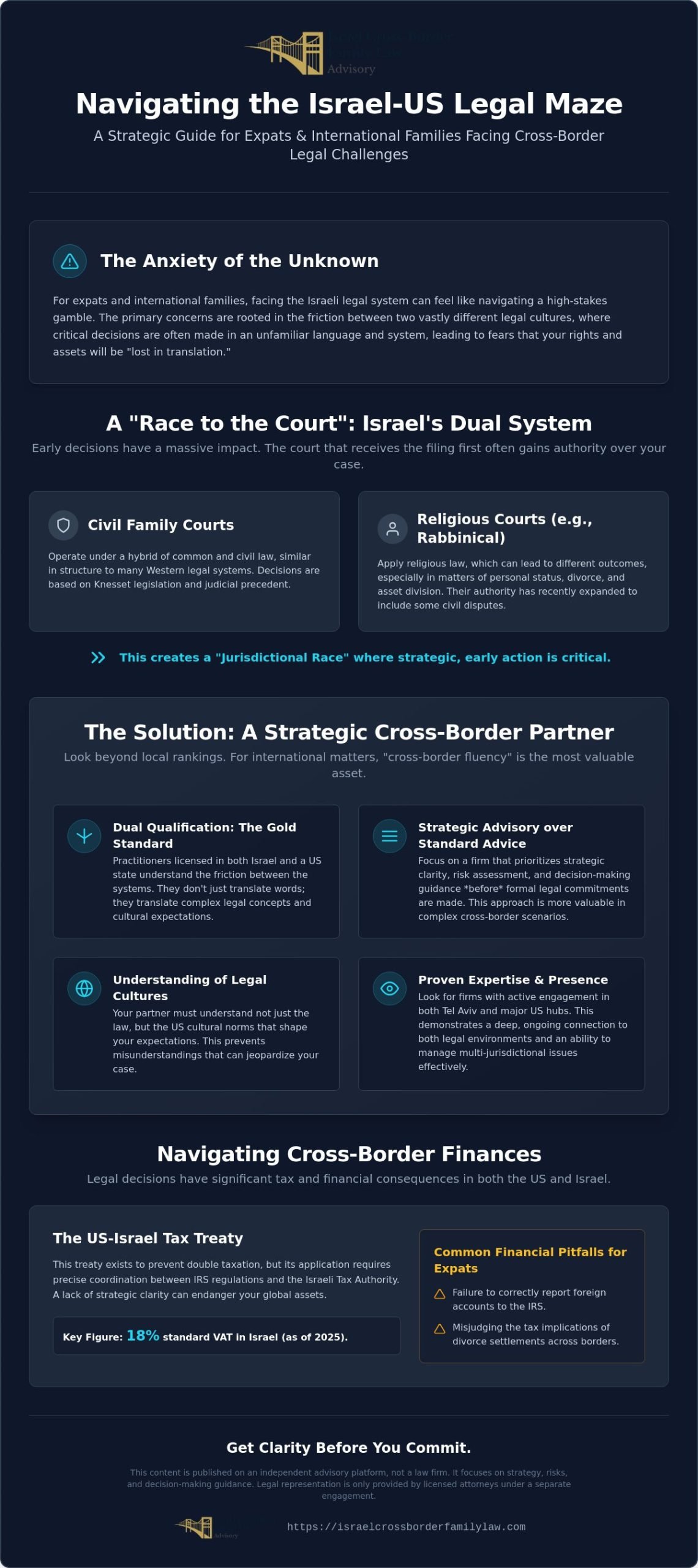
The Israeli legal environment presents unique challenges for US citizens and expats. It’s built on a foundation that differs significantly from the American model. In this context, “IL” refers exclusively to Israel. Understanding Israel’s legal system is the first step toward protecting your interests. This system is a hybrid of common law and civil law, but its most distinctive feature is the dual authority shared between civil family courts and religious courts. For an international family, choosing the right Law Firm means finding practitioners who can navigate both paths simultaneously. This is especially critical for expats and foreign nationals who may not be familiar with local procedures. The Israeli Supreme Court plays a vital role here, often setting precedents for how international treaties are applied locally in cross-border disputes.
To better understand this concept, watch this helpful video:
Civil vs. Religious Jurisdictions
The “Dual System” is a living part of the legal framework. In March 2026, the Knesset passed legislation expanding the authority of religious courts to include civil disputes like property matters. This creates a “jurisdictional race” where the court that receives the filing first typically gains authority. For US citizens, this often leads to confusion. A Rabbinical court might apply different principles than a civil court regarding asset division. Ignoring religious legal authority can lead to significant errors that are difficult to correct later. You need a strategy that accounts for both systems to avoid losing your rights or assets.
The Impact of the US-Israel Tax Treaty
Cross-border legal matters always involve financial complexity. The US-Israel Tax Treaty exists to prevent double taxation, yet its application requires precise coordination. Your chosen Law Firm must understand the interaction between IRS regulations and the Israeli Tax Authority. For example, as of 2025, the standard VAT in Israel is 18%. US expats with Israeli income face common pitfalls, such as failing to report foreign accounts correctly or misjudging the tax implications of a divorce settlement. Strategic clarity is essential to ensure that your global assets remain protected while you remain compliant in both nations. Decisions made early in the process carry heavy weight for your long-term financial health.
This content is published on an independent advisory platform, not a law firm. It focuses on strategy, risks, and decision-making guidance. Legal representation is only provided by licensed attorneys under a separate engagement.
Get clarity before you commit. Request a confidential consultation.
Key Criteria for Selecting a Law Firm in Israel
Selecting the right Law Firm in Israel requires looking beyond standard local rankings or prestige. Most directories focus on the volume of local transactions or peer reviews within the Israeli market. However, for an expat or international family, these metrics don’t capture the essential quality of “cross-border fluency.” You need a team that acts as a strategic bridge. This means they must understand both the Hebrew statute and the US cultural norms that shape your expectations. Decisions made in the early stages of a case carry immense weight. Choosing a firm that understands your background prevents “lost in translation” errors that can jeopardize your assets or rights.
Evaluating Cross-Border Qualifications
Dual-qualified practitioners are the gold standard for international matters. When an attorney is admitted to the bar in both Israel and a US state, they possess an intuitive understanding of the friction between these systems. They don’t just translate words; they translate complex legal concepts. This is vital when managing assets or family matters that span continents. You should look for firms that maintain active engagements in both Tel Aviv and major US hubs like New York. This physical presence signals a deep, ongoing connection to both legal environments. While “Big Law” firms might seem impressive, they often lack the personalized advisory approach necessary for individual family or estate matters. A specialized firm is often better equipped to provide the steady, knowledgeable guidance you need.
- Dual Licensing: Confirm the attorneys are licensed in both jurisdictions.
- Cultural Competence: Ensure they understand US business and family norms.
- Strategic Partnerships: Verify they have existing relationships with US professionals like CPAs or therapists.
Transparency in Pricing and Process
Israeli legal fee structures often differ from the standard US hourly billing models. Under Israel Bar Association regulations, lawyers are required to provide a written fee agreement before commencing substantive work. This protection ensures you have a clear understanding of our pricing and process from the outset. A transparent firm will provide plain-English summaries of your case status rather than dense, jargon-heavy memos. This clarity allows you to make informed decisions without feeling overwhelmed by the complexity of the Israeli system. Before making any commitments, it’s wise to request a confidential case review to gain a clear framework for your specific situation. You may find it helpful to speak with a professional who understands these nuances before moving forward.
This content is published on an independent advisory platform, not a law firm. It focuses on strategy, risks, and decision-making guidance. Legal representation is only provided by licensed attorneys under a separate engagement.
Get clarity before you commit. Request a confidential consultation.
Specialized Expertise: Family Law and Estate Planning
Managing family life across borders introduces a layer of complexity that a standard local Law Firm might not be prepared to handle. When assets are distributed across two countries, a divorce is no longer just a local matter; it becomes a transnational puzzle. You need a team that understands how to manage these assets simultaneously to avoid conflicting rulings or the loss of rights. This is particularly relevant when providing guidance for expats and foreign nationals who may have significant holdings in both jurisdictions. Without a strategic bridge between these legal systems, you risk making early decisions that carry heavy long-term costs.
Cross-Border Divorce and Custody
Child custody and relocation are perhaps the most sensitive areas of international law. The Hague Convention on the Civil Aspects of International Child Abduction plays a central role in these cases, providing a framework for the return of children who’ve been wrongfully removed or retained. However, the risks in these cases are high and the legal standards are strict. You must have international custody and relocation strategies in place before making any moves. This includes understanding how international child support enforcement works across different jurisdictions. In 2026, Israeli courts have continued to prioritize joint parental responsibility, which may differ significantly from the custody models you’re familiar with in the US. A Law Firm that understands these cultural nuances can help you maintain clarity during high-conflict disputes.
Dual-Country Wills and Estates
Estate planning for US citizens with assets in Israel, such as real estate in Tel Aviv or Jerusalem, requires a specialized approach. A common misconception is that a US-based will automatically covers assets in Israel. In reality, the Israeli Land Registry often requires a local probate order or specific language that a standard US will might lack. Structuring a dual-country will ensures your wishes are respected in both locations while minimizing the time your family spends in court. The probate process in Israel can be lengthy; as of 2026, the average length of regular civil proceedings in magistrate courts is 11.2 months, and civil appeals can take even longer. Additionally, US beneficiaries must consider the inheritance tax implications of receiving assets from abroad. Having a clear framework for these cross-border issues is the only way to protect your legacy and your heirs.
This content is published on an independent advisory platform, not a law firm. It focuses on strategy, risks, and decision-making guidance. Legal representation is only provided by licensed attorneys under a separate engagement.
Get clarity before you commit. Request a confidential consultation.
Navigating Corporate Law and Regulatory Compliance
Expanding a business footprint from Israel to the United States involves navigating a maze of regulatory requirements that differ significantly between jurisdictions. A Law Firm acting as a strategic bridge provides more than just documents; it offers a roadmap for market entry that respects both Israeli innovation culture and American corporate governance. This transition often begins with a fundamental decision regarding corporate structuring. Many Israeli startups choose to establish a presence in Delaware or other US jurisdictions to align with the expectations of American venture capital and private equity markets. Understanding how the cross-border advisory works is essential for founders who need to maintain compliance while scaling operations globally.
Startup and Tech Sector Compliance
Establishing a US presence requires a deep understanding of the friction between two distinct legal systems. Intellectual property protection is a primary concern. You must ensure that your IP is properly assigned and protected across borders to avoid future disputes during fundraising or exits. Employment law also presents a significant hurdle. For instance, temporary wartime measures in Israel expired on January 1, 2026, changing how social contributions are handled for reservist employees. When you hire in the US, you encounter “at-will” employment and complex state-specific labor rules that don’t exist in the Israeli model. Additionally, businesses must account for the standard VAT rate in Israel, which increased to 18% in 2025, and new global tax standards like the qualifying domestic minimum top-up tax (QDMTT) implemented for tax years beginning after 2025.
Litigation and Dispute Resolution
Contentious cross-border matters require a Law Firm that can handle both state and federal litigation in the US while managing proceedings in Israeli courts. Strategic due diligence is critical for US investors looking at the Israeli tech sector, especially with updated merger notification thresholds. In January 2026, the minimum combined turnover threshold for merger notification was updated to NIS 423,780,000. Investors must ensure that any target company is fully prepared for regulatory oversight from bodies like the SEC or the Israel Competition Authority. Protecting your interests in multi-jurisdictional investigations requires a steady, knowledgeable guide who understands the weight of early decisions and the inherent complexity of international asset protection.
This content is published on an independent advisory platform, not a law firm. It focuses on strategy, risks, and decision-making guidance. Legal representation is only provided by licensed attorneys under a separate engagement.
Get clarity before you commit. To ensure your corporate entry is handled with strategic precision, consult with our strategic advisors.
The Strategic Advantage of an Advisory Approach
Pure legal advice often focuses strictly on the immediate statute, but a comprehensive strategy considers the long-term impact on your global assets and family stability. In the context of US-Israel relations, a Law Firm must do more than just file motions. It must act as a strategic partner that understands the friction between divergent legal cultures. This is where an independent advisory platform provides immense value. By offering objective decision-making guidance before you enter a formal attorney-client relationship, you gain the clarity needed to navigate multi-jurisdictional complexity without the pressure of immediate litigation. Strategy is the other half of the solution. It ensures that every step you take in Israel (IL) aligns with your broader financial and personal goals in the United States.
Getting Clarity Before You Commit
Decisions made in the earliest stages of a cross-border matter carry immense weight. In the Israeli system, the “race to the court” means that where you file can dictate which laws apply to your assets and family rights. Identifying these risks before they become litigious is the primary goal of a strategic advisory approach. When you frame legal issues as business or family strategy, you move away from reactive crisis management toward proactive protection. This process allows you to evaluate the differences between the civil and religious court systems with a steady, knowledgeable guide. You can request a confidential case review to establish this framework before making any binding legal commitments.
Conclusion and Next Steps
Navigating the legal landscape between the US and Israel requires a firm that understands the nuances of both jurisdictions. Whether you’re managing an international divorce, structuring a dual-country estate, or entering the US market as an Israeli startup, the complexity of these issues cannot be overstated. A cross-border Law Firm serves as the essential bridge between these two worlds, reducing the risk of “lost in translation” errors and protecting your cross-border assets. For visual guides and deeper insights into these topics, you can visit our YouTube channel, which offers detailed explanations of the Israeli family law system.
This content is published on an independent advisory platform, not a law firm. It focuses on strategy, risks, and decision-making guidance rather than an attorney-client relationship. Legal services are only provided by licensed attorneys under a separate engagement. All information provided is for educational purposes and does not constitute formal legal advice.
Get clarity before you commit. Request a confidential consultation.
Strategic Clarity for Your Cross-Border Future
Managing family and financial interests across two nations requires more than simple legal representation. It demands a specialized understanding of how the Israeli and American systems interact. By prioritizing strategic clarity, you can avoid the common pitfalls of jurisdictional races and “lost in translation” legal errors. The weight of early decisions in Israel (IL) cannot be overstated. Having a guide who understands both cultural and legal nuances is essential for protecting your cross-border assets.
This independent advisory platform acts as a bridge, offering decades of experience and insights from practitioners licensed in both jurisdictions. Selecting the right Law Firm is about finding a partner that understands your unique position as an expat or international family. Please remember that this content is for informational and advisory purposes only. It focuses on strategy and decision-making guidance rather than a formal attorney-client relationship. Formal legal services are provided only by licensed attorneys under a separate engagement.
Get clarity before you commit. Request a confidential consultation to begin navigating your legal standing with confidence.
Frequently Asked Questions
Do I need two different law firms for a US-Israel case?
You don’t necessarily need two separate entities if you choose a Law Firm that features dual-qualified practitioners. A firm with expertise in both jurisdictions can manage the overarching strategy, ensuring that actions taken in Israel don’t conflict with your legal standing in the US. This integrated approach reduces the risk of contradictory advice and streamlines the communication process for complex cross-border matters.
Is a US prenuptial agreement enforceable in Israeli courts?
Enforceability depends on whether the agreement aligns with specific Israeli legal standards, such as the Spouses Property Relations Law. While Israeli courts generally respect foreign contracts, these agreements often require local ratification to be fully recognized. You should have your US agreement reviewed by a professional who understands the friction between these two systems to identify any potential gaps in protection.
How much does a cross-border law firm typically cost?
Costs depend heavily on the complexity of your international assets and the level of conflict between parties. Cross-border cases involve additional layers of strategic planning and multi-jurisdictional coordination that standard local cases do not require. Under Israel Bar Association regulations, any Law Firm you engage must provide a written fee agreement before starting substantive work to ensure transparency and clarity regarding your financial commitment.
Can an Israeli lawyer represent me in a US court?
An Israeli lawyer can only represent you in a US court if they are also admitted to the bar in that specific US state. Legal systems are strictly territorial; therefore, practitioners must hold licenses in the jurisdiction where the litigation occurs. This is why many expats prioritize firms with multi-qualified attorneys who can bridge the gap between both the Israeli and American court systems.
What is the first step in an international child custody dispute?
The first step is determining which court has jurisdiction and whether the Hague Convention applies to your specific situation. Because Israel has a dual court system, the “race to the court” is a critical factor; the venue where a claim is filed first often gains the authority to decide the case. Seeking strategic clarity immediately is essential to protect your parental rights and your child’s welfare.
How does the US-Israel tax treaty affect my inheritance?
The treaty serves to prevent double taxation on assets transferred between the US and Israel. However, US citizens remain subject to federal estate tax on their global holdings regardless of their residency status. You must ensure that the probate process in Israel is carefully coordinated with US tax reporting requirements to avoid unnecessary financial penalties or the loss of inherited wealth.
What happens if I ignore a summons from an Israeli Rabbinical court?
Ignoring a summons can lead to serious legal consequences, including the issuance of stay-of-exit orders that prevent you from leaving the country. Even if you are a foreign national, religious courts in Israel hold significant authority over family matters like divorce and marriage. You should always respond to such notices through a qualified representative to ensure your rights are protected within the religious legal framework.
How do I verify if a lawyer is licensed in both the US and Israel?
You can verify a practitioner’s credentials by searching the public databases of the Israel Bar Association and the relevant US State Bar. Most reputable cross-border lawyers will provide their bar admission numbers for both jurisdictions upon request. Confirming these licenses ensures that your representative possesses the formal authority and the necessary training to navigate the complexities of both legal environments.
This content is published on an independent advisory platform, not a law firm. It focuses on strategy, risks, and decision-making guidance. Legal services are only provided by licensed attorneys under a separate engagement.
Get clarity before you commit. Request a confidential consultation.

Article by
Gabriel Lior
A Personal Journey That Became a Mission
The advisory was founded by an American father Gabriel Lior, LLB, MBA , global entrepreneur, and cross-border advisor who spent more than a decade navigating the Israeli family court system firsthand and now lives in Singapore with his son.
As a divorced parent in a cross-border family, Gabriel faced nearly every legal challenge a foreign parent can encounter in Israel — including child custody disputes, child support proceedings, property matters in Israel and abroad, false accusations, and complex immigration and relocation proceedings.
Over the years, he learned the hard way how difficult it is for non-Israeli parents to understand the system, identify the right legal strategy, and choose the right legal representation — especially when language, culture, and jurisdictional differences are involved. He also witnessed how foreign parents and new immigrants are often disadvantaged or taken advantage of by service providers and institutions simply because they lack local knowledge or fluency.
From Client to Advisor
To truly understand — and survive — the system, Gabriel pursued formal legal education in Israel, completing two Israeli law degrees, alongside a BA and MBA earned in the United States. This was never about becoming a practicing attorney, but about gaining a deep, structural understanding of how the system works — and where it breaks down for foreign parents.
This rare combination of:
Firsthand client experience
Israeli legal and US business education
International business and negotiation training
Decades of commercial execution
created a unique perspective – one that understands both sides of the table.
After years of litigation, persistence, and at times self-representation, he ultimately succeeded in securing custody of his son and relocating abroad through a rare legal victory in the Israeli Supreme Court — becoming one of the first fathers in Israel to do so under these circumstances.
Disclaimer
Important Disclaimer:
The information provided on this website and in its content is for general informational and educational purposes only and does not constitute legal advice, legal opinion, or legal representation.
Gabriel Lior is not licensed to practice law in Israel (nor is he interested in doing so) and does not provide legal services, despite having completed 2 Law Degrees. The services offered are advisory in nature and are intended to provide general guidance, strategic insight, and information regarding cross-border family law considerations.
No attorney-client relationship is formed by accessing this website, reading its content, or communicating with us.
Any decisions made based on this information are at your own discretion and risk. For legal advice specific to your situation, you should consult a licensed attorney in the relevant jurisdiction.
Where appropriate, we may refer clients to independent, licensed attorneys or professionals. Such referrals do not constitute legal representation and no liability is assumed for services provided by third parties.