Moving your life back to your home country after a divorce in Israel isn’t just a change of scenery; it’s a permanent shift in your child’s legal and cultural jurisdiction that the court will scrutinize with intense detail. You’re likely asking if you can legally move back home with your children, while simultaneously fearing that a wrong step could lead to accusations of international child abduction. Successfully managing child relocation from Israel after divorce requires a strategic understanding of how Israeli law interacts with the legal system of your destination country.
We understand the anxiety that comes with navigating a foreign court system while trying to protect your family’s future. This guide provides a clear, comprehensive overview of the current legal requirements and the specific criteria Israeli judges use to evaluate relocation requests in 2026. You’ll learn about the necessity of Mirror Orders, the recent expansion of Rabbinical Court authority over child-related financial matters, and the essential steps to obtain relocation permission while remaining in full compliance with the Hague Convention.
Key Takeaways
- Understand that under the Legal Capacity and Guardianship Law, both parents remain natural guardians after a split, meaning major moves require mutual consent or court approval.
- Learn how the Israeli court system applies the “Best Interests of the Child” principle and the specific role that court-appointed experts play in relocation cases.
- Discover why a negotiated agreement is often the most stable path for child relocation from israel after divorce compared to the uncertainty of a court ruling.
- Identify the critical legal risks of the Hague Convention and how to avoid the severe consequences of being accused of international child abduction.
- Gain strategic insight into how early decisions regarding your divorce and custody arrangements can either facilitate or block your ability to move abroad in the future.
The Legal Framework of Child Relocation in Israel
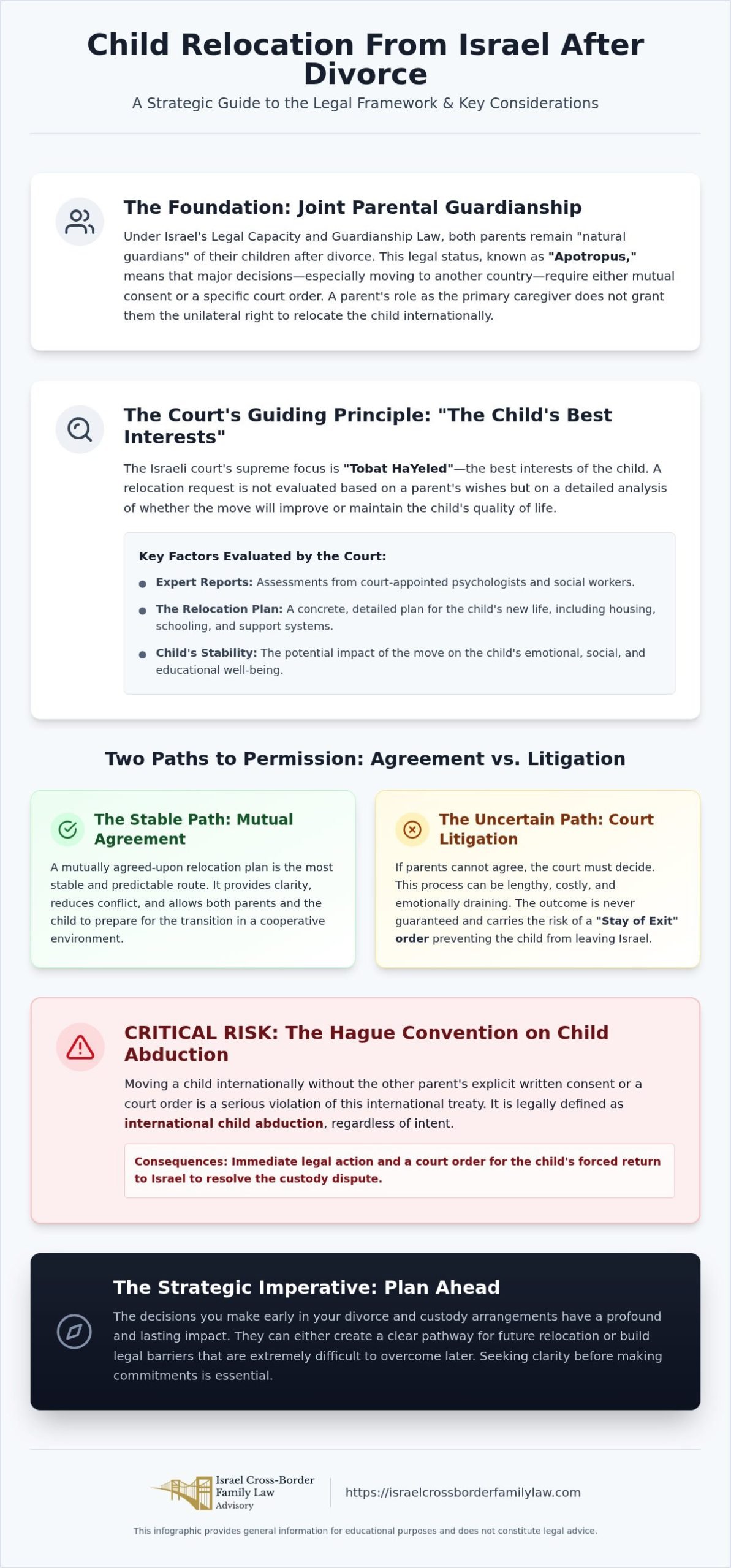
Under Israeli law, the Legal Capacity and Guardianship Law, 5722-1962, governs the fundamental rights and duties of parents. It defines both parents as the “natural guardians” of their children, a status that remains intact regardless of marital status. This means that even after a final divorce decree, both parents typically retain full guardianship rights, or “Apotropus.” Any major decision affecting the child’s welfare, specifically their permanent place of residence, requires the explicit consent of both guardians. If you are considering child relocation from israel after divorce, you must recognize that being the primary caregiver doesn’t grant you the unilateral right to move the child across international borders.
To better understand the legal nuances of moving abroad with your children, watch this helpful video:
There’s a vital distinction between temporary travel and permanent relocation. While a parent might take a child on a short vacation with proper notice, permanent relocation involves a fundamental change in the child’s “habitual residence.” Moving a child permanently without written consent or a specific court order is a violation of the Hague Convention on the Civil Aspects of International Child Abduction. This international treaty ensures that custody disputes are decided in the child’s home country, which, in this context, is Israel. Attempting to bypass this process can lead to immediate legal consequences and the forced return of the child.
Guardianship vs. Physical Custody
In the Israeli legal system, guardianship is distinct from physical custody. While one parent might manage the child’s daily routine, guardianship covers long-term welfare, including education, healthcare, and residence. In the 2026 legal landscape, courts place significant weight on the concept of “Parental Responsibility.” This emphasizes that both parents have a duty to remain active in the child’s life. A custodial parent cannot make life-altering decisions without the other parent’s involvement. Unilateral actions are often viewed unfavorably by the court and can negatively impact your standing in future proceedings.
The Requirement for Judicial Approval
If the non-relocating parent objects to the move, the matter must be resolved by an Israeli court. The court’s primary focus isn’t on the parent’s career goals or personal desires, but on how the move affects the child’s stability. A common tool used in these disputes is the “Stay of Exit” order, known in Hebrew as a Tzav Ikur Yetzia. This order prevents the child from leaving Israel until the court reaches a final decision. Understanding the risks associated with these orders is a critical part of International Custody & Relocation strategy. Seeking clarity on these restrictions before making commitments abroad is essential to avoid costly legal mistakes.
How Courts Evaluate the Best Interests of the Child
The Israeli court treats the “Best Interests of the Child” (Tobat HaYeled) as the supreme legal principle in every custody dispute. When considering child relocation from israel after divorce, the judge’s primary objective is to determine if the proposed move will provide a better or equal quality of life for the child compared to remaining in Israel. This isn’t a subjective decision made by the judge alone. The court heavily relies on reports from court-appointed social workers and psychological experts. These professionals conduct interviews and home visits to assess the child’s emotional state and the potential impact of a cross-border move.
A central component of any petition is the “Relocation Plan.” The court expects a granular level of detail regarding the child’s future environment. This includes confirmed school registrations, specific housing arrangements, and a clear map of the social support network available in the new country. If the plan lacks specificity, the court may view the request as premature or poorly conceived. Because of the inherent complexity of these assessments, requesting a professional case review before filing can help you identify potential weaknesses in your proposal.
The Relocating Parent’s Burden of Proof
The parent seeking to move carries the burden of proof. You must demonstrate that the relocation benefits the child directly; it isn’t enough to show that the move benefits you professionally or personally. The court will investigate the sincerity of your motivations. They check if the move is driven by genuine opportunities, such as family support or a specific career advancement, or if it’s a tactic to distance the child from the other parent. In 2026, the “Tender Years Doctrine” still carries weight for children under age six, often creating a presumption that younger children should remain with their primary caregiver, though this is balanced against the child’s right to maintain a frequent and meaningful connection with the left-behind parent.
Cultural and Educational Continuity
For the Anglo and expat community, the court considers cultural and educational continuity. If a child was raised in an English-speaking home and attended international schools in Israel, moving back to an English-speaking environment might be viewed as a positive step for their long-term development. However, the court also weighs the child’s existing social ties in Israel. In the context of international relocation, “Best Interests” is defined as the delicate balance of providing the child with superior opportunities while ensuring they don’t lose the essential bond with the parent remaining in Israel.
Navigating the Relocation Process: Agreement vs. Litigation
Resolving a dispute over child relocation from israel after divorce typically follows one of two paths: a mutually negotiated agreement or high-stakes litigation. Israeli courts strongly prefer the former. A well-crafted Relocation Agreement provides parents with control over the outcome, whereas litigation leaves the final decision to a judge who may not fully grasp the cultural nuances of an expat family’s lifestyle. Mediation offers a collaborative environment where expats can address the unique challenges of child relocation from israel after divorce without the aggressive posture of a courtroom. Litigation is often a marathon; cases in the Family Court can easily span 18 to 24 months, creating prolonged instability for the children involved. The process begins with a mandatory “Settlement of Dispute” application, costing ₪119 as of January 2026, which serves as a required cooling-off period before full litigation commences. Strategic consideration is also required due to the dual court system. A “race to the court” dynamic exists, where the venue, either the secular Family Court or the Rabbinical Court, can significantly influence the proceedings. This is especially relevant following the November 2025 legislative change that expanded Rabbinical Court jurisdiction over child-related financial needs.
Essential Clauses in a Relocation Agreement
A robust agreement must address more than just the move itself. It needs to define specific “stay-over” or visitation rights, detailing how the child will maintain a relationship with the parent remaining in Israel. This includes scheduling summer blocks, holiday rotations, and digital communication. Financial responsibility for international travel, including airfare and potential escort costs, should be explicitly allocated to prevent future friction. Crucially, the agreement must include a jurisdiction clause to determine which court system handles future disputes. This is particularly important for managing issues like Cross-Border Child Support Enforcement, ensuring that financial obligations remain enforceable regardless of where the family resides.
The Role of Expert Opinions
When parents cannot agree, the court relies on objective assessments. A report from a “Pekidat Saad,” a court-appointed social worker, is mandatory in relocation cases. This official evaluates the proposed move and provides a recommendation that carries significant weight. In complex multi-jurisdictional matters, families often seek private psychological evaluations to provide a deeper analysis of the child’s emotional resilience. The court also considers the “Voice of the Child.” Depending on their age and maturity, children may be interviewed in a sensitive, non-adversarial setting to express their feelings about the move. While the child’s preference isn’t the sole deciding factor, it is a critical component of the court’s holistic evaluation.
The Hague Convention and International Child Abduction
The 1980 Hague Convention on the Civil Aspects of International Child Abduction is the primary international treaty governing the cross-border movement of children. Israel is a signatory to this convention, which establishes a clear legal framework to prevent “forum shopping” in custody disputes. When considering child relocation from israel after divorce, the convention’s rules are the most critical factor to respect. Moving a child to another country without the written consent of the other parent or an explicit court order is legally defined as “wrongful removal.” This is true even if you are the child’s primary caregiver or hold physical custody. The law views this as an infringement on the other parent’s rights of guardianship and residence.
If a child is wrongfully removed from Israel, the left-behind parent can initiate a Hague application in the destination country. The foreign court’s role is not to decide which parent is “better” or to rule on long-term custody. Instead, its mandate is to determine if the child was wrongfully removed from their “habitual residence” and, if so, to issue a “Return Order.” This order requires the child to be sent back to Israel immediately so that the Israeli courts can resolve the underlying custody issues. Because these proceedings move rapidly and carry severe legal weight, consulting with a cross-border professional is a vital step for any parent planning an international move.
Defenses to a Hague Convention claim are extremely narrow and difficult to prove. A court may refuse a return order only if the taking parent can demonstrate that the other parent actually consented to the move, later acquiesced to the child remaining abroad, or if there is a “grave risk” that returning would expose the child to physical or psychological harm. These defenses require a high threshold of evidence and are rarely granted by foreign courts, which prioritize the prompt return of the child to their home jurisdiction.
Preventing Accidental Abduction Claims
To avoid the catastrophic legal consequences of an abduction claim, transparency and documentation are essential. Never rely on verbal agreements or informal emails when discussing a move. You should obtain written, notarized consent for any international travel that could be interpreted as a relocation. If the other parent initially agreed to a move but later changed their mind, having documented evidence of their “Acquiescence” is critical for your defense. For more detailed guidance on these risks, review our resources on Hague Convention & Child Abduction.
The Role of the Central Authority
The Israeli Ministry of Justice acts as the “Central Authority” in these international disputes. They facilitate communication between foreign governments and assist parents in locating children who have been wrongfully removed. If you have a genuine fear that your child will be taken out of Israel without your consent, you can apply for an emergency “Stay of Exit” order. This is a common protective measure used in the community for expats & foreign nationals who are navigating the complexities of the Israeli legal system while maintaining ties to their home countries.
Please note: This content is published on an independent advisory platform and does not constitute formal legal representation or an attorney-client relationship. Our focus is on strategy, risk management, and decision-making guidance. Legal services are provided exclusively by licensed attorneys under a separate engagement.
Strategic Advisory for International Relocation
Successfully managing child relocation from israel after divorce requires a proactive approach that begins long before a suitcase is packed. The principle of “Clarity Before Commitment” is the cornerstone of international family law strategy. Many families make the mistake of focusing solely on the immediate terms of their divorce without considering how those decisions might restrict their mobility years later. A cross-border perspective differs significantly from local Israeli counsel because it accounts for the complex interaction between two distinct legal systems, differing cultural expectations, and international treaties. We focus on the long-term implications of every agreement to ensure your family’s future isn’t compromised by short-term compromises.
Early decisions carry immense weight in the Israeli court system. For instance, the way physical custody is defined in an initial divorce decree can either simplify or complicate a future relocation petition. By addressing potential moves during the initial negotiation phase, parents can establish clear frameworks for visitation and financial responsibility that satisfy both Israeli judges and foreign courts. This level of strategic planning is essential for maintaining stability in a multi-jurisdictional environment. It’s about understanding the “weight” of each clause before it becomes a binding part of your legal reality.
Planning for a Future Move
Strategic drafting involves including specific “future relocation” triggers in divorce agreements. These clauses outline the conditions under which a move would be considered, such as a significant career advancement or a return to a primary family support network. Managing a “Stay of Exit” order is also a critical part of this broader strategy. Rather than viewing it as a permanent barrier, we analyze how it can be used as a tool for negotiation or as a security measure to protect the rights of both parents. You can find more detailed discussions on these strategic elements by visiting our YouTube channel at Israel Family Law.
Requesting a Confidential Case Review
There is significant value in holding a private strategy session before you notify the other parent of your intent to move. This allows you to evaluate risks honestly and prepare your “Relocation Plan” with the level of detail that Israeli courts demand in 2026. Preparation involves gathering concrete data on schooling, housing, and social support in the destination country to build a compelling case for the child’s best interests. To begin this process and gain a nuanced understanding of your specific situation, you may request a confidential case review. Get clarity before you commit. Request a confidential consultation.
Strategic Steps for Your International Move
Successfully managing child relocation from israel after divorce requires a sophisticated integration of legal compliance and long-term family strategy. The process demands more than just a desire to return home; it necessitates a robust Relocation Plan that withstands judicial scrutiny and respects international treaties. By addressing jurisdictional nuances and securing proper documentation early, you mitigate the risks of Hague Convention disputes and ensure a smoother transition for your children. Every decision made today carries significant weight for your family’s multi-jurisdictional future.
Our advisory brings decades of cross-border experience to the table, specifically tailored for the Anglo-Expat community. With practitioners licensed in both Israel and the US, we offer a unique bridge between divergent legal cultures. Get clarity before you commit. Request a confidential consultation.
Moving forward with the right information ensures that your family remains protected across every border you cross. You can navigate these complex global shifts with confidence and peace of mind.
This content is published on an independent advisory platform and is for informational purposes only. It is not legal advice or a substitute for formal legal representation by a licensed attorney.
Frequently Asked Questions
Can I move my child out of Israel if I have sole physical custody?
Physical custody doesn’t grant you the unilateral right to move your child abroad. In Israel, both parents are natural guardians under the Legal Capacity and Guardianship Law, and this status remains regardless of who the child lives with daily. You must obtain written consent from the other parent or a specific court order before initiating any child relocation from israel after divorce to avoid legal penalties or abduction claims.
What is the “Tender Years Doctrine” and does it still apply in 2026?
The “Tender Years Doctrine” is a legal presumption that children under age six should remain in the custody of their mother. While this doctrine still carries weight in 2026 practice, it’s not an absolute rule. Courts increasingly balance this presumption against the “Best Interests of the Child” and the father’s right to maintain an active relationship. Each case is evaluated based on specific family dynamics and emotional stability.
How long does a relocation court case typically take in Israel?
Relocation litigation in Israeli Family Courts is a lengthy process that typically takes between 18 and 24 months to reach a final ruling. Before filing a full lawsuit, you must submit a “Settlement of Dispute” application, which costs ₪119 as of January 2026. This mandatory step includes a required cooling-off period for mediation. Because of this timeline, it’s vital to begin your legal planning well before your intended move date.
Does the child’s preference matter in an Israeli relocation case?
A child’s preference is a significant factor, but it isn’t the only consideration the court weighs. Through the “Voice of the Child” process, children may be interviewed by trained professionals in a sensitive environment. The weight given to their wishes depends on their age, maturity, and whether the court suspects parental influence. While older children have more influence, the judge always makes the final decision based on the child’s overall welfare.
What happens if I move with my child and my ex-spouse later objects?
Moving without consent triggers the Hague Convention, which treats the move as a “wrongful removal” or international child abduction. Your ex-spouse can petition for a “Return Order” in the country where you’ve settled. Foreign courts generally prioritize the child’s immediate return to Israel to resolve custody issues. Attempting a unilateral move creates severe legal risks and often damages your standing in future child relocation from israel after divorce proceedings.
Who pays for the flights for visitation after a relocation is approved?
Travel costs for visitation are typically decided during the negotiation of the Relocation Agreement or by a court order. There is no fixed rule; however, the parent who moves is often expected to bear a larger share of the international airfare and escort costs. Some families agree to split these expenses or adjust child support payments to account for the high cost of maintaining a cross-border relationship with the parent remaining in Israel.
Is a US court order for relocation valid in Israel?
A US court order is not automatically enforceable in Israel. To be recognized, you must undergo a formal process to domesticate the foreign judgment or obtain a “Mirror Order” from the Israeli court. This ensures that the terms of your US custody arrangement are legally binding within the Israeli system. Israeli courts now commonly require these reciprocal orders to protect parental rights and ensure the enforcement of visitation schedules across borders.
Can I prevent my ex-spouse from taking our child on a vacation abroad?
You can prevent a vacation abroad by requesting a “Stay of Exit” order (Tzav Ikur Yetzia) if you have a genuine fear the child won’t return. The court requires evidence of a flight risk, such as a parent making permanent arrangements in another country. While courts generally support a child’s right to travel, they will block exit if the trip appears to be a pretext for permanent relocation without the necessary legal approvals.

Article by
Gabriel Lior
A Personal Journey That Became a Mission
The advisory was founded by an American father Gabriel Lior, LLB, MBA , global entrepreneur, and cross-border advisor who spent more than a decade navigating the Israeli family court system firsthand and now lives in Singapore with his son.
As a divorced parent in a cross-border family, Gabriel faced nearly every legal challenge a foreign parent can encounter in Israel — including child custody disputes, child support proceedings, property matters in Israel and abroad, false accusations, and complex immigration and relocation proceedings.
Over the years, he learned the hard way how difficult it is for non-Israeli parents to understand the system, identify the right legal strategy, and choose the right legal representation — especially when language, culture, and jurisdictional differences are involved. He also witnessed how foreign parents and new immigrants are often disadvantaged or taken advantage of by service providers and institutions simply because they lack local knowledge or fluency.
From Client to Advisor
To truly understand — and survive — the system, Gabriel pursued formal legal education in Israel, completing two Israeli law degrees, alongside a BA and MBA earned in the United States. This was never about becoming a practicing attorney, but about gaining a deep, structural understanding of how the system works — and where it breaks down for foreign parents.
This rare combination of:
Firsthand client experience
Israeli legal and US business education
International business and negotiation training
Decades of commercial execution
created a unique perspective – one that understands both sides of the table.
After years of litigation, persistence, and at times self-representation, he ultimately succeeded in securing custody of his son and relocating abroad through a rare legal victory in the Israeli Supreme Court — becoming one of the first fathers in Israel to do so under these circumstances.
Disclaimer
Important Disclaimer:
The information provided on this website and in its content is for general informational and educational purposes only and does not constitute legal advice, legal opinion, or legal representation.
Gabriel Lior is not licensed to practice law in Israel (nor is he interested in doing so) and does not provide legal services, despite having completed 2 Law Degrees. The services offered are advisory in nature and are intended to provide general guidance, strategic insight, and information regarding cross-border family law considerations.
No attorney-client relationship is formed by accessing this website, reading its content, or communicating with us.
Any decisions made based on this information are at your own discretion and risk. For legal advice specific to your situation, you should consult a licensed attorney in the relevant jurisdiction.
Where appropriate, we may refer clients to independent, licensed attorneys or professionals. Such referrals do not constitute legal representation and no liability is assumed for services provided by third parties.