In a US-Israel family law dispute, the court that hears your case may matter more than the facts of your case. That’s a difficult truth, but it’s one that shapes the outcome of jurisdiction battles in international family cases more often than most people realize. The legal system that gains authority over your children, your assets, and your future isn’t always the one that seems most logical. It’s frequently the one that moves first.
If you’re living between two countries and a family dispute is emerging, you already sense how complicated this can become. Two legal systems, two sets of courts, two very different approaches to custody and parental rights. The anxiety is legitimate. So is the confusion around what Israeli law calls the “Merotz Samchuyot,” loosely translated as the Race to the Court, where the first party to file can gain a decisive strategic advantage.
This article cuts through that complexity. You’ll come away with a clear understanding of how jurisdiction is determined in US-Israel family law matters, what “habitual residence” actually means in practice, and what steps you can take now to avoid being caught on the wrong side of a jurisdictional decision before you even know the race has begun.
Key Takeaways
- Jurisdiction battles in international family cases are often decided by timing, not fairness — the court that files first frequently gains a decisive and lasting advantage over the other.
- US and Israeli law operate under fundamentally different frameworks, and understanding which system applies to your situation — before a dispute escalates — can determine the outcome on custody, support, and asset division.
- Israel’s Rabbinical Courts and civil Family Courts follow different rules and produce different outcomes, making your choice of forum one of the most consequential early decisions you will face.
- Common “self-help” responses to family conflict, such as relocating a child without a court order, can trigger international legal consequences that are extremely difficult to reverse.
- Coordinating legal strategy across two countries requires more than hiring local counsel in each — it requires a single advisory voice who understands both systems and can guide decisions before they become irreversible.
Understanding Jurisdiction Battles in International Family Law
A jurisdiction battle begins the moment two courts, in two different countries, both believe they have the authority to decide your case. It’s not a theoretical problem. It’s a concrete, often urgent conflict that determines which country’s laws govern your children, your finances, and your future. In US-Israel family matters, these disputes arise with striking regularity, particularly among American families who have relocated to Israel, Israeli nationals living in the United States, and binational couples whose lives span both countries.
The outcome of jurisdiction battles in international family cases is rarely decided on the merits of who is the better parent or who contributed more to the marriage. It’s decided on procedure, timing, and legal positioning. That asymmetry surprises most people. It shouldn’t.
The ‘Where’ vs. The ‘What’
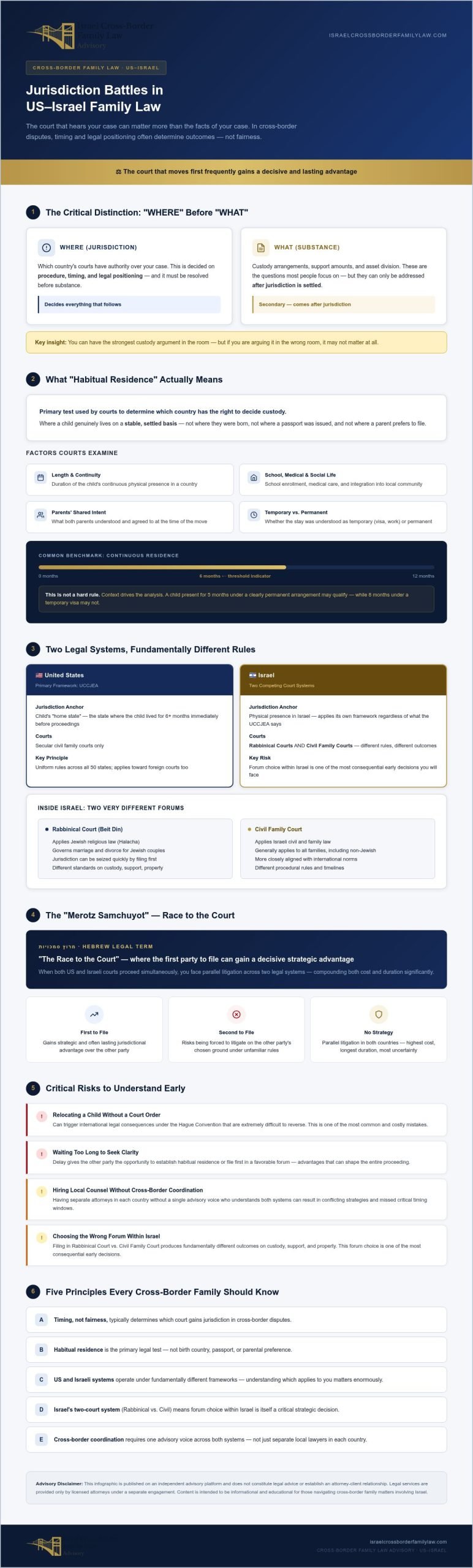
Most people facing a family dispute focus immediately on the substance: custody arrangements, support amounts, asset division. Those are the “what” questions. But in a cross-border case, the “where” question comes first and it controls everything that follows.
Procedural rules in one country can effectively override substantive rights you’d hold in another. A US court might apply the Uniform Child Custody Jurisdiction and Enforcement Act (UCCJEA), which anchors jurisdiction to the child’s “home state.” An Israeli court may apply an entirely different framework based on the child’s physical presence in Israel, regardless of what the UCCJEA says. When both courts proceed simultaneously, you face parallel litigation across two legal systems, compounding both cost and duration significantly.
There’s also a sequencing reality that most people miss: courts don’t typically address the best interests of the child until jurisdiction is settled. You can have the strongest custody argument in the room, but if you’re arguing it in the wrong room, it may not matter.
The Role of Habitual Residence
The legal concept that anchors most international family disputes is habitual residence. It’s the primary test courts use to determine which country has the right to decide custody and related matters. Simply put, it refers to where a child genuinely lives on a stable, settled basis, not where they were born, not where a passport was issued, and not where a parent happens to prefer filing.
Determining habitual residence isn’t always straightforward. Courts look at factors including:
- The length and continuity of the child’s physical presence in a country
- School enrollment, medical care, and social integration
- The parents’ shared intentions at the time of the move
- Whether the stay was described as temporary or permanent
A commonly cited benchmark is six months of continuous residence, which many courts treat as a threshold indicator of habitual residence. But this isn’t a hard rule. A child who has lived in Israel for five months under a clearly permanent arrangement may be considered habitually resident there, while a child present for eight months under a temporary work visa situation may not be. Context drives the analysis.
For US-Israel cases specifically, this distinction carries real weight. If one parent relocates with a child and establishes habitual residence in Israel before the other parent files in a US court, the Israeli court may assert jurisdiction first, and that filing sequence can shape the entire proceeding. Understanding where your child’s habitual residence currently sits, and where it might shift, is one of the most consequential assessments you can make before any dispute escalates. You can learn more about how these custody and relocation dynamics interact at israelcrossborderfamilylaw.com/international-custody-relocation/.
Key Legal Frameworks: UCCJEA and the Hague Convention
Two legal instruments define how US-Israel family disputes are structured before they ever reach a judge on the merits. Understanding both, and how they interact, is essential for anyone facing jurisdiction battles in international family cases. One governs how US courts allocate authority among themselves and toward foreign courts. The other creates an international mechanism designed to deter parental abduction across borders. They operate differently, they have different triggers, and they produce different outcomes.
The UCCJEA and US State Authority
The Uniform Child Custody Jurisdiction and Enforcement Act governs how US state courts determine whether they have the right to hear a custody case. Under the UCCJEA, jurisdiction typically belongs to the child’s “home state,” defined as the state where the child has lived for at least six consecutive months immediately before the proceedings begin. If no US state qualifies, courts look at significant connections to a state and where relevant evidence is located.
What many people don’t realize is that the UCCJEA also applies to foreign countries. A US state court can treat Israel as if it were another state for jurisdictional purposes, but only if Israeli law “substantially conforms” to the UCCJEA’s standards. This is where complexity enters. If a US court determines that Israeli proceedings don’t meet that threshold, it may decline to recognize an Israeli custody order. That refusal can create parallel, conflicting orders across two legal systems simultaneously, which is a scenario that benefits no one except those who profit from prolonged litigation.
Strategic early filing in a US state court, particularly when a child has recently returned from Israel or when one parent remains in the US, can establish home state jurisdiction and create a protective legal position before the other party acts. Timing, again, is decisive.
The UCCJEA also provides for emergency jurisdiction. Even if a child’s habitual residence is clearly in another country, a US court can intervene on a temporary basis if the child is physically present in the state and faces abandonment, mistreatment, or abuse. Emergency orders are temporary by design, but they can buy critical time while the jurisdictional question is resolved through proper channels.
The Hague Convention in US-Israel Cases
Both the United States and Israel are signatories to the Hague Convention on the Civil Aspects of International Child Abduction, which means the treaty framework applies to cross-border custody disputes between these two countries. The Convention’s core purpose is straightforward: when a child is wrongfully removed from their country of habitual residence, or wrongfully retained in another country beyond an agreed period, the receiving country is obligated to return the child promptly.
“Wrongful removal” and “wrongful retention” are defined terms under the Convention. Removal is wrongful when it breaches the custody rights of the other parent under the law of the child’s habitual residence, and when those rights were actually being exercised at the time. Retention becomes wrongful when a parent fails to return a child at the end of an agreed visit or temporary stay. The distinction matters because it determines which parent bears the burden of proof and how Israeli courts frame their response.
For practical guidance on how these requirements apply to relocation decisions, the detailed analysis at israelcrossborderfamilylaw.com/international-custody-relocation/ covers the legal requirements specific to US-Israel situations and what parents need to consider before any move is made.
Israeli courts do recognize a limited set of defenses to a Hague return order. The most significant is the “grave risk” defense, which allows a court to refuse return if sending the child back would expose them to physical or psychological harm, or place them in an intolerable situation. In practice, Israeli courts apply this defense narrowly. A general claim that the other parent is difficult or that living conditions in the US are less comfortable will not satisfy the threshold. Documented evidence of abuse, credible threats, or serious instability is required. Courts are cautious about allowing the grave risk defense to become a routine escape route from the Convention’s return obligation, and Israeli judges have shown consistent restraint in accepting it without compelling evidence.
If you’re uncertain how these frameworks apply to your specific circumstances, understanding the Hague Convention’s practical implications is a sensible first step before any decision is made about travel, relocation, or filing.
The US-Israel Dynamic: Rabbinical vs. Civil Jurisdictional Races
Israel has two parallel court systems that handle family matters, and they don’t simply divide the work neatly. They compete for it. Understanding this internal competition is essential to anyone involved in jurisdiction battles in international family cases with an Israeli dimension, because the forum that gains authority first can shape outcomes in ways that reach far beyond Israel’s borders.
The Israeli Rabbinical Court system handles Jewish divorce and related matters under religious law. The civil Family Courts handle custody, property division, and support under civil statutes. Both systems can assert jurisdiction over overlapping issues, and both move quickly when a party files first. This internal race, the Merotz Samchuyot, is a recognized feature of Israeli family law, not a theoretical edge case. It’s a strategic reality that experienced practitioners account for from day one.
The stakes are significant. Rabbinical Courts apply Halacha, Jewish religious law, which produces materially different outcomes on asset division and support than civil courts would. A party who files first in the preferred forum can lock in that forum’s authority over connected issues, sometimes before the other spouse has retained counsel.
The Rabbinical Court’s Global Reach
One of the most misunderstood aspects of Israeli family law is how far Rabbinical Court jurisdiction can extend. An Israeli Rabbinical Court can claim authority over parties who are not living in Israel, provided both spouses are Jewish and the marriage was conducted under Jewish law. That means a Jewish couple living in the United States can find themselves subject to Rabbinical Court proceedings if one spouse files in Israel first.
The Gett, the Jewish religious divorce document, sits at the center of this dynamic. Under Jewish religious law, a divorce is not legally complete without a Gett being granted by the husband and accepted by the wife. A civil divorce obtained in a US court does not substitute for this. Without a Gett, a woman remains an agunah, a “chained wife,” unable to remarry under religious law. This creates a coercive asymmetry. The Rabbinical Court process can run in parallel with, and complicate, US civil divorce proceedings in ways that are difficult to anticipate without specific cross-border guidance.
Being drawn into Rabbinical Court proceedings without a deliberate strategy is a risk that affects both parties, not just the spouse living in Israel. If you’re a US resident and your spouse files in an Israeli Rabbinical Court before you act, you may find yourself responding to proceedings in a forum you didn’t choose, under rules you didn’t expect, with limited ability to transfer the case elsewhere.
Winning the Race in Israel
Filing first in Israel matters, but filing strategically matters more. Israeli courts evaluate whether a claim is genuine, not just whether it was submitted quickly. The concept of “sincerity of the claim” means that a party who files in a particular forum purely for tactical advantage, with no substantive connection to that forum’s subject matter, may find that the filing carries less weight than anticipated. Courts look at the nature of the relief sought, the connection between the issues raised and the forum’s authority, and whether the filing reflects a legitimate legal position.
That analysis requires knowing which forum is actually appropriate for your circumstances before you file. For some parties, the civil Family Court offers better protections on custody and property. For others, engaging the Rabbinical Court strategically on Gett-related matters can be a necessary component of the overall resolution. The decision isn’t obvious, and it isn’t reversible once made.
Before any filing decision is made in Israel or in the United States, understanding where your case sits across both systems is the most important step you can take. A confidential case review can help identify which forum aligns with your legal position, what the other party is likely to do, and how to sequence your response before the race begins in earnest.
Jurisdiction battles in international family cases are rarely won by the party with the strongest facts. They’re won by the party who understands the terrain before the other side does.
Strategic Risks: Mistakes that Compromise Your Case
Understanding how jurisdiction works is only half the challenge. The other half is avoiding the decisions that quietly destroy your legal position before you’ve had a chance to build one. In jurisdiction battles in international family cases, the most damaging mistakes aren’t usually made in court. They’re made in the weeks and months before anyone files anything.
The instinct to act quickly and protect yourself or your children is entirely understandable. But unilateral action, taken without legal guidance, can transform a difficult situation into an irreversible one.
The Danger of ‘Self-Help’ Measures
Moving a child across an international border without a court order or the other parent’s written consent is one of the most consequential mistakes a parent can make. It doesn’t matter how justified the reasons feel in the moment. Under the Hague Convention, which both the US and Israel have signed, this action can constitute wrongful removal, triggering a mandatory return process that’s extremely difficult to stop once it begins.
Parents who take this step often believe they’re protecting their child. Courts see it differently. What begins as a protective impulse can result in criminal exposure, an immediate loss of credibility in subsequent custody proceedings, and a return order that sends the child back to the very situation the parent was trying to leave. The grave risk defense exists, but as discussed earlier, it’s applied narrowly. It’s not a reliable safety net for parents who act unilaterally.
The same caution applies to retaining a child beyond an agreed visit. Wrongful retention carries the same legal consequences as wrongful removal under the Convention. “Just a few more weeks” can cross a legal threshold that changes everything.
Why Early Decisions Carry Permanent Weight
Temporary orders are called temporary, but they have a way of becoming permanent. Courts making final custody determinations look heavily at the status quo that has developed during interim proceedings. If a child has been living in one country under a temporary arrangement for six to twelve months, that pattern becomes evidence of stability. Disrupting it requires justification. The parent who allowed the arrangement to settle, without challenging it promptly, may find that inaction has been interpreted as acquiescence.
This is why early legal positioning matters so much. Decisions made under pressure, without counsel, in the first days or weeks of a dispute can define the entire trajectory of the case. Waiting to see how things develop is rarely a neutral choice.
The ‘Inconvenient Forum’ Argument
Forum non conveniens is a legal doctrine that allows a court to decline jurisdiction on the basis that another forum is better placed to hear the case. In cross-border family matters, one party sometimes attempts to use this argument to shift proceedings from a court where they’re at a disadvantage to one where they expect a more favorable outcome.
Courts evaluating this argument consider several factors:
- Where the child lives and attends school
- Where the relevant witnesses and evidence are located
- The child’s social environment and established connections
- The practical ability of both parties to participate in proceedings in each forum
- Whether the alternative forum offers adequate legal protections
Successfully challenging a jurisdiction that was improperly seized requires demonstrating that the filing had no genuine connection to that forum, or that proceeding there would cause serious prejudice. This is a high bar. Courts are reluctant to cede jurisdiction once they’ve accepted a matter, which is why preventing an improper filing is always preferable to undoing one after the fact.
Enforcement Challenges Across Borders
Winning an order in one country doesn’t guarantee it will be honored in another. A US custody or support order isn’t automatically enforceable in Israel. Israeli courts must first recognize the foreign order, and that recognition process involves its own procedural requirements and potential grounds for refusal.
The principle governing this mutual recognition is called comity: the idea that legal systems respect each other’s judgments as a matter of international courtesy and reciprocity. But comity isn’t automatic. An Israeli court can decline to recognize a US order if it finds that the US court lacked proper jurisdiction, that the proceedings violated due process, or that enforcement would conflict with Israeli public policy.
For child support specifically, cross-border enforcement is one of the most practically challenging aspects of any international family case. The detailed analysis at israelcrossborderfamilylaw.com/child-support-cross-border-enforcement/ explains why US orders may not be automatically enforced in Israel and what steps are required to give an order real force in both jurisdictions.
The most effective protection is a mirror order: having your decree formally recognized and registered in both countries so that it carries independent legal weight in each system. This takes additional steps and coordination, but it closes the enforcement gap that leaves many parents holding an order they can’t actually use.
Failing to coordinate legal teams across both the US and Israel is where many of these risks converge. Local counsel in each country will understand their own system. What they won’t automatically do is align strategy across both systems simultaneously. Without that coordination, you can win a battle in one forum while unknowingly undermining your position in the other.
Jurisdiction battles in international family cases are won through preparation, not reaction. If your situation is developing and you haven’t yet mapped out the risks across both systems, now is the time to do it. Request a confidential case review to understand where your case stands before a decision is made that can’t be undone.
Navigating the Complexity: The Strategic Advisory Approach
Having two lawyers is not the same as having a strategy. In jurisdiction battles in international family cases, the most common structural failure isn’t a lack of legal representation. It’s a lack of coordination between the legal teams operating in each country. Your Israeli attorney understands Israeli procedure. Your US attorney understands US procedure. Neither one is automatically watching what the other is doing, or adjusting their advice based on the other system’s next move.
That gap is where cases are lost.
What cross-border family matters require is a unifying advisory layer: someone who understands both systems well enough to coordinate the overall strategy, identify where the two legal tracks conflict, and ensure that a decision made in one jurisdiction doesn’t quietly undermine your position in the other. Think of it less like hiring two local experts and more like having a general who understands both theaters of operation before committing troops to either one.
Cultural nuance matters here, too, and it’s frequently underestimated. Legal communication in Israel operates differently than it does in the United States. Timelines, negotiation norms, judicial temperament, and the informal dynamics of how cases actually move through the system don’t appear in any statute. They’re absorbed through experience. An advisory platform with genuine presence in both Tel Aviv and New York brings that contextual fluency to the table in a way that purely local counsel cannot.
Clarity Before Commitment
The single most valuable thing you can do before taking any legal action is to understand what your options actually are across both systems simultaneously. Filing in the wrong jurisdiction, or filing prematurely in the right one, can set a trajectory that’s costly to reverse. Before any decision is made, it’s worth understanding the pricing and process of international legal strategy so that you can plan with realistic expectations rather than react under pressure.
“Waiting to see what happens” is not a neutral position. It’s a decision in itself, and in cross-border family matters, it’s frequently the most dangerous one. The other party may not be waiting. Courts don’t pause because one side isn’t ready.
A Bridge Between Legal Systems
Multi-qualified practitioners who are fluent in both New York and Israeli family law don’t just translate legal concepts. They translate strategic consequences. A filing choice that looks reasonable through a US lens may carry serious risks in the Israeli system, and vice versa. Practitioners who hold that dual perspective can identify those conflicts before they materialize in a courtroom.
If you’re an expat, a foreign national living in Israel, or a binational family trying to understand where you stand, the resources available at israelcrossborderfamilylaw.com/for-expats-foreign-nationals/ are a practical starting point for mapping the landscape before you engage formal legal representation.
Jurisdiction is the foundation of every international family case. Everything else, custody, support, asset division, enforcement, sits on top of it. Build that foundation carefully, with full awareness of both systems, and you give yourself the best possible position for what follows. Rush it, ignore it, or delegate it to counsel who only see half the picture, and you may find yourself fighting on ground you never chose.
Get clarity before you commit. Request a confidential consultation to understand where your case stands across both legal systems before any decision becomes irreversible.
This content is published on an independent advisory platform and is intended for informational and educational purposes only. It does not constitute legal advice and does not create an attorney-client relationship. Legal services are provided exclusively by licensed attorneys under a separate engagement.
Your Next Move in a Cross-Border Dispute Starts Here
Jurisdiction battles in international family cases don’t wait for you to feel ready. The legal frameworks are complex, the timing is unforgiving, and decisions made in the early stages carry weight that’s difficult to reverse later. Two courts, two countries, two very different systems: the party who understands that terrain first is almost always better positioned.
The core lessons from this article are straightforward. Where your case is heard matters as much as what your case contains. Early filing decisions, habitual residence determinations, and the choice between Israeli civil and Rabbinical courts can shape outcomes before the merits are ever argued. And coordinating legal strategy across both the US and Israel requires more than local counsel in each country; it requires a unified perspective that sees both systems at once.
With physical presence in both Tel Aviv and New York, and specialized focus on US-Israel cross-border family matters, this advisory platform is built specifically for families navigating exactly this complexity.
Get clarity before you commit. Request a confidential consultation and take the first step toward understanding your position in both legal systems.
Frequently Asked Questions
What is ‘habitual residence’ in a US-Israel custody case?
Habitual residence is the legal concept courts use to determine which country has the right to decide custody. It refers to where your child genuinely lives on a stable, settled basis, not where they were born or where a parent prefers to file. Courts look at school enrollment, medical care, social integration, and how long the child has lived in each country. It’s a fact-specific analysis, not a simple checklist.
The six-month benchmark is frequently referenced, but it isn’t a hard rule. A child who has lived in Israel for five months under clearly permanent circumstances may be considered habitually resident there, while a child present for longer under a temporary arrangement may not. If you’re uncertain where your child’s habitual residence currently sits, that assessment should happen before any dispute escalates.
Can an Israeli court decide my case if I live in the United States?
Yes, in certain circumstances it can. Israeli Rabbinical Courts can claim jurisdiction over Jewish couples married under Jewish law, even when both spouses are living abroad. If your spouse files in Israel before you act, that filing can draw you into proceedings in a forum you didn’t choose and may not have anticipated. Civil Family Courts in Israel can also assert jurisdiction based on the child’s physical presence or habitual residence in Israel.
Your physical location in the US doesn’t automatically shield you from Israeli proceedings. Jurisdiction battles in international family cases frequently involve exactly this scenario, where one party files strategically in Israel while the other assumes their US residence provides protection. It doesn’t, not without a coordinated legal response across both systems.
What should I do if my spouse files for divorce in Israel while I am in the US?
Don’t wait. Failing to respond promptly can be interpreted as acquiescence, and Israeli courts can proceed in your absence under certain conditions. Your first step is to get advice from someone who understands both the Israeli and US legal frameworks simultaneously, not just one or the other. You’ll need to assess whether the Israeli filing was procedurally valid, which forum is actually appropriate for your circumstances, and whether filing in the US first on specific issues is still an available option.
The sequencing of your response matters as much as the response itself. Acting quickly without a clear strategy can make things worse. Acting slowly can cost you options that were available earlier. Clarity about your position across both systems is the most important thing to establish before you take any formal step.
How does the ‘Race to the Court’ work in Israel?
The Merotz Samchuyot, loosely translated as the Race to the Court, refers to the competitive dynamic between Israel’s two parallel family law systems: the civil Family Courts and the Rabbinical Courts. Both can assert jurisdiction over overlapping issues, and the party who files first in their preferred forum can lock in that forum’s authority before the other spouse has a chance to act. Rabbinical Courts apply Jewish religious law, which produces different outcomes on asset division and support than civil courts would.
Filing first matters, but filing strategically matters more. Israeli courts assess whether a claim has genuine substance and a real connection to the forum’s authority. A purely tactical filing with no legitimate basis can carry less weight than expected. Knowing which forum aligns with your legal position, and why, is the critical decision that has to be made before the race begins.
Is a US child custody order enforceable in Israel?
Not automatically. A US custody order doesn’t carry independent legal force in Israel simply because it was issued by an American court. Israeli courts must first formally recognize the foreign order through their own recognition process, which has its own procedural requirements and potential grounds for refusal. An Israeli court can decline recognition if it finds the US court lacked proper jurisdiction, that due process wasn’t followed, or that enforcement would conflict with Israeli public policy.
The most reliable protection is a mirror order: having your US decree formally registered and recognized in Israel so it carries enforceable weight in both jurisdictions. This requires additional steps and cross-border coordination, but it closes the gap that leaves many parents holding an order they can’t practically use. Cross-border child support enforcement raises similar challenges and deserves the same attention.
What is the Hague Convention, and how does it protect my children?
The Hague Convention on the Civil Aspects of International Child Abduction is an international treaty designed to deter parental abduction across borders. Both the US and Israel are signatories. Its core mechanism is straightforward: if a child is wrongfully removed from their country of habitual residence, or wrongfully retained beyond an agreed period, the receiving country is obligated to return the child promptly. It’s not a custody determination; it’s a procedural safeguard that preserves the status quo while custody is resolved through proper channels.
The Convention’s protections apply in both directions. A parent who takes a child to Israel without the other parent’s consent, or who fails to return a child after an agreed visit, can face a mandatory return process that’s extremely difficult to stop once it begins. The grave risk defense exists as a narrow exception, but it requires documented evidence of serious harm, not general concerns about the other parent’s character or the quality of life in the other country.
Can I change the jurisdiction of my case after it has started?
It’s possible, but it’s difficult and never guaranteed. Courts are reluctant to cede jurisdiction once they’ve accepted a matter. Challenging an existing jurisdiction requires demonstrating either that the original filing had no genuine connection to that forum, or that proceeding there would cause serious prejudice to one party. The forum non conveniens doctrine allows a court to transfer proceedings to a more appropriate venue, but the threshold is high and the outcome uncertain.
Preventing an improper jurisdictional filing is always more effective than trying to undo one after the fact. Once a court has been hearing a case for several months, the practical and procedural barriers to transferring it elsewhere grow substantially. If you believe the wrong court seized jurisdiction at the outset, that challenge needs to be raised early and with a clear legal basis, not as a later tactical move.
Why do I need a cross-border lawyer instead of just a local divorce attorney?
A local divorce attorney understands their own legal system thoroughly. What they don’t automatically do is monitor what’s happening in the parallel system operating in another country, or adjust their advice based on how a decision in one jurisdiction might affect your position in the other. In a US-Israel case, a filing strategy that looks sound through a US lens can carry serious risks under Israeli law, and vice versa. Those conflicts aren’t always visible from one side of the border.
What cross-border family matters require is a unified advisory perspective that sees both systems simultaneously. Without that coordination, you can win a procedural battle in one forum while unknowingly undermining your substantive position in the other. Multi-qualified practitioners who are fluent in both New York and Israeli family law don’t just translate legal concepts; they translate strategic consequences across both legal environments before those consequences become irreversible.

Article by
Gabriel Lior
A Personal Journey That Became a Mission
The advisory was founded by an American father Gabriel Lior, LLB, MBA , global entrepreneur, and cross-border advisor who spent more than a decade navigating the Israeli family court system firsthand and now lives in Singapore with his son.
As a divorced parent in a cross-border family, Gabriel faced nearly every legal challenge a foreign parent can encounter in Israel — including child custody disputes, child support proceedings, property matters in Israel and abroad, false accusations, and complex immigration and relocation proceedings.
Over the years, he learned the hard way how difficult it is for non-Israeli parents to understand the system, identify the right legal strategy, and choose the right legal representation — especially when language, culture, and jurisdictional differences are involved. He also witnessed how foreign parents and new immigrants are often disadvantaged or taken advantage of by service providers and institutions simply because they lack local knowledge or fluency.
From Client to Advisor
To truly understand — and survive — the system, Gabriel pursued formal legal education in Israel, completing two Israeli law degrees, alongside a BA and MBA earned in the United States. This was never about becoming a practicing attorney, but about gaining a deep, structural understanding of how the system works — and where it breaks down for foreign parents.
This rare combination of:
Firsthand client experience
Israeli legal and US business education
International business and negotiation training
Decades of commercial execution
created a unique perspective – one that understands both sides of the table.
After years of litigation, persistence, and at times self-representation, he ultimately succeeded in securing custody of his son and relocating abroad through a rare legal victory in the Israeli Supreme Court — becoming one of the first fathers in Israel to do so under these circumstances.
Disclaimer
Important Disclaimer:
The information provided on this website and in its content is for general informational and educational purposes only and does not constitute legal advice, legal opinion, or legal representation.
Gabriel Lior is not licensed to practice law in Israel (nor is he interested in doing so) and does not provide legal services, despite having completed 2 Law Degrees. The services offered are advisory in nature and are intended to provide general guidance, strategic insight, and information regarding cross-border family law considerations.
No attorney-client relationship is formed by accessing this website, reading its content, or communicating with us.
Any decisions made based on this information are at your own discretion and risk. For legal advice specific to your situation, you should consult a licensed attorney in the relevant jurisdiction.
Where appropriate, we may refer clients to independent, licensed attorneys or professionals. Such referrals do not constitute legal representation and no liability is assumed for services provided by third parties.