What if the distance between the United States and Israel didn’t have to compromise your child’s financial security? Many international families face deep anxiety when a parent moves across the globe. It’s natural to worry that managing Child Support Across International Borders will become an impossible maze of conflicting laws, hidden assets, and high legal fees. You may feel overwhelmed by the complexity of navigating two very different legal systems while trying to ensure your children are protected.
This guide provides a strategic roadmap to help you understand how support is established, enforced, and modified when jurisdictions overlap. We’ll explain the critical role of the 2007 Hague Convention and the specific powers of the Israeli Execution Office. You’ll also gain clarity on the strategic factors you must consider before deciding whether to file your case in Israel or the United States. This content is published on an independent advisory platform for informational purposes and does not constitute formal legal advice. By understanding the “center of life” test and the procedural bridges between these two nations, you can replace confusion with a clear, informed plan of action.
Key Takeaways
- Understand why Child Support Across International Borders requires a specialized strategy due to the unique interplay between the US and Israeli legal systems.
- Learn how the 2007 Hague Convention serves as a procedural bridge to simplify the recognition and enforcement of foreign support orders.
- Gain clarity on Israel’s dual-court system and how the choice between Family Court and Rabbinical Court can significantly impact your enforcement options.
- Identify the practical steps for gathering documentation and determining whether to proceed through a government agency or private advisory.
- Discover why early tactical decisions in cross-border cases are often irreversible and the importance of seeking clarity before committing to a legal path.
The Reality of Child Support Across International Borders
Managing the financial needs of a child becomes significantly more complex when a parent moves to another country. Child support across borders involves the formal legal recognition and enforcement of financial obligations when parents reside in different nations. While a domestic case usually follows a predictable path within a single state’s court system, international cases require a sophisticated understanding of how two distinct legal frameworks interact. This content is published on an independent advisory platform and focuses on strategic decision-making rather than establishing an attorney-client relationship.
International child support is a treaty-based obligation between participating nations that ensures children receive financial maintenance regardless of where their parents live. In the context of the United States and Israel, this relationship is governed by both bilateral agreements and multilateral treaties. The primary mechanism for this cooperation is The 2007 Hague Convention, which provides a structured process for recognizing foreign orders. Establishing Child Support Across International Borders isn’t just about obtaining a court order; it’s about ensuring that order can actually be enforced in a jurisdiction thousands of miles away.
Common Scenarios for US-Israel Support Cases
Many families find themselves navigating these issues following a major life transition. A common scenario involves a parent relocating to Israel after a divorce is finalized in the United States, leaving the other parent to figure out how to enforce an existing American support order. Other cases involve parents who were never married and reside in different countries, requiring the establishment of both paternity and support from scratch. For English-speaking “Anglo” expats in Israel, the challenge is often doubled. They must navigate a Hebrew-speaking legal system with different calculation methods and cultural expectations regarding parental roles and financial responsibility.
The Emotional and Financial Stakes
The stakes in these proceedings are high, both emotionally and financially. Parents often face intense anxiety due to time zone differences, language barriers, and the fear that the other parent might hide assets in a foreign bank account. You can learn more about these complexities through our guide on child support cross-border enforcement. Beyond the legal hurdles, currency fluctuations present a practical challenge. If an order is set in U.S. Dollars but paid in Israeli Shekels, the actual value received can shift monthly based on exchange rates. Because early decisions in these cases are often irreversible, it’s vital to seek strategic clarity before filing any paperwork in either country.
The 2007 Hague Convention: A Bridge Between the US and Israel
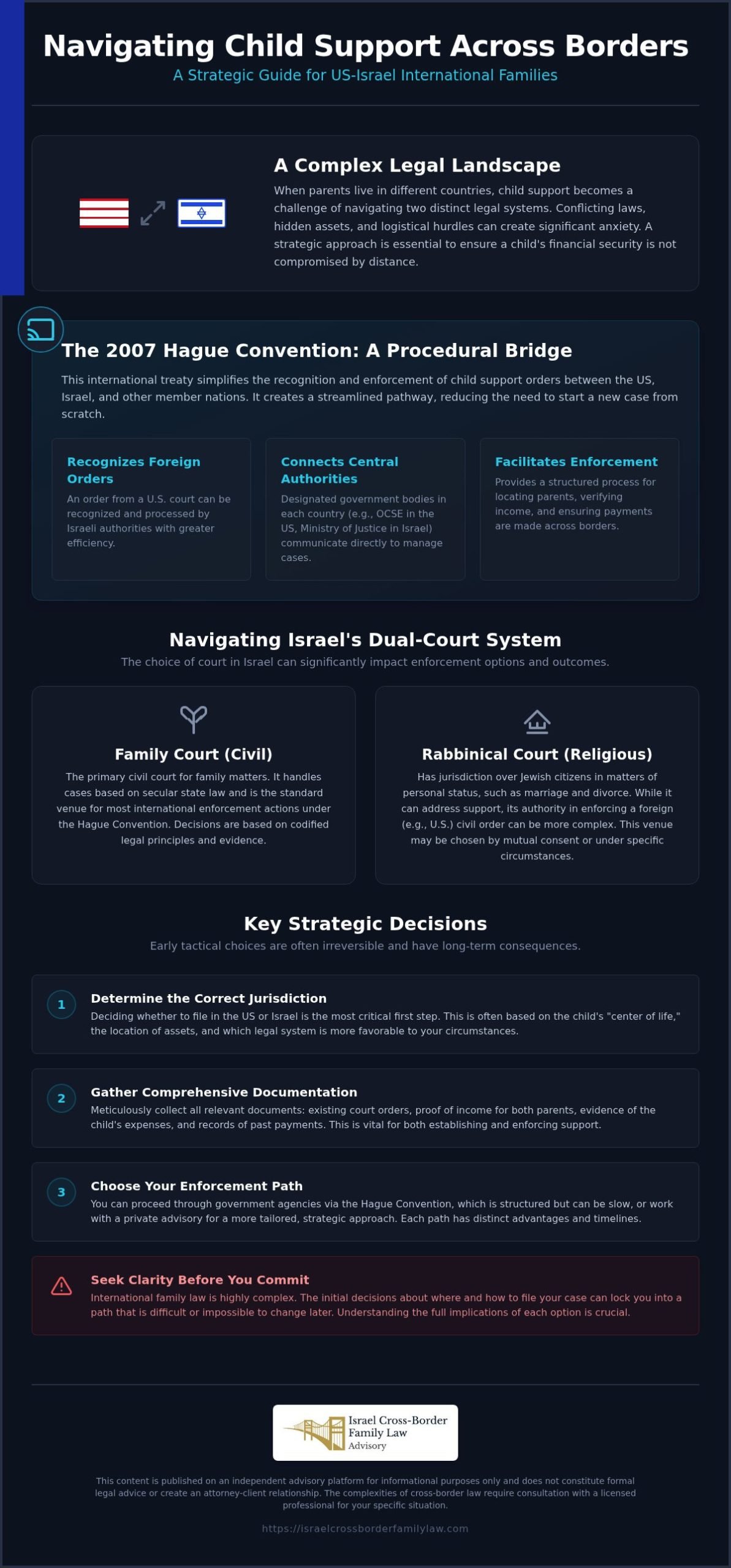
The legal landscape for recovering maintenance changed significantly when the United States ratified the Hague Convention on the International Recovery of Child Support and Other Forms of Family Maintenance. Taking effect in the U.S. on January 1, 2017, this treaty created a streamlined pathway for families managing Child Support Across International Borders. Before this framework, enforcing an order in a foreign country often required starting a new legal case from scratch. Today, the treaty acts as a procedural bridge, allowing an order issued in a New York or California court to be recognized and processed by Israeli authorities with much greater efficiency.
Central to this process is the cooperation between designated “Central Authorities” in each nation. In the United States, this role is filled by the Office of Child Support Enforcement (OCSE) within the Department of Health and Human Services. You can find more detail on these frameworks through the official U.S. International Child Support Arrangements page. In Israel, the Central Authority is the Legal Aid office of the Ministry of Justice. These agencies communicate directly to transmit applications, locate parents, and facilitate payments, acting as the primary tool for enforcement in 2026. This system reduces the need for parents to navigate foreign bureaucracies entirely on their own.
How the Convention Facilitates Enforcement
The treaty simplifies the process by using standardized forms and procedures that both countries have agreed to honor. This uniformity helps reduce the administrative delays that used to plague international cases. When a U.S. order is “registered” in an Israeli court, the Israeli system treats it with a level of respect similar to a domestic order. One significant benefit for families is that many procedures under the Hague Convention and the 2009 bilateral Memorandum of Understanding (MOU) between the U.S. and Israel are provided without application fees. This makes the path to justice more accessible for families who might otherwise be deterred by the high costs of international litigation.
Limitations of the Treaty
While the Hague Convention is powerful, it’s not a universal solution for every family law dispute. It’s designed primarily for the recognition and enforcement of existing financial orders. It does not provide for the automatic modification of those orders. If you need to change the amount of support because of a job loss or a child’s changing needs, you may still face a complex jurisdictional hurdle. Additionally, the treaty only applies between signatory nations. If a parent moves to a country that hasn’t joined the convention, these streamlined protections won’t be available. Understanding these nuances is a key part of child support cross-border enforcement strategy. If you’re feeling uncertain about how these treaties apply to your specific situation, it’s often helpful to request a confidential consultation to gain clarity on your options.
Navigating the Israeli Legal System: Family vs. Rabbinical Courts
Israel operates a unique dual-court system that often surprises those managing Child Support Across International Borders. For family matters, jurisdiction is shared between the secular Civil Family Court and the religious Rabbinical Court. This content is published on an independent advisory platform and is intended for informational purposes rather than formal legal advice. Understanding the distinction between these two systems is critical because the court that hears your case will apply different procedural rules and legal philosophies to determine the final support amount.
A defining feature of the Israeli system is the “Race for Jurisdiction,” also known as the “Race to the Court.” In many cases, the parent who files first determines which court system will handle the dispute. This strategy became even more significant in November 2025, when a temporary law clarified the authority of Rabbinical Courts to hear child support matters if they are bundled within a divorce lawsuit. If you are an American expat or have a child living in Israel, the timing and location of your initial filing can have irreversible consequences for your financial future.
Civil Family Court: The Standard for Expats
The Civil Family Court (Beit Mishpat Le’inyanei Mishpacha) is generally the preferred venue for expats and foreign nationals. These courts use a “center of life” test to determine if they have the right to hear a case, focusing on where the child actually lives and attends school. Modern Israeli civil rulings have moved toward a more gender-neutral model of support. Instead of following traditional religious dictates, the court calculates payments based on the actual needs of the child, the relative income of both parents, and the percentage of time the child spends in each household. This approach often feels more familiar and predictable to those coming from the U.S. legal system.
The Rabbinical Court and Support
The Rabbinical Court (Beit Din Rabbany) operates according to Halakha, or Jewish law. While these courts primarily handle marriage and divorce for Jewish citizens, they can gain jurisdiction over child support if both parents agree or if the matter is properly “linked” to a divorce claim. Under religious law, maintenance is often categorized into “essential needs” and “extraordinary needs.” The father typically bears the primary burden for essential needs, while extraordinary needs, such as extracurricular activities or private schooling, may be shared. For U.S. citizens, unintentionally ending up in the Rabbinical system can create significant complexity, as the legal definitions and enforcement mechanisms differ from secular standards. It’s often helpful to request a confidential consultation to determine which court system aligns best with your family’s needs before taking any formal action.
Practical Strategies for Enforcement and Modification
Successfully managing Child Support Across International Borders depends on a disciplined approach to documentation and timing. While the Hague Convention provides the legal framework, the practical execution requires navigating specific bureaucratic requirements in both the United States and Israel. This content is published on an independent advisory platform for informational purposes and does not constitute formal legal representation. Following a structured set of steps can help reduce the friction often associated with cross-border financial obligations.
- Step 1: Document Consolidation. You must gather certified copies of all existing court orders and a verified history of payments. In Israel, a petitioner typically has five years from the date a foreign order was established to apply for its recognition.
- Step 2: Channel Selection. You must decide whether to proceed through the government Central Authority or engage private advisory. While government services are provided without application fees, private counsel often provides the strategic depth needed for high-stakes or high-conflict cases.
- Step 3: Registration. The foreign order must be formally “registered” with the Israeli Family Court to be treated as a local judgment.
- Step 4: Ongoing Compliance. Both parties should maintain meticulous records of bank transfers, as the Israeli Execution Office (Hotzaa LaPoal) requires clear evidence to resolve disputes over arrears.
Enforcing a US Order in Israel
The process of making a foreign judgment enforceable in Israel is known as the “Exequatur” process. Under the Foreign Judgments Enforcement Law of 1958, an Israeli court must declare the U.S. order enforceable before local authorities can take action. This process can take approximately 6 to 18 months to complete. Common defenses used to block enforcement include claims that the parent wasn’t properly served in the U.S. or that the order contradicts Israeli public policy. Because financial support is often tied to where the child lives, you may also find value in our guide on International Custody and Relocation.
Modifying Support Across Borders
Changing a child support amount requires a “Significant Change in Circumstances.” In the Israeli system, this is a high threshold that goes beyond minor salary fluctuations. The court with jurisdiction is usually the one where the child’s “center of life” is currently established. You should never stop or reduce payments unilaterally before a court grants a formal modification. In Israel, failure to pay can lead to severe sanctions, including the suspension of a driver’s license or “stop-exit” orders that prevent you from leaving the country. If you’re facing a shift in your financial situation, you should request a confidential case review to understand the risks before modifying your payment patterns.
Strategic Decision-Making: Seeking Clarity Before Committing
Establishing a comprehensive strategy for Child Support Across International Borders is the most effective way to protect your family’s interests. This content is published on an independent advisory platform and is intended for informational purposes rather than formal legal representation. Before you file any paperwork or sign a single document, you must understand how your decisions will ripple through two different legal systems. A well-planned roadmap helps you account for jurisdictional conflicts, currency volatility, and the long-term financial needs of your children.
Early decisions in US-Israel cases are often irreversible. Once a court in Israel or the United States accepts jurisdiction over a support matter, it becomes exceptionally difficult to move that case to a different venue. If you inadvertently trigger the “Race for Jurisdiction” in the Rabbinical system when the Civil Family Court would have been more advantageous, you may be bound by that choice for years. You must honestly assess the risks involved, including the typical 6 to 18 month timeframe for enforcement and the potential for high litigation costs if a case becomes contested.
The Advisory Approach vs. Traditional Litigation
Choosing an advisory-led path often provides more stability for international families than immediate litigation. By focusing on strategy first, you can explore mediation and detailed financial agreements that address the specific complexities of cross-border life. These agreements can account for international travel costs, private schooling in Israel, and exchange rate protections that standard court orders often overlook. You can learn more about how this process unfolds by reviewing how it works on our advisory platform.
Next Steps for International Families
For parents seeking deeper insights into these challenges, we recommend viewing the educational resources on the Israel Family Law YouTube Channel. Managing the intersection of US and Israeli law requires the expertise of practitioners who understand the nuances of both cultures and legal frameworks. These specialized professionals act as a bridge, ensuring that your rights are respected in both jurisdictions. Clarity is your best defense against the uncertainty of cross-border legal issues. It allows you to make decisions based on facts rather than fear or confusion.
Get clarity before you commit. Request a confidential consultation.
Securing Financial Stability for Your International Family
Effectively managing Child Support Across International Borders requires more than just following local procedures; it demands a comprehensive understanding of how the 2007 Hague Convention interacts with Israel’s unique dual-court system. We’ve explored how the “Race for Jurisdiction” can dictate the trajectory of your case and why early, informed decisions are the most powerful tool for long-term stability. This content is published on an independent advisory platform to provide strategic cross-border guidance for families navigating the specific complexities of US-Israel family dynamics. It’s designed to help you understand the risks and opportunities within each jurisdiction before you commit to a specific path.
By focusing on strategic clarity before taking formal legal action, you can avoid common pitfalls like jurisdictional conflicts or irreversible procedural errors. Our advisory approach is centered on providing the decision-making framework you need to move forward with confidence. Navigating two legal systems is inherently complex, but having a clear roadmap ensures that your child’s financial security remains a priority. You don’t have to face these transnational challenges without a steady, knowledgeable guide to walk you through the process.
Get clarity before you commit. Request a confidential case review.
Frequently Asked Questions
Is a U.S. child support order automatically enforceable in Israel?
No, a U.S. order is not automatically enforceable. It must first be recognized by an Israeli Family Court under the Foreign Judgments Enforcement Law of 1958. This legal process ensures that the U.S. order doesn’t contradict Israeli public policy and that the parent was properly served before the state begins collection efforts. You generally have five years from the date the order was issued to apply for this recognition in Israel.
How do I get child support if the other parent moved to Israel to avoid paying?
You can initiate an enforcement application through the U.S. Central Authority or engage private advisory to file directly in the Israeli court system. This process utilizes the 2007 Hague Convention framework to locate the parent and register the support obligation locally. This content is published on an independent advisory platform and focuses on strategic guidance rather than formal legal representation. Acting quickly is important to prevent the accumulation of untraceable arrears.
Can the Israeli Rabbinical Court handle child support for U.S. citizens?
Yes, the Rabbinical Court can gain jurisdiction if the support claim is part of a broader divorce lawsuit or if both parents consent to the venue. A law passed in November 2025 clarified the power of these religious courts to hear support matters in specific contexts. Many Americans find the civil court system more predictable, so it’s vital to seek clarity on which system best serves your family’s needs before filing any documents.
What happens if the parent in the U.S. loses their job? Can the support amount be changed in Israel?
Support amounts can be modified, but only if you can prove a “Significant Change in Circumstances.” The court where the child’s “center of life” is established usually has the authority to hear modification claims. You should never stop making payments unilaterally. In the U.S., arrears over $2,500 can lead to passport denial, while in Israel, it can trigger immediate “stop-exit” orders that prevent you from leaving the country.
How long does it typically take to enforce an international child support order?
The enforcement of a U.S. order in Israel typically takes between 6 and 18 months. This period includes the time needed for the Israeli Family Court to declare the order enforceable and for the Execution Office to set up the collection mechanism. While the 2007 Hague Convention has streamlined these procedures, the multi-jurisdictional complexity of these cases often requires a steady, patient approach to navigate the bureaucratic steps in both nations.
Do I need to travel to Israel for a child support hearing if I live in the U.S.?
Physical travel is not always required. Israeli courts often allow testimony via video conference or through authorized legal representatives for parents living abroad. However, your presence might be beneficial in high-conflict cases where direct testimony regarding financial assets is necessary. Understanding the logistical requirements of your specific court is a key part of managing Child Support Across International Borders effectively without unnecessary travel expenses.
What is the role of the Israeli Central Authority in child support cases?
The Legal Aid office of the Ministry of Justice serves as the Israeli Central Authority. They act as the primary bridge between the two countries, processing applications under the 2007 Hague Convention and the 2009 Memorandum of Understanding. They facilitate the transmission of documents and help locate parents. While they provide essential administrative support without application fees, they do not provide the personalized strategic advice often required for complex cross-border family dynamics.
Can child support be taken directly from an Israeli bank account or salary?
Yes, once an order is recognized, the Israeli Execution Office (Hotzaa LaPoal) has significant enforcement powers. They can garnish wages, place liens on bank accounts, and even seize assets to satisfy support debts. These authorities take maintenance obligations seriously and can also suspend driver’s licenses to encourage compliance. Meticulous record-keeping of all transfers is essential to ensure that the Execution Office has an accurate history of your payment compliance.

Article by
Gabriel Lior
A Personal Journey That Became a Mission
The advisory was founded by an American father Gabriel Lior, LLB, MBA , global entrepreneur, and cross-border advisor who spent more than a decade navigating the Israeli family court system firsthand and now lives in Singapore with his son.
As a divorced parent in a cross-border family, Gabriel faced nearly every legal challenge a foreign parent can encounter in Israel — including child custody disputes, child support proceedings, property matters in Israel and abroad, false accusations, and complex immigration and relocation proceedings.
Over the years, he learned the hard way how difficult it is for non-Israeli parents to understand the system, identify the right legal strategy, and choose the right legal representation — especially when language, culture, and jurisdictional differences are involved. He also witnessed how foreign parents and new immigrants are often disadvantaged or taken advantage of by service providers and institutions simply because they lack local knowledge or fluency.
From Client to Advisor
To truly understand — and survive — the system, Gabriel pursued formal legal education in Israel, completing two Israeli law degrees, alongside a BA and MBA earned in the United States. This was never about becoming a practicing attorney, but about gaining a deep, structural understanding of how the system works — and where it breaks down for foreign parents.
This rare combination of:
Firsthand client experience
Israeli legal and US business education
International business and negotiation training
Decades of commercial execution
created a unique perspective – one that understands both sides of the table.
After years of litigation, persistence, and at times self-representation, he ultimately succeeded in securing custody of his son and relocating abroad through a rare legal victory in the Israeli Supreme Court — becoming one of the first fathers in Israel to do so under these circumstances.
Disclaimer
Important Disclaimer:
The information provided on this website and in its content is for general informational and educational purposes only and does not constitute legal advice, legal opinion, or legal representation.
Gabriel Lior is not licensed to practice law in Israel (nor is he interested in doing so) and does not provide legal services, despite having completed 2 Law Degrees. The services offered are advisory in nature and are intended to provide general guidance, strategic insight, and information regarding cross-border family law considerations.
No attorney-client relationship is formed by accessing this website, reading its content, or communicating with us.
Any decisions made based on this information are at your own discretion and risk. For legal advice specific to your situation, you should consult a licensed attorney in the relevant jurisdiction.
Where appropriate, we may refer clients to independent, licensed attorneys or professionals. Such referrals do not constitute legal representation and no liability is assumed for services provided by third parties.