What if your first legal filing in Israel actually surrendered your rights to a U.S. court without you ever realizing it? Filing for divorce first in the wrong country isn’t just a procedural error; it’s a strategic mistake that can permanently compromise your financial assets and parental rights. You might feel paralyzed by the distance between you and your partner, wondering how an Israeli court can legally reach someone living in Florida or California. It’s natural to feel anxious about losing control of the process when you’re managing a Divorce When One Spouse Lives Abroad, especially when the legal systems seem to contradict one another.
This article provides the clarity you need to navigate the high-stakes “race to court” between Israel and the United States. You’ll learn exactly how to secure jurisdictional advantage and protect your interests in both countries. We’ll walk through the technical requirements of the Hague Service Convention, including the ₪355 processing fee required as of 2026, and explain how to prevent international child abduction. By the end of this guide, you’ll have a clear roadmap for serving papers across borders and ensuring your future is protected under both Israeli and international law.
Key Takeaways
- Identify whether Israel or the U.S. has jurisdiction by applying the “Habitual Residence” test to your family’s specific circumstances.
- Discover how to legally navigate a Divorce When One Spouse Lives Abroad using the Hague Service Convention to ensure your papers are recognized by foreign courts.
- Gain a strategic advantage in the “Race to Court” by understanding the critical differences between the Israeli Rabbinical and Civil court systems.
- Secure your children’s future by learning how international treaties like the Hague Convention protect against unauthorized relocation across borders.
- Learn why seeking professional clarity before your first legal filing is the most effective way to protect your global assets and parental rights.
Understanding Jurisdiction: Where Can You File for Divorce?
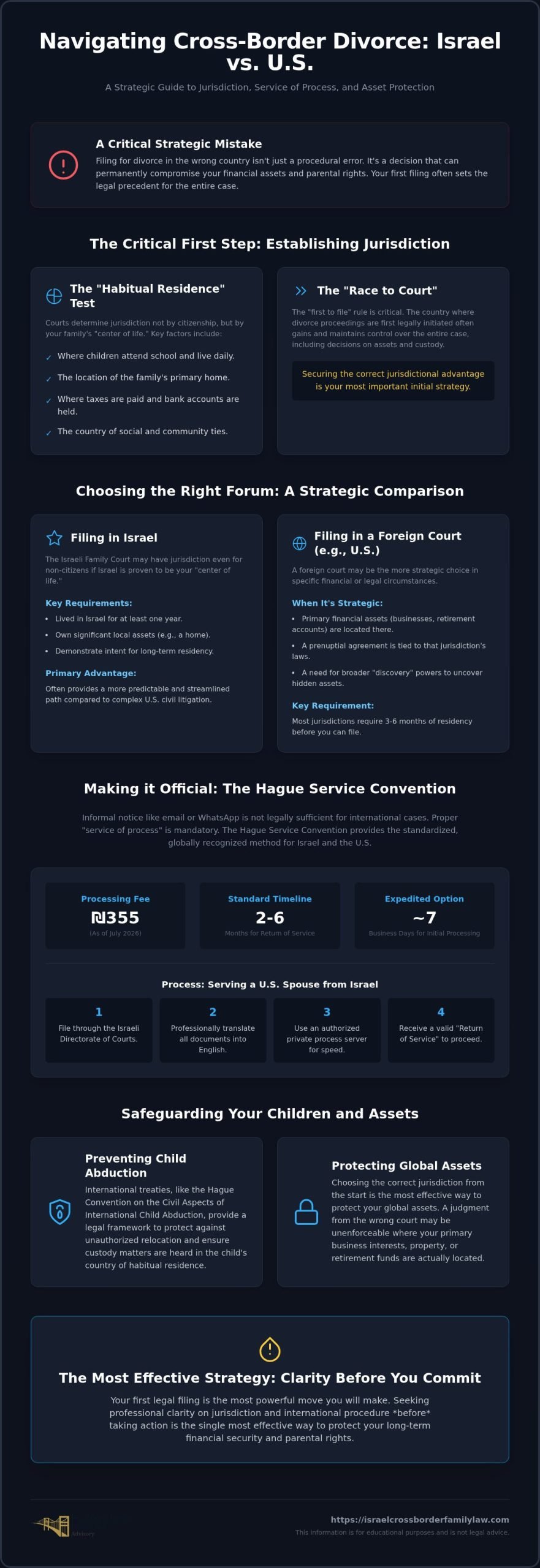
Jurisdiction is essentially the legal permission a court needs to hear your case and issue binding orders. When you’re dealing with a Divorce When One Spouse Lives Abroad, this is the first and most vital hurdle you’ll face. You might find that both countries claim authority simultaneously, leading to a complex Conflict of divorce laws. To resolve this, courts generally apply the “habitual residence” test. This test doesn’t just look at where you hold citizenship; it examines where the family’s daily life actually happens, including where children attend school and where you pay taxes. Since the “first to file” rule often determines which country maintains control over the proceedings, understanding your jurisdictional standing is the most important step in your strategy.
To gain a clearer perspective on how these jurisdictional rules apply to international families, watch this expert explanation:
Filing in Israel as an Expat or Foreign National
The Israeli Family Court can accept your case even if you aren’t an Israeli citizen. The primary requirement is proving that Israel has become your “center of life.” Judges look for concrete evidence of your connection to the country, such as having lived here for at least one year or owning significant local assets like a home in Jerusalem or Tel Aviv. For many expats and foreign nationals, filing in Israel provides a more predictable and streamlined path than the expensive civil litigation often found in the United States. However, you must be prepared to show that your move to Israel was intended to be permanent or at least long-term to satisfy the court’s residency requirements.
When a Foreign Court May Be the Better Forum
There are specific scenarios where a foreign court might be the more strategic choice for your future. This is often the case if your primary financial assets, such as business interests or retirement accounts, are located in that country. Similarly, if you have a prenuptial agreement specifically tied to the laws of a particular foreign jurisdiction, filing there could be advantageous. Some foreign legal systems also offer broader “discovery” powers. This legal process allows your team to uncover financial records and hidden assets that might be harder to access within the Israeli system. Deciding where to file requires a careful look at country-specific residency rules, as many jurisdictions require you to live there for three to six months before you can legally start the process. Choosing the wrong forum can lead to a judgment that isn’t enforceable where your assets actually sit.
Serving Divorce Papers Across Borders: The Legal Challenge
Service of process is the formal notification that triggers a court’s power over a defendant. When managing a Divorce When One Spouse Lives Abroad, many assume a quick email or a WhatsApp message suffices. While Israel’s family courts are increasingly modern, “informal” service rarely meets the strict requirements for international enforcement. If a spouse later claims they weren’t properly served according to the laws of their country of residence, your final decree could be declared void. This waste of time and resources is avoidable by adhering to the Hague Service Convention.
This treaty provides a standardized, globally recognized method for serving legal documents between member nations like Israel and the United States. As of July 2026, formal service requests for individuals under the Convention require a ₪355 processing fee. This fee is paid to the authorized private contractors who manage the transmission of documents. While the system ensures legal validity, it’s not fast. You should expect a timeline of two to six months for the return of service, although expedited options can sometimes reduce the initial processing to seven business days.
Step-by-Step: Serving a Spouse in the United States
When filing in Israel to serve a spouse in the U.S., you must work through the Israeli Directorate of Courts. All legal documents must be professionally translated into English. While you can use the U.S. Central Authority, many practitioners prefer using private process servers authorized under the Convention to speed up the process. Without a valid “Return of Service” filed with the Israeli court, your case cannot proceed to a final judgment. It’s often helpful to seek a professional assessment of your specific service needs to avoid technical delays.
Serving Papers to a Spouse Residing in Israel
If the divorce is filed in a U.S. state like Florida or New York, the papers must reach the spouse in Israel through the Israeli Central Authority. These documents must be translated into Hebrew to be legally binding. If the spouse is intentionally evading service, you may need to request “substituted service” from the court. This allows the judge to recognize service via a relative or even a digital platform, but only after you prove that traditional Hague methods were exhausted. Failure to follow these steps can lead to the U.S. court losing jurisdiction over the Israeli resident, halting the entire process.
The ‘Race to Court’: Israeli Rabbinical vs. US Civil Courts
Israel’s legal landscape features a unique “dual-track” system that often surprises those accustomed to the United States’ purely civil approach. While the Israeli Family Court operates similarly to a US civil court, the Rabbinical Court holds parallel authority over Jewish couples. This creates the Meroz Samchuyot, or “Race to Court.” In this race, the first court to receive a valid filing typically gains the authority to decide related matters like property division and spousal support. When you’re coordinating a Divorce When One Spouse Lives Abroad, the outcome of this race can dictate the financial trajectory of your entire case.
The strategy involves more than just speed; it requires a deep understanding of which system favors your specific goals. If you file in an Israeli Rabbinical court and “bind” (kricha) your financial claims to the divorce petition, you may prevent a US court from later deciding those same issues. Conversely, a spouse living in the US might rush to file in a state court to ensure that liberal discovery rules and equitable distribution laws apply instead of Israeli religious law. This “first to file” advantage is often the deciding factor in multi-jurisdictional disputes.
The Rabbinical Court’s Global Reach
The Israeli Rabbinical Court can claim jurisdiction over Jewish couples even if one spouse lives in the US, provided certain connections to Israel are met. This reach is particularly significant regarding the Get, or religious divorce decree. Under Israeli law, the court can impose severe sanctions on a spouse who refuses to grant or receive a Get, including exit stays from the country or financial penalties. While US courts don’t enforce these religious sanctions directly, they’re increasingly aware of “Get refusal” issues and may consider a spouse’s conduct when determining financial settlements in their own civil proceedings.
Conflicts of Law: When US and Israeli Orders Clash
When two courts in different countries issue conflicting orders, the legal principle of “comity” dictates whether one will respect the other. US courts often respect Israeli rulings if they’re convinced the process was fair and the court had proper jurisdiction. However, if an Israeli Rabbinical court issues a ruling that contradicts fundamental US public policy, a US judge might refuse to recognize it. This is why early tactical decisions are vital For Expats & Foreign Nationals. A decision to file in Israel versus the US can result in vastly different alimony outcomes, as Israeli law handles spousal maintenance differently than the “permanent alimony” models seen in some US states.
Managing Children and Assets in a Transnational Divorce
Managing the division of assets and the welfare of children in a Divorce When One Spouse Lives Abroad introduces layers of complexity that a standard domestic case never encounters. You must address the physical distance while ensuring that any agreement reached is legally enforceable in both the United States and Israel. Courts in both jurisdictions prioritize the “Best Interests of the Child,” but their methods for determining this standard can differ significantly. While 49 U.S. states have adopted the Uniform Child Custody Jurisdiction and Enforcement Act (UCCJEA) as of 2026 to prevent jurisdictional confusion, Israeli courts rely heavily on the “Habitual Residence” of the child to establish authority.
The 1980 Hague Convention on the Civil Aspects of International Child Abduction remains the primary defense against unauthorized relocation. If a spouse moves a child from a city like Miami or Los Angeles to Tel Aviv without a court order or written consent, the Convention mandates a specific legal process to return the child to their home country. Because these cases are time-sensitive and technically demanding, having a strategy that accounts for both legal systems is essential for parental protection. Similarly, dividing real estate requires a nuanced approach, as a U.S. judge cannot directly transfer title to an apartment in Jerusalem, and an Israeli court cannot force the sale of a home in Florida.
International Custody and Relocation
Protecting your parental rights often requires proactive measures before a dispute escalates. In Israel, a common tool is the Nechut Yitzia or “Stay of Exit” order, which prevents a child from leaving the country without both parents’ consent or a specific court-approved bond. When drafting a International Custody & Relocation agreement, you must include detailed provisions for international travel, holiday rotations, and digital communication. A plan that works in a local U.S. setting may fail when applied across an 11-hour time difference, making specificity the only way to avoid future litigation.
Cross-Border Financial Enforcement
Dividing a global portfolio involves more than just splitting bank accounts. Israeli courts must often decide how to treat American retirement vehicles like 401(k)s or IRAs. Because these are governed by U.S. federal law, an Israeli court order may not be sufficient for a U.S. plan administrator to release funds without a domestic Qualified Domestic Relations Order (QDRO). Expert witnesses are frequently used to explain these foreign regulations to the court, ensuring that the final judgment is actually executable. For those seeking Child Support Cross-Border Enforcement, Israel and the U.S. share reciprocal agreements that allow for the collection of support across borders. If you’re struggling to manage assets in multiple jurisdictions, you should request a strategic review of your financial exposure.
Strategic Decision-Making: Clarity Before Commitment
The first legal document filed in a Divorce When One Spouse Lives Abroad often sets a path that is nearly impossible to reverse. Many individuals make the mistake of filing a petition in their local court without considering how that choice affects their rights in another country. Because international jurisdiction is based on complex tests like “Habitual Residence,” an early, poorly timed filing can lead to a court dismissing your case months later. This forces you to start over at a much higher cost. A global strategy ensures that your first move protects your assets and children in both the US and Israel simultaneously.
Litigation cultures vary significantly between these two nations. US proceedings are often defined by exhaustive discovery and high-stakes depositions, which can be both invasive and expensive. In contrast, Israeli family law moves at a faster pace and requires a nuanced understanding of how civil and rabbinical systems interact. Choosing a legal team with dual-system proficiency is not just a luxury; it’s a necessity for anyone with cross-border interests. You need practitioners who understand that a victory in a California court is meaningless if it cannot be enforced against assets in Tel Aviv or Jerusalem.
Risk Assessment in Cross-Border Cases
You must evaluate the risk of “Forum Shopping,” where a spouse might attempt to file in the jurisdiction they believe is most favorable to them. This often happens when one party realizes the other country’s laws on alimony or property division are less generous. Identifying red flags in international service is also vital. If you receive papers that haven’t been served through the Hague Convention channels, it could be a sign that your spouse is trying to bypass legal safeguards. Early awareness of these tactics allows you to counter-file or challenge jurisdiction before the court makes a binding decision.
Getting Started with a Cross-Border Strategy
Before making any commitments, you should compile a “Jurisdictional Dossier.” This collection should include residency dates, travel history, and a list of global assets. Having this information ready allows your advisor to determine which country has the strongest legal claim to your case. Understanding how the advisory works can help you move from a state of confusion to one of strategic clarity. For more detailed insights into specific scenarios, you can explore the resources at the Israel Family Law YouTube channel. Taking these steps ensures that you’re acting on facts rather than fear.
Securing Strategic Advantage in Your International Case
Successfully managing a Divorce When One Spouse Lives Abroad requires more than just local legal knowledge; it demands a comprehensive understanding of how the Israeli and U.S. systems intersect. You’ve seen how the “first to file” rule can dictate your financial future and why adhering to the Hague Service Convention is the only way to ensure your orders are recognized internationally. Whether you’re navigating the Israeli Rabbinical courts or protecting assets in a U.S. civil forum, every decision carries significant weight.
Our advisory platform serves as a specialized bridge for the Anglo community, offering expertise in complex Hague Convention cases and cross-border enforcement. By establishing a clear jurisdictional dossier before you file, you can avoid the most common and expensive mistakes in transnational litigation. This content is published on an independent advisory platform and does not constitute formal legal representation.
Get clarity before you commit. Request a confidential consultation.
Taking the time to build a global strategy today is the most effective way to protect your parental rights and financial stability for years to come.
Frequently Asked Questions
Can I get a divorce in Israel if my spouse lives in the US and refuses to sign?
Yes, you can obtain a divorce in Israel even without your spouse’s consent. If you establish that Israel is your “center of life,” the court can proceed with a contested divorce. Once you complete the formal service of process according to international law, the court has the authority to issue a decree regardless of whether your spouse chooses to participate or sign the documents.
How long does it take to serve divorce papers from Israel to the United States?
The timeline for serving papers through the Hague Service Convention typically ranges from two to six months. While some private contractors can process the initial request within seven business days, the total duration depends on the local sheriff or process server in the U.S. state. As of 2026, a ₪355 processing fee is required for formal service requests involving private individuals.
Will a US court recognize a divorce granted by an Israeli Rabbinical court?
U.S. courts generally recognize Israeli divorces under the principle of comity if the court had proper jurisdiction and the spouse was legally served. However, U.S. judges may scrutinize religious rulings to ensure they don’t violate state public policy. Recognition is most consistent when the divorce decree is accompanied by a civil judgment from the Israeli Family Court covering financial and parental matters.
What happens if my spouse files for divorce in the US after I already filed in Israel?
This creates a jurisdictional conflict often resolved by the “first to file” rule. When you are managing a Divorce When One Spouse Lives Abroad, the court that first assumes jurisdiction usually maintains control over the case. The second court will often stay its proceedings once it receives proof of the prior filing in Israel, provided the Israeli court has a valid claim to the case.
Can I stop my spouse from taking our children to the US during a divorce?
You can apply for a “Stay of Exit” order, known as Nechut Yitzia, from an Israeli court to prevent children from leaving the country. This order is a standard precautionary measure in international cases. It ensures that the children remain in Israel until a final custody agreement is reached or the court grants specific permission for travel with an appropriate financial bond.
How is child support calculated when parents live in different countries?
Courts usually calculate support based on the child’s needs in their country of residence while adjusting for the paying parent’s income and local cost of living. Israel and the U.S. maintain reciprocal agreements for the enforcement of these orders. You may need an expert witness to explain U.S. tax returns or 401(k) structures to the Israeli court to ensure an equitable calculation.
Do I need two separate lawyers for a US-Israel divorce?
If you have significant assets or children in both countries, you will likely need legal representation in both jurisdictions. A cross-border advisor can act as a bridge between your U.S. and Israeli teams to ensure a unified strategy. This coordination prevents a ruling in one country from accidentally compromising your legal or financial standing in the other.
What is the ‘Get’ and why does it matter for US-based Jewish couples?
The ‘Get’ is the religious divorce document required by Jewish law to end a marriage. Even if a couple obtains a civil divorce in the U.S., they aren’t considered divorced religiously without a Get. Israeli Rabbinical courts have the power to sanction a spouse who refuses to provide one, which can include travel bans or financial penalties that carry weight within the Jewish community globally.

Article by
Gabriel Lior
A Personal Journey That Became a Mission
The advisory was founded by an American father Gabriel Lior, LLB, MBA , global entrepreneur, and cross-border advisor who spent more than a decade navigating the Israeli family court system firsthand and now lives in Singapore with his son.
As a divorced parent in a cross-border family, Gabriel faced nearly every legal challenge a foreign parent can encounter in Israel — including child custody disputes, child support proceedings, property matters in Israel and abroad, false accusations, and complex immigration and relocation proceedings.
Over the years, he learned the hard way how difficult it is for non-Israeli parents to understand the system, identify the right legal strategy, and choose the right legal representation — especially when language, culture, and jurisdictional differences are involved. He also witnessed how foreign parents and new immigrants are often disadvantaged or taken advantage of by service providers and institutions simply because they lack local knowledge or fluency.
From Client to Advisor
To truly understand — and survive — the system, Gabriel pursued formal legal education in Israel, completing two Israeli law degrees, alongside a BA and MBA earned in the United States. This was never about becoming a practicing attorney, but about gaining a deep, structural understanding of how the system works — and where it breaks down for foreign parents.
This rare combination of:
Firsthand client experience
Israeli legal and US business education
International business and negotiation training
Decades of commercial execution
created a unique perspective – one that understands both sides of the table.
After years of litigation, persistence, and at times self-representation, he ultimately succeeded in securing custody of his son and relocating abroad through a rare legal victory in the Israeli Supreme Court — becoming one of the first fathers in Israel to do so under these circumstances.
Disclaimer
Important Disclaimer:
The information provided on this website and in its content is for general informational and educational purposes only and does not constitute legal advice, legal opinion, or legal representation.
Gabriel Lior is not licensed to practice law in Israel (nor is he interested in doing so) and does not provide legal services, despite having completed 2 Law Degrees. The services offered are advisory in nature and are intended to provide general guidance, strategic insight, and information regarding cross-border family law considerations.
No attorney-client relationship is formed by accessing this website, reading its content, or communicating with us.
Any decisions made based on this information are at your own discretion and risk. For legal advice specific to your situation, you should consult a licensed attorney in the relevant jurisdiction.
Where appropriate, we may refer clients to independent, licensed attorneys or professionals. Such referrals do not constitute legal representation and no liability is assumed for services provided by third parties.