What if the simple act of filing for divorce in Jerusalem instead of New York could fundamentally change your financial future? When you’re managing assets and family life across borders, the question of Which Country Has Jurisdiction Over Your Divorce? becomes the most consequential decision you’ll make. For many expats and international families in Israel, the complexity of dual legal systems creates an overwhelming sense of urgency. You likely feel the pressure of the “race to court,” fearing that a single procedural misstep might jeopardize your property or parental rights. It’s a valid concern because the intersection of Israeli and international law is intricate and carries significant consequences.
This article, published on an independent advisory platform, provides strategic information rather than formal legal representation. You’ll gain a clear understanding of the legal criteria used to determine the proper venue and how this decision impacts your long-term security. We’ll examine residency requirements, the ₪119 mandatory dispute resolution process in Israel, and a strategic framework for choosing the jurisdiction that best protects your interests. Understanding these risks early is the most effective way to maintain control over your family’s future and ensure your rights are respected in both legal systems.
Key Takeaways
- Understand that jurisdiction is the legal authority that dictates your financial future and parental rights across international borders.
- Learn how to navigate the qualitative “Center of Life” test in Israel versus the fixed residency requirements found in US states like New York or Florida.
- Discover why the “race to court” between Israel’s civil and religious systems makes the timing of your filing a critical strategic decision.
- Evaluate the differences between US equitable distribution and Israeli resource balancing to determine Which Country Has Jurisdiction Over Your Divorce? for your specific assets.
- Gain a framework for making informed decisions before you commit to a legal path or pay the ₪119 mandatory dispute resolution fee.
Defining Jurisdiction in Cross-Border Divorce Cases
Jurisdiction is the fundamental legal authority that allows a court to hear your case and issue binding orders. In cross-border scenarios, this isn’t always a straightforward matter of one country over another. It’s common for multiple nations to claim authority simultaneously, creating a complex Conflict of divorce laws that can dictate the outcome of your filing. When you’re trying to determine Which Country Has Jurisdiction Over Your Divorce?, you must understand that jurisdiction can be fragmented. A court might have “subject matter jurisdiction” to end the marriage but lack “personal jurisdiction” over a spouse who lives abroad, making it impossible to enforce financial orders against them.
This distinction is vital for expats. Personal jurisdiction requires a specific connection, or “nexus,” between the individual and the court’s territory. Without it, a court’s power is limited. You might find yourself in a situation where an Israeli court can grant your divorce decree but cannot legally touch your 401(k) or real estate holdings located in the United States if the other spouse has no ties to Israel.
The Role of Habitual Residence
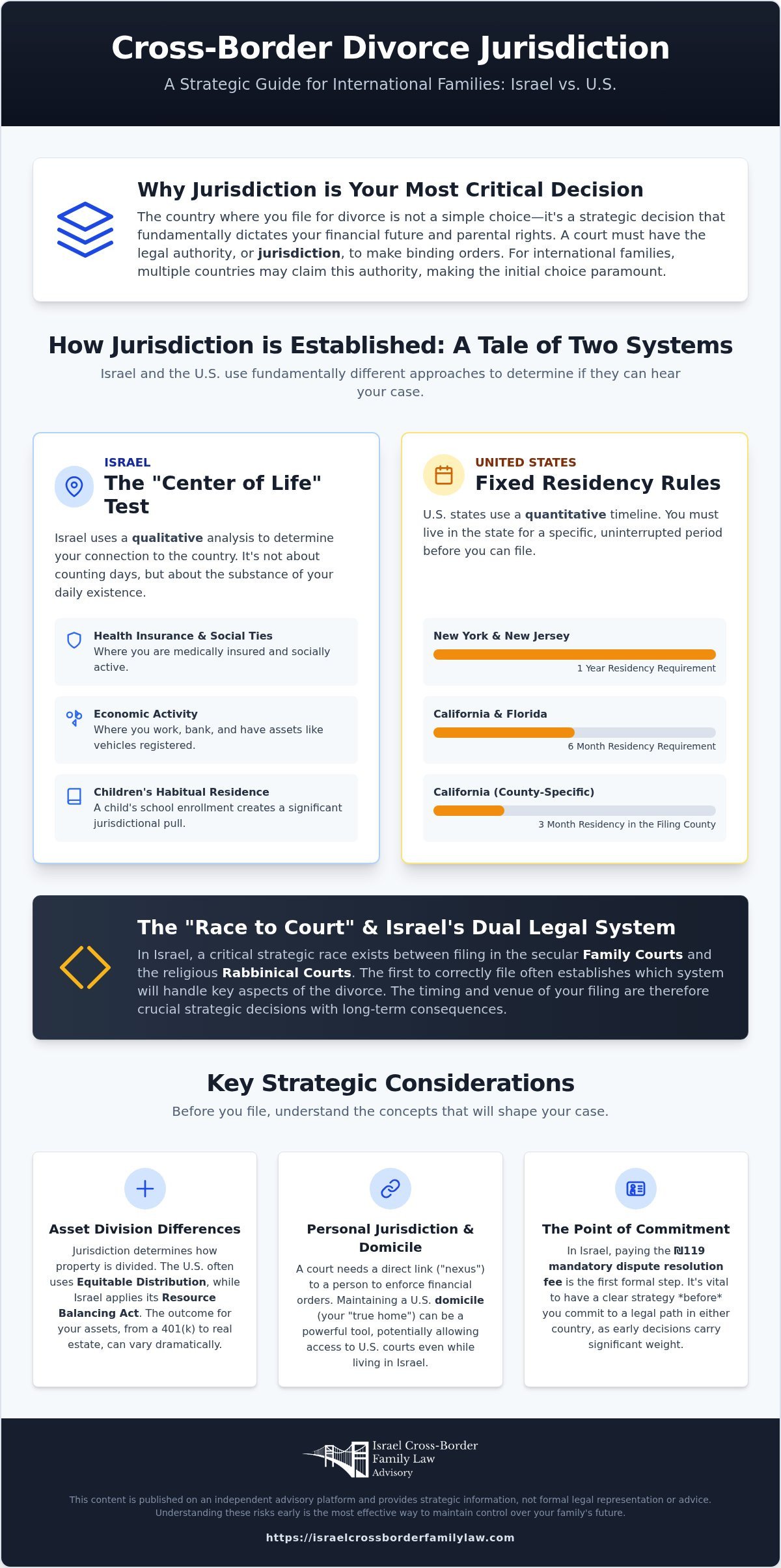
Habitual residence is a cornerstone of international family law, particularly within the framework of the Hague Convention. In Israel, the courts determine this through a “center of life” test. This isn’t just about counting days; it’s a qualitative look at your daily existence. Judges examine where you pay health insurance, where your car is registered, and where your children are enrolled in school. While some US states use a strict 183-day rule or specific residency windows, Israel looks for the heart of your social and economic activity to decide if it has the right to hear your case.
Domicile vs. Nationality
Your domicile is your true, permanent home, the place you intend to return to even if you are currently living elsewhere. For many Anglos in Israel, maintaining a US domicile is a strategic choice. Even if you’ve resided in Ra’anana or Jerusalem for several years, you might still be domiciled in a state like New York or California for legal purposes. This can be a deciding factor in Which Country Has Jurisdiction Over Your Divorce? because it allows you to access US courts for specific financial protections. Dual citizenship further complicates these claims. While the Israeli Family Court provides a venue for all citizens, your foreign nationality can impact how the court views cases for expats and foreign nationals and their unique cross-border obligations.
Criteria for Establishing Jurisdiction: US vs. Israel
The determination of Which Country Has Jurisdiction Over Your Divorce? depends largely on the specific residency laws of the competing regions. In the United States, jurisdiction is typically tied to a quantitative timeline. As of 2026, California requires six months of state residency and three months in the specific county where the filing occurs. Florida also maintains a six-month residency requirement, while hubs like New York and New Jersey generally require a full year. These rigid windows provide a predictable path for those seeking to file in their home state, provided they can prove they meet the statutory minimums.
In contrast, Israel utilizes a qualitative “Center of Life” test. This doctrine focuses on the depth of your connection to the land rather than a simple count of days. While the presence of minor children creates a significant jurisdictional pull toward their habitual residence, the location where your marriage was celebrated is often less important than where it was registered. Israel recognizes civil marriages performed abroad; however, the authority to dissolve them still involves complex interactions between civil and religious systems. Understanding these distinctions is the first step in protecting your rights across borders.
Filing for Divorce in the United States
US courts require “minimum contacts” to establish personal jurisdiction. If you reside in Israel while your spouse files in a state like New York, the court must confirm it has the authority to issue orders that affect you personally. Serving legal papers to a spouse residing in Israel is a primary challenge; it often requires formal procedures under international treaties to ensure the service is recognized. While a US court can issue a divorce decree, its ability to divide Israeli-based assets may be limited, often resulting in an adjustment of US-based assets to compensate for property held abroad.
Filing for Divorce in Israel
Establishing jurisdiction in Israel requires proving your “Center of Life” is within the country. Markers include your Kupat Cholim (health insurance) activity, Israeli employment records, and where your children attend school. Even non-citizens can file in Israeli courts if they meet these qualitative standards. For Jewish couples, the Rabbinical court holds exclusive authority over the “Get” (religious divorce), which can create a jurisdictional overlap with the civil Family Court. Initiating this path typically begins with a ₪119 “Settlement of Dispute” application and a mandatory mediation period. Before you commit to a specific venue, it is wise to evaluate your specific residency status to avoid a conflict of laws.
The ‘Race to Court’ and Israel’s Dual Legal System
In Israel, answering the question of Which Country Has Jurisdiction Over Your Divorce? is only the first step in a multi-layered legal process. Once it’s established that Israel has authority, you enter an internal jurisdictional competition known as the “race to court.” This unique feature of the Israeli system involves a choice between the civil Family Court and the religious Rabbinical Court. The court that receives the first valid filing generally gains the authority to decide related matters like asset division and spousal support. This makes the timing and location of your initial filing one of the most consequential decisions in your case.
Strategic risks are inherent in this dual system. A party might file in one court to gain a perceived advantage, but if the other spouse has already initiated proceedings in a US state, the Israeli court may be forced to pause. This highlights the importance of a coordinated strategy that considers both domestic and international venues before any legal papers are served.
Rabbinical Court vs. Family Court
The Rabbinical Court holds exclusive jurisdiction over the act of divorce itself (the “Get”) for Jewish residents. However, civil matters such as property division, alimony, and custody can be heard in either the Family Court or the Rabbinical Court. To have these issues decided by a religious panel, a spouse must “bind” them to the divorce lawsuit. This triggers a “sincerity test,” where judges evaluate whether the issues were bound in good faith. It’s also vital to account for recent legal shifts; a law approved on November 18, 2025, clarified the Rabbinical court’s jurisdiction to hear child support matters when they are part of a divorce lawsuit. While the Family Court often emphasizes shared parental responsibility, the religious courts may apply different legal nuances to financial obligations.
The International Race: US vs. Israel
When cases are filed in both the US and Israel simultaneously, courts apply the doctrine of lis alibi pendens, which translates to “suit pending elsewhere.” This principle guides a court in deciding whether to stay its own proceedings out of respect for the jurisdiction that was seized first. If a US court issues a final decree, Israeli courts don’t automatically enforce it. They will scrutinize the judgment to ensure it aligns with Israeli public policy and that the party residing abroad was properly served. For those managing international custody or relocation issues, the “race” involves ensuring that the court hearing the case is the one most familiar with the child’s habitual residence and “center of life.”
Strategic Considerations: Where Should You File?
Deciding Which Country Has Jurisdiction Over Your Divorce? requires a side-by-side analysis of how each legal system treats your specific assets and family structure. In the United States, many states follow the principle of “Equitable Distribution,” which allows judges significant discretion to divide property based on what they deem fair. In contrast, Israel operates under the Spousal Property Relations Law, which utilizes a “Resource Balancing” approach. This typically results in a 50/50 split of assets acquired during the marriage; however, a 2026 Israeli Supreme Court decision has made it increasingly difficult to exclude pre-marital inheritances or real estate from the marital pool if they were “mingled” during the relationship.
Spousal support, or alimony, represents another major divergence. US courts in jurisdictions like New York or Florida may award long-term support based on the length of the marriage and the lifestyle maintained. Israeli courts generally view spousal support as a temporary bridge until the divorce is finalized, with less emphasis on lifelong maintenance. Identifying Which Country Has Jurisdiction Over Your Divorce? is not just a procedural step; it is a tactical maneuver. If you are the higher-earning spouse, the choice of venue could result in a difference of hundreds of thousands of shekels over several years.
Financial Outcomes and Asset Division
For families with US-based retirement accounts like 401(k)s or IRAs, the location of the filing is critical. Israeli courts lack the direct authority to issue a Qualified Domestic Relations Order (QDRO) to a US plan administrator. Instead, they may award a larger share of Israeli assets, such as a home in Tel Aviv or Haifa, to the non-account-holding spouse to balance the value. High-net-worth individuals with complex trusts often find US courts more experienced in handling multi-layered corporate structures. If your wealth is primarily tied to US equity markets, filing in the US may provide more robust discovery and enforcement mechanisms than those available in a foreign civil court.
Child-Related Issues and Relocation
The interpretation of “The Best Interests of the Child” has evolved significantly. As of 2026, Israeli courts have moved away from the traditional “Tender Years Doctrine” and now prioritize shared parental responsibility for children of all ages. However, your ability to relocate back to the US with your children is heavily influenced by which court manages the case. Strategic use of international custody laws is essential for parents who envision a future move. Filing in the country where you intend to reside long-term can simplify the enforcement of child support orders and travel permissions. To protect your parental rights, you should request a strategic review of your jurisdictional options before initiating any paperwork.
Securing Clarity Before You File
Entering a legal process without a clear jurisdictional map is a significant risk for international families. Early commitments, such as signing a preliminary mediation agreement or filing a “Settlement of Dispute” application in Israel, can inadvertently lock you into a venue that may not be favorable to your specific needs. Determining Which Country Has Jurisdiction Over Your Divorce? is a strategic baseline that must be established before any formal papers are served. A misstep at this stage can lead to years of litigation in a court that lacks the practical authority to enforce orders on your primary assets or pension funds.
An effective strategy requires a dual-lens perspective. You must respect the residency requirements of your US home state while simultaneously addressing the qualitative “center of life” standards in Israel. This is why working with a cross-border family lawyer is essential. These practitioners act as a bridge between divergent legal cultures, ensuring that your filings are recognized in both countries and that your strategy remains cohesive across the Atlantic.
The Advisory Approach
Moving from an emotional reaction to a strategic decision-making framework is the primary goal of an advisory engagement. By evaluating the specific risks of your residency status, you can gain clarity on the potential financial and parental outcomes in each jurisdiction. Understanding the pricing and process of this international legal strategy allows you to budget for expertise that protects your long-term security. For those in the early stages of research, the Israel Family Law YouTube channel provides essential context on the unique dual-court system and common challenges faced by the Anglo community in Israel.
Next Steps for Expats
Preparation is the most effective way to manage the inherent complexity of a cross-border divorce. Before seeking a professional review, you should begin gathering documentation that clarifies your legal standing in both nations. This includes:
- Original marriage certificates and any valid prenuptial or postnuptial agreements.
- Detailed residency records, such as flight logs, lease agreements, and utility bills, to support “center of life” claims.
- A comprehensive list of assets, including real estate, 401(k) accounts, and business interests located in both Israel and the United States.
A “Confidential Case Review” provides a structured environment to analyze these documents and determine Which Country Has Jurisdiction Over Your Divorce? based on current 2026 regulations and state laws. This process ensures that you are making informed choices rather than reactive ones. Get clarity before you commit. Request a confidential consultation to evaluate your strategic options.
Protecting Your Interests Across Borders
Determining Which Country Has Jurisdiction Over Your Divorce? is the most consequential strategic decision you’ll make in this process. As we have explored, the choice between US equitable distribution and Israeli resource balancing can lead to vastly different financial outcomes for your family. Simultaneously, the internal “race to court” within Israel’s dual legal system adds a layer of urgency that requires immediate, expert attention. Successfully managing these multi-jurisdictional complexities requires more than just standard legal knowledge; it demands a strategic advisory approach that bridges the gap between two distinct legal cultures.
Our platform offers specialized expertise in complex US-Israel litigation with dedicated support for the Anglo-Israeli expat community. By evaluating your “center of life” and asset locations before you file, you can significantly minimize legal risk and protect your long-term parental rights. Get clarity before you commit. Request a confidential consultation to discuss your jurisdictional strategy. Building a secure legal framework now ensures your interests remain protected on both sides of the Atlantic.
Frequently Asked Questions
Can I get a divorce in the US if I currently live in Israel?
You can file in the US while living in Israel if you maintain a legal domicile or meet specific state residency timelines. Determining Which Country Has Jurisdiction Over Your Divorce? often depends on your ability to prove a continued connection to your home state. The primary challenge is the technical process of serving your spouse in Israel according to international treaties, ensuring the US court can issue binding financial orders.
What happens if my spouse files for divorce in Israel before I file in the US?
If a spouse files in Israel first, they likely seize jurisdiction under the “first to file” rule. This triggers the doctrine of lis alibi pendens, where a US court may stay its proceedings to avoid conflicting judgments. Because the Israeli system includes a mandatory 45 to 60 day mediation period, the timing of your response is critical to protect your rights in both legal systems.
Does it matter which country we were married in for jurisdictional purposes?
The location of your wedding ceremony generally does not dictate where you can file for divorce. Courts focus on where the couple is currently living or where they maintain their “center of life.” While you may have married in London or New York, an Israeli court can dissolve the marriage if you are residents. The key is ensuring the marriage was properly registered with the relevant authorities before initiating proceedings.
Is an Israeli divorce decree recognized by US courts?
US courts typically recognize Israeli divorce decrees through the legal principle of comity. This recognition isn’t automatic; the US court will verify that the defendant was properly served and that the Israeli proceedings provided due process. If the decree includes financial orders for US-based assets, additional domestic filings may be necessary to ensure local banks or pension funds comply with the Israeli judgment.
How long do I need to live in Israel before the courts have jurisdiction over my divorce?
Israel does not use a strict day-count rule, but instead applies the qualitative “Center of Life” test. Judges examine your integration into Israeli society, including your employment, health insurance activity, and your children’s schooling. While living in Israel for at least a year is a strong indicator of residency, the court can claim jurisdiction earlier if you clearly intended to make Israel your permanent home.
Can a Rabbinical court in Israel decide on my assets located in the United States?
A Rabbinical court can issue rulings on international property if those assets are “bound” to the divorce lawsuit. While the court cannot directly seize a New York apartment, it can apply “resource balancing” to award the other spouse a larger share of Israeli assets. This ensures the total value of the marital pool is divided 50/50, regardless of where the physical property is located.
What is ‘forum shopping’ and is it legal in international divorce?
Forum shopping is the strategic process of selecting the court system most likely to provide a favorable outcome. It is a standard part of international litigation provided you meet the residency requirements of that venue. Understanding Which Country Has Jurisdiction Over Your Divorce? allows you to compare different systems, such as US equitable distribution versus Israeli resource balancing, to protect your financial interests and parental rights.
How does the Hague Convention affect jurisdiction in cases involving children?
The Hague Convention dictates that custody disputes must be heard in the child’s “habitual residence.” This prevents one parent from unilaterally moving a child to a different country to seek a more favorable custody arrangement. It ensures that the court most familiar with the child’s daily life and welfare has the exclusive authority to make decisions regarding their upbringing and long-term relocation.

Article by
Gabriel Lior
A Personal Journey That Became a Mission
The advisory was founded by an American father Gabriel Lior, LLB, MBA , global entrepreneur, and cross-border advisor who spent more than a decade navigating the Israeli family court system firsthand and now lives in Singapore with his son.
As a divorced parent in a cross-border family, Gabriel faced nearly every legal challenge a foreign parent can encounter in Israel — including child custody disputes, child support proceedings, property matters in Israel and abroad, false accusations, and complex immigration and relocation proceedings.
Over the years, he learned the hard way how difficult it is for non-Israeli parents to understand the system, identify the right legal strategy, and choose the right legal representation — especially when language, culture, and jurisdictional differences are involved. He also witnessed how foreign parents and new immigrants are often disadvantaged or taken advantage of by service providers and institutions simply because they lack local knowledge or fluency.
From Client to Advisor
To truly understand — and survive — the system, Gabriel pursued formal legal education in Israel, completing two Israeli law degrees, alongside a BA and MBA earned in the United States. This was never about becoming a practicing attorney, but about gaining a deep, structural understanding of how the system works — and where it breaks down for foreign parents.
This rare combination of:
Firsthand client experience
Israeli legal and US business education
International business and negotiation training
Decades of commercial execution
created a unique perspective – one that understands both sides of the table.
After years of litigation, persistence, and at times self-representation, he ultimately succeeded in securing custody of his son and relocating abroad through a rare legal victory in the Israeli Supreme Court — becoming one of the first fathers in Israel to do so under these circumstances.
Disclaimer
Important Disclaimer:
The information provided on this website and in its content is for general informational and educational purposes only and does not constitute legal advice, legal opinion, or legal representation.
Gabriel Lior is not licensed to practice law in Israel (nor is he interested in doing so) and does not provide legal services, despite having completed 2 Law Degrees. The services offered are advisory in nature and are intended to provide general guidance, strategic insight, and information regarding cross-border family law considerations.
No attorney-client relationship is formed by accessing this website, reading its content, or communicating with us.
Any decisions made based on this information are at your own discretion and risk. For legal advice specific to your situation, you should consult a licensed attorney in the relevant jurisdiction.
Where appropriate, we may refer clients to independent, licensed attorneys or professionals. Such referrals do not constitute legal representation and no liability is assumed for services provided by third parties.