Winning a relocation case in Israel isn’t about proving the United States is a “better” country; it’s about demonstrating that your child’s stability remains intact despite the 6,000-mile distance. For many parents, the prospect of moving feels like walking a tightrope between a new opportunity and the terrifying risk of a Hague Convention abduction accusation. You’re likely anxious about how to maintain a deep parental bond when time zones and oceans stand in the way, especially when facing a legal system where contested cases often last between 18 and 24 months.
We understand that you want to protect your child’s future while navigating the complex “best interests” standard used by Israeli Family Courts. This article provides the clarity you need by answering the critical question: What Evidence Helps in Relocation Cases? You’ll learn exactly which documents, expert testimonies, and logistical plans create a persuasive argument for the court. We’ll preview the essential evidence you must gather, from virtual visitation schedules to mandatory Mirror Orders, giving you the confidence to present a relocation strategy that the law will respect and enforce.
Key Takeaways
- Understand how the “Best Interests of the Child” standard governs international moves and why Israeli courts demand a higher threshold of proof for cross-border relocation.
- Identify What Evidence Helps in Relocation Cases? by compiling specific documentation regarding employment security, financial stability, and comparative educational opportunities in the destination country.
- Learn to develop a robust Parenting Plan that incorporates legally mandated virtual visitation and enforceable “Mirror Orders” to protect the bond with the left-behind parent.
- Discover the critical role of the *Pekidat Sa’ad* (Social Worker) and how to prepare testimony that demonstrates a “village” of support in your new location.
- Gain insights into proving past parental cooperation to mitigate risks of abduction accusations and demonstrate your commitment to the child’s emotional well-being.
Understanding the Legal Standard for International Relocation
The “Best Interests of the Child,” known in Hebrew as Tobat HaYeled, serves as the supreme guiding principle under the Legal Capacity and Guardianship Law, 1962. In the context of a move between Israel and the US, the court evaluates whether the child’s developmental, emotional, and social needs are better served by the relocation than by remaining in their current environment. International relocation faces significantly higher scrutiny than domestic moves because it fundamentally alters the child’s daily access to one parent. Judges aren’t looking for a “good” reason to move, such as a slightly higher salary; they require a “compelling” reason that demonstrates the move is essential for the child’s long-term stability and well-being.
Establishing “lawful removal” is the first step in avoiding the severe legal repercussions of the Hague Convention on International Child Abduction. Because Israel is a dedicated signatory to this treaty, any unilateral move without formal written consent or a specific court order is legally classified as abduction. When determining What Evidence Helps in Relocation Cases?, the most foundational piece of data is proof that you’ve adhered to the mandatory “Settlement of Dispute” process, which requires an initial fee of ₪119. This demonstrates that the move is a transparent legal request rather than an attempt to bypass the other parent’s rights.
To better understand how these legal standards translate into your litigation strategy, watch this helpful video:
The Israeli Family Court Perspective
Israeli judges place immense weight on the child’s “habitual residence,” whether that’s a neighborhood in Tel Aviv or a suburb of Jerusalem. Since both parents are natural and equal guardians, the court views any move that severs local ties with skepticism. You must provide early documentation of your intent to move to maintain credibility, as contested relocation cases often last between 18 and 24 months. When analyzing What Evidence Helps in Relocation Cases?, courts look for a clear, documented history of your efforts to include the other parent in the decision-making process before the petition was even filed.
US Courts and the Relocation Burden
If the case involves a move to or from the United States, you must account for the wide variation in US state laws regarding the “presumption of relocation.” Some jurisdictions favor the primary custodial parent’s choice, while others require a neutral “net benefit” analysis for the child. It’s vital to prove that the move isn’t intended to frustrate the other parent’s rights or hide the child across borders. Our expertise in international custody and relocation helps parents navigate these conflicting standards. The burden of proof rests entirely on the petitioning parent to demonstrate that the proposed relocation serves the child’s best interests more effectively than the status quo.
Logistical Evidence: Proving the Practicality of the Move
Israeli courts prioritize the continuity of a child’s standard of living and social environment above all else. When clients ask, What Evidence Helps in Relocation Cases?, the answer begins with hard, verifiable data. You must prove that the move is sustainable and that the child’s needs will be met without interruption. Vague intentions to “find work” or “look for a house” are insufficient. The court requires a granular look at the destination’s infrastructure, including housing contracts, neighborhood safety reports, and proximity to essential services. This logistical framework serves as the foundation for the “Best Interests” argument.
Employment and Financial Stability
Judges require absolute certainty regarding your financial future in the United States. You should present signed employment contracts or official offer letters detailing your salary, benefits, and job security. Speculative business ventures or “potential” opportunities carry almost no weight in a contested hearing. Providing tax returns and a detailed cost-of-living comparison helps the court understand your purchasing power in the new location compared to your current life in Israel. Crucially, you must document the financial feasibility of international visitation. This includes budgeting for round-trip flights, which can cost between ₪4,000 and ₪7,500 per person during peak seasons, ensuring the court that the child can maintain their relationship with the parent remaining in Israel.
Educational and Extra-Curricular Continuity
The court meticulously evaluates how the move affects the child’s academic trajectory. A successful petition includes a comparative analysis of the Israeli curriculum versus the specific US state standards. If your child has an Individualized Education Program (IEP) or receives specialized therapeutic support in Israel, you must provide evidence that similar or superior services are accessible in the new school district. This level of detail is essential because the court views any drop in support as a risk to the child’s stability.
According to this Report on Israeli court procedures, the judiciary looks for evidence that the child’s social and religious identity will be preserved across borders. Letters from US schools confirming enrollment availability or correspondence with local community centers provide the necessary proof of continuity. Whether it is a specific sports league, a Hebrew-speaking youth group, or a specialized music program, documenting these details demonstrates that the move enhances the child’s development. Understanding these requirements is complex, so you might consider a confidential strategy session to review your specific documentation.
Relationship Evidence: Maintaining the Bond with the Other Parent
Israeli judges harbor a deep-seated concern regarding “parental alienation” when a child moves thousands of miles away. When determining What Evidence Helps in Relocation Cases?, the court looks for a history of proactive cooperation between parents. You must provide evidence that you have historically supported the child’s bond with the other parent. This includes documenting instances where you facilitated extra visitation time or collaborated on medical and educational decisions. A parent who demonstrates a commitment to the other’s role in the child’s life is viewed with significantly more trust than one who appears to be using the move to sever ties.
The Parenting Plan stands as the most critical piece of evidence in your petition. It serves as a comprehensive roadmap for the child’s emotional and logistical future. It shouldn’t be a vague set of promises; it must be a legally binding framework that addresses the reality of a 10 to 12-hour flight. Courts require proof that you have researched the practicalities of this transition, including airline policies for unaccompanied minors and the financial logistics of international travel. Providing airline quotes and a clear breakdown of travel expenses, which can easily exceed ₪20,000 per year for multiple cross-border trips, shows the court that you’re prepared for the long-term commitment of maintaining these bonds.
The Proposed Visitation Schedule
A successful relocation petition requires a detailed 12-month calendar that visualizes the child’s life across two continents. This schedule must account for Israeli school holidays, US federal holidays, and summer vacation blocks. Our expertise in international custody and relocation highlights that judges favor plans offering fewer, longer visits over frequent, short trips that disrupt the child’s stability. You should include specific flight paths and airline unaccompanied minor age requirements to prove the plan’s feasibility. This level of detail transforms a theoretical move into a manageable reality for the court.
Digital Communication and Virtual Visitation
Bridging the significant time zone gap between Israel and the US requires a disciplined “Digital Parenting Plan.” Your evidence should specify platforms like Zoom or WhatsApp and define the frequency of these interactions. Don’t just propose “calls”; suggest shared activities like virtual homework help, reading bedtime stories, or online gaming. This demonstrates that you intend to maintain the child’s daily emotional connection with the non-relocating parent. Virtual visitation serves as a vital emotional bridge, yet it remains a supplement to physical presence rather than a replacement for it. By documenting these digital strategies, you provide the court with the reassurance that the 6,000-mile distance won’t lead to the erosion of the parental bond.
Social and Cultural Evidence: Demonstrating Support Systems
The Israeli judiciary places significant weight on the concept of the “village” surrounding a child. When a parent proposes moving 6,000 miles away, the court’s primary concern is whether the child will be isolated or integrated into a thriving support network. While previous sections focused on financial and logistical stability, proving social continuity is often the deciding factor in contested hearings. When analyzing What Evidence Helps in Relocation Cases?, judges look for concrete proof that the child will have immediate access to a multi-generational family structure and a community that mirrors their existing social identity.
Language and cultural transitions require specific evidentiary support, particularly for families within the “Anglo” community in Israel. If a child is moving from a Hebrew-speaking environment in Tel Aviv to an English-speaking school in the US, the court needs to see a plan for linguistic maintenance. You should provide evidence of Hebrew-language tutors, Israeli scout chapters (Tzofim), or local synagogues that offer a cultural bridge. This documentation proves that the relocation isn’t a severance of the child’s Israeli heritage but an evolution of their dual identity. Testimony from current teachers or therapists can further validate the child’s resilience and their ability to adapt to these cultural shifts.
Extended Family and Community Ties
The most persuasive evidence for social stability comes from the people who will inhabit the child’s new daily life. You should gather formal affidavits from grandparents, aunts, uncles, or cousins in the target US city. These documents must be specific; they should outline the frequency of intended contact and the tangible support they will provide, such as childcare or holiday gatherings. Evidence of pre-existing community involvement, such as a confirmed membership in a religious congregation or an expat group, demonstrates that a support structure is already waiting. Our services for expats and foreign nationals often focus on coordinating this cross-border testimony to ensure it meets the rigorous standards of Israeli Family Courts.
The Child’s Preference and Voice
As children mature, their own perspective gains significant weight in the eyes of the court. In Israel, the “voice of the child” is typically considered more formally once they reach the age of 10 to 12, though this varies based on individual maturity. The court may appoint a Guardian Ad Litem or an independent child expert to conduct an evaluation. Evidence of the child’s maturity, their academic records, and their personal reasons for supporting the move can be pivotal. You must document that the child’s preference is independent and not the result of parental pressure. If you are navigating these sensitive social dynamics, we recommend a case-specific consultation to discuss how to present this evidence effectively.
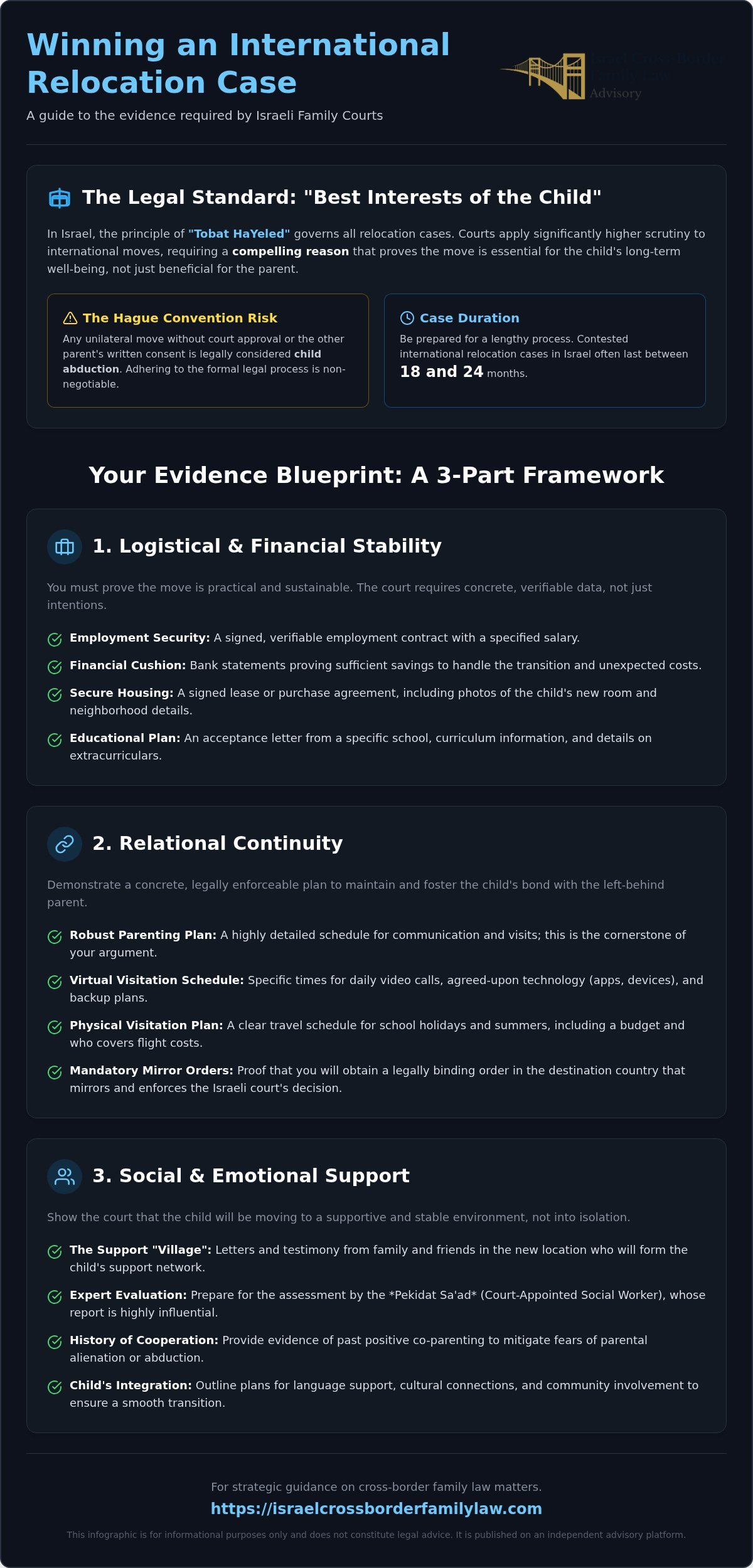
Navigating the Israeli Court Process for Relocation
The Israeli Family Court does not operate in a vacuum. Judges rely heavily on the Pekidat Sa’ad, a court-appointed social worker who serves as the eyes and ears of the judiciary. This official conducts home visits, interviews family members, and eventually submits a comprehensive report that often dictates the court’s trajectory. When considering What Evidence Helps in Relocation Cases? during this phase, you must provide the social worker with a transparent view of your life. This includes proof of your historical involvement in the child’s daily routine and a clear, non-combative explanation for the move. Unilateral actions or attempting to bypass this process can lead to a “Stay of Exit” order, which remains in effect until the child turns 18 unless a judge intervenes.
Court-Appointed Experts and Evaluations
In complex cross-border disputes, the court frequently appoints a psychologist or a family expert to conduct a thorough evaluation of the child’s emotional needs. This process is rigorous and designed to uncover whether the relocation serves the child’s stability or merely the parent’s convenience. You should prepare evidence that highlights your emotional and psychological health, such as references from therapists or long-term family physicians. The expert’s recommendation carries immense weight; judges rarely deviate from these professional assessments unless there is a clear legal error. Demonstrating that you have carefully considered the child’s psychological transition to a new culture is essential for a favorable report.
Timeline and Strategy
Strategic patience is a requirement in the Israeli legal system. While Hague Convention cases are prioritized and typically conclude within six to eight weeks, a contested relocation motion often spans 18 to 24 months in the Family Court. This extended timeline reflects the court’s cautious approach to permanent international moves. You must avoid the temptation of “temporary” moves without formal orders, as these can trigger Hague Convention and child abduction risks that jeopardize your entire case. The expansion of Rabbinical Court authority in late 2025 has added another layer of complexity to child-related financial needs, making the forum in which you first file your case a critical strategic decision.
Final steps: Get clarity before you commit. We invite you to Request a confidential consultation to secure the strategic guidance required for your international transition.
Securing Your Child’s Future Across Borders
Relocating a child between Israel and the United States is a sophisticated legal undertaking that requires a precise evidentiary strategy. Success in these matters isn’t found in generic quality-of-life claims. It’s built through meticulous documentation of financial stability, detailed virtual visitation schedules, and the verified support of a multi-generational “village” in the destination country. Understanding What Evidence Helps in Relocation Cases? is the critical first step in a journey that often spans 18 to 24 months in the Israeli Family Court system.
Our firm serves as a strategic bridge between these two distinct legal systems. We offer specialized support for the Anglo-Israeli expat community and maintain a deep advisory focus on complex Hague Convention matters. Get clarity before you commit. Request a confidential consultation regarding your relocation case.
With the right preparation and authoritative guidance, you can navigate these multijurisdictional challenges and build a stable, prosperous future for your family abroad.
Frequently Asked Questions
How long does a relocation case typically take in Israeli courts?
Contested relocation cases in the Israeli Family Court typically span between 18 and 24 months from the initial filing. This timeline accounts for the mandatory “Settlement of Dispute” process and the thorough evaluations conducted by the court-appointed social worker. While Hague Convention petitions for the return of a child are prioritized and usually conclude within six to eight weeks, permanent relocation motions require an exhaustive analysis of the child’s long-term stability.
Can I move with my child if the other parent doesn’t agree?
You cannot legally relocate a child from Israel without the other parent’s written consent or a specific court order. Under the Legal Capacity and Guardianship Law, 1962, both parents are equal natural guardians. Moving a child unilaterally is considered child abduction under the Hague Convention. This can trigger immediate legal action and the issuance of a “Stay of Exit” order, which prevents the child from leaving Israel until they reach age 18.
What is the most important document to have in a relocation case?
The most critical document is a comprehensive Parenting Plan that outlines how the child will maintain a bond with the non-relocating parent. When determining What Evidence Helps in Relocation Cases?, judges look for a 12-month calendar detailing visitation blocks, virtual communication schedules, and Mirror Orders. This plan must be supported by concrete proof of financial stability, such as signed employment contracts and housing documentation in the destination country, to prove the move’s practicality.
Will the court listen to my child’s preference about moving?
Israeli courts typically consider the child’s preference once they reach the age of 10 to 12, though younger children’s views may be heard depending on their maturity. The court often appoints an independent expert or a Guardian Ad Litem to facilitate this process. While the child’s voice is influential, it is not the sole deciding factor. The “Best Interests of the Child” remains the supreme principle, overriding any specific parental or child preference.
What happens if I move the child without a court order?
Moving a child without a court order or parental consent is legally classified as international child abduction. Israel is a signatory to the Hague Convention, which provides a framework for the prompt return of children to their country of habitual residence. Such actions can lead to criminal charges, the immediate loss of custody rights, and severe prejudice against any future relocation petitions. It’s essential to secure a formal judgment before taking any action.
How much does it cost to fly a child for visitation between Israel and the US?
Round-trip flights between Israel and the United States generally range from ₪4,000 to ₪7,500 per person during peak seasons. When presenting a relocation plan, you must demonstrate the financial capacity to cover these costs for the child and, if necessary, an accompanying adult. The court requires a detailed budget for international visitation to ensure that the 6,000-mile distance does not become a financial barrier to maintaining the parental bond.
Does the “Tender Years Doctrine” still apply in Israeli relocation cases?
The “Tender Years Doctrine,” which presumes children under six should remain with their mother, still carries legal weight in 2026 but is no longer an absolute rule. Israeli courts increasingly focus on gender-neutral evaluations of the child’s bond with each parent. When asking What Evidence Helps in Relocation Cases?, the focus has shifted toward “Parental Responsibility” and the quality of the existing caregiver relationship rather than traditional maternal presumptions.
Can a US court order be enforced in Israel if I relocate?
A US court order is not automatically enforceable in Israel without a formal recognition process through the Israeli legal system. To ensure cross-border compliance, parents often obtain “Mirror Orders” in both jurisdictions. This creates a synchronized legal framework that protects visitation rights and custody arrangements in both the US and Israel. This dual-jurisdiction approach is a standard requirement for ensuring the long-term enforceability of a relocation agreement.

Article by
Gabriel Lior
A Personal Journey That Became a Mission
The advisory was founded by an American father Gabriel Lior, LLB, MBA , global entrepreneur, and cross-border advisor who spent more than a decade navigating the Israeli family court system firsthand and now lives in Singapore with his son.
As a divorced parent in a cross-border family, Gabriel faced nearly every legal challenge a foreign parent can encounter in Israel — including child custody disputes, child support proceedings, property matters in Israel and abroad, false accusations, and complex immigration and relocation proceedings.
Over the years, he learned the hard way how difficult it is for non-Israeli parents to understand the system, identify the right legal strategy, and choose the right legal representation — especially when language, culture, and jurisdictional differences are involved. He also witnessed how foreign parents and new immigrants are often disadvantaged or taken advantage of by service providers and institutions simply because they lack local knowledge or fluency.
From Client to Advisor
To truly understand — and survive — the system, Gabriel pursued formal legal education in Israel, completing two Israeli law degrees, alongside a BA and MBA earned in the United States. This was never about becoming a practicing attorney, but about gaining a deep, structural understanding of how the system works — and where it breaks down for foreign parents.
This rare combination of:
Firsthand client experience
Israeli legal and US business education
International business and negotiation training
Decades of commercial execution
created a unique perspective – one that understands both sides of the table.
After years of litigation, persistence, and at times self-representation, he ultimately succeeded in securing custody of his son and relocating abroad through a rare legal victory in the Israeli Supreme Court — becoming one of the first fathers in Israel to do so under these circumstances.
Disclaimer
Important Disclaimer:
The information provided on this website and in its content is for general informational and educational purposes only and does not constitute legal advice, legal opinion, or legal representation.
Gabriel Lior is not licensed to practice law in Israel (nor is he interested in doing so) and does not provide legal services, despite having completed 2 Law Degrees. The services offered are advisory in nature and are intended to provide general guidance, strategic insight, and information regarding cross-border family law considerations.
No attorney-client relationship is formed by accessing this website, reading its content, or communicating with us.
Any decisions made based on this information are at your own discretion and risk. For legal advice specific to your situation, you should consult a licensed attorney in the relevant jurisdiction.
Where appropriate, we may refer clients to independent, licensed attorneys or professionals. Such referrals do not constitute legal representation and no liability is assumed for services provided by third parties.