Did you know that a Hague Convention trial isn’t actually about who is the better parent? Many families arriving in an Israeli courtroom, whether in Tel Aviv, Jerusalem, or Haifa, are shocked to find that the judge often refuses to hear testimony about school grades or bedtime routines. If you’re asking yourself, “What Happens During a Hague Convention Trial?” the answer is rooted more in geography than in parenting skills. These proceedings focus strictly on whether a child was wrongfully removed or retained and which country holds the legal jurisdiction to decide their future.
It’s completely normal to feel a sense of dread when facing the Israeli family court system, especially if you’re an expat or Anglo unfamiliar with local procedures in places like central Israel or the surrounding regions. You want to protect your child’s stability, but the fear of a sudden, life-altering ruling can be paralyzing. Here at Israel Cross Border Law Firm, we understand these concerns. This article clarifies the procedural steps, specific evidentiary requirements, and what you’ll experience inside the courtroom. We’ll walk through the typical trial timeline in Israel, explain the valid legal defenses available to you, and provide the strategy needed for emotional and legal preparation. By understanding the rules of this unique legal framework, you can move forward with clarity instead of confusion.
Key Takeaways
- Understand that these trials focus on the child’s “habitual residence” and the legality of their removal rather than determining which parent is better.
- Learn about the accelerated procedural timeline in Israeli Family Courts, where cases are fast-tracked and discovery is often limited compared to standard litigation.
- Identify specific legal defenses, such as the “grave risk” exception, that are recognized under international law and applied within the Israeli legal framework.
- Gain a clear perspective on what happens during a Hague Convention trial, including the private nature of the hearing and the judge’s active role in questioning.
- Discover the strategic steps to take following a ruling, including the process for lodging an appeal in the District or Supreme Court of Israel.
Understanding the Scope: Why a Hague Trial is Not a Custody Case
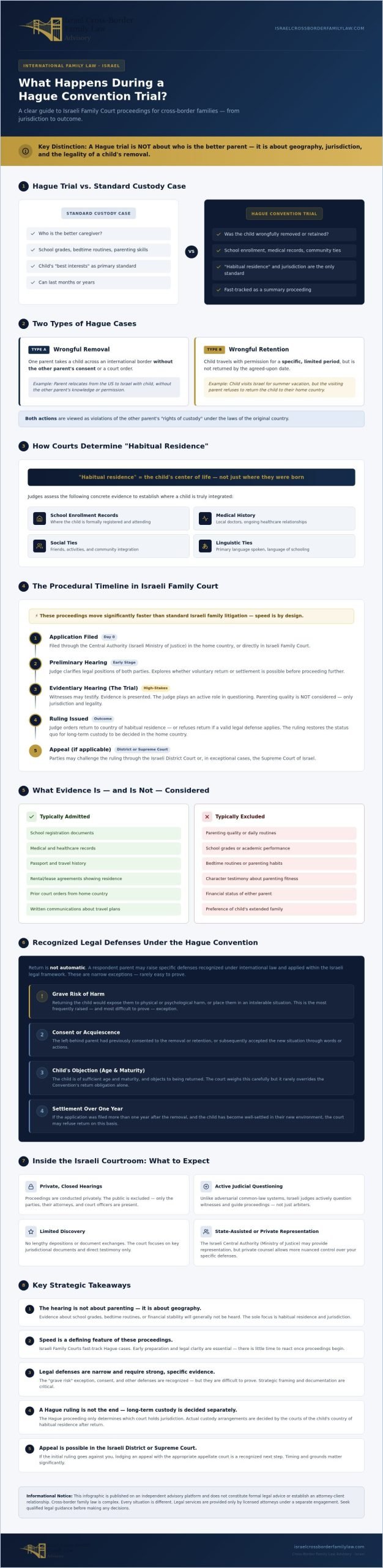
The most critical distinction for any parent involved in a cross-border dispute is that a Hague Convention hearing is not a custody trial. While a standard family law case in Israel might examine which parent provides a more stable home or a better education, these factors are largely irrelevant in a Hague proceeding. The court’s focus is intentionally narrow: it seeks to determine if a child was “wrongfully” moved across international borders and whether they should be returned to their country of habitual residence. Understanding what happens during a Hague Convention trial requires shifting your perspective from parenting quality to jurisdictional legality.
In the Israeli legal system, Hague cases are treated as summary proceedings. This means they move with significant speed compared to standard litigation, which can often drag on for years. The objective is to restore the status quo as quickly as possible so that the proper court in the home country can then decide the long-term custody arrangements. Because of this, the judge will often actively prevent parties from introducing evidence about “best interests” or parenting skills, focusing instead on the specific legal pillars of the Convention.
The Concept of Habitual Residence
To decide if a child must be returned, the court must first identify where they actually lived before the dispute began. Judges look at the child’s “center of life” to determine their habitual residence. This isn’t just about where the child was born; it’s about where they were integrated into a community. The court evaluates concrete evidence such as school enrollment records, medical history with local doctors, and the child’s social and linguistic ties to a specific country. A child’s habitual residence is defined as their center of life.
Wrongful Removal vs. Wrongful Retention
A Hague case typically falls into one of two categories. Wrongful removal occurs when one parent takes a child across an international border without the other parent’s consent or a court order. Wrongful retention, which is increasingly common, happens when a child travels with permission for a specific period, such as a summer vacation in Israel, but is not returned by the agreed-upon date. Both actions are viewed as violations of the other parent’s “rights of custody” under the laws of the original country. If you are facing these complexities, it’s vital to seek strategic guidance on Hague Convention child abduction cases early in the process to protect your parental rights.
The Procedural Timeline: From Filing to the Final Hearing
The speed of a Hague case often catches parents off guard. Unlike standard divorce proceedings that might linger for months, a Hague application triggers an accelerated legal engine. The process begins when a parent files an application, either through the Central Authority in their home country or directly in the Israeli Family Court. Because these are summary proceedings, What Happens During a Hague Convention Trial? is characterized by a lack of extensive discovery. You won’t see months of depositions or endless document exchanges. Instead, the court moves quickly to identify the core jurisdictional conflict.
The first major milestone is the preliminary hearing. During this session, the judge clarifies the legal positions of both parties and determines if a settlement or voluntary return is possible. If the case proceeds, it moves to an evidentiary hearing. This is the actual trial where witnesses may testify and evidence is presented. It’s a high-pressure environment where every decision carries significant weight. If you’re feeling uncertain about these upcoming milestones, you can request a confidential consultation to discuss your specific situation.
The Role of the Israeli Central Authority
In Israel, the Central Authority is a specialized department within the Ministry of Justice. They act as the primary liaison between Israel and foreign governments to facilitate the return of children. While the state can provide legal representation in certain cases, there is a distinct difference between state-led litigation and a private legal strategy. A private approach often allows for more nuanced control over the specific evidence and defenses presented to the judge. You can learn more about how these different paths converge by reviewing how it works within the Israeli legal system.
The 6-Week Target
The Hague Convention explicitly mandates that courts reach a decision within six weeks of the initial filing. This ambitious target exists to minimize the time a child spends in legal limbo. In the Israeli court system, achieving this deadline is often challenging due to heavy caseloads and the requirement for certified Hebrew translations of foreign documents. While the “fast-track” is the legal goal, cases frequently take slightly longer in practice. Managing your expectations around this timeline is essential for maintaining both emotional and strategic stability throughout the process.
Key Evidence and Legal Defenses in Israeli Family Court
While the Hague Convention operates on the presumption that a child should be returned to their habitual residence, the treaty provides specific, narrow exceptions. These are not open-ended “best interest” arguments; they are high-threshold legal defenses that require rigorous proof. Understanding what happens during a Hague Convention trial involves recognizing that the burden of proof shifts to the parent opposing the return. In Israeli courts, the most common defenses include consent, acquiescence, and the “settled” defense, which applies if the case was filed more than one year after the removal occurred.
Consent and acquiescence focus on the left-behind parent’s actions. If you can prove that the other parent agreed to the move before it happened, or later accepted the child’s new life in Israel through emails, texts, or financial arrangements, the court may deny the return order. However, these defenses are fact-sensitive. Israeli judges scrutinize the timeline of these communications closely to determine if the consent was clear and unequivocal. Every piece of digital evidence can become a cornerstone of your strategy in these high-stakes proceedings.
Proving Grave Risk of Harm (Article 13b)
The “Grave Risk” defense is perhaps the most misunderstood. To succeed, you must demonstrate that returning the child would expose them to physical or psychological harm or otherwise place them in an intolerable situation. Israeli courts set an exceptionally high bar for this. General claims of “bad parenting” or a lower standard of living in the home country don’t meet the threshold. Instead, the court requires objective evidence of severe domestic violence, war, or a total lack of protection in the requesting state. Judges often appoint expert psychologists to conduct evaluations to determine if the risk is truly “grave” or if it’s a standard custody dispute in disguise.
The Voice of the Child
Israeli law places significant weight on the child’s own perspective, provided they have reached an appropriate age and degree of maturity. There isn’t a fixed age, but courts generally begin to listen more closely to children aged 10 to 12 and older. Rather than having the child testify in open court, which is rare and discouraged, the judge typically appoints a specialized social worker known as a Pekidat Saad. This professional interviews the child in a neutral setting and reports back to the court. If a child strongly objects to being returned, and that objection isn’t the result of parental alienation, it can be a decisive factor in Hague Convention child abduction cases. This process ensures the child’s voice is heard without subjecting them to the trauma of a full courtroom confrontation.
The Courtroom Experience: What to Expect During Testimony
Israeli Family Courts operate under a strict principle of privacy. Unlike the public galleries often seen in other jurisdictions, these hearings are closed-door sessions. This can make the environment feel intense and personal, as only the parties, their legal representatives, and court-authorized professionals are present. When considering What Happens During a Hague Convention Trial?, you should expect a setting where the focus remains tightly on the legal merits of the application rather than public spectacle.
The role of the judge in Israel is notably active. While you might be used to a judge acting as a passive referee, Israeli judges often lead the questioning. They may interrupt testimony to seek clarification or pivot the discussion back to the specific legal pillars of the Hague Convention. This inquisitorial style is designed to get to the facts quickly, but it requires you to be exceptionally well-prepared for direct interaction with the bench. If you are feeling overwhelmed by these procedural hurdles, you can reach out for a strategy session to help navigate the courtroom environment.
Language can also be a significant factor in your experience. Even though you may be fluent in English, the official language of the court is Hebrew. Professional translators are usually present to bridge this gap. This adds a layer of complexity, as nuances can sometimes be lost in translation. It’s vital to speak clearly and in short sentences to ensure the record accurately reflects your testimony. Preparing for this rhythmic delay is a key part of your courtroom strategy.
Preparing Your Testimony
When you take the stand, your testimony should remain laser-focused on the facts of the move and the child’s “center of life.” The court has little interest in the emotional failures of the marriage unless they directly relate to a “grave risk” defense. Staying calm is paramount. A neutral, factual tone often carries more weight with a judge than an emotional plea. For a better visual understanding of the process, you can refer to the Israel Family Law YouTube channel, which offers guidance on navigating these specific legal hurdles.
The Final Argument
After the witnesses have been heard, the legal teams present their final arguments. This is where they synthesize the evidence to prove or disprove habitual residence and the validity of any defenses. The judge rarely issues a decision immediately from the bench. Instead, they will typically take the matter under advisement and issue a written ruling within a few days or weeks. Once the gavel falls, the order becomes legally binding, often with immediate instructions for the child’s return or continued stay in Israel. Understanding this finality helps you prepare for the logistical steps that follow the ruling.
Strategic Clarity: Managing the Outcome and Next Steps
The conclusion of a hearing marks a pivotal moment for any international family. Understanding What Happens During a Hague Convention Trial? includes recognizing that the court’s decision is rarely the end of the legal journey. If the judge grants the return, the child must typically be transported back to their habitual residence within a very narrow window. Conversely, if the return is denied, the child remains in Israel, and the focus often shifts to local custody proceedings. Regardless of the outcome, the immediate period following the ruling requires precise coordination and a clear understanding of your next legal steps.
In Israel, the losing party has a right to appeal. This process starts at the District Court and, in rare instances involving significant legal questions, can reach the Supreme Court of Israel. It’s important to realize that an appeal doesn’t always stay the return order. You may need to file a specific request to delay the child’s departure while the higher court reviews the case. This layer of complexity is why many families seek strategic guidance well before the initial verdict is delivered. Managing these transitions requires a calm, methodical approach to ensure the child’s stability isn’t compromised by the shifting legal landscape.
If the Return is Ordered
When a return order is issued, the court will specify the logistical details. This includes determining which parent bears the travel costs, who will accompany the child on the flight, and where the child will reside upon arrival. A critical component of this transition is the implementation of “safe harbor” orders. These are protective measures designed to ensure the child’s safety and financial support in the destination country until the local courts there can take over the case. Navigating these international custody and relocation issues requires a synchronized approach between legal systems to avoid further disruption to the child’s life.
Seeking a Confidential Case Review
Early intervention is the most decisive factor in cross-border disputes. The strategy you set before the first document is filed often determines the eventual outcome. There’s a significant difference between formal legal representation and the strategic advisory needed to navigate the risks of multi-jurisdictional litigation. This platform provides that high-level strategy to help you make informed decisions before you commit to a specific course of action. It’s about gaining clarity in a system that can often feel overwhelming and foreign.
Disclaimer: This content is published on an independent advisory platform and is not a law firm. Legal services are only provided by licensed attorneys under a separate engagement.
Get clarity before you commit. Request a confidential consultation.
Navigating Your Cross-Border Legal Journey
Facing a multi-jurisdictional legal dispute in an Israeli courtroom can feel overwhelming, especially when the stakes involve your child’s future. As we’ve explored, the Hague Convention operates on a specific, fast-tracked logic that prioritizes jurisdictional rules over standard custody arguments. By focusing on the core issues of habitual residence and valid legal defenses, you can better manage the intense procedural demands of the Israeli Family Court.
Gaining a clear perspective on What Happens During a Hague Convention Trial? is essential for any expat or international family seeking to protect their rights. Our advisory approach provides the strategic clarity necessary to navigate the complexities of US-Israel cross-border disputes with confidence. We offer dedicated resources tailored specifically for English-speaking families who require a steady, knowledgeable guide through these challenging legal landscapes.
Early decision-making and a well-defined strategy are your most powerful tools in these high-speed cases. Get clarity before you commit. Request a confidential consultation today to discuss your situation in a secure, professional environment. You can find the path forward when you have the right expertise by your side.
Frequently Asked Questions
How long does a Hague Convention trial usually last in Israel?
A Hague Convention trial in Israel typically aims for completion within six weeks, as mandated by the international treaty. However, the reality of the Israeli court schedule often extends this timeline. Factors such as the need for certified Hebrew translations of foreign documents and the availability of court-appointed social workers can cause delays. You should prepare for a process that moves much faster than standard litigation but may take several months to reach a final ruling.
Can my child testify in a Hague Convention hearing?
Children rarely testify directly in an Israeli courtroom to avoid unnecessary trauma. Instead, the judge usually appoints a specialized social worker, known as a Pekidat Saad, to interview the child in a neutral setting. This professional then submits a report to the court detailing the child’s views and maturity level. The judge uses this report to understand the child’s perspective without subjecting them to the pressure of a formal cross-examination.
What is the difference between a Hague trial and a custody trial?
The primary difference lies in the legal objective of the proceeding. A Hague trial determines which country has the jurisdiction to decide custody, while a custody trial decides which parent should have the child. When asking What Happens During a Hague Convention Trial?, remember that the court focuses on “habitual residence” rather than “best interests.” Judges will actively block evidence regarding parenting skills because those issues belong in the home country’s courts.
Do I have to be physically present in Israel for the trial?
While physical presence is strongly encouraged and often expected for your own testimony, Israeli courts have become more flexible with technology. In certain circumstances, you may request to testify via video link from abroad. However, being physically present allows for better communication with your legal team and demonstrates your commitment to the case. The court makes these decisions on a case-by-case basis depending on travel restrictions or personal hardships.
What happens if I lose my Hague Convention case?
If you lose a Hague case, the court will issue a “Return Order” requiring the child to be sent back to their country of habitual residence. This order usually includes specific logistical instructions regarding travel dates and which parent will accompany the child. It’s a legally binding decision that often carries immediate consequences. If you are on the receiving end of such an order, you must act quickly to coordinate the return or file an appeal.
Can I stop a Hague return order with an appeal?
An appeal does not automatically stop a return order from being carried out. To pause the process, you must file a specific request for a “stay of execution” with the District Court or the Supreme Court of Israel. If the stay is granted, the child remains in Israel until the appeal is heard. Without this legal pause, the child may be required to leave the country even while the higher court is still reviewing your case.
Is a Hague trial expensive?
Hague litigation is inherently costly due to the specialized nature of international law and the speed of the proceedings. You will likely face expenses for expert legal strategy, certified translations of foreign evidence, and potential travel costs. While specific fees vary, the complexity of cross-border issues requires a significant financial commitment. Understanding What Happens During a Hague Convention Trial? helps you budget for these necessary resources, including court-appointed professionals and international communication.
What are the most common defenses in a Hague trial?
The most common defenses include the “Grave Risk” of harm and the “Child’s Objection.” To succeed with a grave risk defense, you must prove that returning the child would expose them to an intolerable situation. Other defenses include showing that the other parent consented to the move or that the child is now “settled” in Israel after a delay in filing. Each defense has a high evidentiary bar that requires clear, objective proof.

Article by
Gabriel Lior
A Personal Journey That Became a Mission
The advisory was founded by an American father Gabriel Lior, LLB, MBA , global entrepreneur, and cross-border advisor who spent more than a decade navigating the Israeli family court system firsthand and now lives in Singapore with his son.
As a divorced parent in a cross-border family, Gabriel faced nearly every legal challenge a foreign parent can encounter in Israel — including child custody disputes, child support proceedings, property matters in Israel and abroad, false accusations, and complex immigration and relocation proceedings.
Over the years, he learned the hard way how difficult it is for non-Israeli parents to understand the system, identify the right legal strategy, and choose the right legal representation — especially when language, culture, and jurisdictional differences are involved. He also witnessed how foreign parents and new immigrants are often disadvantaged or taken advantage of by service providers and institutions simply because they lack local knowledge or fluency.
From Client to Advisor
To truly understand — and survive — the system, Gabriel pursued formal legal education in Israel, completing two Israeli law degrees, alongside a BA and MBA earned in the United States. This was never about becoming a practicing attorney, but about gaining a deep, structural understanding of how the system works — and where it breaks down for foreign parents.
This rare combination of:
Firsthand client experience
Israeli legal and US business education
International business and negotiation training
Decades of commercial execution
created a unique perspective – one that understands both sides of the table.
After years of litigation, persistence, and at times self-representation, he ultimately succeeded in securing custody of his son and relocating abroad through a rare legal victory in the Israeli Supreme Court — becoming one of the first fathers in Israel to do so under these circumstances.
Disclaimer
Important Disclaimer:
The information provided on this website and in its content is for general informational and educational purposes only and does not constitute legal advice, legal opinion, or legal representation.
Gabriel Lior is not licensed to practice law in Israel (nor is he interested in doing so) and does not provide legal services, despite having completed 2 Law Degrees. The services offered are advisory in nature and are intended to provide general guidance, strategic insight, and information regarding cross-border family law considerations.
No attorney-client relationship is formed by accessing this website, reading its content, or communicating with us.
Any decisions made based on this information are at your own discretion and risk. For legal advice specific to your situation, you should consult a licensed attorney in the relevant jurisdiction.
Where appropriate, we may refer clients to independent, licensed attorneys or professionals. Such referrals do not constitute legal representation and no liability is assumed for services provided by third parties.