In the Israeli legal system, your window to protect an inheritance can vanish in exactly 14 days. You likely feel the weight of this urgency while grappling with Hebrew documents and a court system thousands of miles away. Contesting a will in israel from abroad involves more than just a disagreement over assets; it requires a precise understanding of the Succession Law and the procedural nuances of the Registrar of Inheritance.
It’s natural to feel uncertain when you can’t physically attend a hearing or verify the authenticity of a signature from another continent. This guide provides the clarity you need by detailing the specific legal grounds for challenges and the logistical roadmap for managing litigation remotely. We’ll examine the mandatory fees, the 2026 digital filing requirements, and the strategic risks involved in these multi-jurisdictional disputes.
This content is published on an independent advisory platform and is intended for informational purposes only; it doesn’t constitute formal legal advice or an attorney-client relationship. Legal services are only provided by licensed attorneys under a separate engagement. Our goal is to help you understand the framework of the Israeli system so you can make informed decisions about your family’s future.
Key Takeaways
- Recognize why the 14-day statutory window is the most critical factor when contesting a will in israel from abroad and how to pause the probate process.
- Identify the primary legal grounds for an objection, such as proving the deceased was not of sound mind or was under unfair pressure from a beneficiary.
- Learn the logistics of remote litigation, including how to sign an Israeli Power of Attorney from your home country and how to testify via video link.
- Evaluate the strategic risks and costs of cross-border litigation to ensure your pursuit of justice is a sound financial decision.
- Understand that this guide is published on an independent advisory platform for informational purposes and does not constitute formal legal advice or an attorney-client relationship.
Understanding the Right to Object to an Israeli Probate Order
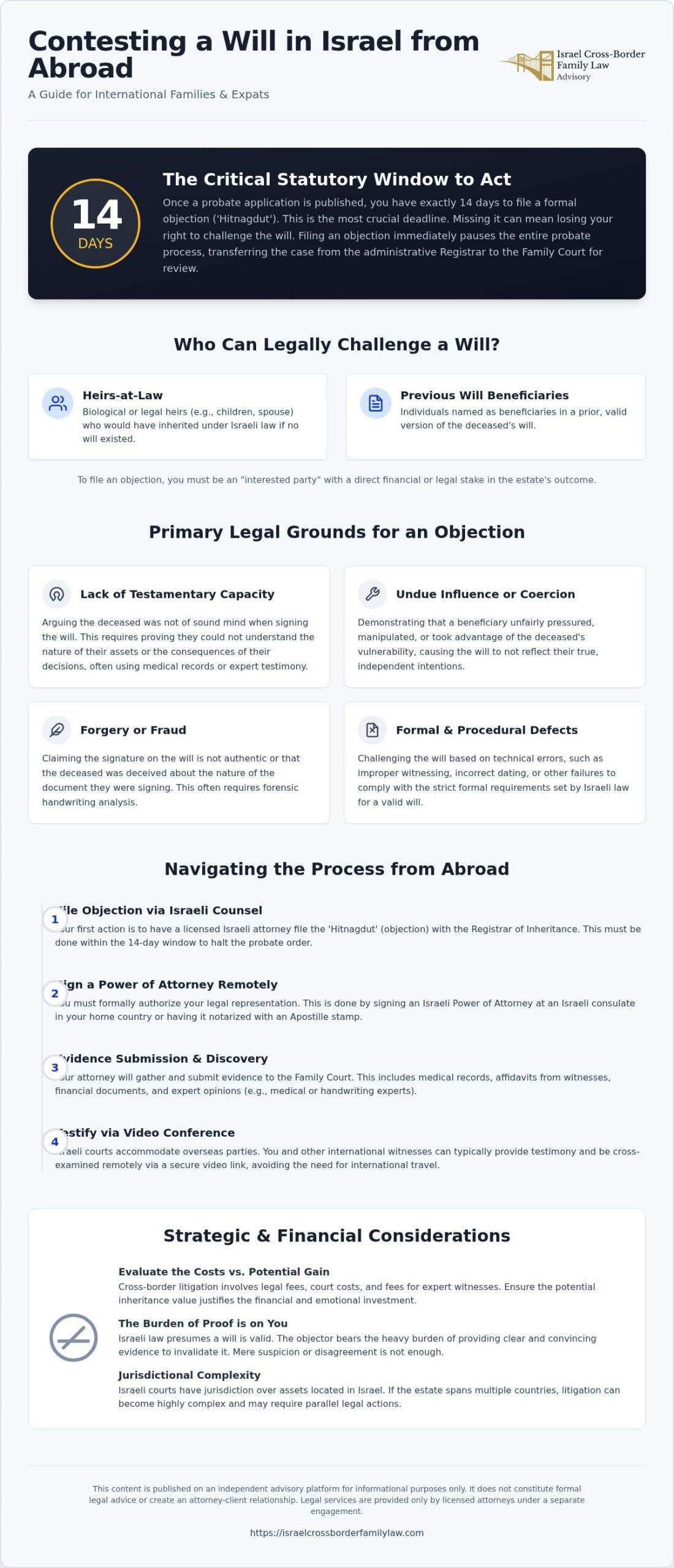
Challenging a legal document from thousands of miles away requires a clear understanding of the Israeli procedural landscape. In Israel, the formal process of challenging a will is known as filing an “Objection to a Succession Order,” or Hitnagdut. This isn’t just a grievance; it’s a structured legal filing that halts the probate process until a judge can review the merits of your claim. It’s vital to distinguish between the two: contesting the will refers to the legal arguments against the document itself, while the objection is the procedural tool used to stop the Registrar from issuing a formal probate order.
The Registrar of Inheritance Affairs, or Rasham HaYerusha, serves as the primary gateway for all estate matters. When an application for a probate order is submitted, the Registrar publishes a public notice in daily newspapers and the official gazette. This notice triggers a critical window for anyone contesting a will in israel from abroad to step forward. Living overseas doesn’t diminish your legal standing, but it does mean you must navigate a system that operates in Hebrew and follows strict local timelines. The Registrar’s role is administrative; if a valid objection is filed, the case is typically transferred to the Family Court for a judicial ruling.
To better understand this concept, watch this helpful video:
The Legal Framework: The Inheritance Law of 1965
The foundation of all estate matters in the country is the Inheritance Law of 1965. This legislation prioritizes the principle of “testamentary freedom,” which means the law aims to protect the actual intentions of the deceased person. Understanding Inheritance Law on a global scale helps clarify that while many principles are universal, Israeli courts maintain exclusive jurisdiction over any assets physically located within IL. Whether the deceased was a citizen or a foreign resident, the distribution of their Israeli apartments, bank accounts, or business interests must follow Israeli procedural law. The court’s primary duty is to ensure the will being probated is the “true will,” free from defects or outside interference.
Who Has Standing to Contest a Will from Abroad?
Not everyone has the legal right to interfere in a probate application. To file an objection, you must qualify as an “interested party,” or Tzad Meunyan. This category typically includes biological heirs who would have inherited by law if no will existed, or beneficiaries named in a previous version of the will. Understanding your status is vital because the court will dismiss objections from those without a direct financial or legal stake in the estate. For many, the process feels overwhelming due to the distance and language barriers. You can find more specific information for expats and foreign nationals to see how these definitions apply to those living outside the country.
This content is published on an independent advisory platform and is intended for informational purposes only. It doesn’t constitute formal legal advice or an attorney-client relationship. Legal services are only provided by licensed attorneys under a separate engagement.
Legal Grounds for Challenging a Will Under Israeli Law
When you’re contesting a will in israel from abroad, the court requires evidence that the document doesn’t reflect the deceased’s genuine wishes. Israeli law identifies several specific Grounds for Challenging a Will, ranging from medical incapacity to procedural errors. One of the most common grounds is the lack of testamentary capacity. This means the testator wasn’t of sound mind or didn’t understand the consequences of the document they were signing. Proving this usually involves analyzing medical records or expert testimony from the time the will was executed.
Procedural integrity is also a major factor. If a will has formal defects, such as missing signatures or witnesses who don’t meet legal requirements, it may be declared invalid. Additionally, Section 35 of the Israeli Succession Law creates a strict prohibition against beneficiaries participating in the drafting of the will. If a person who stands to inherit was involved in writing the document or served as a witness, the gift to that person is typically voided. This rule is designed to prevent conflicts of interest and ensure the testator acted independently.
Undue Influence (Hashpa’a Bliti Hogenet)
Undue influence occurs when a beneficiary exerts unfair pressure that overrides the testator’s free will. In cross-border cases, family members living overseas are often at a disadvantage because they aren’t present to witness daily interactions. Israeli courts apply a four-part test to determine if influence was “undue.” This includes examining the deceased’s physical and mental dependence on the beneficiary, the level of isolation from other family members, and the beneficiary’s level of involvement in the will’s creation. The “isolation” factor is particularly relevant when heirs live abroad, as it’s easier for a local influencer to restrict communication between the deceased and their international family.
Forced Heirship vs. Testamentary Freedom
It’s vital for US-based heirs to understand that Israel doesn’t have “forced heirship” laws like those found in France or Italy. In the Israeli system, a person has the right to disinherit their children or spouse entirely. However, the law provides a safety net called Mezonot, or maintenance from the estate. If a spouse or child was financially dependent on the deceased, they may be entitled to support payments regardless of what the will says. This is not an automatic right to a percentage of the assets but rather a needs-based claim for support. Understanding these cultural and legal distinctions is a key part of assessing your strategy before moving forward with a claim.
This content is published on an independent advisory platform and is intended for informational purposes only. It doesn’t constitute formal legal advice or an attorney-client relationship. Legal services are only provided by licensed attorneys under a separate engagement.
Navigating the Logistics of International Will Contests
Managing a legal challenge across borders requires more than just a valid claim; it demands a mastery of international logistics. The shift toward a digital-first approach by the Ministry of Justice and the Registrar of Inheritance in 2026 has significantly eased the burden for those residing overseas. This modernization allows for remote online filing of probate and succession applications, which is a vital tool when contesting a will in israel from abroad. While the system operates primarily in Hebrew, your local representative can manage the submission of documents, fee payments, and status tracking without requiring your physical presence in IL.
To initiate this process, you’ll need to provide your legal representative with a specific Power of Attorney (PoA). For this document to be recognized by Israeli authorities, it must be signed at an Israeli consulate or authenticated via an Apostille stamp in your home country. This authentication verifies the notary’s signature under international standards, ensuring the document’s validity in the Israeli court system. While the Israeli Law of Succession provides the statutory framework for who can inherit, these procedural steps are the gatekeepers to your day in court.
One of the most common concerns for international heirs is the necessity of travel for court appearances. Fortunately, Israeli courts have become increasingly flexible regarding remote testimony. In many cases, judges allow witnesses and plaintiffs to testify via secure video conferencing platforms like Zoom. This is especially common when the distance or health of the witness makes travel impractical. However, this is not an automatic right; your counsel must file a formal request explaining why remote testimony is necessary and how the integrity of the cross-examination will be maintained.
Document Authentication and Service of Process
Evidence sourced from outside Israel, such as medical records or affidavits from foreign witnesses, must undergo a rigorous authentication process. Under the Hague Convention, US-based documents generally require an Apostille to be admissible. Furthermore, any document not written in Hebrew must be translated and notarized by an Israeli notary who can certify the accuracy of the translation. Serving legal notice to other beneficiaries who may also reside outside IL adds another layer of complexity. This often requires coordinating with international process servers to ensure that the service meets both Israeli court standards and the local laws of the country where the beneficiary resides.
Remote Legal Representation and Strategy
Successfully challenging a will from a distance requires a “Cross-Border” strategy that anticipates the friction between different legal cultures. It’s not enough to simply hire a local lawyer; you need a strategic partner who understands how your home country’s laws might interact with Israeli probate rules. For instance, if the deceased left a foreign will, a “Foreign Law Expert Opinion” is often required to prove the document’s validity under the laws of the country where it was signed. You can learn more about how our advisory process works to bridge the gap between your current location and the Israeli legal system.
This content is published on an independent advisory platform and is intended for informational purposes only. It doesn’t constitute formal legal advice or an attorney-client relationship. Legal services are only provided by licensed attorneys under a separate engagement.
The Procedural Timeline: From Objection to Court Ruling
The most critical phase of contesting a will in israel from abroad begins with a ticking clock. Once a probate application is submitted to the Registrar of Inheritance Affairs, a public notice is issued. You have exactly 14 days from the date of this publication to file a formal objection. This two-week window is remarkably short, especially for those managing the process from a different time zone. Missing this deadline doesn’t just complicate your case; it often results in the immediate issuance of a probate order, after which reversing the distribution of assets becomes significantly more difficult.
Filing the objection requires the payment of a statutory fee, which stands at 1,140 ILS as of 2026. Once the Registrar receives a valid objection, the file is transferred from an administrative track to a judicial one. The case moves to the Family Court, known as Bet Mishpacha, where a judge is assigned to oversee the litigation. This transition marks the beginning of the discovery phase. During this time, your legal team gathers evidence within IL, such as medical records from local hospitals or testimony from neighbors and caregivers who interacted with the deceased in their final months.
The Initial Filing and Response
Your statement of objection must be precise. It isn’t enough to state that a will feels “unfair”; you must allege specific factual grounds, such as a lack of mental capacity or evidence of undue influence. Once filed, the proponents of the will have the right to submit a counter-response. The court often schedules an initial hearing to narrow the issues or suggest court-ordered mediation. Mediation is a common step in the Israeli system, designed to see if a settlement can be reached before the costs of a full trial accrue. If you’re acting within this tight timeframe, it’s vital to secure professional guidance immediately to ensure your filings meet strict Hebrew evidentiary standards.
The Evidentiary Hearing and Final Judgment
If mediation doesn’t resolve the dispute, the case proceeds to evidentiary hearings. This is the trial phase where witnesses are cross-examined. As established in 2026, the court may appoint its own independent medical or psychological experts to review the deceased’s sound mind at the time of signing. These experts carry significant weight in the judge’s final decision. While the digital-first approach has streamlined many administrative steps, litigation in the Family Court typically takes between six months and two years to reach a final ruling. The court’s judgment will either uphold the will, disqualify specific clauses, or void the document entirely in favor of a previous will or the legal rules of succession.
This content is published on an independent advisory platform and is intended for informational purposes only. It doesn’t constitute formal legal advice or an attorney-client relationship. Legal services are only provided by licensed attorneys under a separate engagement.
Strategic Considerations Before Initiating Legal Action
Deciding to move forward with a legal challenge is a significant commitment that requires a cold-eyed assessment of the estate’s value against the projected costs of litigation. While the desire for justice is powerful, strategy must lead. When you’re contesting a will in israel from abroad, you must factor in the expenses of international document authentication, expert medical opinions, and the potential for a trial lasting up to two years. If the estate primarily consists of a small bank account or a modest property, the financial recovery might not justify the investment of time and resources.
One factor to consider is the presence of a “no-contest” clause, also known as an In Terrorem clause. These provisions are designed to strip a beneficiary of their inheritance if they challenge the document. In the Israeli system, the validity of these clauses is limited. Courts often set them aside if they find the objection was filed in good faith and based on reasonable grounds. However, the risk remains a strategic variable that requires careful analysis before the first document is filed with the Registrar. Beyond the financial aspects, the emotional toll of cross-border family litigation shouldn’t be underestimated. Distance can amplify misunderstandings, and a public court battle often severs family ties permanently.
Mediation as a Bridge Between International Parties
Mediation serves as a private, faster alternative to the Family Court track. It’s particularly effective for international families who wish to avoid the exposure of a public trial. In Israel, a mediated settlement agreement can be granted the status of a court judgment, making it fully enforceable. This process allows parties to reach creative compromises that a judge might not have the authority to grant, such as specific arrangements for the management of family businesses or the sentimental distribution of personal property. Because mediation happens behind closed doors, it often preserves the possibility of future family reconciliation.
Next Steps: Securing Clarity
The weight of early decisions in probate cases cannot be overstated. Once the 14-day window opens, every move carries consequences for your legal standing. Before committing to a full litigation track, it’s essential to review the will with a professional who understands the unique friction between different legal cultures. Managing the complexities of contesting a will in israel from abroad requires a roadmap that balances legal strength with commercial reality. Get clarity before you commit. Request a confidential consultation.
This content is published on an independent advisory platform and is intended for informational purposes only. It doesn’t constitute formal legal advice or an attorney-client relationship. Legal services are only provided by licensed attorneys under a separate engagement.
Securing Your Rights in the Israeli Probate System
Protecting your inheritance requires a proactive approach that recognizes the speed and complexity of the Israeli legal system. You’ve learned that the 14-day window for filing a formal objection is the most critical hurdle, and that proving grounds like undue influence or lack of capacity requires specific evidence sourced within IL. Fortunately, digital modernization and the court’s willingness to accept remote testimony mean that distance is no longer a barrier to justice. Contesting a will in israel from abroad is a strategic process that requires blending local procedural expertise with international logistical coordination.
This content is published on an independent advisory platform and is intended for informational purposes only; it doesn’t constitute formal legal advice or an attorney-client relationship. Legal services are only provided by licensed attorneys under a separate engagement. We provide expert cross-border advisory for US-Israel estate matters and detailed guidance on Israeli probate litigation risks to help you make informed decisions. Get clarity before you commit. Request a confidential case review.
With the right strategy and a clear understanding of the procedural risks, you can protect your family’s legacy and ensure the deceased’s true wishes are honored.
Frequently Asked Questions
How long do I have to contest a will in Israel?
You have exactly 14 days from the date the probate application is publicly noticed in daily newspapers or the official gazette to file a formal objection. This timeframe is strictly enforced by the Registrar of Inheritance Affairs. While it’s possible to request an extension, these aren’t granted automatically and require a compelling reason. Acting within this window is the most vital step in contesting a will in israel from abroad to prevent the distribution of assets.
Can I contest an Israeli will without traveling to Israel?
Traveling to Israel isn’t mandatory to protect your inheritance rights. You can manage the entire case by providing your representative with a Power of Attorney signed at an Israeli consulate or authenticated with an Apostille stamp. Modern court procedures in 2026 allow for remote testimony through secure video conferencing platforms like Zoom. This allows you to participate in hearings and provide evidence from your home country without the logistical burden of international travel.
What are the main reasons an Israeli court will overturn a will?
Israeli courts will disqualify a will if they find evidence of lack of testamentary capacity, undue influence, or fraud. Another major ground is the direct involvement of a beneficiary in the drafting process, which is prohibited under Section 35 of the Succession Law. Formal defects in the document, such as a lack of proper witnesses or incorrect signing procedures, can also lead a judge to void the will in favor of a previous version.
Is it expensive to contest a will in Israel from abroad?
The fixed government fee for filing an objection to a probate application is 1,140 ILS as of 2026. Beyond this fee, you should consider the costs of Hebrew translations, notarizations, and the authentication of foreign evidence via the Hague Convention. Litigation is a resource-intensive process that can last between six months and two years. It’s important to conduct a cost-benefit analysis to ensure the value of the Israeli estate justifies the investment in legal proceedings.
Does a US will cover assets I own in Israel?
A US will can cover Israeli assets, but it must go through the Israeli probate system to be legally recognized. This process often requires a Foreign Law Expert Opinion, which is a specialized legal affidavit confirming the will’s validity under the laws of the US state where it was signed. Without this Israeli probate order, local banks and the Land Registry won’t allow the transfer of property or funds to the named heirs.
What happens if a person died in the US but had a will in Israel?
If the deceased was a US resident, the distribution of their estate is generally governed by the law of their last domicile. However, Israeli courts maintain exclusive jurisdiction over any physical assets located within IL. This means you must still follow Israeli procedural law and file for a probate order locally. The court will ensure that the distribution of Israeli apartments or bank accounts aligns with both the will and the applicable international legal principles.
Can I stop the probate process if it has already started?
You can pause the probate process by filing a formal “Objection to a Succession Order” with the Registrar of Inheritance Affairs. Once this objection is filed and the fee is paid, the Registrar stops the administrative process and transfers the file to the Family Court for a judicial hearing. It’s much easier to stop the process before a probate order is issued than it is to reverse the distribution of assets after they’ve been legally transferred.
How do I prove “undue influence” if I live in another country?
Proving undue influence from a distance involves gathering evidence of the testator’s physical or mental dependence on a local beneficiary. You’ll likely need to secure medical records from Israeli hospitals and testimony from caregivers or neighbors who witnessed the deceased’s daily life. Documentation of restricted communication or isolation from family members abroad is often used to show that the testator’s free will was overridden by unfair pressure or manipulation within the country.

Article by
Gabriel Lior
A Personal Journey That Became a Mission
The advisory was founded by an American father Gabriel Lior, LLB, MBA , global entrepreneur, and cross-border advisor who spent more than a decade navigating the Israeli family court system firsthand and now lives in Singapore with his son.
As a divorced parent in a cross-border family, Gabriel faced nearly every legal challenge a foreign parent can encounter in Israel — including child custody disputes, child support proceedings, property matters in Israel and abroad, false accusations, and complex immigration and relocation proceedings.
Over the years, he learned the hard way how difficult it is for non-Israeli parents to understand the system, identify the right legal strategy, and choose the right legal representation — especially when language, culture, and jurisdictional differences are involved. He also witnessed how foreign parents and new immigrants are often disadvantaged or taken advantage of by service providers and institutions simply because they lack local knowledge or fluency.
From Client to Advisor
To truly understand — and survive — the system, Gabriel pursued formal legal education in Israel, completing two Israeli law degrees, alongside a BA and MBA earned in the United States. This was never about becoming a practicing attorney, but about gaining a deep, structural understanding of how the system works — and where it breaks down for foreign parents.
This rare combination of:
Firsthand client experience
Israeli legal and US business education
International business and negotiation training
Decades of commercial execution
created a unique perspective – one that understands both sides of the table.
After years of litigation, persistence, and at times self-representation, he ultimately succeeded in securing custody of his son and relocating abroad through a rare legal victory in the Israeli Supreme Court — becoming one of the first fathers in Israel to do so under these circumstances.
Disclaimer
Important Disclaimer:
The information provided on this website and in its content is for general informational and educational purposes only and does not constitute legal advice, legal opinion, or legal representation.
Gabriel Lior is not licensed to practice law in Israel (nor is he interested in doing so) and does not provide legal services, despite having completed 2 Law Degrees. The services offered are advisory in nature and are intended to provide general guidance, strategic insight, and information regarding cross-border family law considerations.
No attorney-client relationship is formed by accessing this website, reading its content, or communicating with us.
Any decisions made based on this information are at your own discretion and risk. For legal advice specific to your situation, you should consult a licensed attorney in the relevant jurisdiction.
Where appropriate, we may refer clients to independent, licensed attorneys or professionals. Such referrals do not constitute legal representation and no liability is assumed for services provided by third parties.