What if the legal battle you are facing isn’t actually about who is the better parent, but simply about which country has the right to decide? For many international families moving between the United States and Israel, this distinction is the difference between a standard custody dispute and a high-stakes treaty violation. It’s a frightening reality to realize your child has been relocated or retained without your consent. You likely feel a profound sense of urgency and confusion regarding how two different legal systems will interact. This guide offers Hague Convention Child Abduction Cases Explained through a strategic lens, focusing on the specific procedural requirements and risks involved in these cross-border matters.
This content is published on an independent advisory platform and does not constitute formal legal representation. We’ll help you understand the “return to status quo” mechanism that Israeli and U.S. courts use to restore stability. You’ll gain clarity on the role of Central Authorities, the strict one-year filing deadlines, and the limited defenses that courts actually recognize. By the end of this article, you’ll have a roadmap for navigating the multi-jurisdictional complexity of international family law with confidence. For more visual guidance, you can also explore the resources available on the IsraelFamilyLaw YouTube channel.
Key Takeaways
- Understand that this information is published on an independent advisory platform, not a law firm, to provide strategic guidance rather than legal advice.
- Learn how the Hague Convention functions as a procedural tool to restore the status quo by returning a child to their “habitual residence.”
- Discover the narrow legal defenses available, such as the “grave risk of harm” exception, in this guide to Hague Convention Child Abduction Cases Explained.
- Identify the specific procedural roles of the Central Authorities in both Israel and the United States and the critical nature of filing deadlines.
- Recognize the long-term impact of early strategic decisions and the inherent complexity of navigating different legal cultures and systems.
What is the Hague Convention on International Child Abduction?
The Hague Convention on the Civil Aspects of International Child Abduction is a multilateral treaty that functions as the primary global framework for resolving international parental kidnapping. Established in 1980, this agreement aims to protect children from the harmful effects of wrongful removal or retention across international borders. It provides a structured legal pathway for parents to seek the prompt return of their children to their country of habitual residence. This content is published on an independent advisory platform and focuses on strategic risk management rather than formal legal representation.
When looking at Hague Convention Child Abduction Cases Explained, it’s vital to recognize that these proceedings are not custody trials. The court’s role is not to decide which parent is more fit or what the long term parenting schedule should look like. Instead, a Hague case is a jurisdictional dispute. The judge’s only task is to determine which country has the legal authority to make those custody decisions. By focusing on jurisdiction, the treaty prevents parents from “forum shopping” or seeking a more favorable ruling in a different country after taking a child without consent.
The “Status Quo” Mechanism
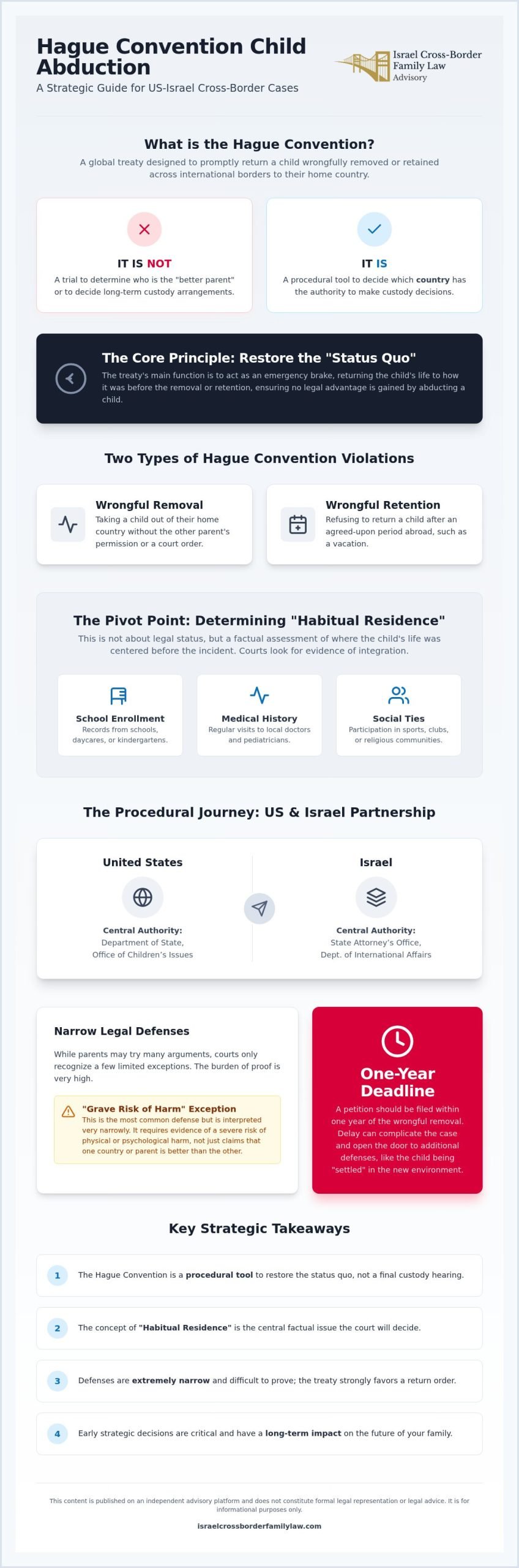
The treaty acts as a procedural emergency brake designed to restore the child’s life to how it was before the dispute began. Courts focus heavily on “Habitual Residence,” which refers to the country where the child was integrated before the removal. This mechanism serves as a powerful deterrent against parental abduction because it ensures that taking a child to a new country provides no legal advantage. Legal professionals distinguish between two types of violations:
- Wrongful Removal: This occurs when a parent takes a child out of their home country without the other parent’s permission or a court order.
- Wrongful Retention: This happens when a child travels abroad with permission, such as for a summer vacation, but the parent refuses to return them at the agreed-upon time.
US and Israel as Treaty Partners
The United States and Israel are both active signatories and maintain a robust reciprocity agreement established in the late 20th century. This partnership means that both nations have committed to honoring the treaty’s protocols and working together through their respective Central Authorities. In the U.S., the Department of State’s Office of Children’s Issues manages these applications. In Israel, the Department of International Affairs within the State Attorney’s Office handles the process. Understanding how these two distinct legal cultures interact is a critical first step for any family facing a cross-border crisis.
Determining Habitual Residence and Rights of Custody
In Hague Convention Child Abduction Cases Explained, the concept of “Habitual Residence” serves as the absolute pivot point for every legal determination. It isn’t a fixed legal term but a factual assessment of where the child’s life was centered before the alleged abduction. Courts look at the child’s integration into their environment rather than the parents’ long-term immigration status. This distinction is vital for international families who may be living abroad on temporary visas or work assignments.
To establish residence, the court requires a wealth of objective evidence. This often includes school enrollment records, medical history with local pediatricians, and documented social ties such as participation in local religious communities or sports teams. Because this content is published on an independent advisory platform, our focus is on helping you understand these strategic requirements before you enter a courtroom. If you are unsure how your child’s current living situation might be viewed by a judge, you may wish to request a strategic review of your circumstances.
Article 5 of the Convention defines “Rights of Custody” as the right to determine the child’s place of residence. A petitioner must prove they were “actually exercising” these rights at the time of removal. Both Israeli and U.S. courts typically interpret this threshold broadly. Unless a parent has completely abandoned the child, they are usually considered to be exercising their custody rights even if the other parent was the primary caregiver.
Defining the Child’s Center of Life
Israeli family courts frequently apply the “Center of Life” test. This focuses on the child’s physical presence and daily routine within the country. In contrast, U.S. courts often place more weight on “shared parental intent,” looking at what the parents collectively intended for the child’s permanent home. This divergence can create significant risks. For example, a temporary stay in Israel for a sabbatical could be reclassified as habitual residence if the child becomes sufficiently integrated into the local culture during that time.
Establishing Wrongful Removal or Retention
A removal or retention is legally “wrongful” only if it breaches the custody rights of the left-behind parent under the laws of the habitual residence. When looking at Hague Convention Child Abduction Cases Explained, the court examines the parent’s intent and the specific legal agreements in place before the child left. This is why understanding international custody and relocation frameworks is so important. According to Israel’s Central Authority for Hague Convention cases, the Department of International Affairs will scrutinize whether the left-behind parent actually consented to the relocation or if it was a unilateral move.
Common Defenses in Hague Convention Cases
While the treaty’s primary objective is the swift return of the child, the framework acknowledges that certain exceptional circumstances may make a return order inappropriate. These exceptions, known as defenses, are interpreted narrowly by both Israeli and U.S. courts to ensure the treaty’s deterrent effect remains intact. When looking at Hague Convention Child Abduction Cases Explained, it’s crucial to realize that the burden of proof shifts to the parent opposing the return. They must provide clear and convincing evidence that one of the following exceptions applies:
- Consent or Acquiescence: The left-behind parent previously agreed to the relocation or subsequently accepted the new living arrangement.
- The One-Year Rule: If the application is filed more than one year after the wrongful removal, the court may refuse return if the child is now “settled” in their new environment.
- Grave Risk of Harm: A return would expose the child to physical or psychological danger or otherwise place them in an intolerable situation.
- The Child’s Objection: A child of sufficient age and maturity objects to the return.
This content is published on an independent advisory platform and provides strategic guidance on these risks. Understanding these defenses is essential for any parent involved in a cross-border dispute. If you need to explore how these exceptions might apply to your specific situation, you can learn more about our advisory process.
The High Bar for “Grave Risk”
The “Grave Risk” exception under Article 13b is often misunderstood. It doesn’t use the “best interests of the child” standard common in standard custody trials. Instead, it requires evidence of extreme danger, such as active war zones or documented severe domestic violence where the home country cannot provide protection. Israeli courts are particularly hesitant to grant this exception without exhaustive evidence. In Israel, this often involves court-appointed psychological evaluations to determine if the risk is truly “grave” or if it’s a manageable part of a standard relocation dispute.
The Child’s Objection Defense
Courts may refuse a return order if a child objects and has reached an age and degree of maturity where it’s appropriate to take their views into account. While there’s no fixed age, Israeli and U.S. courts typically begin to give significant weight to objections from children aged 12 or 13. However, judges are trained to look for signs of parental alienation. They must determine if the child’s objection is genuine or if they’ve been coached by the taking parent. In many Israeli cases, the court will appoint an independent legal guardian (Gal-Ed) to represent the child’s voice separately from both parents. You can find detailed discussions on how courts handle these sensitive interviews on the IsraelFamilyLaw YouTube channel.
The Procedural Journey: Filing in Israel vs. the United States
The path to recovering a child involves a highly structured administrative and legal sequence that differs significantly between the United States and Israel. In the U.S., the Department of State’s Office of Children’s Issues serves as the Central Authority. They facilitate communication and provide resources but don’t provide legal representation. In Israel, the process is managed by the Department of International Affairs at the State Attorney’s Office in Jerusalem. This content is published on an independent advisory platform, and our goal is to provide strategic clarity on these divergent systems. Having Hague Convention Child Abduction Cases Explained through a procedural lens helps parents understand that while the treaty is international, the execution is local.
Time is the most critical factor in these proceedings. The “one-year clock” begins the moment a child is wrongfully removed or retained. If an application is filed after this twelve-month window, the taking parent can argue that the child is now “settled” in their new environment, which is a difficult defense to overcome. The interaction between civil courts and the Hague Convention child abduction process is designed to be swift, but the administrative start must be precise to avoid delays.
Initiating the Application
Starting a Hague application requires submitting detailed evidence of habitual residence and custody rights to the relevant Central Authority. In the United States, filing an application with the State Department costs nothing. In Israel, while the Central Authority assistance is a government service, parents must still navigate the Israeli Family Court system. For example, as of January 2026, a mandatory “Settlement of Dispute” application in Israel carries a filing fee of ₪119. Because the initial paperwork sets the strategy for the entire case, many families choose a Confidential Case Review to assess their standing before formal filing.
Court Proceedings and Appeals
Israeli law provides an accelerated timeline for these cases. An initial hearing must occur within 15 days of filing the petition, with a legal goal of reaching a final verdict within six weeks. In practice, complex cases involving expert testimony can extend beyond this target. If a return is ordered, the court also considers cross-border enforcement to ensure the transition is stable. Appeals are possible through the District Court and, in rare instances of constitutional importance, the Supreme Court. To understand how these timelines might affect your specific family dynamic, you can request a strategic consultation to discuss your options.
Strategic Considerations for Parents Navigating Cross-Border Disputes
The weight of early decisions in international family law cannot be overstated. When looking at Hague Convention Child Abduction Cases Explained, it becomes clear that the initial steps you take often determine the entire trajectory of the jurisdictional dispute. Once a formal application is submitted to a Central Authority, the procedural path is largely set and difficult to reverse. This makes it vital to seek strategic clarity before making any commitments or signing documents that could be interpreted as “acquiescence” or consent to a new living arrangement. Navigating the inherent complexity of moving children between different legal cultures requires a steady hand and a clear understanding of how both U.S. and Israeli systems view parental rights.
This content is published on an independent advisory platform focusing on strategy and risk management. It’s not formal legal representation. For families seeking visual guidance on these complex topics, the resources on the IsraelFamilyLaw YouTube channel offer valuable insights into the practical realities of the Israeli family court system. Understanding the cultural differences in how judges approach these cases is often just as important as the legal text itself.
The Risks of Self-Help and Informal Agreements
Parents in crisis sometimes consider “self-help” measures, such as attempting to re-take a child from their current location without a court order. You must understand that these actions carry severe legal risks, including potential criminal charges under international kidnapping laws. Similarly, informal “handshake” agreements carry significant risk in cross-border contexts. Without a formal, court-approved agreement that is recognizable in both jurisdictions, these arrangements often fail when tensions rise. Securing international custody and relocation frameworks through the proper legal channels is the only way to ensure long-term stability and enforceability.
Decision-Making in a Crisis
Evaluating whether to file a Hague application or pursue mediation requires a calm, structured framework. While the Hague process is an effective tool to restore the status quo, it’s also adversarial and can be expensive. An advisor helps you identify multi-jurisdictional risks that might not be obvious at first glance. For example, the decision of where to file first can have lasting impacts on future child support or property divisions. Seeking a strategic assessment allows you to weigh these risks before the situation escalates further. Professional guidance is essential in these high-stakes matters to ensure that your decisions are based on clarity rather than fear.
Securing Strategic Clarity for Your Family’s Future
The complexities of international family disputes require a steady hand and a deep understanding of how divergent legal cultures interact. As this guide to Hague Convention Child Abduction Cases Explained demonstrates, the process focuses on restoring the jurisdictional status quo rather than conducting a standard custody trial. Success in these matters often hinges on identifying the child’s habitual residence and acting within the strict procedural timelines mandated by both U.S. and Israeli authorities. Decisions made in the initial days of a dispute carry significant weight and often set the path for the entire proceeding.
This platform provides specialized US-Israel cross-border expertise to help families navigate multi-jurisdictional complexity with confidence. We focus on providing calm, authoritative guidance that helps you identify risks before they escalate. By understanding the narrow defenses available and the specific roles of the Central Authorities in Jerusalem and Washington, you can make informed choices for your children’s stability. Professional strategic advisory ensures that your decisions are grounded in clarity rather than crisis. Get clarity before you commit. Request a confidential consultation to evaluate your options. You don’t have to navigate these high-stakes transitions alone.
Frequently Asked Questions
How long does a Hague Convention case typically take in Israel?
Israeli law mandates an initial court hearing within 15 days of a petition being filed. While the official target for a final verdict is six weeks, the practical reality is that complex cases often take much longer. Having Hague Convention Child Abduction Cases Explained through this timeline helps parents manage expectations. In many instances, proceedings can extend over several months if expert reports or multiple appeals are required to resolve the dispute.
Can I stop a Hague return order if I can prove the other parent was abusive?
You can raise a defense under Article 13b if there’s a grave risk that returning would expose the child to physical or psychological harm. Courts interpret this exception very narrowly and require extreme evidence that the home country’s legal system cannot provide adequate protection. This content is published on an independent advisory platform to help you evaluate these high-stakes strategic risks before you commit to a specific legal path.
What happens if the child is taken to a country that is not a member of the Hague Convention?
If a child is relocated to a non-signatory nation, the treaty’s streamlined “return to status quo” mechanism doesn’t apply. Instead, you must rely on the local laws of that specific country or general international legal principles. These cases are significantly more complex and often require separate legal actions in both jurisdictions. Seeking strategic clarity early is essential because the legal protections available vary wildly between different global legal cultures.
Does the Hague Convention apply to children over the age of 16?
No, the treaty exclusively applies to children under the age of 16. Once a child reaches their 16th birthday, the Convention no longer provides a legal mechanism for their return. For older children, families must navigate standard custody laws or international relocation frameworks. In Israel, children are considered adults at age 18, but the specific protections of this treaty expire earlier, making the timing of your application a critical factor.
Will the court decide who gets permanent custody during a Hague hearing?
No, the court will not make a final determination on custody during these proceedings. The sole purpose of the hearing is to decide which country has the jurisdiction to hear the custody case. If a return is ordered, the child is sent back to their habitual residence so that local courts can make long-term parenting decisions. This is a core concept in Hague Convention Child Abduction Cases Explained and prevents unilateral relocation.
Can I file for child support during a Hague Convention case?
While you can technically file, a Hague proceeding is an emergency jurisdictional dispute that usually takes precedence over financial matters. Most courts won’t decide on long-term child support until the child’s habitual residence is firmly established. However, you can discuss interim financial arrangements. Understanding the interaction between return orders and cross-border enforcement is a key strategic consideration for international families navigating these challenging transitions between the U.S. and Israel.
What is the role of the Central Authority in a child abduction case?
The Central Authority acts as a facilitator between nations to ensure the treaty is followed. In the U.S., it’s the State Department’s Office of Children’s Issues; in Israel, it’s the Ministry of Justice. They process applications, help locate children, and facilitate communication between legal systems. They don’t act as your personal attorney, which is why many parents seek independent advisory services to manage their specific strategic goals and multi-jurisdictional risks.
Is a US custody order enforceable in Israel during a Hague dispute?
A U.S. custody order serves as evidence of your rights, but it doesn’t automatically override the Hague process. The Israeli court must first determine if the child was wrongfully removed under the treaty’s definitions. While an existing order helps prove you were actually exercising custody rights, the Hague case focuses primarily on the child’s habitual residence. This highlights the importance of seeking clarity on how different legal systems interpret foreign judgments during a crisis.

Article by
Gabriel Lior
A Personal Journey That Became a Mission
The advisory was founded by an American father Gabriel Lior, LLB, MBA , global entrepreneur, and cross-border advisor who spent more than a decade navigating the Israeli family court system firsthand and now lives in Singapore with his son.
As a divorced parent in a cross-border family, Gabriel faced nearly every legal challenge a foreign parent can encounter in Israel — including child custody disputes, child support proceedings, property matters in Israel and abroad, false accusations, and complex immigration and relocation proceedings.
Over the years, he learned the hard way how difficult it is for non-Israeli parents to understand the system, identify the right legal strategy, and choose the right legal representation — especially when language, culture, and jurisdictional differences are involved. He also witnessed how foreign parents and new immigrants are often disadvantaged or taken advantage of by service providers and institutions simply because they lack local knowledge or fluency.
From Client to Advisor
To truly understand — and survive — the system, Gabriel pursued formal legal education in Israel, completing two Israeli law degrees, alongside a BA and MBA earned in the United States. This was never about becoming a practicing attorney, but about gaining a deep, structural understanding of how the system works — and where it breaks down for foreign parents.
This rare combination of:
Firsthand client experience
Israeli legal and US business education
International business and negotiation training
Decades of commercial execution
created a unique perspective – one that understands both sides of the table.
After years of litigation, persistence, and at times self-representation, he ultimately succeeded in securing custody of his son and relocating abroad through a rare legal victory in the Israeli Supreme Court — becoming one of the first fathers in Israel to do so under these circumstances.
Disclaimer
Important Disclaimer:
The information provided on this website and in its content is for general informational and educational purposes only and does not constitute legal advice, legal opinion, or legal representation.
Gabriel Lior is not licensed to practice law in Israel (nor is he interested in doing so) and does not provide legal services, despite having completed 2 Law Degrees. The services offered are advisory in nature and are intended to provide general guidance, strategic insight, and information regarding cross-border family law considerations.
No attorney-client relationship is formed by accessing this website, reading its content, or communicating with us.
Any decisions made based on this information are at your own discretion and risk. For legal advice specific to your situation, you should consult a licensed attorney in the relevant jurisdiction.
Where appropriate, we may refer clients to independent, licensed attorneys or professionals. Such referrals do not constitute legal representation and no liability is assumed for services provided by third parties.