This article is published on an independent advisory platform (not a law firm). It does not imply an attorney-client relationship, legal representation, or legal advice. The focus is on strategy, risks, and decision-making guidance. For specific assistance, please request a confidential consultation.
Could your daily domestic life in Netanya be creating the same legal obligations as a traditional wedding under the canopy? Many English speaking expats and international families choose to live as Yeduim BaTzibur to avoid the complexities of the Rabbinical court system, believing it offers a simpler path to financial independence. It’s a common assumption that without a formal marriage certificate, your assets remain strictly separate, but the reality of a common law marriage separation in Netanya is often far more nuanced and legally demanding.
You likely feel that your private arrangements should dictate your financial future, and you’re right to prioritize clarity before making any major moves. This guide will help you understand the evidentiary standards of the Netanya Family Court and how the presumption of partnership affects your property. We’ll examine the mandatory dispute resolution process, the 60 day cooling off period, and the strategic differences between civil and religious jurisdictions to ensure your family interests and global assets remain protected during this transition.
Key Takeaways
- Learn how the ‘Yeduim BaTzibur’ status in Israel creates binding financial obligations similar to marriage, even without a formal ceremony or contract.
- Understand the critical role of mandatory ‘Mahut’ sessions and the specific filing requirements when initiating a common law marriage separation in Netanya.
- Discover how the ‘Presumption of Partnership’ governs asset division and why the legal date of separation is the most contested fact in the Netanya Family Court.
- Identify the specific evidentiary requirements needed to prove a shared domestic unit to protect your individual financial interests and real estate rights.
- Gain strategic insights into protecting international assets and managing the legal risks of relocation claims for families with cross-border ties.
This article is published on an independent advisory platform (not a law firm). Do NOT use language that implies attorney-client relationship, legal representation, or giving legal advice. Focus on strategy, risks, and decision-making guidance. Soft CTA to advisory call / WhatsApp.
Defining Common Law Marriage in Israel: The ‘Yeduim BaTzibur’ Status
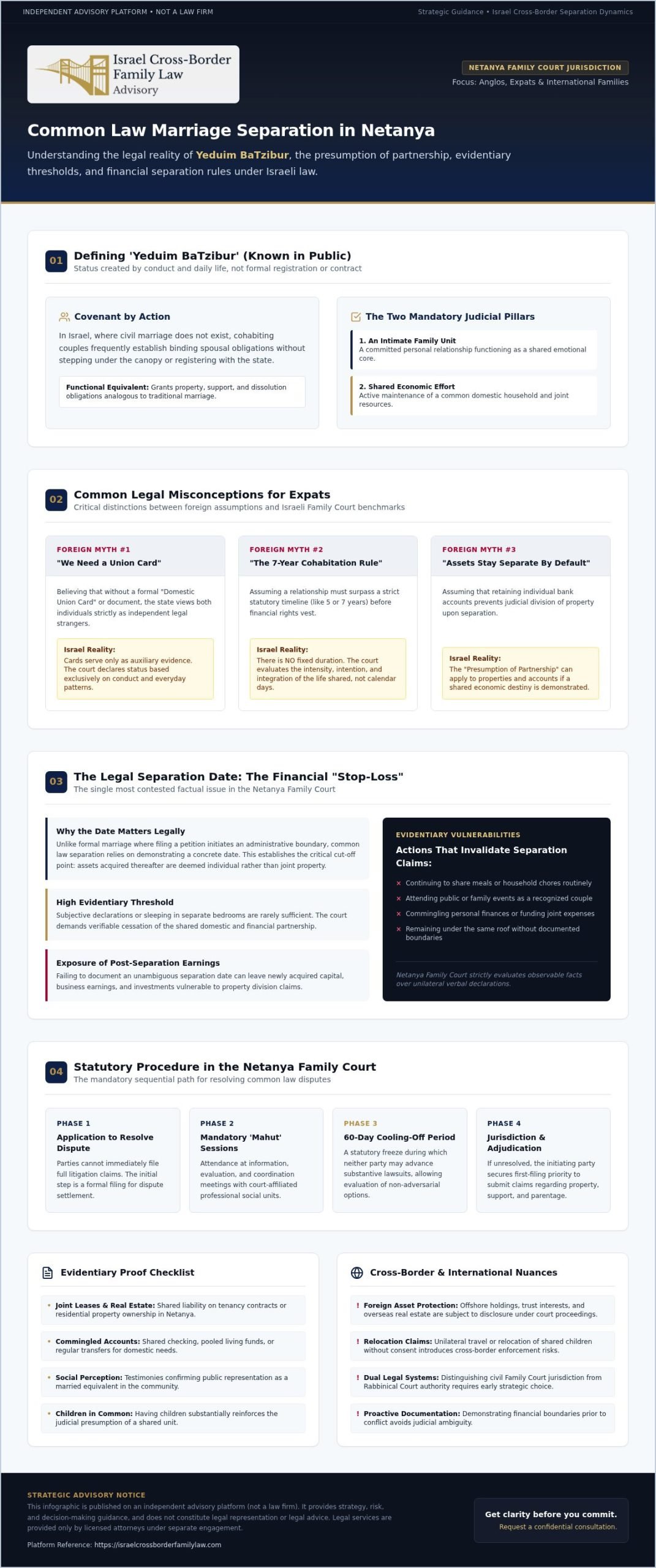
In the Israeli legal landscape, the term ‘Yeduim BaTzibur’ translates to ‘Known in Public,’ representing a functional equivalent to marriage. This status grants partners similar rights and obligations without the need for a religious ceremony. It is unique because it isn’t something you register for at a government office; instead, the law recognizes it based on your daily life. Yeduim BaTzibur is a legal status created by conduct rather than contract.
When facing a common law marriage separation in Netanya, the court focuses on two primary criteria: maintaining a joint household and living as a family unit. You must prove an intimate relationship combined with a shared economic effort. Unlike US or UK frameworks that often rely on specific statutes or long-term cohabitation, Israel’s approach is highly flexible and evidentiary. The absence of civil marriage in Israel makes this status a critical bridge for many couples who don’t wish to marry through the Rabbinate. For more information on these legal concepts, you can visit the Israel Family Law YouTube Channel.
Common Misconceptions for Expats in Netanya
Expats in coastal neighborhoods like Ir Yamim or Ramat Poleg often carry legal assumptions from their home countries that don’t apply here. One major myth is that you aren’t common law partners unless you hold a ‘Domestic Union Card.’ While these cards are useful evidence, the court can declare you ‘Yeduim BaTzibur’ based on your actions alone. Another misconception is the ‘seven year rule’ found in other jurisdictions. In Israel, there’s no fixed duration; the intensity of the shared life matters more than the calendar. You can learn more about how these rules apply by reviewing our guidance for expats and foreign nationals, backed by the insights of the Israel Cross Border Law Firm.
The Role of Intent in Establishing Status
Establishing status during a common law marriage separation in Netanya requires looking at the intent behind your actions. The court examines whether you shared bank accounts, signed joint leases, or introduced each other as spouses at social events. Having children together significantly strengthens the presumption of a family unit. The court looks for a ‘shared destiny’ rather than just a casual arrangement. Because the legal consequences involve property and support rights, achieving strategic clarity is essential. Understanding how your daily choices are being interpreted by the legal system is the first step toward protecting your future. If you are navigating this transition and need strategic guidance tailored to your specific circumstances, we invite you to reach out to our team via WhatsApp to discuss your options.
The Legal Criteria for Establishing Separation in Netanya
Determining the exact moment a relationship ends is the most frequent point of contention in the Netanya Family Court. Unlike a registered marriage, where a formal filing often marks the beginning of the end, a common law marriage separation in Netanya relies on proving the “date of separation” through specific actions. This date is critical; it serves as the financial “stop-loss” point where assets acquired after this moment are generally considered individual property rather than joint assets.
Proving the intent to permanently dissolve the family unit requires meeting a significant evidentiary burden. It isn’t enough to simply argue or sleep in separate rooms. Judges look for a clear cessation of the shared household and family unit criteria. If you continue to share meals, attend social functions as a couple, or commingle funds, a judge may rule that the separation hasn’t legally occurred. This could potentially expose your post-separation earnings or new investments to claims from your partner.
Living under the same roof while separated is a reality for many in high-value neighborhoods like Ir Yamim, but it requires careful documentation to be recognized by the court. Moving out prematurely carries strategic risks, such as being accused of abandoning the home or losing leverage in future custody discussions. It’s often wiser to request a strategic assessment before changing your residence to ensure your long-term interests are protected.
Evidentiary Requirements for Separation
The court requires tangible proof that the intimate and economic partnership has ended. Digital evidence, including WhatsApp messages, emails, or calendar invites, often plays a pivotal role in establishing the timeline of the breakup. You should document the closing of joint accounts or the redirection of salaries into private accounts. In Netanya, early decisions regarding your living arrangements can significantly impact your ability to claim rights to the family home during the final property division.
Jurisdiction: Netanya Family Court vs. Rabbinical Court
For common law partners, the default venue is the Netanya Family Court located at 57 Herzl Street. Unlike Jewish married couples who face a complex race for jurisdiction, Rabbinical Courts only have authority over common law partners if both parties voluntarily consent in writing. For international families, the Family Court is typically better equipped to handle the multi-jurisdictional complexity of foreign pensions and real estate. However, the party who files the Request for Dispute Resolution first still gains a 15 day priority window to choose their preferred forum once the mandatory stay of proceedings expires.
Property Division and Financial Rights: Married vs. Common Law
Understanding the financial implications of a common law marriage separation in Netanya begins with recognizing that Israeli law applies different frameworks to married and unmarried couples. Married couples fall under the Spousal Property Relations Law (1973), which mandates an equal “balancing of resources” for assets acquired during the marriage. However, for common law couples, property division is not automatic and requires proof of joint intent to share specific assets. Without a marriage certificate, the court doesn’t simply assume every bank account or pension fund is a 50/50 split.
Real estate is often the most significant asset in a Netanya separation, particularly in high value areas like Nitza Boulevard or the city center. If the family home is registered in only one partner’s name, the other partner doesn’t lose all rights by default. The court will examine the length of cohabitation, financial contributions to the mortgage, and whether the couple lived in the property as their primary domestic base. While a deed is powerful evidence, the “Presumption of Partnership” can override formal registration if a clear intent to share the home as a joint family asset is proven.
The ‘Presumption of Partnership’ Framework
Judges in the Netanya Family Court use the “Presumption of Partnership” to determine which assets belong to the joint pool. This framework distinguishes between “family assets,” like the home and household goods, and “business assets,” such as a private company or a specialized professional practice. Proving an intent to share a business is significantly more difficult than proving an intent to share a home. For international families, this complexity extends to foreign holdings. Ensuring you are protecting international assets for expats requires a clear mapping of what was brought into the relationship versus what was built together through mutual effort.
Alimony and Spousal Support for Common Law Partners
Israeli religious law doesn’t provide for spousal maintenance (Mezonot) for unmarried partners. However, the civil courts have developed the concept of “Contractual Alimony” based on the principles of good faith and implied agreement. If one partner became economically dependent on the other during the relationship, the court may award rehabilitative support. This is designed as a temporary financial bridge to help the lower earning partner transition to independence after the separation. Factors influencing the amount and duration include:
- The length of the cohabitation period in Netanya.
- The age and health of both partners.
- The standard of living maintained during the relationship.
- The degree of economic disparity between the parties at the time of separation.
Early decisions regarding financial disclosures and asset tracing are vital. Because the division isn’t statutory, the quality of your evidence regarding “intent” will dictate the outcome of your financial future.
Navigating the Separation Process in the Netanya Family Court
The first formal step for any common law marriage separation in Netanya isn’t a lawsuit, but a procedural requirement called a Request for Dispute Resolution. This application initiates a mandatory 60 day cooling off period during which neither partner can file active claims in court. In the Central District, this process is designed to lower conflict and encourage a mediated resolution through the court’s Assistance Unit. For international families, this phase is particularly important as it allows for a structured environment to discuss complex cross border issues, such as US based 401(k) accounts or the tax implications of transferring Israeli real estate.
During this period, you’ll attend ‘Mahut’ sessions. These sessions provide a platform to evaluate the needs of the family unit without the immediate pressure of litigation. Social workers and mediators at the Netanya Family Court are experienced in handling the specific cultural nuances of the Anglo expat community. They help identify whether a case requires specialized actuarial input for foreign assets or if a straightforward local agreement is feasible. Clarity during these early stages prevents costly mistakes in the final property division.
The Mandatory Mediation Phase
The law requires four mandatory Mahut sessions before you’re permitted to proceed to a contested hearing. This window represents your best opportunity to reach a comprehensive ‘Separation Agreement’ (Heskem Perida). Negotiating during this phase often results in more creative and flexible solutions than a judge might impose. It’s a time to clarify your priorities and understand how the advisory process works to support your decision making. Early participation in these sessions can significantly reduce the timeline for a final resolution.
Drafting a Separation Agreement
A professionally drafted separation agreement is the cornerstone of a secure future. Unlike informal verbal arrangements, a court validated agreement carries the weight of a final judgment. It should explicitly cover child support, custody arrangements, and the finality of all financial claims. Once the Netanya Family Court reviews and ratifies the document, it becomes a legally enforceable ‘Judgment.’ This status is essential for ensuring that future disputes over assets or parental responsibilities have a clear, binding resolution. For those with US citizenship, these agreements must also consider the reporting requirements and tax consequences of asset division to avoid future complications with the IRS.
Strategic Decisions: Protecting Your Future in a Cross-Border Separation
Managing a common law marriage separation in Netanya requires more than just local knowledge; it demands a global perspective on your financial and parental future. For international families, the end of a relationship often reveals a tangled web of assets held in multiple countries. Early asset mapping isn’t just a suggestion; it’s a necessity for protecting your long term stability. You’ll need to identify which assets are governed by the Israeli ‘Presumption of Partnership’ and which might be subject to foreign tax or distribution laws. For those living in the Sharon region, a Confidential Case Review for Netanya residents can help clarify these distinctions before you commit to a specific legal path.
Assessing the risk of relocation claims is equally vital. If one partner intends to leave Israel with children, the legal stakes rise instantly. You must decide early between a collaborative approach aimed at a shared parenting plan or a protective litigation strategy if the risk of unilateral movement is high. Decisions made in the first few weeks of a separation often dictate the trajectory of the entire case.
Cross-Border Complexity and International Law
Israeli courts generally view US based retirement accounts, such as 401(k)s or IRAs, as part of the joint pool if they were accumulated during the cohabitation period. However, enforcing an Israeli court order against a US financial institution presents significant technical hurdles. You must also understand Hague Convention child abduction risks if there’s a threat of a child being taken across borders without consent. These cases are handled with extreme urgency in the Netanya Family Court to prevent permanent changes to a child’s habitual residence.
Clarity Before Commitment
An initial strategic consultation saves time and emotional distress by providing a roadmap through the Israeli system. For English speakers unfamiliar with local procedures, a neutral, advisory perspective is invaluable. You’ll gain a clearer understanding of your risks and opportunities without the pressure of immediate litigation. Making informed choices today is the only way to prevent legal complications tomorrow. Your focus should be on achieving a fair resolution that respects both your local rights and your international obligations. Get clarity before you commit. Request a confidential consultation.
This article is published on an independent advisory platform (not a law firm). Do NOT use language that implies attorney-client relationship, legal representation, or giving legal advice. Focus on strategy, risks, and decision-making guidance. Soft CTA to advisory call / WhatsApp.
Securing Your Financial and Parental Future in Netanya
Managing a common law marriage separation in Netanya requires a balanced understanding of local Israeli family law and the multi-jurisdictional complexities inherent to international families. You’ve learned that ‘Yeduim BaTzibur’ status creates real financial obligations, even without a formal contract. Identifying the correct date of separation and navigating the mandatory dispute resolution sessions at the Netanya Family Court are essential steps in protecting your interests. The intersection of Israeli property regimes and foreign retirement accounts demands a strategic approach that local frameworks often overlook.
Our advisory service provides specialized guidance tailored for Anglos and expats, ensuring that US based assets and Hague Convention considerations are addressed with calm, authoritative expertise. By prioritizing strategy before litigation, you can secure a stable future for your family and assets. We focus on cross-border asset protection and providing a steady hand through the Central District’s legal system. Informed choices made today are the best defense against long-term legal complications. Take the first step toward resolution with confidence.
This article is published on an independent advisory platform (not a law firm).
Frequently Asked Questions
Is there a ‘Common Law’ registration in Netanya?
No official government registry exists for common law status in Israel. While some organizations issue cards to provide evidence of a domestic union, the status of Yeduim BaTzibur is determined by the court based on your shared conduct. In a common law marriage separation in Netanya, the judge evaluates your joint household and family life rather than checking a central database. It’s an evidentiary status that requires demonstrating a shared economic and intimate destiny.
Do I need to prove we lived together for 7 years to be considered a common-law couple?
There is no statutory requirement to live together for seven years or any other fixed period. Israeli courts focus on the quality and nature of the partnership rather than the duration. Some couples are recognized after a relatively short time if they’ve commingled finances or had children; others may live together for years without meeting the criteria. The court examines whether you functioned as a family unit and maintained a joint household during your time in Netanya.
Can my partner claim half of the apartment I bought before we met?
Assets owned before the relationship are generally considered separate property under the presumption of partnership. However, if you lived in the apartment together as a family and your partner contributed to its maintenance or mortgage, they might claim a share based on “intent to share.” This is a highly contested area in Netanya Family Court. Proving that an asset was intended to remain private requires clear documentation and a strategic approach to financial separation before a dispute arises.
What happens to child support if we were never married?
Child support obligations remain the same regardless of whether the parents were formally married. In Israel, child support is determined by the child’s needs and the relative income levels of both parents. The Netanya Family Court handles these claims based on civil principles. Whether you were married or recognized as common law partners, both parents are legally responsible for the financial well-being of their children according to established Israeli fee schedules and guidelines.
Can a common-law partner prevent me from moving back to the US with our children?
Yes, a partner can legally challenge your relocation if it involves moving children abroad. Israel is a signatory to the Hague Convention, which prevents the unilateral removal of children from their habitual residence. Even in a common law marriage separation in Netanya, you must obtain written consent from the other parent or a court order before relocating to the US. Attempting to leave without these permissions can trigger immediate legal investigations and potential abduction claims.
Does the Rabbinical Court have any authority over common-law separations in Netanya?
The Rabbinical Court generally lacks jurisdiction over common law partners unless both individuals voluntarily consent to its authority in writing. For most English speaking expats and international families, the Netanya Family Court is the primary venue for property and financial disputes. This is a significant difference from married Jewish couples, who often face a race for jurisdiction. Without mutual consent, the religious court cannot impose rulings on the division of your shared assets.
How long does a typical separation process take in the Netanya Family Court?
An uncontested separation handled through a mediated agreement typically takes between three and six months to finalize in Netanya. This timeline includes the mandatory 60 day stay of proceedings and the required Mahut sessions. If the parties cannot agree and move into full litigation, the process can extend for a year or more depending on the court’s backlog. Early strategic decisions and choosing a collaborative path are the most effective ways to reduce this duration.
Is a US prenuptial agreement valid for a common-law couple in Israel?
A US prenuptial agreement may serve as strong evidence of your original financial intent, but it isn’t automatically binding in Israel. To be fully enforceable during a common law separation, the agreement should ideally be ratified by an Israeli court. Judges in Netanya will review the document to ensure it doesn’t contradict Israeli public policy. For international families, it’s vital to assess how these foreign contracts align with local “intent to share” standards before a dispute arises.

Article by
Gabriel Lior
A Personal Journey That Became a Mission
The advisory was founded by an American father Gabriel Lior, LLB, MBA , global entrepreneur, and cross-border advisor who spent more than a decade navigating the Israeli family court system firsthand and now lives in Singapore with his son.
As a divorced parent in a cross-border family, Gabriel faced nearly every legal challenge a foreign parent can encounter in Israel — including child custody disputes, child support proceedings, property matters in Israel and abroad, false accusations, and complex immigration and relocation proceedings.
Over the years, he learned the hard way how difficult it is for non-Israeli parents to understand the system, identify the right legal strategy, and choose the right legal representation — especially when language, culture, and jurisdictional differences are involved. He also witnessed how foreign parents and new immigrants are often disadvantaged or taken advantage of by service providers and institutions simply because they lack local knowledge or fluency.
From Client to Advisor
To truly understand — and survive — the system, Gabriel pursued formal legal education in Israel, completing two Israeli law degrees, alongside a BA and MBA earned in the United States. This was never about becoming a practicing attorney, but about gaining a deep, structural understanding of how the system works — and where it breaks down for foreign parents.
This rare combination of:
Firsthand client experience
Israeli legal and US business education
International business and negotiation training
Decades of commercial execution
created a unique perspective – one that understands both sides of the table.
After years of litigation, persistence, and at times self-representation, he ultimately succeeded in securing custody of his son and relocating abroad through a rare legal victory in the Israeli Supreme Court — becoming one of the first fathers in Israel to do so under these circumstances.
Disclaimer
Important Disclaimer:
The information provided on this website and in its content is for general informational and educational purposes only and does not constitute legal advice, legal opinion, or legal representation.
Gabriel Lior is not licensed to practice law in Israel (nor is he interested in doing so) and does not provide legal services, despite having completed 2 Law Degrees. The services offered are advisory in nature and are intended to provide general guidance, strategic insight, and information regarding cross-border family law considerations.
No attorney-client relationship is formed by accessing this website, reading its content, or communicating with us.
Any decisions made based on this information are at your own discretion and risk. For legal advice specific to your situation, you should consult a licensed attorney in the relevant jurisdiction.
Where appropriate, we may refer clients to independent, licensed attorneys or professionals. Such referrals do not constitute legal representation and no liability is assumed for services provided by third parties.