Navigating a family law matter is inherently challenging, but when your case spans the legal systems of both the United States and Israel, the complexity can feel overwhelming. Questions of jurisdiction, the enforcement of orders across borders, and the division of international assets require more than just standard legal counsel; they demand the sophisticated guidance of a family lawyer with proven cross-border experience. When you are uncertain which country’s laws will apply to your divorce or custody case, finding a single, expert team that understands both cultures and legal frameworks is paramount for your peace of mind and a successful outcome.
This guide is designed to demystify the multi-jurisdictional landscape of US-Israel family law. We will explore the essential roles of a family lawyer in these intricate cases, from securing enforceable custody agreements and protecting parental rights across continents to strategically managing assets held in both nations. You will discover how a specialized legal strategy provides the clarity and confidence needed to protect your family’s future, ensuring your rights are vigorously defended in both legal arenas.
The Core Responsibilities of a Family Lawyer
A family lawyer operates within a sophisticated and deeply personal area of civil law focused on domestic relations and family-related disputes. This legal discipline, broadly defined in resources that explore What is Family Law?, governs the intricate web of relationships that form the foundation of our society. The role of legal counsel in these matters is not merely procedural; it involves providing objective, strategic guidance during what are often emotionally charged and life-altering circumstances.
To better understand the multifaceted duties involved, watch this helpful video overview:
A skilled family lawyer serves as a multi-faceted advisor, acting as a strategic negotiator to achieve amicable settlements, a zealous litigator when court intervention is unavoidable, and a meticulous drafter of critical legal documents such as court petitions and marital agreements. In every capacity, their primary mandate is to represent their client’s best interests, ensuring their rights are protected throughout settlement discussions and court proceedings while offering a stabilizing, objective perspective.
Marriage, Separation, and Divorce
Navigating the dissolution of a marriage requires expert legal guidance. This includes managing the complexities of both contested and uncontested divorce proceedings, from initial filing to final decree. A key responsibility is handling the equitable division of all marital assets and liabilities and providing robust representation in determining and litigating claims for spousal support to ensure a fair financial outcome.
Matters Involving Children
When children are involved, their best interests are the paramount concern. Legal responsibilities include establishing clear and sustainable child custody arrangements and parenting plans, ensuring the accurate calculation and enforcement of child support obligations, and representing clients in sensitive paternity disputes. Furthermore, we manage the complex legal frameworks for families growing through adoption and surrogacy, guiding them through each procedural requirement.
Financial and Protective Agreements
Proactive legal planning is central to long-term security. This practice area involves drafting, reviewing, and enforcing prenuptial and postnuptial agreements designed to protect individual assets and clarify financial arrangements. Counsel also extends to advising on and securing legal orders for protection against domestic violence and structuring sophisticated financial settlements that safeguard our clients’ long-term economic stability.
The Unique Complexities of US-Israel Cross-Border Family Law
Navigating family law disputes between the United States and Israel presents a multi-jurisdictional labyrinth that a standard domestic family lawyer is often unequipped to handle. These cases are not merely about applying one set of laws in a different location; they involve the complex intersection of US civil law, Israeli civil law, and, often, Israeli religious law (Halakha). Success requires a sophisticated, coordinated legal strategy that bridges two distinct legal systems, languages, and cultures, ensuring that actions taken in one country do not inadvertently jeopardize your standing in the other.
Jurisdictional Challenges: Where to File Your Case
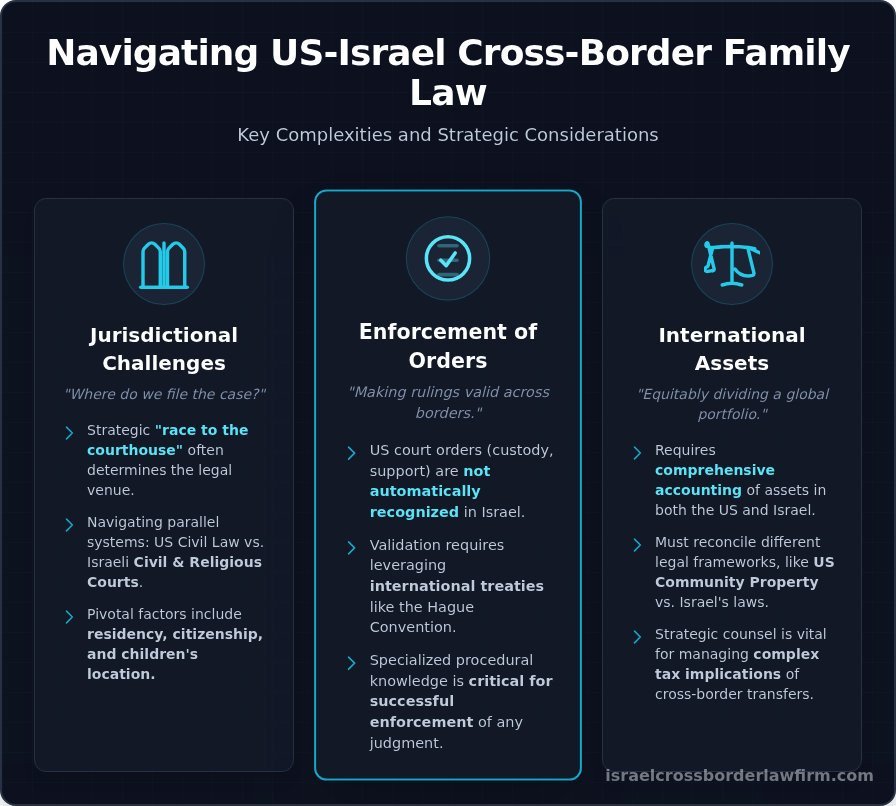
A critical initial determination is jurisdiction-which country’s courts will preside over your case. This often leads to a strategic "race to the courthouse," as the first party to file can secure a more favorable legal venue. In Israel, this is complicated by the parallel systems of civil Family Courts and religious Rabbinical Courts, each with distinct rules. Your residency, your spouse’s citizenship, and the location of your children all heavily influence this pivotal decision, demanding expert analysis from the outset.
Enforcement of International Orders
Securing a judgment is only half the battle; enforcing it across borders requires deep procedural knowledge. A US custody or support order is not automatically recognized in Israel. The process involves leveraging international treaties to validate the foreign decree. In cases of wrongful child removal, the Hague Convention on the Civil Aspects of International Parental Child Abduction provides a critical framework, but its application demands specialized guidance. Similarly, enforcing financial judgments requires a methodical approach to overcome cross-border legal hurdles.
Division of International Assets
Cross-border divorce necessitates a comprehensive accounting of assets located in both the US and Israel. This complex process involves valuing disparate holdings-from real estate in Herzliya to tech startup equity in Silicon Valley. Our legal team is adept at navigating the differences between US community property laws and Israel’s marital property regime to ensure an equitable division. We provide strategic counsel on the significant tax implications of transferring assets, such as pension funds or stock options, across international borders.
When Should You Hire a Family Lawyer? Key Scenarios
Engaging a family lawyer is not solely a reactive measure for resolving disputes; it is a strategic decision for proactive planning and asset protection. Recognizing the critical junctures where professional legal intervention becomes necessary is essential for navigating complex family matters, particularly those with cross-border implications. Even scenarios perceived as amicable can benefit significantly from formalized legal agreements to secure your interests and prevent future conflict.
Before or During a Marriage
Proactive legal counsel is invaluable prior to or during a marriage. This is particularly true if you or your partner possess significant personal, business, or inherited assets. Drafting a comprehensive prenuptial agreement defines financial rights and obligations, providing clarity and protection. The complexity escalates when international elements are involved, such as a marriage between US and Israeli citizens, which impacts spousal rights and estate planning. Furthermore, sophisticated matters like international adoption or surrogacy demand specialized legal guidance from the very beginning to navigate multi-jurisdictional regulatory frameworks.
During Separation or Divorce
The decision to end a marriage is a definitive moment to seek legal representation. Disagreements over fundamental issues such as child custody, spousal and child support, and the division of marital property require expert negotiation and, if necessary, litigation. These challenges are magnified in cross-border divorces, where spouses reside in different countries like the US and Israel, raising critical questions of legal jurisdiction. In situations where domestic violence is a factor, immediate intervention from an experienced family lawyer is paramount to ensure the safety and legal protection of you and your children.
Post-Divorce and Future Planning
Legal needs often extend beyond the finalization of a divorce. If a former spouse fails to comply with court-ordered support payments or custody arrangements, legal action may be required for enforcement. Life changes can also necessitate further legal counsel; for instance, wishing to relocate internationally with your child is a complex legal process that requires court approval and careful navigation of international law. Similarly, updating your will and estate plan to account for international heirs is crucial for ensuring your assets are distributed according to your wishes and in compliance with all relevant legal systems.
If you face one of these situations, schedule a confidential consultation to discuss your legal options.
[
Download
](https://getautoseo.com/screenshots/getautoseocom_1767372788_sopxjG6M.jpg)
Feedback & Recreate
Delete

How to Choose the Right International Family Lawyer for Your US-Israel Case
Selecting your legal representation is the single most critical decision in a US-Israel family law matter. These sophisticated, cross-border cases demand more than standard credentials; they require a firm that functions as a seamless bridge between two distinct legal and cultural worlds. The right international family lawyer possesses a unique combination of dual-jurisdictional qualifications, strategic acumen, and robust resources, ensuring your interests are protected on both continents.
Essential Qualifications and Experience
Begin your vetting process by scrutinizing the foundational qualifications that are non-negotiable for multi-jurisdictional disputes. A truly capable advisor will demonstrate proficiency far beyond what is expected in a domestic case. Key diligence items include:
- Licensure and Standing: Verify that the attorney holds active licensure and is in good standing in all relevant jurisdictions, such as the State of New York and Israel.
- Treaty Knowledge: Inquire about their specific experience with key US-Israel family law conventions and treaties, including the Hague Convention on the Civil Aspects of International Child Abduction.
- Relevant Case History: Ask for anonymized examples of prior cases they have successfully managed that mirror the complexities of your own situation.
- Language Fluency: Confirm professional fluency in both English and Hebrew to ensure nothing is lost in translation during sensitive negotiations or court proceedings.
Strategic Approach and Communication
Beyond credentials, evaluate the firm’s strategic mindset. A premier family lawyer will not view your case as two separate domestic issues but as one integrated, multi-jurisdictional challenge. They must articulate a clear strategy that anticipates legal moves in both the US and Israel. Assess how their team coordinates with legal and financial professionals in the other country, and probe their understanding of the cultural nuances that influence negotiations and judicial outcomes. Establish clear protocols for communication to ensure you remain informed at every stage.
Team and Resources
An effective international practice is supported by a deep well of resources. Investigate whether the firm maintains a physical presence or a deeply integrated network of trusted professionals in both countries-a true "team on the ground." It is crucial to understand who, beyond the lead attorney, will be working on your file and to inquire about the firm’s established relationships with international financial experts and forensic accountants adept at navigating cross-border asset valuation. Navigating these intricate matters requires a partner with proven capabilities. For a confidential consultation to discuss your specific US-Israel case, we invite you to contact our cross-border team.
Secure Your Family’s Future in Complex US-Israel Matters
Navigating the intersection of United States and Israeli family law presents a unique set of challenges demanding specialized expertise. As we have explored, the role of a family lawyer becomes significantly more complex in a cross-border context, requiring a sophisticated understanding of conflicting jurisdictions, international treaties, and distinct cultural norms. Successfully resolving these matters hinges on selecting counsel with proven, multi-jurisdictional experience.
Our firm is uniquely positioned to provide this critical guidance. With attorneys dual-licensed to practice in both the United States and Israel, we bring decades of collective experience navigating these intricate disputes. We possess a deep, nuanced understanding of both the US civil family courts and the Israeli Rabbinical courts, ensuring comprehensive and strategic representation. When your family’s future spans two nations, you need a legal team that acts as a seamless bridge.
Protect your rights and gain the clarity you need to move forward. Schedule a Confidential Consultation with Our US-Israel Legal Team to discuss your case with our dedicated experts.
Frequently Asked Questions About International Family Law
What is the main difference between a family lawyer and a divorce lawyer?
The distinction lies in the scope of practice. A divorce lawyer specializes exclusively in the dissolution of marriage and related matters like alimony. In contrast, a family lawyer manages a broader spectrum of domestic legal issues, including divorce, child custody, prenuptial agreements, and adoption. For complex international cases involving multiple legal facets, securing representation from a comprehensive family law practitioner who can navigate all interrelated matters is a critical strategic advantage for clients.
How much does an international family lawyer for a US-Israel case typically cost?
The legal fees for sophisticated cross-border cases are contingent upon the unique complexities, required court appearances, and the seniority of the advising attorneys. While a precise figure is case-dependent, clients can generally expect hourly rates for experienced partners in Israel to range from ₪800 to over ₪2,000. A substantial initial retainer is typically required to begin work on such multi-jurisdictional matters, reflecting the significant resources dedicated to achieving a successful outcome.
Can I handle a cross-border divorce through mediation instead of going to court?
Yes, mediation is a viable and often preferable alternative to litigation for resolving multi-jurisdictional divorce proceedings. This collaborative process can reduce conflict and costs. However, it is imperative to understand that any agreement reached through mediation must be formally ratified by the appropriate courts in both Israel and the United States to ensure it is legally binding and enforceable. Expert legal counsel is essential to guide this complex ratification process effectively.
If I am a US citizen living in Israel, where do I file for divorce?
Determining the correct jurisdiction is a critical preliminary step governed by intricate international and domestic laws. As a US citizen residing in Israel, you may be able to file in either country. The decision depends on factors such as the length of residency in Israel, the location of the marital home, and where your children reside. Selecting the most advantageous jurisdiction requires a sophisticated legal analysis, as it can significantly impact the outcome of your case.
Is a prenuptial agreement I signed in the US automatically enforceable in Israel?
A prenuptial agreement executed in the United States is not automatically granted full legal force in Israel. An Israeli court will review the foreign agreement to ensure it aligns with Israeli public policy and was entered into without coercion. To maximize its enforceability, it is highly advisable to have the US agreement reviewed by Israeli counsel and, where possible, formally ratified by an Israeli family court before any dispute arises, thereby securing its legal standing within Israel.
What is the Hague Convention and how does it apply to my child custody case?
The Hague Convention on the Civil Aspects of International Child Abduction is a multi-jurisdictional treaty to which both the US and Israel are signatories. Its primary function is to secure the prompt return of a child wrongfully removed to or retained in a foreign country. The Convention does not adjudicate long-term custody rights; rather, it determines that the custody dispute should be resolved by the courts in the child’s country of habitual residence.

Article by
Gabriel Lior
A Personal Journey That Became a Mission
The advisory was founded by an American father Gabriel Lior, LLB, MBA , global entrepreneur, and cross-border advisor who spent more than a decade navigating the Israeli family court system firsthand and now lives in Singapore with his son.
As a divorced parent in a cross-border family, Gabriel faced nearly every legal challenge a foreign parent can encounter in Israel — including child custody disputes, child support proceedings, property matters in Israel and abroad, false accusations, and complex immigration and relocation proceedings.
Over the years, he learned the hard way how difficult it is for non-Israeli parents to understand the system, identify the right legal strategy, and choose the right legal representation — especially when language, culture, and jurisdictional differences are involved. He also witnessed how foreign parents and new immigrants are often disadvantaged or taken advantage of by service providers and institutions simply because they lack local knowledge or fluency.
From Client to Advisor
To truly understand — and survive — the system, Gabriel pursued formal legal education in Israel, completing two Israeli law degrees, alongside a BA and MBA earned in the United States. This was never about becoming a practicing attorney, but about gaining a deep, structural understanding of how the system works — and where it breaks down for foreign parents.
This rare combination of:
Firsthand client experience
Israeli legal and US business education
International business and negotiation training
Decades of commercial execution
created a unique perspective – one that understands both sides of the table.
After years of litigation, persistence, and at times self-representation, he ultimately succeeded in securing custody of his son and relocating abroad through a rare legal victory in the Israeli Supreme Court — becoming one of the first fathers in Israel to do so under these circumstances.
Disclaimer
Important Disclaimer:
The information provided on this website and in its content is for general informational and educational purposes only and does not constitute legal advice, legal opinion, or legal representation.
Gabriel Lior is not licensed to practice law in Israel (nor is he interested in doing so) and does not provide legal services, despite having completed 2 Law Degrees. The services offered are advisory in nature and are intended to provide general guidance, strategic insight, and information regarding cross-border family law considerations.
No attorney-client relationship is formed by accessing this website, reading its content, or communicating with us.
Any decisions made based on this information are at your own discretion and risk. For legal advice specific to your situation, you should consult a licensed attorney in the relevant jurisdiction.
Where appropriate, we may refer clients to independent, licensed attorneys or professionals. Such referrals do not constitute legal representation and no liability is assumed for services provided by third parties.