If you are planning to marry and your lives or assets involve both the United States and Israel, start with the countries involved, any existing agreement, your main assets and the wedding date. This guide introduces questions to discuss with independent licensed lawyers before deciding how to prepare or review a US–Israel prenuptial agreement.
Need help organizing your next step? Request a confidential review of your US–Israel prenuptial questions. Share a brief outline of your circumstances and any deadline. ICBFL provides independent advisory and informational support; legal advice, drafting and representation are provided by independent licensed lawyers.
Why a Standard Prenup Fails for US-Israel International Couples
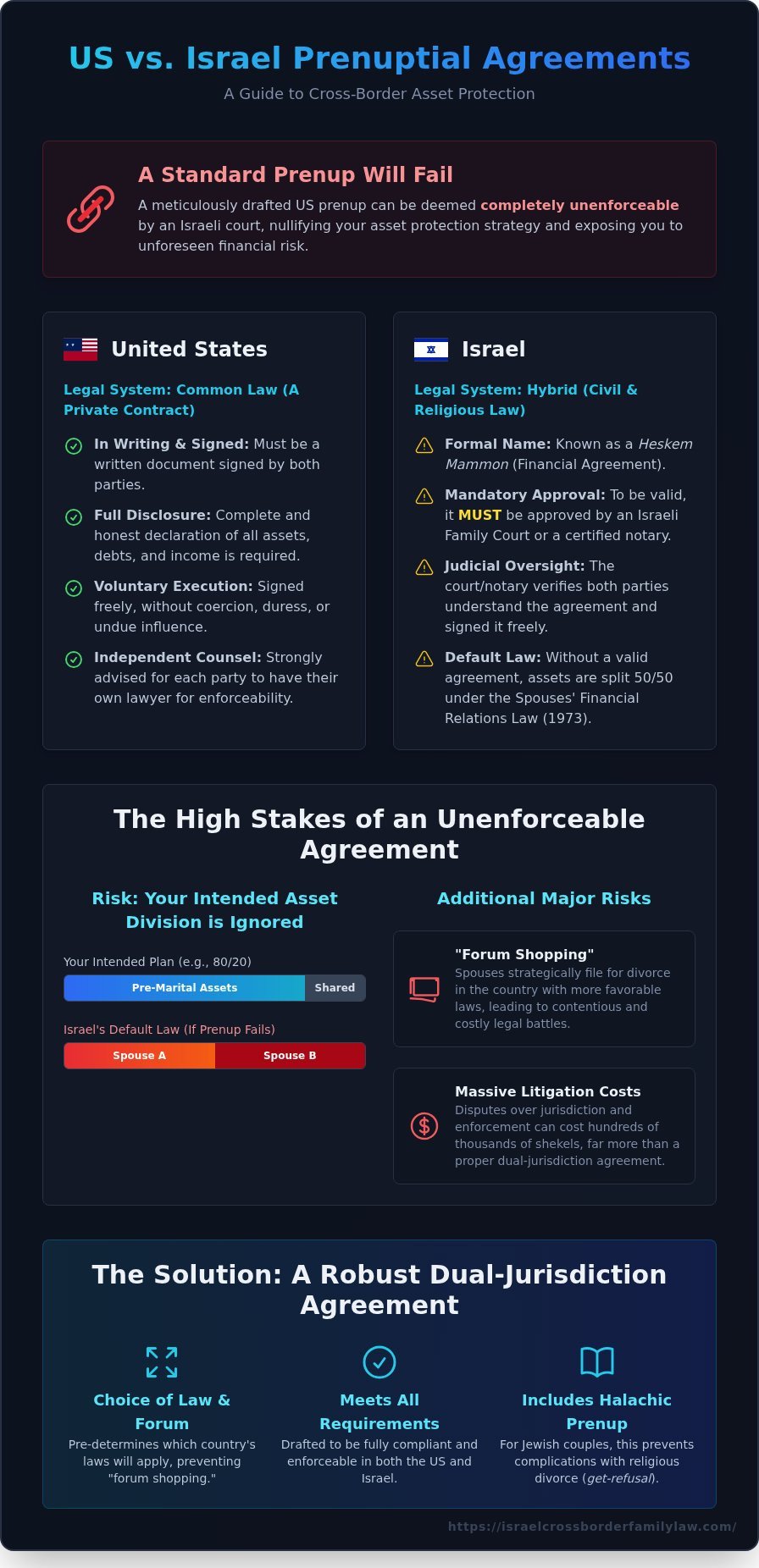
For international couples with connections to both the United States and Israel, assuming a standard domestic prenuptial agreement will suffice is a significant financial misstep. The core problem is one of enforceability across borders; a meticulously drafted agreement, fully valid under New York law, may be rendered partially or completely ineffective by a family court in Tel Aviv. These multi-jurisdictional relationships present a sophisticated set of legal challenges that a single-jurisdiction document is simply not equipped to handle. Relying on such an agreement exposes cross-border assets to unforeseen risks, underscoring why proactive, specialized legal planning is not a luxury but a necessity.
To better understand the complexities of cross-border asset protection, the following video provides a helpful overview:
The Clash of Legal Systems: Common Law vs. Israeli Law
The fundamental conflict arises from two disparate legal traditions. The US system, based on common law, generally treats a prenuptial agreement as a private contract between two individuals, requiring procedural fairness and disclosure but with significant contractual freedom. In contrast, Israel’s legal framework is a hybrid of civil law and religious law. Under Israel’s Spouses’ Financial Relations Law (1973), a prenuptial agreement is not considered valid until it is formally approved by a family court or a notary, who must verify that both parties understand its implications and have entered into it of their own free will. This mandatory judicial or notarial oversight is a critical step that a standard US-drafted agreement will invariably miss.
Jurisdiction: The Million-Dollar Question of Where You’d Divorce
For an international couple, the question of which country’s courts will have jurisdiction in the event of a divorce is paramount. Jurisdiction is often determined by factors like the couple’s last common place of residence. This ambiguity can lead to "forum shopping," a costly and contentious scenario where one spouse strategically files for divorce in the jurisdiction with laws more favorable to their financial position. A properly structured us israel prenuptial agreement is designed to mitigate this risk by including a clear choice of law and forum selection clause, pre-determining which legal system will govern the dissolution of the marriage and the division of assets.
The High Stakes of an Unenforceable Agreement
The worst-case scenario is not merely a legal dispute; it is the complete nullification of your agreement by a court. If an Israeli court deems a US-based prenup unenforceable for failing to meet local requirements, it will disregard the couple’s intentions entirely. Instead, the court will apply Israel’s default property division laws, which typically mandate an equal distribution of all assets accumulated during the marriage, irrespective of title. This can lead to an asset division that is profoundly different from what you planned. The potential cost of litigating these complex jurisdictional and enforcement issues can easily run into hundreds of thousands of shekels, far exceeding the initial investment in drafting a robust, dual-jurisdiction agreement.
Core Principles: Prenuptial Agreements in the US vs. Israel
Crafting an effective US-Israel prenuptial agreement requires navigating two distinct and sophisticated legal landscapes. An agreement that is perfectly valid in New York may be unenforceable in Tel Aviv, and vice versa. Therefore, the core challenge is to create a single, cohesive document that satisfies the mandatory legal requirements of both jurisdictions. The complexities of drafting enforceable Cross Border Prenuptial Agreements demand a nuanced understanding of each country’s mandates to ensure your assets are protected, regardless of where the marital journey leads.
Key Requirements for a Valid US Prenup
In the United States, the enforceability of a prenuptial agreement generally depends on procedural fairness. While specific laws vary by state, the foundational principles are consistent and focus on protecting both parties from duress or misinformation. Key requirements include:
In Writing: The agreement must be a written document and signed by both prospective spouses.
Full Disclosure: Both parties must provide a complete and accurate disclosure of all significant assets, debts, and income.
Voluntary Execution: The agreement must be entered into voluntarily, free from any coercion, duress, or undue influence.
Independent Counsel: While not always mandatory, it is strongly advised and often critical for enforceability that each party retains their own independent legal counsel.
Israel’s Financial Relations Law & Approval Process
Israel’s legal framework operates on a different premise. The Spouses’ Financial Relations Law of 1973 establishes a default regime of equal division of all assets accumulated during the marriage. A prenuptial agreement, known as a Heskem Mammon, is the formal mechanism to opt out of this default. The most significant distinction from the US system is the requirement for official authentication. For a Heskem Mammon to be legally valid, it must be approved and authenticated by either the Family Court or a certified notary, who confirms the couple understands its terms and implications freely.
The Role of Religious Law: The Halachic Prenup
For Jewish couples, a comprehensive US-Israel prenuptial agreement strategy must also address the complexities of religious divorce. A separate but complementary agreement, the Halachic Prenuptial Agreement, is designed specifically to prevent get-refusal-a situation where one spouse refuses to grant or accept the Jewish divorce document (a get). This agreement creates financial incentives, such as escalating support payments, to ensure both parties cooperate in the religious divorce proceedings before the Rabbinical Court, thereby preventing one party from being trapped in the marriage religiously.
Drafting an Ironclad US-Israel Cross-Border Prenuptial Agreement
Successfully navigating the complexities of a multi-jurisdictional marriage requires more than a standard prenuptial template; it demands a sophisticated us israel prenuptial agreement engineered to be enforceable in both legal systems. Creating a robust and defensible document is the central pillar of asset protection, ensuring clarity and predictability regardless of where the future leads. The following components are foundational to this strategic process.
Essential Clauses for Cross-Border Asset Protection
A formidable international prenuptial agreement must meticulously address the financial landscape of the relationship. Our attorneys focus on incorporating precise clauses that provide comprehensive protection, including:
Defining Separate vs. Marital Property: Clearly delineating which assets (pre-marital holdings, specific business interests, real estate) remain separate property, insulating them from Israel’s community property presumptions and US equitable distribution laws.
Provisions for Future Assets: Explicitly stipulating the treatment of future inheritances, significant gifts from family, and distributions from trusts to prevent them from being unintentionally commingled into the marital estate.
Addressing Liabilities and Debts: Assigning clear responsibility for any debts, whether personal or business-related, that were acquired by either party prior to or during the marriage.
Spousal Support (Alimony): Carefully structuring clauses regarding spousal support or maintenance, which may include a full waiver or specific limitations, drafted to withstand judicial scrutiny in both countries.
The Critical Jurisdiction and ‘Choice of Law’ Clause
This is arguably the most vital clause in any international agreement. It specifies which country’s laws (e.g., the laws of New York or the laws of Israel) will govern the interpretation and enforcement of the prenup. It also designates the forum-the specific courts that will have jurisdiction over any disputes. While a court is not always legally bound to accept these designations, a skillfully drafted clause, grounded in the specific circumstances of the couple, is exceptionally persuasive and can prevent costly and protracted jurisdictional battles down the line.
For a broader legal overview, review our guide to choice of law and enforceability for a US–Israel prenup.
Technical Strategies: Mirror Provisions and Dual Execution
To ensure dual-compliance, legal experts employ advanced drafting techniques. This includes creating "mirror provisions"-clauses written to satisfy the distinct legal standards of both jurisdictions simultaneously. Furthermore, the execution of the document itself must be flawless. This often involves a dual execution process, where the agreement is signed, witnessed, and notarized or approved by a court/notary in both the US and Israel, adhering to the strict procedural formalities of each legal system. If the document is in multiple languages, certified translations are essential. Crafting these complex clauses requires expertise. Consult with our cross-border attorneys to ensure your agreement is structured for maximum enforceability.
Enforceability: Will Your Agreement Hold Up in Court?
A primary concern for any couple entering into a cross-border marital contract is its ultimate validity. A meticulously drafted us israel prenuptial agreement is designed to be robust and withstand judicial scrutiny in both jurisdictions. While courts in each country have distinct procedural standards, the principle of honoring a fair and properly executed private contract generally prevails. The key lies in navigating the specific requirements of each legal system from the outset to ensure your agreement is not just a document, but an enforceable legal instrument.
How Israeli Courts View Foreign Prenuptial Agreements
Israeli courts generally operate on the principle of comity, meaning they extend respect to the laws and judicial decisions of other nations. Consequently, a prenuptial agreement validly executed in the United States is often recognized. However, an Israeli court will scrutinize the agreement to ensure it does not contradict Israeli public policy. A significant point of contention can be the lack of approval by an Israeli court or notary, a standard requirement for domestic agreements, which underscores the need for dual-jurisdictional legal guidance.
How US Courts Treat Israeli Financial Agreements
Similarly, US state courts typically enforce foreign prenuptial agreements, provided they meet fundamental standards of procedural fairness. This includes full and frank financial disclosure from both parties, confirmation that each party had access to independent legal counsel, and an absence of duress or coercion. The agreement must not be "unconscionable" at the time of signing. Interestingly, having a us israel prenuptial agreement formally approved by an Israeli court can substantially strengthen its perceived legitimacy and enforceability within the American legal system.
Common Pitfalls That Weaken an Agreement
Even the most well-intentioned agreements can be jeopardized by critical oversights. Avoiding these common pitfalls is essential for ensuring the enforceability of your prenuptial contract:
Inadequate Financial Disclosure: Failure by one or both parties to provide a complete and accurate representation of their assets, debts, and income can render an agreement invalid.
Duress or Coercion: The agreement must be signed voluntarily. Any evidence that a party was pressured or forced into signing can be grounds for nullification.
Lack of Independent Legal Counsel: Courts heavily favor agreements where each spouse was represented by their own attorney, ensuring both parties fully understood the terms and implications.
Vague or Ambiguous Language: Imprecise terms can lead to disputes over interpretation. A strong agreement uses clear, specific language to define the rights and obligations of each party.
Navigating these multi-jurisdictional complexities requires specialized counsel. To ensure your agreement is structured for maximum enforceability in both countries, contact our team of cross-border legal experts.
The Process: Choosing the Right Legal Team for a Multi-Jurisdictional Agreement
Having established the critical components of a cross-border prenuptial agreement, the focus now shifts to the most crucial decision in the process: selecting your legal representation. The enforceability and effectiveness of your agreement are directly tied to the expertise of the professionals who draft and review it. This is not a task for a general practitioner; it demands a sophisticated understanding of two distinct and complex legal landscapes.
Why You Need Counsel in Both the US and Israel
An attorney admitted to the bar in New York cannot provide legal advice on Israeli family law, and vice versa. Attempting to rely on a single lawyer creates significant legal vulnerabilities. The correct approach involves a collaborative, two-firm strategy. A primary drafting attorney in one jurisdiction crafts the agreement, while a reviewing attorney in the other jurisdiction meticulously vets the document to ensure it complies with local laws and will be upheld by its courts. This dual-counsel method is the only way to guarantee comprehensive, multi-jurisdictional protection.
What to Look for in a Cross-Border Family Lawyer
When vetting potential legal teams for a us israel prenuptial agreement, your due diligence should focus on confirming specific, non-negotiable qualifications. Your chosen counsel must possess:
Verifiable Experience: A proven track record of successfully negotiating and drafting complex, high-asset prenuptial agreements specifically for US-Israeli couples.
Jurisdictional Admission: Active admission to the bar in at least one of the relevant jurisdictions (e.g., a US state bar or the Israel Bar Association).
Bilingual & Bicultural Fluency: Native or near-native proficiency in both English and Hebrew is essential for navigating legal documents and cultural nuances without misunderstanding.
A Robust Professional Network: An established network of trusted, vetted legal counterparts in the other country to ensure seamless collaboration.
Our Integrated Approach to Your Financial Security
Our firm is uniquely positioned to serve as the bridge between these two legal worlds. Our team includes bicultural and bilingual attorneys with deep experience in the intricate interplay between US and Israeli family law. We guide our clients through every stage, providing a seamless and integrated professional home for these sophisticated matters. We don’t just draft documents; we architect comprehensive strategies for long-term financial security across borders. To protect your future effectively, you need a team that operates fluently in both worlds. Learn about our team’s cross-border expertise.
Navigating Your Cross-Border Union with Confidence
As we have detailed, a standard prenuptial agreement is fundamentally inadequate for the complexities of a US-Israeli union. The significant distinctions between American and Israeli family law necessitate a sophisticated, multi-jurisdictional strategy to ensure your custom-drafted us israel prenuptial agreement is both robust and enforceable across borders. Navigating this intricate legal terrain demands counsel with demonstrable, deep expertise in both legal systems.
ICBFL provides independent advisory and informational support to help you organize your circumstances and identify questions for independent licensed lawyers in the relevant jurisdictions. Legal advice, drafting and representation are provided by those lawyers through their own firms. Discuss the scope, fees and proposed approach directly with each provider before deciding how to proceed.
Protect your shared future by taking the definitive first step today. Schedule a Confidential Consultation to Secure Your Cross-Border Financial Future.
Frequently Asked Questions
What is the difference between a prenup and a ‘Heskem Mammon’ (financial relations agreement) in Israel?
A ‘Heskem Mammon’ is the Israeli legal instrument for a financial relations agreement, functionally equivalent to a U.S. prenuptial or postnuptial agreement. The primary distinction lies in the jurisdictional requirements for validation; in Israel, the agreement must be authenticated by a Family Court or a Notary. For international couples, a comprehensive agreement must be meticulously drafted to be enforceable under both Israeli law and the relevant U.S. state statutes, a complexity our cross-border practice is uniquely positioned to navigate.
How much does a cross-border US-Israel prenuptial agreement typically cost?
The cost for a comprehensive cross-border prenuptial agreement reflects the sophisticated legal work required to harmonize two distinct legal systems. While fees vary based on the complexity of assets and negotiations, clients can typically expect professional fees to range from ₪15,000 to over ₪50,000. This investment ensures the meticulous drafting and validation necessary to protect significant international assets, providing certainty and mitigating the risk of far more costly future litigation across multiple jurisdictions.
Do we need to translate the entire prenuptial agreement into both Hebrew and English?
For a us israel prenuptial agreement to be robustly enforceable in both countries, a professional translation is not merely advisable-it is essential. We guide clients to execute the agreement in both English and Hebrew, with each version being a certified translation of the other. This dual-language approach preempts any potential challenges based on misunderstanding or linguistic ambiguity, ensuring that the intent of the parties is unequivocally clear to both an Israeli Family Court and a U.S. state court.
Can a US-Israel prenup determine child custody or child support arrangements?
No, a prenuptial agreement cannot legally predetermine matters of child custody or child support. The legal doctrine in both the United States and Israel holds that the "best interests of the child" are paramount and must be determined by a court at the time of separation or divorce. Any provisions attempting to waive child support or fix custody arrangements in advance are considered void as they infringe upon the court’s jurisdiction and the child’s fundamental rights.
What happens to our assets if we are a US-Israel couple who divorces without a prenup?
In the absence of a prenuptial agreement, divorcing US-Israel couples face a complex division of assets governed by default laws. In Israel, the Spouses’ Property Relations Law generally mandates an equal division of all marital assets. Concurrently, a U.S. court may apply its own state laws, creating conflicting claims and necessitating costly multi-jurisdictional litigation. This legal ambiguity underscores the critical importance of a proactively drafted agreement to ensure a predictable and controlled outcome.
We are already married. Is it too late to create a financial agreement?
It is not too late. An agreement delineating financial arrangements can be executed after the marriage has commenced; this is known as a postnuptial agreement in the U.S. and is also covered by the ‘Heskem Mammon’ framework in Israel. This instrument serves the same strategic purpose as a prenuptial agreement, allowing couples to define the division of separate and marital property, which is particularly valuable if financial circumstances have changed significantly since the wedding.

Article by
Gabriel Lior
A Personal Journey That Became a Mission
The advisory was founded by an American father Gabriel Lior, LLB, MBA , global entrepreneur, and cross-border advisor who spent more than a decade navigating the Israeli family court system firsthand and now lives in Singapore with his son.
As a divorced parent in a cross-border family, Gabriel faced nearly every legal challenge a foreign parent can encounter in Israel — including child custody disputes, child support proceedings, property matters in Israel and abroad, false accusations, and complex immigration and relocation proceedings.
Over the years, he learned the hard way how difficult it is for non-Israeli parents to understand the system, identify the right legal strategy, and choose the right legal representation — especially when language, culture, and jurisdictional differences are involved. He also witnessed how foreign parents and new immigrants are often disadvantaged or taken advantage of by service providers and institutions simply because they lack local knowledge or fluency.
From Client to Advisor
To truly understand — and survive — the system, Gabriel pursued formal legal education in Israel, completing two Israeli law degrees, alongside a BA and MBA earned in the United States. This was never about becoming a practicing attorney, but about gaining a deep, structural understanding of how the system works — and where it breaks down for foreign parents.
This rare combination of:
Firsthand client experience
Israeli legal and US business education
International business and negotiation training
Decades of commercial execution
created a unique perspective – one that understands both sides of the table.
After years of litigation, persistence, and at times self-representation, he ultimately succeeded in securing custody of his son and relocating abroad through a rare legal victory in the Israeli Supreme Court — becoming one of the first fathers in Israel to do so under these circumstances.
Disclaimer
Important Disclaimer:
The information provided on this website and in its content is for general informational and educational purposes only and does not constitute legal advice, legal opinion, or legal representation.
Gabriel Lior is not licensed to practice law in Israel (nor is he interested in doing so) and does not provide legal services, despite having completed 2 Law Degrees. The services offered are advisory in nature and are intended to provide general guidance, strategic insight, and information regarding cross-border family law considerations.
No attorney-client relationship is formed by accessing this website, reading its content, or communicating with us.
Any decisions made based on this information are at your own discretion and risk. For legal advice specific to your situation, you should consult a licensed attorney in the relevant jurisdiction.
Where appropriate, we may refer clients to independent, licensed attorneys or professionals. Such referrals do not constitute legal representation and no liability is assumed for services provided by third parties.