Initiating divorce proceedings is a significant undertaking; when your spouse resides abroad, the legal complexity multiplies exponentially, introducing a daunting layer of international regulations and potential procedural pitfalls. The critical first step of serving divorce papers internationally from israel is not merely a formality but a foundational legal requirement governed by a sophisticated web of treaties. A single misstep in this cross-border process can result in substantial delays, escalating costs, or even the outright dismissal of your case, leaving you in a state of prolonged legal uncertainty. This challenge is often compounded by the difficulty of locating a spouse abroad or contending with their deliberate evasion.
This definitive guide is designed to demystify this multi-jurisdictional challenge and provide authoritative clarity. We will navigate you through the precise legal frameworks, including the Hague Service Convention and other diplomatic channels, outlining the step-by-step procedures required for legally effective service. By understanding these critical requirements, you will gain the confidence that your service of process will be recognized by both Israeli and foreign courts, enabling you to successfully notify your spouse and move your divorce proceedings forward with assurance and legal validity.
The Legal Imperative: Why Proper Service of Process is Non-Negotiable
Initiating a cross-border divorce proceeding from Israel to the United States begins with a foundational legal requirement: the service of process. This is not a mere formality but the official, legally mandated notification to your spouse that a lawsuit has been filed against them. Rooted in the fundamental principle of ‘due process’, this step ensures the respondent is given a fair opportunity to appear in court and present their case. It is the cornerstone upon which the entire legal action is built.
To better understand this complex international procedure, we recommend the following overview:
Executing this step correctly is particularly critical when serving divorce papers internationally from Israel, as the process is governed by a sophisticated framework of both domestic Israeli law and international treaties, most notably The Hague Service Convention. A failure to adhere strictly to these protocols can invalidate your entire case from the outset, underscoring why professional guidance is essential. This crucial action formally establishes the Israeli court’s jurisdiction over your spouse, empowering it to make binding legal decisions.
What is ‘Jurisdiction’ in an International Divorce?
In the context of a multi-jurisdictional family law matter, ‘personal jurisdiction’ refers to the court’s authority over the individuals involved in the case. Proper service of process is the key that unlocks this authority. By formally and correctly notifying your spouse in the US of the Israeli legal proceedings, you are legally submitting them to the jurisdiction of the Israeli court. Without this established jurisdiction, any divorce decree, child custody order, or asset division ruling issued by the court is legally void and unenforceable abroad.
The Severe Consequences of Improper Service
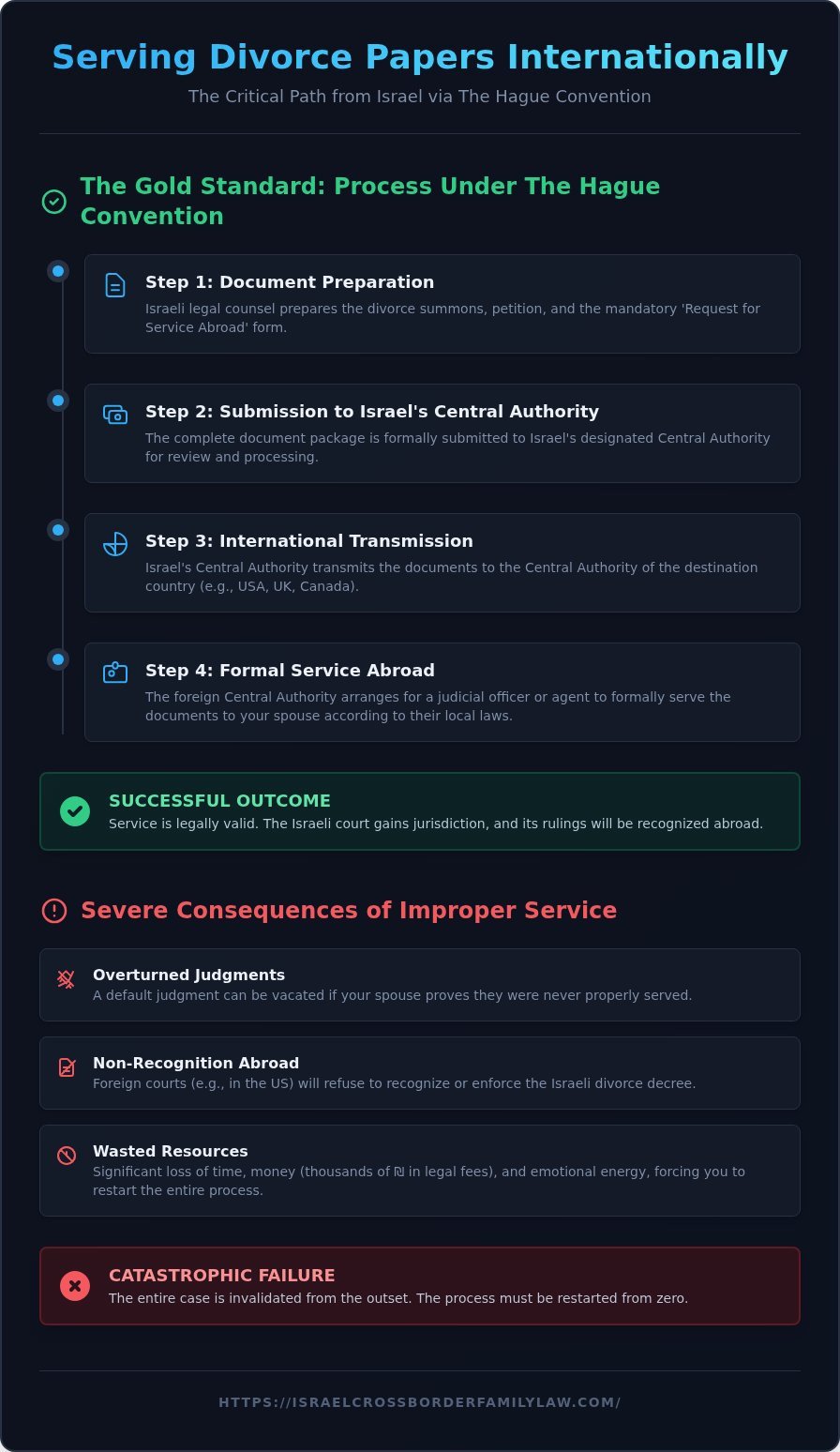
Attempting to cut corners or failing to comply with the precise international and local rules for service carries significant and costly risks. The repercussions of improper service are not minor procedural setbacks; they can be catastrophic to your case and include:
- Overturned Judgments: A default judgment granted in your favor can be easily appealed and vacated if your spouse can prove they were never properly served.
- Non-Recognition Abroad: US courts will refuse to recognize or enforce an Israeli divorce decree if the service of process did not meet American constitutional standards of due process.
- Wasted Resources: You will face the loss of significant time, emotional energy, and financial resources, potentially amounting to thousands of shekels (₪) in wasted legal fees, forcing you to restart the entire arduous process.
The Hague Service Convention: The Gold Standard for International Service
When navigating the complexities of multi-jurisdictional family law, procedural integrity is paramount. The Hague Convention on the Service Abroad of Judicial and Extrajudicial Documents in Civil or Commercial Matters, commonly known as the Hague Service Convention, provides the definitive international treaty for this purpose. Its objective is to create a reliable and efficient method for serving legal documents between signatory countries, ensuring that a defendant is properly notified of a legal action in a manner that will be recognized by courts in both jurisdictions. For individuals initiating divorce proceedings in Israel against a spouse residing abroad, this Convention is not merely an option-it is the mandatory and gold-standard method for countries that are party to the treaty, including the United States, the United Kingdom, Canada, and most of Europe.
How Service Works Under the Hague Convention: A Step-by-Step Guide
The process of serving divorce papers internationally from Israel under the Convention is meticulously structured to ensure legal validity across borders. The procedure involves a formal government-to-government channel that, while methodical, guarantees the service is executed correctly. The key stages are as follows:
- Step 1: Document Preparation: Your Israeli legal counsel prepares the complete set of divorce documents, including the official summons and petition. These are accompanied by the mandatory ‘Request for Service Abroad’ form.
- Step 2: Submission to Israel’s Central Authority: The entire package is formally submitted to Israel’s designated Central Authority, which is typically managed within the court administration.
- Step 3: International Transmission: Israel’s Central Authority reviews the documents for compliance and then transmits them directly to the Central Authority of the destination country where your spouse resides. Details regarding the specific processes and requirements can be found directly from the official sources governing the Hague Service Convention in Israel.
- Step 4: Formal Service Abroad: The foreign Central Authority arranges for the documents to be served upon your spouse in accordance with its own domestic laws, whether through a judicial officer, local sheriff, or another authorized agent. Once service is complete, a Certificate of Service is returned through the same channels.
Key Documents and Translation Requirements
The cornerstone of a Hague Convention request is the ‘Request for Service Abroad of Judicial or Extrajudicial Documents’ form. This document must be completed meticulously, as errors can lead to significant delays or rejection. Critically, all documents being served-including the divorce petition itself-must be translated into the official language of the country where service is being effected. These cannot be informal translations; they must be professional, certified translations to ensure their legal sufficiency and to protect against future challenges to the validity of the service.
Expected Timelines and Costs
While the Hague Convention provides legal certainty, it is not the fastest method. The timeline for completing service can vary dramatically, from as few as three to four months to well over a year, depending on the efficiency of the foreign country’s Central Authority. The associated costs are comprised of several components: your Israeli lawyer’s legal fees for preparing the complex application, certified translation fees which can amount to several thousand shekels depending on document length, and administrative processing fees charged by the authorities. Although more time-consuming and costly than informal methods, its legally robust nature makes it an indispensable tool for serving divorce papers internationally from Israel, ensuring any resulting judgment is enforceable globally.
Alternative Methods for Serving a Spouse in a Non-Hague Country
When a spouse resides in a country that is not a signatory to the Hague Service Convention, the process of serving divorce papers internationally from Israel becomes significantly more complex. These non-signatory nations operate under their own distinct domestic laws for service of process, which do not conform to the streamlined procedures established by the Convention. Navigating this multi-jurisdictional landscape requires a sophisticated understanding of international law and bilateral relations, as the absence of a treaty framework introduces substantial procedural hurdles. These difficulties are often compounded by the inherent challenges of dual citizenship divorce, where conflicting legal systems can create unforeseen complications. In such cases, petitioners must rely on more traditional, and often more cumbersome, diplomatic or legal channels.
Letters Rogatory: The Formal Diplomatic Route
One of the most formal methods available is the use of Letters Rogatory, also known as a Letter of Request. This is a formal, written request from an Israeli family court to a court in the foreign jurisdiction, asking for its assistance in effectuating service of process upon the respondent. The request is not sent directly but is transmitted through diplomatic channels, typically moving from the Israeli Ministry of Justice to the Ministry of Foreign Affairs, then to the corresponding foreign ministry, and finally to the local court. This process is notoriously slow, often taking a year or more, and is subject to the bureaucratic intricacies of both governments.
Service Through Consular or Diplomatic Channels
In certain circumstances, it may be possible to effect service through Israeli diplomatic or consular agents stationed in the foreign country. However, this method is highly contingent upon the laws of the destination state; it is only permissible if that country’s domestic law explicitly allows for service by foreign consular officials. Many nations view this as an infringement on their judicial sovereignty and prohibit it. Consequently, this avenue is becoming increasingly rare for serving divorce papers internationally from Israel and is not a universally reliable strategy.
Another potential option is the use of a private process server in the foreign country. This can be an efficient method, but its validity is entirely dependent on the laws of both Israel and the destination country. Proceeding without a thorough legal analysis can result in the service being deemed invalid, causing significant delays and additional costs. Advising on the viability of these alternative methods requires deep cross-border legal expertise. If you are facing this complex situation, our firm can provide the strategic guidance necessary to navigate these international legal frameworks.
Navigating Common Challenges in International Service of Process
Initiating divorce proceedings across borders introduces a layer of complexity that can be daunting. The process of serving divorce papers internationally from Israel to a spouse in the United States is frequently complicated by practical and logistical hurdles. Understanding these potential obstacles is the first step toward developing a successful legal strategy to ensure your case proceeds without unnecessary delay or invalidation.
Handling an Uncooperative or Evasive Spouse
A common concern is a respondent spouse who actively avoids being served. It is critical to understand that evasion does not halt the legal process. Engaging a professional U.S. process server, who is experienced in handling difficult recipients, is a highly effective strategy. Furthermore, adhering to the formal mechanisms of the Hague Service Convention creates an official, irrefutable record of all service attempts. This documentation is vital, as it demonstrates to the Israeli court that you have exercised due diligence, thereby preventing the evasive spouse from later claiming improper notification.
What If the Spouse’s Address is Unknown?
When a spouse’s precise whereabouts in the U.S. are unknown, the challenge intensifies but is not insurmountable. The initial step involves lawful and diligent efforts to locate the individual, which may include retaining a licensed private investigator. If, after exhaustive attempts, the spouse cannot be found, our firm can petition the Israeli Family Court for an order permitting ‘substituted service.’ This alternative method, such as publication in a newspaper, is an extraordinary measure granted only when all other reasonable avenues have been exhausted and proven to the court.
Why You Cannot Simply Use Email, Social Media, or Regular Mail
In our interconnected world, it may seem practical to notify a spouse via email, a social media platform, or standard international post. However, these methods are legally insufficient for formal service of process. The core legal principle of ‘due process’ requires a verifiable method of notification that these informal channels cannot provide. Service attempted through such means will almost certainly be ruled invalid by the Israeli court, jeopardizing the validity of your entire divorce action. While some courts are beginning to permit electronic service, this is rare and requires a specific court order under exceptional circumstances.
The successful navigation of these multi-jurisdictional challenges is paramount. The procedural requirements for serving divorce papers internationally from Israel are strict and unforgiving of error. Facing these challenges requires strategic legal counsel to protect your interests and ensure compliance with both Israeli and international law. Contact our firm for assistance.
Secure Your Legal Standing in Complex Cross-Border Proceedings
As this guide has demonstrated, the process of serving divorce papers internationally from israel is a critical and complex legal undertaking. The validity of your entire divorce proceeding rests upon executing this step correctly, whether through the structured protocols of the Hague Service Convention or via alternative methods required for non-signatory nations. Overlooking these intricate procedural requirements can lead to significant delays and the potential invalidation of your case, jeopardizing your legal standing.
Protecting your rights in a multi-jurisdictional family law matter demands sophisticated legal counsel. Our firm offers a distinct advantage with attorneys dual-qualified in both Israel and the U.S., possessing extensive, hands-on experience with the Hague Service Convention and a proven track record in the most challenging cases. Do not leave this foundational step to chance. Ensure your international divorce proceeds correctly. Schedule a consultation to discuss the service of process.
Allow our team to provide the authoritative guidance required to navigate this challenging process and move forward with confidence.
Frequently Asked Questions
How long does it take to serve divorce papers internationally from Israel?
The timeline for serving divorce papers internationally from Israel to the US is highly variable, contingent upon the method of service and the specific jurisdiction of the recipient. Utilizing the Hague Service Convention, while the most formally recognized method, can take anywhere from three to twelve months due to processing through official Central Authorities. Engaging a private international process server may expedite this to several weeks, but the legal validity of this approach depends entirely on the local laws where your spouse resides.
What is the approximate cost of serving divorce papers abroad?
The cost associated with international service of process is a multi-faceted calculation, typically ranging from ₪3,000 to over ₪10,000. Key factors influencing the final expenditure include the fees for a professional process server in the destination country, the necessity of translating documents into English, court filing fees, and the specific procedural requirements of the governing international treaties. Our firm provides a detailed cost analysis to manage client expectations in these sophisticated cross-border matters.
Can I serve the papers myself when I visit the other country?
Attempting personal service of divorce papers is strongly inadvisable and is legally invalid in most jurisdictions, including the United States. Courts require that service be executed by a neutral, third-party adult who is not a party to the case to prevent any conflict of interest and ensure due process is upheld. Self-service can lead to the entire process being dismissed by the court, causing significant delays and necessitating that you incur the additional legal costs of starting over correctly.
What happens if my spouse refuses to sign for or accept the documents?
A spouse’s refusal to accept or acknowledge receipt of divorce documents does not halt the legal proceedings. This is a common challenge in international family law matters. In such cases, the professional process server will document the attempted service and the refusal in a sworn affidavit. We can then petition the court for permission to use an alternative method, such as “substitute service,” which involves leaving the documents with another adult at the residence or place of business, ensuring the divorce can advance.
Does successfully serving the papers mean the divorce is automatic?
No. Successful service of process is a critical preliminary step, but it does not result in an automatic divorce. Serving the papers officially notifies your spouse of the legal action and establishes the court’s jurisdiction. Following service, the respondent has a designated period to file a formal response. The divorce proceedings, including negotiations on asset division and custody, commence only after this foundational requirement is properly completed and documented with the court.
Why do I need a lawyer specializing in cross-border law for this?
Navigating the service of process between Israel and the US involves a complex matrix of international treaties, such as the Hague Service Convention, and disparate local, state, and federal laws. A specialist in cross-border law ensures every procedural requirement is meticulously met, preventing costly errors that could invalidate the service and jeopardize your entire case. Our firm possesses the sophisticated, multi-jurisdictional expertise required to guide clients through these intricate legal frameworks, ensuring full compliance and strategic advantage.

Article by
Gabriel Lior
A Personal Journey That Became a Mission
The advisory was founded by an American father Gabriel Lior, LLB, MBA , global entrepreneur, and cross-border advisor who spent more than a decade navigating the Israeli family court system firsthand and now lives in Singapore with his son.
As a divorced parent in a cross-border family, Gabriel faced nearly every legal challenge a foreign parent can encounter in Israel — including child custody disputes, child support proceedings, property matters in Israel and abroad, false accusations, and complex immigration and relocation proceedings.
Over the years, he learned the hard way how difficult it is for non-Israeli parents to understand the system, identify the right legal strategy, and choose the right legal representation — especially when language, culture, and jurisdictional differences are involved. He also witnessed how foreign parents and new immigrants are often disadvantaged or taken advantage of by service providers and institutions simply because they lack local knowledge or fluency.
From Client to Advisor
To truly understand — and survive — the system, Gabriel pursued formal legal education in Israel, completing two Israeli law degrees, alongside a BA and MBA earned in the United States. This was never about becoming a practicing attorney, but about gaining a deep, structural understanding of how the system works — and where it breaks down for foreign parents.
This rare combination of:
Firsthand client experience
Israeli legal and US business education
International business and negotiation training
Decades of commercial execution
created a unique perspective – one that understands both sides of the table.
After years of litigation, persistence, and at times self-representation, he ultimately succeeded in securing custody of his son and relocating abroad through a rare legal victory in the Israeli Supreme Court — becoming one of the first fathers in Israel to do so under these circumstances.
Disclaimer
Important Disclaimer:
The information provided on this website and in its content is for general informational and educational purposes only and does not constitute legal advice, legal opinion, or legal representation.
Gabriel Lior is not licensed to practice law in Israel (nor is he interested in doing so) and does not provide legal services, despite having completed 2 Law Degrees. The services offered are advisory in nature and are intended to provide general guidance, strategic insight, and information regarding cross-border family law considerations.
No attorney-client relationship is formed by accessing this website, reading its content, or communicating with us.
Any decisions made based on this information are at your own discretion and risk. For legal advice specific to your situation, you should consult a licensed attorney in the relevant jurisdiction.
Where appropriate, we may refer clients to independent, licensed attorneys or professionals. Such referrals do not constitute legal representation and no liability is assumed for services provided by third parties.