For parents in Israel navigating the complexities of a multi-jurisdictional family life, a divorce that crosses international borders introduces a formidable layer of legal and logistical challenges. Concerns over disparate legal systems, the enforcement of agreements, and the practicalities of maintaining a strong parent-child relationship across continents can feel insurmountable. A meticulously structured international co-parenting plan after divorce is the cornerstone of a stable future, transforming uncertainty into a predictable and secure framework for your child.
This definitive guide is engineered to provide that framework, offering authoritative counsel on crafting a legally sound and enforceable document. We will guide you through the critical components, from establishing clear communication protocols and travel arrangements to ensuring compliance with both Israeli and foreign court jurisdictions. Our objective is to empower you with the strategic knowledge required to protect your child’s best interests and preserve your parental rights, providing confidence and clarity no matter the distance.
What is an International Co-Parenting Plan and Why Is It Crucial?
An international co-parenting plan is a comprehensive, legally binding agreement meticulously designed for divorced or separated parents residing in different countries. It transcends the scope of a standard domestic arrangement by addressing the sophisticated, multi-jurisdictional complexities inherent in cross-border family life. While the foundational principles remain rooted in collaborative child-rearing, understanding what is co-parenting in a global context requires navigating disparate legal frameworks, international travel protocols, and jurisdictional authority. Its primary objective is to establish a stable, predictable, and secure environment for the child, mitigating the uncertainty that geographical distance can create.
To better understand the scheduling aspects of such plans, this video provides a helpful overview:
Proactively establishing a detailed international co-parenting plan after divorce is not merely a recommendation; it is an essential strategy for preventing future conflict. Ambiguity is the primary catalyst for disputes, which can escalate into protracted and emotionally draining legal battles, with litigation costs easily exceeding tens of thousands of shekels (₪). A well-drafted plan provides a clear roadmap for decision-making, communication, and visitation, thereby preserving the parental relationship and safeguarding the child’s emotional well-being from the strain of parental discord.
The Unique Challenges of Cross-Border Co-Parenting
Navigating co-parenting across international borders presents a unique matrix of challenges. Parents must contend with different, and often conflicting, family law systems and court processes between Israel and another nation. The logistics are inherently complex, involving the management of significant time zone differences, communication technologies, and substantial travel expenses. Furthermore, disparate cultural norms regarding parenting styles and expectations can create friction, while the considerable physical distance invariably places an emotional strain on both the child and the parents, making consistent connection a paramount concern.
The Legal Weight of a Professionally Drafted Plan
A professionally drafted international co-parenting plan is far more than a guideline; it is a powerful legal instrument. When ratified by the appropriate courts, it becomes a court-enforceable order in the specified jurisdictions, providing a clear mechanism for remedy in case of non-compliance. Critically, it serves as an indispensable tool in preventing and resolving allegations of international parental child abduction, clearly defining travel permissions and residency. This document eliminates ambiguity, demonstrates a profound commitment from both parents to act in the child’s best interests, and provides the legal certainty required to foster a stable, long-distance co-parenting relationship.
Core Components of a Comprehensive International Parenting Plan
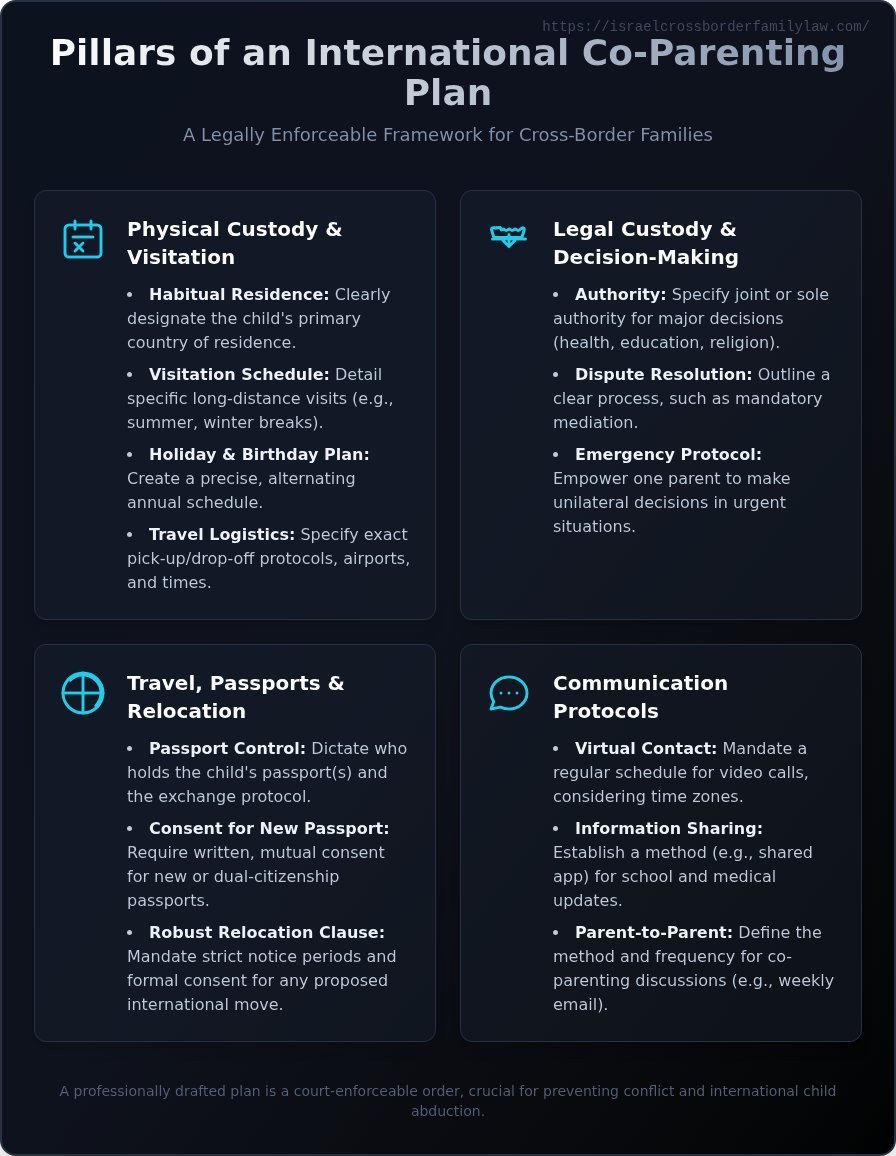
Navigating a cross-border separation requires an exceptionally robust legal framework. The following components represent the essential checklist for structuring a comprehensive international co-parenting plan after divorce. To prevent future disputes and ensure enforceability across multiple jurisdictions, every clause must be drafted with meticulous detail and absolute clarity. A well-constructed plan is built upon four foundational pillars-physical custody, legal custody, communication, and travel-each tailored to your family’s unique international circumstances.
Physical Custody and a Detailed Visitation Schedule
This section legally establishes the child’s day-to-day life and is critical for stability. It is imperative to explicitly designate the child’s primary country of ‘habitual residence,’ a key legal term under international law. From this foundation, a detailed long-distance visitation schedule must be constructed, outlining specific periods for the non-residential parent. Key elements include:
- Long-Distance Visitation: Clearly define timeframes, such as entire summer breaks or specific school holidays (e.g., winter and spring breaks).
- Holiday Schedule: Create a precise rotation for major holidays and birthdays, often alternating on an annual basis.
- Logistics: Detail the exact protocols for pick-ups and drop-offs, including designated airports, responsible parties, and precise times to eliminate ambiguity.
Decision-Making Authority (Legal Custody)
Legal custody governs who has the authority to make significant long-term decisions for the child. Your agreement must specify whether this authority is joint, requiring mutual consent, or if one parent holds sole authority in certain domains. Key areas to define include education, non-emergency medical care, and religious upbringing. Crucially, a clear process for resolving disagreements is necessary, which may involve mediation or, for high-conflict situations, implementing structured parallel parenting strategies to minimize direct conflict. The plan must also include provisions for emergencies where one parent must be empowered to make an immediate, unilateral decision.
Travel, Passports, and Relocation Clauses
In an international context, managing travel is paramount to preventing parental child abduction. The agreement must dictate who holds the child’s passport(s) and outline a secure protocol for their exchange before international visits. It should include clauses that require written, mutual consent before applying for new or dual-citizenship passports. Perhaps most critically, a robust relocation clause is non-negotiable. This must establish strict notice periods and formal consent requirements for any proposed move to another country, protecting both parents’ rights and the child’s stability. Provisions addressing responsibility for visa applications and associated travel documentation are also essential.
Navigating Legal and Jurisdictional Challenges Across Borders
This is the most critical and complex facet of structuring a durable international co-parenting plan after divorce. The interplay between the legal systems of two sovereign nations introduces a level of sophistication that standard domestic agreements cannot address. Proactive legal structuring is not merely advisable; it is a non-negotiable prerequisite for future enforceability and stability. Engaging legal counsel with specific expertise in cross-border family law, particularly within the U.S.-Israel corridor, is essential to transforming a well-intentioned agreement into a legally binding and resilient document.
Determining Jurisdiction: Which Country’s Laws Apply?
The foundational question in any multi-jurisdictional case is which court has the authority to make and modify custody orders. International law heavily relies on the concept of the child’s ‘habitual residence’-the country where their life is primarily based. As outlined in any comprehensive guide to parenting arrangements, a robust plan must include a jurisdiction clause that clearly designates which country’s courts will have exclusive, continuing jurisdiction. This preempts future conflicts and the significant risk of competing orders from courts in two different countries. In the United States, for instance, the Uniform Child Custody Jurisdiction and Enforcement Act (UCCJEA) governs these matters, highlighting the need for precise legal drafting.
The Hague Convention and Preventing Child Abduction
The Hague Convention on the Civil Aspects of International Child Abduction is the principal international treaty designed to protect children from wrongful removal or retention across borders. A meticulously drafted and court-ordered parenting plan serves as your primary defense, clearly defining custodial rights and travel permissions. Both the United States and Israel are signatories, providing a robust framework for cooperation. The Convention’s primary objective is not to settle the custody dispute, but to secure the prompt return of a child to their country of habitual residence, where the local courts can then properly address the parenting issues.
Ensuring Your Plan is Enforceable Abroad
A U.S. court order holds little direct power in Israel, and vice versa. To ensure your international co-parenting plan after divorce is fully enforceable, it is often necessary to create ‘mirror orders’-securing substantively identical orders from the competent courts in both countries. This process involves registering and domesticating the foreign custody order, effectively translating it into a local, enforceable decree. This requires language that is fully compliant with the legal statutes and terminology of both nations. Navigating these multi-jurisdictional requirements demands specialized expertise. Organise your cross-border parenting questions before speaking with independent counsel.
Practical Logistics: Making Long-Distance Co-Parenting Work
Once the foundational legal and jurisdictional issues are settled, the success of an international co-parenting plan after divorce pivots to its day-to-day operational integrity. A meticulously drafted agreement must provide a clear, unambiguous roadmap for managing the complex logistics of raising a child across different countries and time zones. This section addresses the practical mechanisms that transform a legal document into a functional, reliable framework for your family, emphasizing consistency as the cornerstone of a stable parent-child relationship despite geographical distance.
Communication Protocols and Technology
Maintaining a strong parental bond requires a disciplined and technologically-leveraged communication strategy. Modern platforms can effectively bridge the distance, but their use must be structured within the agreement to prevent misunderstandings. Key provisions should include:
- Scheduled Video Calls: A fixed schedule for video communication (e.g., Tuesday and Thursday evenings Tel Aviv time) that respects the child’s routine and accounts for significant time differences between Israel and other nations.
- Private Access: A clause guaranteeing the child’s right to private, uncensored digital communication with the non-resident parent via text, email, or video call at reasonable times.
- Centralized Platforms: Utilizing sophisticated co-parenting applications like OurFamilyWizard or 2houses to manage schedules, share documents, and track expenses. This creates a single, verifiable record of communication.
- Parental Conduct: A stipulation that all parent-to-parent communication remains respectful, business-like, and confined to matters directly concerning the child’s welfare.
Managing International Travel and Expenses
The financial and logistical burdens of international travel are significant and must be explicitly detailed to avoid future disputes. A comprehensive international co-parenting plan after divorce must provide definitive guidance on travel arrangements.
- Cost Allocation: An unambiguous formula for dividing travel costs. This may involve a percentage split (e.g., 60/40) or assign specific costs (e.g., one parent covers flights, the other covers accommodation). For instance, a flight from Tel Aviv to New York costing ₪5,000 might be divided according to the parents’ respective incomes.
- Booking Responsibility: Clearly designating which parent is responsible for researching and booking flights, and who will accompany the child, particularly when they are young.
- Airline Policies: Addressing specific airline policies, such as El Al’s or other carriers’ rules for unaccompanied minors, and building these requirements and associated fees into the plan.
- Contingency Planning: Establishing a clear protocol for travel disruptions, such as flight cancellations or medical emergencies while abroad, including who holds the child’s passport and who is the primary emergency contact in each country.
Navigating these sophisticated logistical challenges requires experienced legal guidance. For assistance in structuring a detailed agreement that ensures clarity, compliance, and stability for your family, request a case review to clarify your next steps.
Creating, Reviewing, and Modifying Your Plan
An international co-parenting plan is not a static document; it is a dynamic framework designed to evolve with your child’s needs and your family’s circumstances. The process of creating, implementing, and adapting this critical agreement requires strategic foresight and expert legal guidance. From initial negotiations to future modifications, a structured approach ensures the plan remains robust, enforceable, and always centered on the child’s best interests across international borders.
Methods of Creation: Mediation vs. Litigation
For parents committed to a cooperative outcome, mediation offers a superior forum for developing a customized, child-focused agreement. Utilizing a mediator with specific experience in cross-border family law facilitates nuanced discussions on complex issues like international travel and jurisdictional compliance. However, in high-conflict situations or cases involving a refusal to cooperate, litigation may be the only viable path to secure a court-ordered plan. Regardless of the method, any negotiated agreement must be formalized by legal counsel and ratified by the court to become legally binding and enforceable.
Planning for the Future: Review and Modification
To ensure its long-term viability, your plan must include a clear protocol for review and modification. We advise incorporating a provision for a scheduled annual review to address routine adjustments. Furthermore, the agreement should define specific life events that automatically trigger a formal review, such as a child entering primary school, a proposed relocation, or a significant change in a parent’s circumstances. Any proposed modifications must follow an agreed-upon negotiation process, be committed to writing, and subsequently be approved by the court to maintain legal validity.
The Indispensable Role of Your International Family Lawyer
Navigating the complexities of an international co-parenting plan after divorce demands sophisticated legal expertise. An experienced international family lawyer is essential for managing the entire lifecycle of your agreement. Their role is multi-faceted and critical to your success:
- They ensure the plan is fully compliant with the disparate and often conflicting laws of multiple jurisdictions, including Israel and the other parent’s country of residence.
- They possess the foresight to anticipate potential loopholes and draft precise, unambiguous language to prevent future disputes over interpretation.
- They serve as your dedicated advocate, protecting your parental rights while maintaining an unwavering focus on the child’s best interests.
- They manage the complex procedural requirements of getting the plan recognized, ordered, and enforced by the relevant courts.
Securing a durable and effective international co-parenting plan after divorce is a foundational step toward providing your child with stability. For expert guidance tailored to your unique cross-border situation, discuss preparation and coordination support with ICBFL.
Securing Your Family’s Future Across Borders
Navigating a divorce that spans international borders presents a unique and sophisticated set of challenges. As this guide has detailed, creating a meticulously detailed and legally enforceable agreement is not merely advisable-it is the cornerstone of stability for your children. Ultimately, a comprehensive international co-parenting plan after divorce is the foundational document that protects your child’s well-being and your parental rights across different legal jurisdictions. The complexities involved, from Hague Convention matters to the practical logistics of long-distance parenting, demand specialized legal counsel.
With decades of focused experience in US-Israel cross-border family law, deep expertise in Hague Convention litigation, and a proven track record in drafting and enforcing these complex international agreements, our firm is positioned to provide the authoritative guidance you require. We invite you to Request a case review for your cross-border parenting situation. Taking proactive, informed steps today ensures a more predictable and secure future for your family, no matter the distance.
Frequently Asked Questions
What happens if my ex-partner violates the international co-parenting plan?
A violation of a court-ordered international co-parenting plan is a serious legal breach. The immediate course of action involves seeking legal counsel to initiate enforcement proceedings. Depending on the nature of the breach and the jurisdictions involved, remedies may be pursued through the Israeli family courts or the foreign court. For severe violations such as wrongful retention, provisions under the Hague Convention on the Civil Aspects of International Child Abduction may be invoked to secure the child’s prompt return.
Who is responsible for paying for the child’s international travel for visitation?
Financial responsibility for the child’s travel must be explicitly delineated within the parenting agreement. Comprehensive plans typically stipulate a clear allocation of costs, which may involve one parent bearing the full expense, an equal division, or a proportional split based on parental incomes. For example, a round-trip flight can range from ₪3,500 to over ₪9,000. Defining these terms prevents significant future conflict and ensures visitation is financially sustainable for all parties involved.
How do we handle medical emergencies when the child is with the parent abroad?
Your parenting plan must contain robust and specific provisions for medical emergencies. These clauses should grant the traveling parent authority to consent to urgent medical treatment and mandate immediate notification to the other parent. The agreement must also clearly address financial responsibility for medical expenses and confirm the applicability of the child’s Israeli or international health insurance in the foreign jurisdiction. This foresight is critical for safeguarding the child’s well-being while overseas.
Can an international parenting plan be changed once it’s a court order?
Yes, a court-ordered international parenting plan can be modified, but it requires a formal legal process. The party seeking the change must petition the court and demonstrate a significant and material change in circumstances that has occurred since the original order was established. The court’s paramount consideration in any modification proceeding will be the child’s best interests. Navigating such multi-jurisdictional modifications demands sophisticated legal guidance to ensure compliance with all relevant legal frameworks.
At what age can my child have a say in the parenting plan arrangements?
Under Israeli law, there is no definitive age at which a child’s preference becomes binding. However, family courts will afford considerable weight to the expressed wishes of a mature child, generally from the age of 10-12 onwards, depending on the child’s comprehension and emotional maturity. While the judge retains ultimate discretion, the perspective of a mature minor is a significant factor when structuring or modifying an international co-parenting plan after divorce to serve the child’s best interests.
What is a ‘mirror order’ and is it necessary for my parenting plan?
A ‘mirror order’ is a legal decree issued by a court in a foreign country that formally recognizes and reflects the terms of the original parenting order from the Israeli court. While not universally mandatory, obtaining one is a highly recommended strategic measure. A mirror order makes your international co-parenting plan after divorce directly and swiftly enforceable in the other jurisdiction, providing a powerful mechanism for compliance and significantly reducing the complexity of potential cross-border legal disputes.

Article by
Gabriel Lior
A Personal Journey That Became a Mission
The advisory was founded by an American father Gabriel Lior, LLB, MBA , global entrepreneur, and cross-border advisor who spent more than a decade navigating the Israeli family court system firsthand and now lives in Singapore with his son.
As a divorced parent in a cross-border family, Gabriel faced nearly every legal challenge a foreign parent can encounter in Israel — including child custody disputes, child support proceedings, property matters in Israel and abroad, false accusations, and complex immigration and relocation proceedings.
Over the years, he learned the hard way how difficult it is for non-Israeli parents to understand the system, identify the right legal strategy, and choose the right legal representation — especially when language, culture, and jurisdictional differences are involved. He also witnessed how foreign parents and new immigrants are often disadvantaged or taken advantage of by service providers and institutions simply because they lack local knowledge or fluency.
From Client to Advisor
To truly understand — and survive — the system, Gabriel pursued formal legal education in Israel, completing two Israeli law degrees, alongside a BA and MBA earned in the United States. This was never about becoming a practicing attorney, but about gaining a deep, structural understanding of how the system works — and where it breaks down for foreign parents.
This rare combination of:
Firsthand client experience
Israeli legal and US business education
International business and negotiation training
Decades of commercial execution
created a unique perspective – one that understands both sides of the table.
After years of litigation, persistence, and at times self-representation, he ultimately succeeded in securing custody of his son and relocating abroad through a rare legal victory in the Israeli Supreme Court — becoming one of the first fathers in Israel to do so under these circumstances.
Disclaimer
Important Disclaimer:
The information provided on this website and in its content is for general informational and educational purposes only and does not constitute legal advice, legal opinion, or legal representation.
Gabriel Lior is not licensed to practice law in Israel (nor is he interested in doing so) and does not provide legal services, despite having completed 2 Law Degrees. The services offered are advisory in nature and are intended to provide general guidance, strategic insight, and information regarding cross-border family law considerations.
No attorney-client relationship is formed by accessing this website, reading its content, or communicating with us.
Any decisions made based on this information are at your own discretion and risk. For legal advice specific to your situation, you should consult a licensed attorney in the relevant jurisdiction.
Where appropriate, we may refer clients to independent, licensed attorneys or professionals. Such referrals do not constitute legal representation and no liability is assumed for services provided by third parties.