The decision to move abroad with your child is a monumental one, fraught with emotional weight and significant legal hurdles. For parents in Israel, this cross-border transition introduces a layer of judicial complexity that can feel overwhelming, sparking fears of misinterpretation and concern for the child’s ongoing relationship with the other parent. Successfully obtaining permission to relocate with child Israel is not merely a procedural step; it is a sophisticated legal undertaking where the court’s primary focus is unequivocally the child’s best interests. This requires a meticulously prepared case that addresses every facet of the proposed international move.
This complete legal guide is designed to provide clarity and strategic direction. We will navigate you through the critical stages of the Israeli family court system, from filing the initial application to presenting a compelling and viable relocation plan. By understanding the key factors judges consider and the evidence required to substantiate your request, you can build a strong case that protects the rights of both parents and, most importantly, secures a stable and prosperous future for your child in their new home. This guide will equip you with the foundational knowledge needed to approach this complex process with confidence.
Understanding Child Relocation in Israeli Law: Consent vs. Court Order
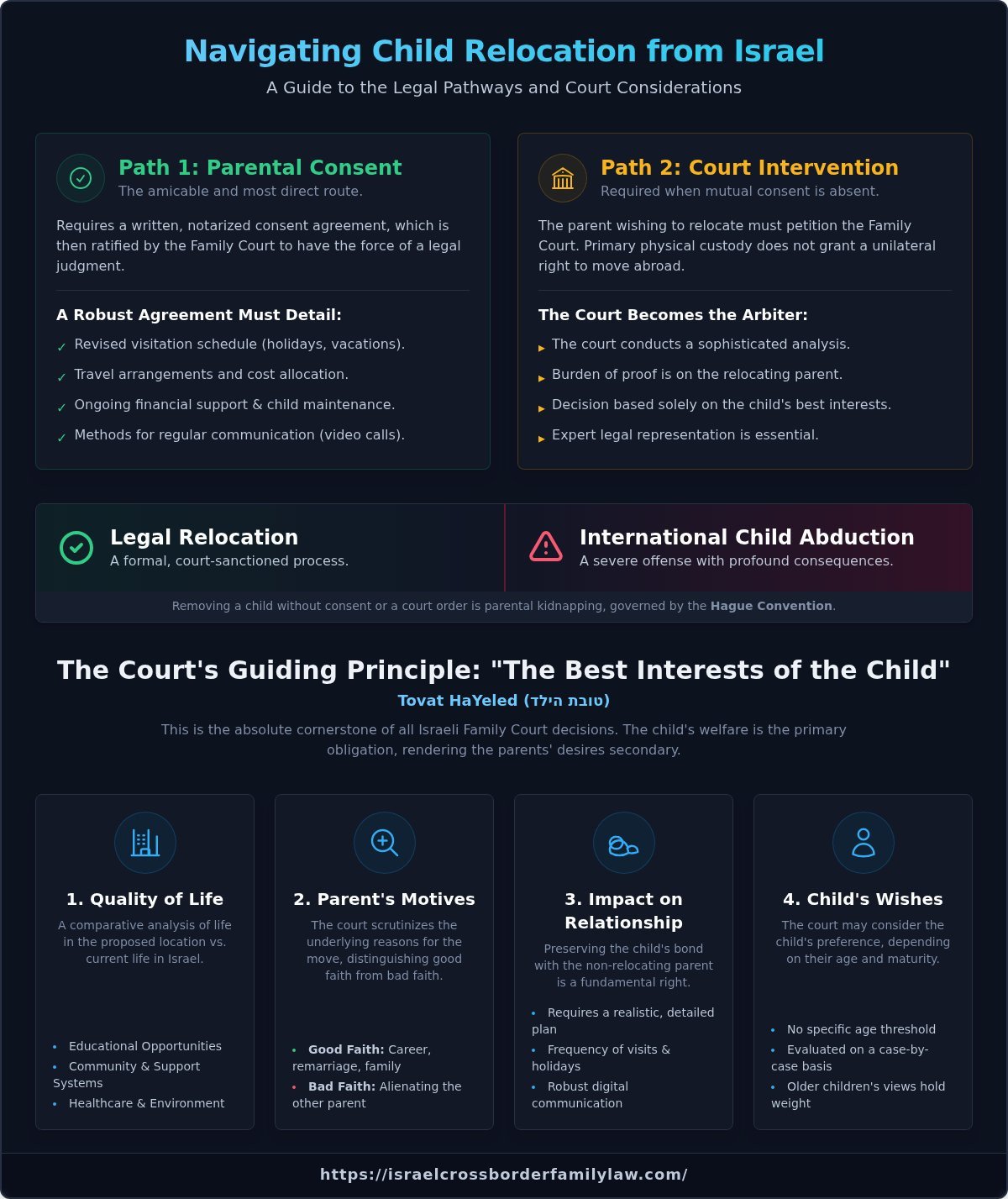
Navigating the legal framework for moving a child abroad from Israel involves a complex process formally known as the ‘Immigration Emigration of a Minor.’ This area of family law is governed by a fundamental principle: a child cannot be permanently removed from Israel without the explicit consent of all legal guardians or a definitive court order. Understanding this distinction is the critical first step for any parent contemplating an international move and seeking legal permission to relocate with child Israel.
To better understand the complexities of this legal journey, the following video provides a valuable overview:
Relocation vs. International Child Abduction
It is imperative to distinguish between a legal relocation and an act of international child abduction. Relocation is the formal, court-sanctioned process of moving a child’s primary residence to another country. Conversely, removing a child from Israel without the other parent’s consent or a court order is considered parental kidnapping. This is a severe offense with profound legal consequences under international treaties to which Israel is a signatory, most notably the Hague Convention on the Civil Aspects of International Child Abduction, which mandates the prompt return of wrongfully removed children.
The Power of Parental Consent
The most direct and amicable path to relocation is securing written, notarized consent from the non-relocating parent. A comprehensive relocation agreement is the ideal instrument for this purpose. This formal document can then be submitted to the Israeli Family Court to be ratified and given the force of a legal judgment. A robust agreement should meticulously detail:
- A revised and detailed visitation schedule for the non-relocating parent, including holidays and school vacations.
- Protocols for travel arrangements and cost allocation.
- Clear terms for ongoing financial support and child maintenance.
- Methods for regular communication (e.g., video calls).
When Court Intervention Becomes Necessary
In the absence of mutual consent, the parent wishing to relocate must petition the Family Court for permission. It is a common misconception that a parent with primary physical custody has the unilateral right to move abroad with their child; this is not the case under Israeli law. The court becomes the ultimate arbiter, tasked with a sophisticated analysis of whether the proposed move serves the child’s best interests. The court’s decision will be based on a thorough evaluation of numerous factors, making expert legal representation essential when seeking permission to relocate with child Israel through litigation.
The Core Principle: ‘The Best Interests of the Child’ (Tovat HaYeled)
When seeking permission to relocate with child Israel, every legal argument and piece of evidence is weighed against a single, paramount legal doctrine: Tovat HaYeled, or ‘The Best Interests of the Child’. This principle is the absolute cornerstone of Israeli Family Court decisions in child custody and relocation matters. It mandates that the court’s primary obligation is to the child’s welfare, rendering the desires and interests of the parents secondary. The parent petitioning for the move bears the significant burden of proof, and must present a compelling, evidence-based case demonstrating that the relocation will unequivocally serve the child’s best interests.
Factor 1: Quality of Life in the Proposed Location
The court conducts a meticulous, comparative analysis of the child’s potential life abroad versus their current life in Israel. This comprehensive review assesses tangible and intangible factors, including:
- Educational Opportunities: The quality of schools, language of instruction, and availability of special programs.
- Support Systems: The proximity of extended family, community resources, and social integration prospects.
- Healthcare and Environment: Access to quality medical care and the overall stability and safety of the proposed living environment.
Factor 2: The Motives of the Relocating Parent
The court will rigorously scrutinize the underlying reasons for the proposed move. A legitimate, good-faith motive-such as a significant career opportunity, remarriage to a foreign national, or returning to a country of origin with a robust family support network-is essential. Conversely, if the court suspects the relocation is motivated, even partially, by a desire to marginalize or alienate the other parent, the petition is highly likely to be denied. Demonstrating a well-researched and sincere plan is critical to establishing credibility.
Factor 3: Impact on the Non-Relocating Parent’s Relationship
Israeli law fiercely protects a child’s fundamental right to maintain a meaningful and consistent relationship with both parents. The court must be convinced that this bond can be preserved despite the geographical distance. The relocating parent must present a realistic and detailed plan for maintaining contact, which is often a decisive factor. This plan must go beyond vague promises, detailing the frequency of visits, holiday schedules, and robust arrangements for regular digital communication. The court’s duty to protect these rights is fundamental, aligning with broader legal frameworks detailed in the Israeli Ministry of Justice procedures concerning international child welfare.
Factor 4: The Child’s Age, Maturity, and Wishes
While not the sole determinant, the child’s own preference is a significant consideration, with its weight increasing in direct proportion to their age and level of maturity. For younger children, the court relies more heavily on expert evaluations. For older, more mature children, their expressed wishes are given substantial consideration. The court may appoint a social worker or psychologist to speak with the child in a neutral setting to ascertain their true feelings, free from parental influence. However, this preference is always balanced against the other critical factors to arrive at a final determination.
The Legal Process for Obtaining Relocation Permission: Step-by-Step
Navigating the Israeli Family Court system to secure permission for international child relocation is a formal, multi-stage legal proceeding. This is not a simple request but a complex litigation process that scrutinizes every facet of the proposed move in relation to the child’s best interests. The journey is often lengthy and emotionally demanding, requiring meticulous preparation and strategic legal guidance from the outset. Understanding the chronological steps involved is critical for setting realistic expectations and building a compelling case.
Step 1: Filing the Relocation Motion
The process formally commences when the relocating parent, through their legal counsel, files a comprehensive motion with the Family Court. This initial filing is substantial, including detailed affidavits that articulate the reasons for the move and a robust, well-researched relocation plan. This plan must cover specifics such as proposed housing, schooling, healthcare arrangements in the new country, and a viable, detailed plan for maintaining the child’s relationship with the non-relocating parent. Subsequently, the other parent files a formal response, outlining their objections to the move.
Step 2: The Role of Expert Opinions and Reports
Given the profound impact of relocation on a child, the court almost invariably appoints a neutral, third-party expert-typically a psychologist or social worker-to conduct a thorough assessment. This expert evaluates the child’s needs, the family dynamics, and the capacity of each parent to support the child’s welfare. After a series of interviews and observations, the expert submits a detailed report to the court with a professional recommendation, which carries significant weight in the judge’s final deliberation on the matter of permission to relocate with child israel.
Step 3: The Court Hearing and Judgment
The culmination of the process is the court hearing, where both parents provide testimony and may be subject to cross-examination. Lawyers present their arguments, submit evidence, and may call upon the court-appointed expert to testify regarding their findings. After considering all evidence, testimony, and legal arguments, the judge renders a final, binding judgment, either granting or denying the relocation request. The legal process is complex and the stakes are exceptionally high. Seek expert guidance for your case.
Building a Strong Relocation Case: Evidence and Strategy
Securing judicial approval for international relocation with a child from Israel is a complex legal undertaking that hinges on meticulous preparation and compelling evidence. The Israeli Family Court’s primary mandate is to protect the child’s best interests. Therefore, your objective is to present an irrefutable case demonstrating that the proposed move offers a significant, tangible benefit to the child’s welfare and future, while thoughtfully mitigating any potential detriment.
A proactive and comprehensive approach not only addresses the court’s stringent requirements but also anticipates and neutralizes the other parent’s potential objections. This demonstrates foresight and responsibility, positioning you as a parent who has thoroughly considered every facet of this life-altering decision.
Developing a Comprehensive Relocation Plan
The cornerstone of your application is a detailed and practical relocation plan. This document must move beyond aspirations and provide concrete evidence of a stable and enriching life abroad. It should meticulously outline specifics regarding housing, including a signed lease or property agreement; schooling, with acceptance letters or a comparative analysis of educational institutions; and healthcare arrangements, detailing providers and insurance coverage. Crucially, it must substantiate your financial stability through a formal job offer, a comprehensive budget projecting expenses in the new country, and proof of savings.
Proposing a Viable Visitation Schedule
Successfully obtaining permission to relocate with child Israel requires acknowledging and respecting the vital role of the non-relocating parent. Your application must include a generous and practical visitation schedule designed to preserve and foster this critical relationship. Propose extended stays during school holidays, such as summer and Pessach, and establish a clear plan for frequent communication via video calls. To demonstrate good faith and a commitment to co-parenting, consider offering to cover a substantial portion of the child’s international travel costs, for instance, by proposing an annual travel budget of ₪10,000-₪15,000.
Gathering Supporting Documentation
Every claim made in your relocation plan must be substantiated with official documentation. Assembling this portfolio is a critical step in building a persuasive and credible case. This evidence should include:
- Official Records: Current school reports, comprehensive medical histories, and any relevant psychological evaluations that speak to the child’s needs and development.
- Logistical Proof: Signed employment contracts, formal housing agreements, and official school enrollment confirmations.
- Letters of Support: Testimonials from teachers, employers, or family members in the destination country who can attest to the support network awaiting the child.
- Evidence of Bond: A collection of photographs, communication logs, and testimonies that powerfully illustrate your strong bond and role as the primary caregiver.
Assembling this complex portfolio requires strategic legal guidance. For expert assistance in building a compelling case tailored to the specific requirements of the Israeli courts, we invite you to contact our experienced legal team for a consultation.
Special Considerations for US-Israel Cross-Border Cases
Securing court approval for an international move is inherently complex. When the relocation involves the United States and Israel, the legal intricacies multiply, requiring a sophisticated understanding of two distinct judicial systems. Navigating issues of jurisdiction, enforcement, and international treaties demands specialized legal counsel capable of bridging both legal cultures.
The Hague Convention on Child Abduction
Both the United States and Israel are signatories to the Hague Convention on the Civil Aspects of International Child Abduction. This treaty provides a powerful legal mechanism for the prompt return of a child wrongfully removed or retained across international borders. Attempting to relocate without explicit court permission can be construed as international parental abduction, triggering severe legal consequences under the Convention. Therefore, meticulously following the correct legal process to obtain permission to relocate with child israel is not merely advisable-it is essential to avoid devastating legal challenges.
Jurisdiction and Enforcement of Orders
A common challenge in US-Israel cases is the enforcement of court orders across jurisdictions. While Israeli courts may recognize a US custody or relocation order under principles of legal comity, enforcement is not automatic. The order must typically be domesticated through a formal legal process in the Israeli Family Court. Navigating this multi-jurisdictional framework requires counsel with deep experience in both legal systems to ensure your court-approved relocation plan is legally sound and enforceable on both sides of the Atlantic.
Practical Challenges to Address
Beyond the formidable legal hurdles, the practical realities of a US-Israel relocation demand careful planning. Courts will scrutinize the feasibility of maintaining a meaningful relationship between the child and the non-relocating parent. Key factors include:
- Time Zone Discrepancies: Managing a 7 to 10-hour time difference for virtual visitation and co-parenting decisions.
- Travel and Logistics: The significant financial burden, with flights often costing thousands of shekels (₪), and the lengthy travel time for in-person visitation.
- Cultural and Linguistic Integration: Ensuring the child has adequate support for adapting to a new language (Hebrew or English) and a different cultural environment.
Our firm specializes in navigating the complexities of US-Israel cross-border family law. We provide the strategic guidance necessary to address these sophisticated legal and practical challenges. Contact us for a consultation.
Strategic Counsel for Your Cross-Border Relocation Matter
Securing the necessary permission to relocate with child israel is a complex, multi-faceted legal process, fundamentally governed by the principle of Tovat HaYeled-the best interests of the child. As this guide has detailed, success is contingent upon a meticulously constructed legal strategy, whether you are negotiating consent or presenting a compelling case before the family court, particularly when navigating the unique challenges of US-Israel cross-border matters.
These sophisticated international custody cases require strategic guidance from a team with proven experience. Our firm offers deep expertise in US-Israel family law, providing clients with the distinct advantage of bilingual attorneys admitted to practice in both jurisdictions. If you are contemplating or facing a relocation case, we invite you to Schedule a Consultation to Discuss Your Cross-Border Relocation Case. Allow our dedicated team to provide the clarity and direction you need to move forward with confidence.
Frequently Asked Questions
What happens if I relocate with my child from Israel without permission?
Relocating a child internationally from Israel without the other parent’s consent or a court order constitutes child abduction under Israeli law and the Hague Convention. This action carries severe legal ramifications, including the issuance of an international arrest warrant and an immediate court order for the child’s return. Such unilateral actions can critically damage your position in future custody proceedings and may result in a significant loss of parental rights, representing a grave breach of international family law.
How long does the court process for child relocation typically take in Israel?
The timeline for a child relocation case in Israel is highly variable and depends on the complexity of the matter. An uncontested case, where both parents agree, may be resolved within a few months. However, a contested relocation is a far more sophisticated legal process, often requiring comprehensive psychological assessments and expert testimony. These complex cases can extend from 12 to 24 months, or longer, contingent upon the court’s schedule and the depth of the litigation involved.
Can I relocate with my child to a different city within Israel without the other parent’s permission?
Domestic relocation within Israel is governed by the principle of whether the move substantively impacts the other parent’s custody and visitation rights. A short-distance move may not require formal consent. However, a significant relocation, such as from Tel Aviv to Eilat, that fundamentally alters existing custody arrangements will almost certainly require either the other parent’s explicit agreement or a court order. The court’s primary consideration remains the child’s best interest and the preservation of their relationship with both parents.
What are the estimated legal costs for a contested child relocation case?
The legal costs for a contested child relocation are significant and contingent upon the case’s complexity and duration. A comprehensive legal strategy involves attorney’s fees, court fees, and substantial costs for court-appointed psychological experts who assess the family. In Israel, clients should anticipate that total expenses for a complex, litigated case can range from approximately ₪50,000 to upwards of ₪200,000, reflecting the extensive professional resources required to navigate these sophisticated proceedings effectively.
If I have sole custody in Israel, do I still need permission to relocate abroad?
Yes, obtaining court approval is mandatory. In Israeli family law, holding sole custody (aputropsivut) grants you primary decision-making authority for the child’s welfare but does not extinguish the other parent’s fundamental rights. A cross-border move is viewed as a profound change that impacts the non-custodial parent’s relationship with the child. Therefore, you must still secure either their consent or a court order granting specific permission to relocate with child israel before moving abroad.
Will the Israeli court force me to move back if I am a foreign citizen who wants to return home?
The court’s decision is not automatic and will not be based solely on your status as a foreign national. The paramount principle guiding the Israeli family court is the “best interests of the child.” The court will conduct a comprehensive balancing test, weighing your fundamental right to return to your country of origin against the child’s established life, stability, and right to maintain a meaningful relationship with the parent remaining in Israel. Your citizenship is a significant factor but is not determinative.

Article by
Gabriel Lior
A Personal Journey That Became a Mission
The advisory was founded by an American father Gabriel Lior, LLB, MBA , global entrepreneur, and cross-border advisor who spent more than a decade navigating the Israeli family court system firsthand and now lives in Singapore with his son.
As a divorced parent in a cross-border family, Gabriel faced nearly every legal challenge a foreign parent can encounter in Israel — including child custody disputes, child support proceedings, property matters in Israel and abroad, false accusations, and complex immigration and relocation proceedings.
Over the years, he learned the hard way how difficult it is for non-Israeli parents to understand the system, identify the right legal strategy, and choose the right legal representation — especially when language, culture, and jurisdictional differences are involved. He also witnessed how foreign parents and new immigrants are often disadvantaged or taken advantage of by service providers and institutions simply because they lack local knowledge or fluency.
From Client to Advisor
To truly understand — and survive — the system, Gabriel pursued formal legal education in Israel, completing two Israeli law degrees, alongside a BA and MBA earned in the United States. This was never about becoming a practicing attorney, but about gaining a deep, structural understanding of how the system works — and where it breaks down for foreign parents.
This rare combination of:
Firsthand client experience
Israeli legal and US business education
International business and negotiation training
Decades of commercial execution
created a unique perspective – one that understands both sides of the table.
After years of litigation, persistence, and at times self-representation, he ultimately succeeded in securing custody of his son and relocating abroad through a rare legal victory in the Israeli Supreme Court — becoming one of the first fathers in Israel to do so under these circumstances.
Disclaimer
Important Disclaimer:
The information provided on this website and in its content is for general informational and educational purposes only and does not constitute legal advice, legal opinion, or legal representation.
Gabriel Lior is not licensed to practice law in Israel (nor is he interested in doing so) and does not provide legal services, despite having completed 2 Law Degrees. The services offered are advisory in nature and are intended to provide general guidance, strategic insight, and information regarding cross-border family law considerations.
No attorney-client relationship is formed by accessing this website, reading its content, or communicating with us.
Any decisions made based on this information are at your own discretion and risk. For legal advice specific to your situation, you should consult a licensed attorney in the relevant jurisdiction.
Where appropriate, we may refer clients to independent, licensed attorneys or professionals. Such referrals do not constitute legal representation and no liability is assumed for services provided by third parties.