For parents navigating a separation between the United States and Israel, the geographic distance can feel immense, amplifying anxieties about maintaining a strong relationship with your child and the complexities of conflicting legal systems. The fear that an agreement made in one country will not be honored in the other is a significant and valid concern. The key to bridging this divide and securing your child’s stability lies in a meticulously crafted international co-parenting plan. This document is far more than a simple custody schedule; it is a sophisticated, multi-jurisdictional legal instrument designed for enforceability in both US and Israeli courts. It provides the clear, predictable framework essential for your child’s well-being while protecting your fundamental parental rights across borders. This comprehensive guide will navigate you through the critical components of creating such a plan, from managing international travel and cultural differences to establishing clear protocols for decision-making and resolving disputes without resorting to expensive, complex international litigation. Learn how to build a legally sound foundation for a stable, long-term relationship with your child, no matter the distance.
What Is an International Co-Parenting Plan and Why Is It Non-Negotiable?
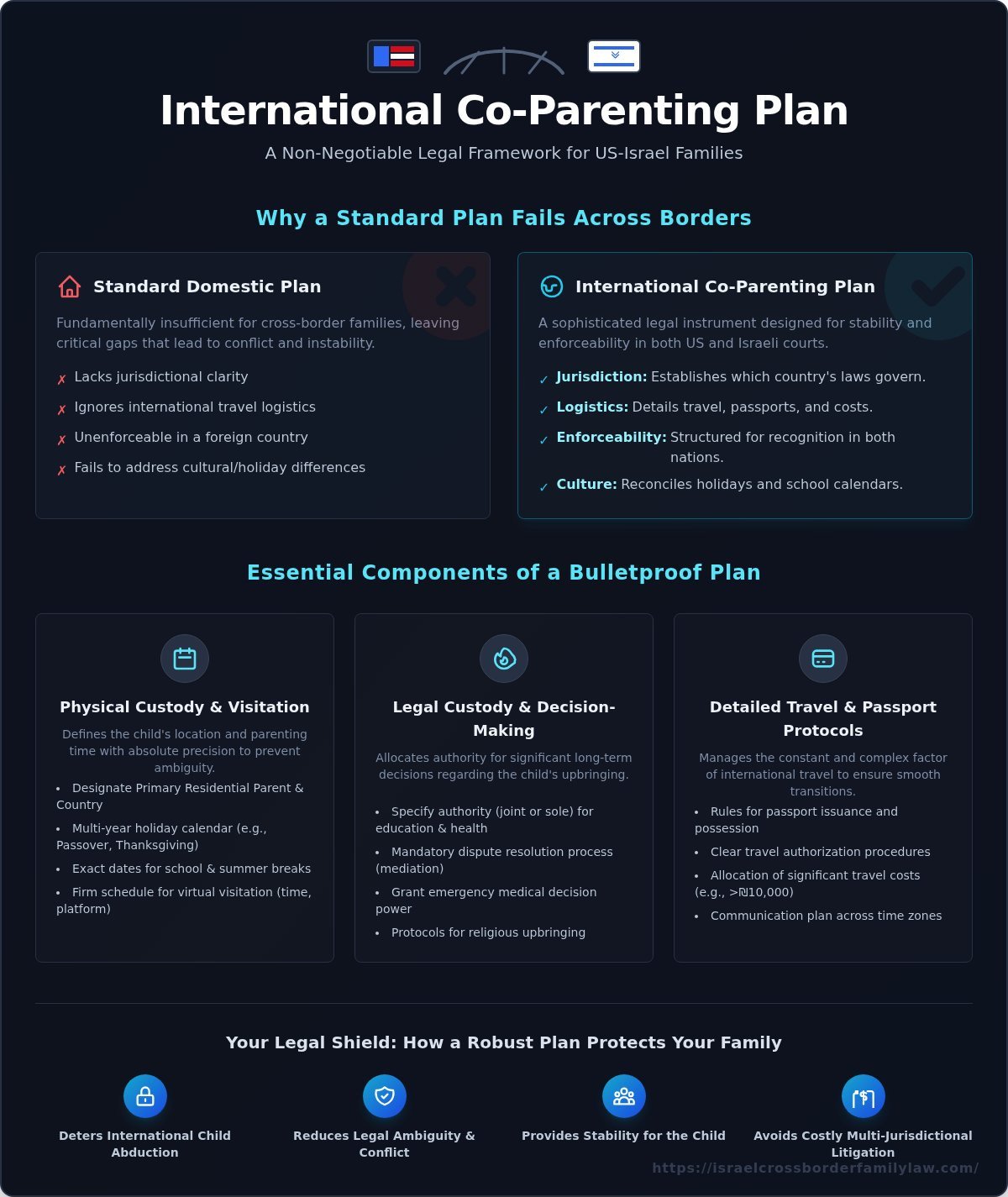
When co-parenting spans sovereign borders, such as between Israel and the United States, a standard domestic parenting agreement is fundamentally insufficient. An international co-parenting plan is a sophisticated, comprehensive legal agreement meticulously designed to govern the rights and responsibilities of parents residing in different countries. Its primary objective is to provide unwavering stability and predictability for the child, mitigating the inherent complexities of a multi-jurisdictional upbringing. In the high-stakes environment of international family law, this document is not merely advisable-it is an absolute necessity to protect your child’s welfare and your parental rights. To better understand the core principles of a co-parenting plan, consider the following overview:
Key Differences Between Domestic and International Plans
The complexities of a cross-border arrangement introduce variables that domestic plans do not address. Navigating these requires specialized legal expertise to account for:
- Jurisdictional Issues: A critical determination of which country’s laws will govern disputes. Will Israeli family court or a US state court have primary jurisdiction over custody modifications?
- Logistical Complexities: The plan must detail protocols for international travel, passport issuance and possession, managing significant time zone differences for communication, and allocating substantial travel costs, which can easily exceed ₪10,000 per trip.
- Enforcement Challenges: A court order issued in one country is not automatically enforceable in another. The plan must be structured for recognition and enforcement in both jurisdictions.
- Cultural and Language Considerations: The agreement must reconcile different school calendars, religious observances, and national holidays (e.g., Chanukah vs. Christmas) to ensure the child maintains a strong connection to both cultures.
The Legal Foundation: Protecting Your Child and Your Rights
A robust international co-parenting plan serves as a foundational legal instrument that preemptively addresses potential conflicts. By establishing clear, mutually agreed-upon terms for everything from visitation schedules to educational decisions, it drastically reduces the legal ambiguity that often fuels parental disputes. More critically, it acts as a powerful deterrent against the gravest risk in these situations: international child abduction. A well-drafted plan, recognized by courts in both nations, provides the first and most effective line of defense against wrongful removal or retention. It works in concert with international treaties like the Hague Abduction Convention to create a formidable legal barrier, ensuring a clear framework exists for resolving future disagreements without resorting to protracted and emotionally devastating multi-jurisdictional litigation.
Essential Components of a Bulletproof International Parenting Plan
In navigating the complexities of multi-jurisdictional family law, ambiguity is the primary catalyst for future conflict. A meticulously drafted international co-parenting plan serves as a foundational legal instrument, designed to provide clarity, predictability, and stability for children living between two countries. To be effective and enforceable, the agreement must be extraordinarily specific, addressing not just general principles but the granular details of the co-parenting relationship. The following components are critical for constructing a resilient and comprehensive plan.
Physical Custody and Visitation Schedules
This section defines the child’s physical location and the structure of parenting time. Vague agreements are unenforceable; therefore, absolute precision is required. Key provisions should include:
- Primary Residential Parent: Clearly designate which parent will be the primary residential parent and in which country (e.g., Israel or the United States).
- Holiday Schedules: Create a detailed, multi-year calendar that explicitly allocates major holidays in both countries, such as Rosh Hashanah, Passover, Thanksgiving, and Christmas.
- School and Summer Breaks: Define the exact start and end dates for parenting time during extended school and summer holidays, including specific travel dates and exchange locations.
- Virtual Visitation: Establish a firm schedule for remote contact, specifying the frequency, duration, and platforms (e.g., “video calls every Sunday at 6:00 PM Israel Standard Time for 30 minutes”).
Legal Custody: Decision-Making Authority
Legal custody concerns the authority to make significant long-term decisions for the child. A robust international co-parenting plan must delineate these responsibilities to prevent disputes over fundamental aspects of the child’s upbringing.
- Allocation of Authority: Specify whether decisions regarding education, non-emergency healthcare, and religious upbringing will be made jointly or allocated to one parent.
- Dispute Resolution: Incorporate a mandatory process for resolving disagreements on joint decisions, such as engaging a designated mediator or parent coordinator before resorting to court action.
- Emergency Decisions: Grant the parent who is physically with the child the authority to make emergency medical decisions, with a duty to inform the other parent as soon as practicable.
Detailed Travel and Passport Protocols
For parents residing in different countries, travel is a constant factor. This section is paramount for ensuring smooth transitions and preventing parental child abduction. These protocols are not merely for convenience; they are fundamental safeguards, aligning with U.S. State Department prevention tips for high-conflict situations.
- Expense Allocation: Clearly assign financial responsibility for all travel, including airfare, ground transport, and accommodation. For example, specify that the visiting parent is responsible for round-trip airfare up to a maximum of ₪7,000.
- Passport Control: Designate which parent will hold the child’s passport(s) and outline the protocol for transferring the document(s) before scheduled travel. Include terms for renewal of all passports.
- Travel Consent: Mandate that a notarized and signed letter of consent from the non-traveling parent is required for all international travel.
- Contingency Plans: Address potential travel disruptions, such as flight cancellations or medical emergencies while abroad, and define the procedures and financial responsibilities for managing them.
Navigating Legal Enforceability in the US and Israel
A meticulously drafted international co-parenting plan is foundational, but its practical value hinges on its legal enforceability across borders. A custody order issued by a court in the United States is not automatically recognized or enforced by the Israeli family court system, and vice versa. This disparity creates significant risk and uncertainty. Navigating the complex interplay between national laws and international treaties requires sophisticated legal strategy to ensure your agreement provides genuine security for your family’s future.
The Hague Convention: Your First Line of Defense
The Hague Convention on the Civil Aspects of International Child Abduction is a critical international treaty designed to secure the prompt return of a child wrongfully removed to or retained in another signatory country. A detailed co-parenting plan serves as powerful evidence of the child’s “habitual residence” and the custodial rights of each parent. This documentation is invaluable in proving a “wrongful retention” has occurred. However, as detailed in the official guide to International Child Abduction Laws in Israel, the Convention is a mechanism for return, not a tool for enforcing specific visitation schedules, making a comprehensive plan essential.
Jurisdiction Clauses: Deciding Which Court Has Power
To prevent protracted multi-jurisdictional legal battles, your plan must explicitly designate a single country’s court system (the “home state”) to have exclusive jurisdiction over future disputes. In the US, the Uniform Child Custody Jurisdiction and Enforcement Act (UCCJEA) governs these matters. While Israeli courts generally respect foreign custody orders, particularly from fellow Hague Convention signatories, they retain ultimate authority over the welfare of children residing in Israel. A clear jurisdiction clause provides critical guidance to the courts in both nations.
Using Mirror Orders for Seamless Enforcement
The gold standard for cross-border enforceability is the creation of “mirror orders.” This strategic legal process involves having your initial custody order reviewed and ratified by the court in the second country, resulting in a substantively identical and legally binding order in both jurisdictions. Registering a US order in Israel, for example, transforms it into a local decree that Israeli authorities can enforce directly, eliminating ambiguity and streamlining compliance. This is the most effective method for ensuring your international co-parenting plan is robust and actionable. Ensure your plan is enforceable. Consult with our experts.
Proactively Addressing Common International Co-Parenting Challenges
A truly effective international co-parenting plan does more than outline a schedule; it anticipates future friction and provides a clear, mutually agreed-upon framework for resolution. By addressing potential “what-if” scenarios from the outset, parents can build a foundation of trust and significantly reduce the likelihood of costly, emotionally draining future litigation. This foresight demonstrates a shared commitment to stability and is the hallmark of a sophisticated, durable agreement designed for the complexities of cross-border family life.
Parental Relocation: Moving to a Third Country
One of the most significant anxieties in international co-parenting is the potential for one parent to relocate to a third country. To mitigate this, your plan should include specific clauses requiring a minimum of 90-120 days’ advance written notice and the express written consent of the other parent before any international move with the child. The agreement must also define a clear process for modifying the plan, establishing which jurisdiction will oversee changes and outlining how parenting time, travel costs, and support obligations will be reassessed.
Managing Communication Across Time Zones and Cultures
Logistical and cultural barriers can strain communication. A robust international co-parenting plan should therefore codify communication protocols. This includes establishing a set schedule for parent-to-parent discussions (e.g., a weekly email update) and mandating the use of a monitored co-parenting application to maintain an official record. Critically, it should also contain a language provision, stipulating that all binding communications regarding the children be conducted in a single, agreed-upon language, such as English, to prevent misinterpretation.
Dispute Resolution Mechanisms
To avoid defaulting to court intervention for every disagreement, a strategic plan incorporates a tiered dispute resolution process. We advise clients to include clauses that:
- Require mandatory mediation with a certified family mediator as a prerequisite to filing any court action.
- Appoint a neutral parenting coordinator to resolve minor, day-to-day disagreements, with professional fees in Israel typically starting from ₪500-₪800 per hour.
- Clearly allocate the costs associated with these resolution processes, which are often shared equally.
Integrating these mechanisms provides a structured, cost-effective path to resolving conflict while preserving the parental relationship. For expert guidance on structuring a plan that navigates these complex, multi-jurisdictional issues, our team of cross-border specialists is prepared to assist.
Modifying Your Plan as Your Child’s Needs Evolve
A meticulously drafted international co-parenting plan provides essential structure and predictability for families living across borders. However, it is a foundational error to view this agreement as static. As a child matures from infancy through adolescence, their needs, preferences, and circumstances will inevitably change. A successful plan must therefore be a living document, designed with the flexibility to adapt to the dynamic realities of your child’s life and your multi-jurisdictional family structure.
Age-Appropriate Adjustments
The logistical and emotional requirements of co-parenting evolve directly with a child’s age. Provisions that are appropriate for a toddler will be insufficient or even counterproductive for a teenager. A forward-thinking plan anticipates these shifts, and modifications should address:
- Travel Arrangements: A young child may require an adult escort for international flights, a significant logistical and financial consideration. An older, more independent teenager, however, may be capable of traveling solo, which alters arrangements for supervision, costs, and travel documentation.
- Scheduling Input: While parents dictate the schedule for a young child, granting older teens a voice in their visitation schedule-factoring in their academic, social, and extracurricular commitments-can foster greater cooperation and respect for the co-parenting relationship.
- Virtual Communication: The expectation of daily video calls with a five-year-old may transition to scheduled weekly calls or more flexible text-based communication with a high-school student, acknowledging their need for greater autonomy.
The Formal Modification Process
When adjustments are needed, the path to modification depends on the scope of the proposed change. For minor logistical shifts mutually agreed upon by both parents, a simple written and signed agreement may be sufficient. However, for substantial alterations to custody, visitation schedules, or relocation matters, a formal court-ordered modification is imperative to ensure legal enforceability. In Israel, as in many jurisdictions, modifying a court-sanctioned parenting order requires demonstrating a “significant change in circumstances” (shinui nesibot mahuti). This is a considerable legal threshold. The petitioning parent must provide compelling evidence that the existing arrangements are no longer in the child’s best interests due to new, unforeseen circumstances. Navigating this complex process requires sophisticated legal guidance to properly present your case to the court and amend your international co-parenting plan effectively. Life changes. Your parenting plan can too. Let us help.
Secure Your Child’s Future with a Strategic Cross-Border Parenting Plan
Navigating the complexities of a US-Israel co-parenting arrangement demands more than a standard agreement; it requires a meticulously crafted, legally robust international co-parenting plan. This foundational document must anticipate future challenges and be enforceable across both jurisdictions. As we have detailed, a comprehensive plan proactively addresses critical issues from relocation clauses to holiday schedules, providing essential stability for your child amidst the intricacies of cross-border family life and transforming potential conflict into a clear, predictable framework. Protecting your child’s best interests across continents is a complex legal undertaking. Our firm offers specialized expertise in US-Israel cross-border family law, providing sophisticated guidance on creating legally enforceable, multi-jurisdictional agreements. With a deep understanding of The Hague Convention and international custody law, we are uniquely positioned to protect your parental rights. Do not leave your family’s future to chance. Schedule a Consultation to Draft Your US-Israel Cross-Border Parenting Plan and build a secure foundation for your child’s well-being. Taking this proactive step today provides peace of mind for all the years to come.
Frequently Asked Questions
What happens if my ex-partner violates the international co-parenting plan?
If your ex-partner violates the international co-parenting plan, immediate legal action is required. Once ratified by the court, the plan is a legally binding order. A violation can trigger contempt of court proceedings in the jurisdiction that issued the order. For severe breaches, such as wrongful retention of a child, remedies may be available under the Hague Convention on the Civil Aspects of International Child Abduction. It is critical to consult with counsel in the relevant jurisdiction to initiate enforcement proceedings.
Can I prevent my child from traveling to Israel or the US if I have safety concerns?
Preventing a child’s court-approved international travel requires demonstrating a specific and credible risk to the child’s well-being. A parent must petition the court and provide compelling evidence of immediate danger, such as political instability, a direct threat, or a high risk of abduction, not just general anxiety. The court will then evaluate the evidence based on the child’s best interests. Without a court order modifying the travel agreement, preventing the travel could be considered a violation of the custody order.
How do we handle different school calendars and major holidays between the US and Israel?
A comprehensive plan must explicitly map out both the US and Israeli school calendars, including the American summer break and the Israeli “Chofesh Gadol.” Major holidays for both cultures, such as Rosh Hashanah, Passover, Thanksgiving, and Christmas, must be addressed with precision. A common strategy is to alternate key holidays annually and clearly define the start and end times for each parent’s custodial period, including travel arrangements, to prevent future disputes across different time zones and cultural calendars.
Do we need separate family law attorneys in both the United States and Israel?
Yes, retaining counsel in both jurisdictions is not only advisable but essential for effective representation and enforcement. Each country possesses a distinct legal framework, procedural rules, and judicial standards for family law. An attorney licensed in Israel is required to navigate the Israeli family court system, while a US-licensed attorney is necessary for all proceedings on American soil. This dual-counsel approach ensures your cross-border parenting agreement is robust, compliant, and enforceable in both nations.
What is the difference between sole and joint legal custody in an international context?
In a cross-border context, joint legal custody grants both parents shared authority to make crucial decisions regarding the child’s education, healthcare, and religious upbringing, irrespective of physical location. Sole legal custody vests this decision-making power in a single parent. This distinction is critical for international matters, including passport applications, consent for international travel, and potential relocation. While logistically complex, courts often favor joint arrangements to ensure both parents remain involved in the child’s life.
How can a co-parenting plan address concerns about parental alienation?
A sophisticated international co-parenting plan can proactively mitigate the risk of parental alienation by incorporating specific, enforceable clauses. These provisions should mandate regular and unimpeded communication via video and phone, prohibit disparaging language about the other parent, and require each parent to actively foster the child’s relationship with the other. The plan can also establish a clear protocol for dispute resolution, such as mandatory mediation, to address alienating behaviors before they escalate into a complex multi-jurisdictional conflict.

Article by
Gabriel Lior
A Personal Journey That Became a Mission The advisory was founded by an American father Gabriel Lior, LLB, MBA , global entrepreneur, and cross-border advisor who spent more than a decade navigating the Israeli family court system firsthand and now lives in Singapore with his son.
As a divorced parent in a cross-border family, Gabriel faced nearly every legal challenge a foreign parent can encounter in Israel — including child custody disputes, child support proceedings, property matters in Israel and abroad, false accusations, and complex immigration and relocation proceedings. Over the years, he learned the hard way how difficult it is for non-Israeli parents to understand the system, identify the right legal strategy, and choose the right legal representation — especially when language, culture, and jurisdictional differences are involved. He also witnessed how foreign parents and new immigrants are often disadvantaged or taken advantage of by service providers and institutions simply because they lack local knowledge or fluency. From Client to Advisor To truly understand — and survive — the system, Gabriel pursued formal legal education in Israel, completing two Israeli law degrees, alongside a BA and MBA earned in the United States. This was never about becoming a practicing attorney, but about gaining a deep, structural understanding of how the system works — and where it breaks down for foreign parents. This rare combination of: Firsthand client experience Israeli legal and US business education International business and negotiation training Decades of commercial execution created a unique perspective – one that understands both sides of the table. After years of litigation, persistence, and at times self-representation, he ultimately succeeded in securing custody of his son and relocating abroad through a rare legal victory in the Israeli Supreme Court — becoming one of the first fathers in Israel to do so under these circumstances.
Disclaimer
Important Disclaimer: The information provided on this website and in its content is for general informational and educational purposes only and does not constitute legal advice, legal opinion, or legal representation. Gabriel Lior is not licensed to practice law in Israel (nor is he interested in doing so) and does not provide legal services, despite having completed 2 Law Degrees. The services offered are advisory in nature and are intended to provide general guidance, strategic insight, and information regarding cross-border family law considerations. No attorney-client relationship is formed by accessing this website, reading its content, or communicating with us. Any decisions made based on this information are at your own discretion and risk. For legal advice specific to your situation, you should consult a licensed attorney in the relevant jurisdiction. Where appropriate, we may refer clients to independent, licensed attorneys or professionals. Such referrals do not constitute legal representation and no liability is assumed for services provided by third parties.