Entering into a marriage in Israel when your financial life-your assets, business interests, and inheritances-is rooted in another country presents a unique and complex set of legal challenges. For many international couples, questions surrounding the enforceability of foreign agreements and the division of assets under Israeli law can be a significant source of uncertainty. Navigating the dual jurisdiction of Israel’s Family Courts and Rabbinical Courts adds another layer of complexity, making a meticulously drafted israeli prenup for foreigners an essential instrument for securing your future. This comprehensive guide is designed to navigate you through this multi-jurisdictional landscape. We will provide a definitive roadmap covering the critical steps, essential legal requirements, and key protections for creating a valid and enforceable prenuptial agreement in Israel. Our objective is to deliver the clarity and strategic insight necessary to protect your cross-border assets, demystify the legal process, and provide you with the profound peace of mind that comes from a secure financial foundation for your international marriage.
Why an Israeli Prenup is Essential for Foreigners and Expats
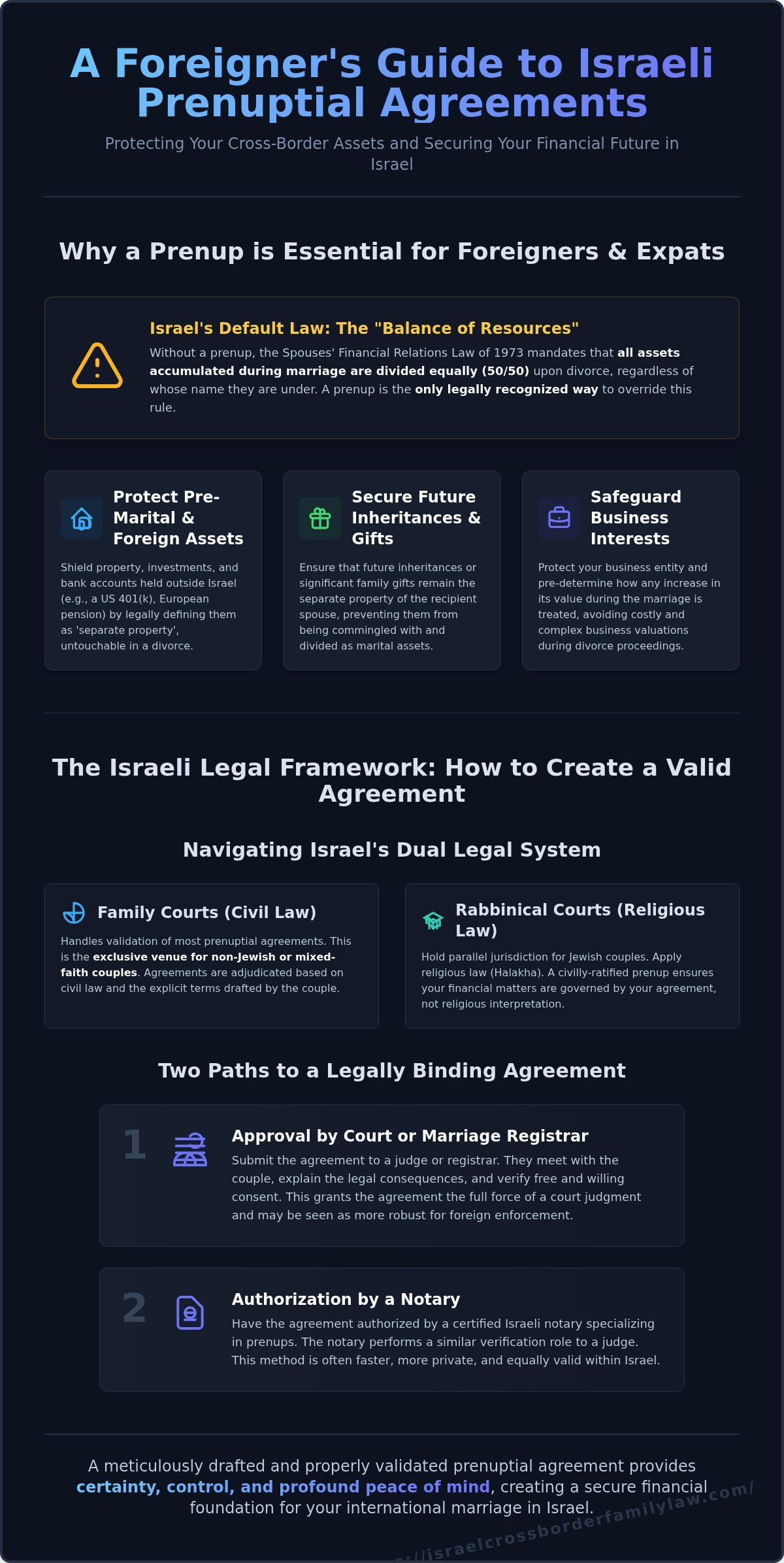
For international couples establishing a life in Israel, a prenuptial agreement is no longer a tool reserved for the exceptionally wealthy; it is a fundamental component of sophisticated financial and marital planning. Under Israel’s Spouses (Property Relations) Law, 5733-1973, the default legal presumption is that all assets accumulated during the marriage are to be divided equally upon divorce. This framework can create significant uncertainty for expats with complex, multi-jurisdictional financial profiles. A meticulously drafted agreement provides clarity and control, allowing couples to override these default provisions and establish their own legally binding terms. Understanding what a prenuptial agreement is on a global scale provides essential context for appreciating its power within Israeli law. To better understand the specific benefits within the Israeli legal context, the following video provides a concise overview:
Protecting Pre-Marital and Foreign Assets
A primary function of an israeli prenup for foreigners is to explicitly define and protect ‘separate property.’ This includes all assets owned by either party prior to the marriage. For expats, this is particularly critical as it shields real estate, investment portfolios, and bank accounts held outside of Israel from being considered part of the marital estate. For example, assets such as a US-based 401(k), a European pension plan, or property in another country can be legally designated as separate, ensuring they remain untouched in the event of a marital dissolution.
Securing Future Inheritances and Gifts
Cross-border families often involve significant future inheritances or substantial gifts. An Israeli prenuptial agreement provides a robust mechanism to ensure these assets remain the separate property of the recipient spouse. Without such an agreement, gifted funds or inherited property can become commingled with marital assets over time, potentially subjecting them to division. This legal foresight offers peace of mind not only to the couple but also to family members abroad who wish for their bequests to benefit their intended heir exclusively.
Safeguarding Business Interests
For entrepreneurs or individuals with ownership stakes in a business established before the marriage, a prenup is indispensable. The agreement can protect the business entity itself and, crucially, address the complex issue of how any appreciation in the business’s value during the marriage will be treated. By pre-determining this division-or stipulating that the appreciation remains separate property-couples can prevent protracted and expensive business valuations, which can cost tens of thousands of shekels, and potential litigation during divorce proceedings.
The Israeli Legal Framework: Navigating the System as a Foreigner
For expatriates residing in Israel, understanding the domestic legal landscape governing marital assets is not merely advisable; it is critical. The foundational legislation is the Spouses’ Financial Relations Law of 1973, which establishes a default regime for all couples married after January 1, 1974. This law institutes the principle of ‘Balance of Resources,’ meaning that upon divorce or death, all assets and properties accumulated during the marriage-irrespective of whose name they are registered under-are presumed to be joint property and are typically divided equally. This includes real estate, savings, pensions, and even business interests. Crucially, a prenuptial agreement is the only legally recognized instrument to deviate from this default system. Any verbal or informal understandings regarding asset division are unenforceable in Israeli courts, making a formal, written agreement indispensable.
Family Court vs. Rabbinical Court: A Critical Distinction
Israel operates a dual legal system for family matters, a complex reality that foreigners must navigate. Civil matters, including the validation of most prenuptial agreements, are handled by the Family Courts. For non-Jewish or mixed-faith couples, this is the exclusive venue. For Jewish couples, the Rabbinical Courts, which apply religious law (Halakha), have parallel jurisdiction. A civilly-ratified prenuptial agreement provides certainty and ensures that financial matters are governed by the couple’s explicit intentions rather than religious interpretations, a vital consideration for creating a robust israeli prenup for foreigners with multi-jurisdictional assets.
Two Paths to a Legally Binding Agreement
To ensure an Israeli prenuptial agreement is legally binding and enforceable, it must be formally validated through one of two official channels. The process is designed to confirm that both parties fully comprehend the agreement’s terms and consent to them freely and without coercion.
- Method 1: Approval by the Family Court or a Marriage Registrar. This path involves submitting the agreement to a judge or registrar who will meet with the couple, explain the legal consequences of the agreement, and verify their willing consent before granting it the force of a court judgment.
- Method 2: Authorization by a Notary. Alternatively, a couple can have their agreement authorized by a certified Israeli notary specializing in prenuptial agreements. The notary performs a similar verification function to that of a judge.
For international couples, the choice between these methods can be strategic. While a notarized agreement is often faster and more private, a court-approved agreement may be perceived as more robust for enforcement in foreign jurisdictions. A comprehensive understanding of the Israeli legal framework for prenups is essential, as the procedural requirements are strict and determinative of the agreement’s validity in any future cross-border dispute.
Essential Clauses for a Cross-Border Prenuptial Agreement
A robust cross-border prenuptial agreement is far more than a standard template; it is a bespoke legal strategy crafted to anticipate the future complexities of international life. For expatriates in Israel, a generic document is insufficient. A meticulously drafted israeli prenup for foreigners must precisely detail global assets to ensure its enforceability across jurisdictions. Failure to address these multi-jurisdictional issues can lead to protracted and costly legal battles, a primary concern in the complex landscape of divorce for international families.
Defining Separate and Marital Property
This foundational clause requires an exhaustive inventory of all pre-marital assets, specifying their exact location and valuation. From real estate in Herzliya to an inheritance held in a European bank, each item must be clearly designated as separate property. The agreement must also articulate a clear framework for how assets acquired during the marriage will be treated-whether as joint marital property subject to division or as separate assets, depending on the source of funds and the couple’s mutual intentions.
Handling Foreign Assets, Pensions, and Investments
For expats, this section is of paramount importance. The agreement must explicitly address assets held outside of Israel, such as foreign bank accounts, international stock portfolios, and retirement funds like a U.S. 401(k) or a UK pension. Sophisticated clauses should govern the treatment of any appreciation on these separate assets. Furthermore, the document must anticipate the complexities of fluctuating currency exchange rates and the divergent tax laws of multiple jurisdictions to prevent future financial ambiguity.
Spousal Support (Alimony) and Choice of Law
An effective prenup can proactively define the terms of spousal support (alimony), either through a complete waiver or by establishing specific conditions, duration, and amounts, thereby providing certainty. Crucially, it must include a “Choice of Law” clause. This provision specifies which country’s legal system will govern the agreement’s interpretation. For couples with ties to Israel and another nation, this clause is a cornerstone of a defensible agreement, ensuring that one consistent legal standard applies. This is a critical consideration given the unique aspects of Israeli marriage laws and their interaction with foreign legal systems.
The Process: How to Draft and Ratify Your Israeli Prenup
Navigating the creation of an israeli prenup for foreigners involves a structured, multi-stage process meticulously designed to ensure legal validity and mutual fairness. The cornerstone of this entire procedure is absolute transparency. Both parties are legally required to provide full and honest financial disclosure, detailing all assets and liabilities, whether held in Israel or abroad. Any attempt to conceal assets or misrepresent one’s financial standing can be used as grounds to invalidate the entire agreement in the future. Our firm is adept at guiding international clients through each stage to ensure a smooth and legally sound outcome. We manage the complexities so you can focus on the future. You can learn about how our process works in more detail here.
Step 1: Seeking Independent Legal Counsel
It is a non-negotiable prerequisite under Israeli law that each partner retains their own independent legal counsel. This fundamental requirement ensures that the agreement is not one-sided and that both individuals’ rights and long-term interests are robustly protected. For expats with assets in multiple countries, engaging a lawyer with specific expertise in cross-border family law is critical to addressing complex, multi-jurisdictional financial matters with the necessary sophistication.
Step 2: Drafting, Translation, and Negotiation
Once legal representation is secured, the process moves to the drafting phase. The agreement is typically prepared in both Hebrew and English to ensure complete clarity for all parties. This initial draft becomes the basis for negotiation, a collaborative yet meticulous stage where both legal teams refine the terms to reflect a mutual understanding. Ensuring the final translation is certified and accurately conveys the precise legal intent of the original text is a paramount concern.
Step 3: Ratification Before a Court or Notary
The final, critical step is official ratification. Both parties must appear in person before either a Family Court judge or a specially authorized notary. This official will verbally confirm that both individuals fully understand the agreement’s terms and consequences, and are signing it of their own free will without coercion. Once signed and ratified, the prenuptial agreement attains the binding legal force of a court judgment, providing maximum legal certainty and enforceability.
Common Pitfalls for Foreigners and How to Avoid Them
Navigating the Israeli legal system presents unique challenges for non-citizens, particularly in the sphere of family law and asset protection. The complexities of multi-jurisdictional assets and differing legal standards demand a proactive strategy. A poorly executed prenuptial agreement can be more detrimental than having no agreement at all, creating costly legal battles that it was designed to prevent. Proactive planning with expert legal guidance is the definitive key to avoiding these errors and securing your financial future.
Mistake 1: Relying Solely on a Foreign Prenup
A common misconception is that a prenuptial agreement drafted and signed in another country, such as the United States or the United Kingdom, is automatically enforceable in Israel. In reality, such a document may require ratification by an Israeli court to be considered valid, a process that is by no means guaranteed. The most secure and effective strategy is to draft an agreement that is fully compliant with Israeli law from the outset, ensuring its validity and enforceability within the Israeli legal framework.
Mistake 2: Vague Language and Incomplete Disclosure
Ambiguity is the enemy of a sound prenuptial agreement. When dealing with international assets, vague terms can lead to significant disputes over interpretation during a divorce. Furthermore, Israeli law requires full and transparent disclosure of all assets. A failure to disclose can be used as grounds to invalidate the entire agreement. To avoid this, your agreement must be meticulously detailed, specifying:
- Bank account numbers and financial institutions
- Specific addresses for real estate properties
- Legal names of business entities and trusts
- Valuations for significant personal property
Mistake 3: Signing Under Duress or Without Understanding
An agreement must be entered into freely and with full comprehension. Presenting a prenup immediately before a wedding can be legally construed as coercion or duress, jeopardizing its validity. Both parties must have adequate time to review the document with their own independent counsel. Crucially, if you are not fluent in Hebrew, you must never sign a document you cannot read. Insist on a certified translation to ensure you fully understand every clause and its implications. Crafting a valid israeli prenup for foreigners demands careful attention to these procedural safeguards. Our firm possesses deep and specialized experience in advising international clients on these complex matters. We understand the intersection of Israeli and foreign legal systems, providing the strategic counsel necessary to draft an agreement that protects your interests. For a detailed overview of our work, please review our dedicated services for expats and foreign nationals. To ensure your agreement is structured correctly from the start, contact our legal team for a consultation.
Navigating Your Cross-Border Union with Confidence
For expatriates and foreign nationals, entering into marriage in Israel necessitates a proactive approach to asset protection. As this guide has detailed, a prenuptial agreement is not merely a precautionary measure but a foundational tool for financial clarity in a multi-jurisdictional context. The key takeaways are clear: understanding Israel’s distinct legal system is paramount, and a bespoke agreement is essential to safeguard international assets. Successfully creating an israeli prenup for foreigners means navigating complex legal nuances to avoid common pitfalls that could undermine the agreement’s future validity. Executing such a sophisticated legal instrument demands specialized counsel. With decades of experience protecting the assets of international families, our firm provides unparalleled and specialized expertise in US-Israel cross-border family law. Our bilingual attorneys are fluent in the legal and cultural nuances of both systems, ensuring your agreement is robust and enforceable. Do not leave your financial future to chance. Secure your assets with expert guidance. Request a confidential case review. By taking this definitive step, you can enter your marriage with the security and peace of mind that comes from strategic foresight.
Frequently Asked Questions About Israeli Prenuptial Agreements
Is a prenuptial agreement from the United States valid in Israel?
A prenuptial agreement executed in the United States is not automatically enforceable in Israel. For such a cross-border agreement to be legally binding, it must be ratified by an Israeli Family Court or an authorized notary. The court will review the foreign agreement to ensure its terms do not contravene Israeli public policy and that both parties fully understood its implications before signing. Without this crucial ratification step, the agreement may face significant challenges to its validity in an Israeli divorce proceeding.
Do my fiancé and I both need to hire our own separate lawyers?
While not a strict legal requirement in Israel, it is highly advisable for each party to retain their own independent legal counsel. This ensures that both individuals receive impartial advice tailored to their specific financial circumstances and protects their respective interests. Having separate representation also strengthens the agreement against future claims of duress or lack of understanding, thereby enhancing its legal robustness and enforceability should the need arise in a complex, multi-jurisdictional marital dissolution.
What happens if we don’t speak Hebrew? How is the agreement ratified?
The Israeli legal system is well-equipped to handle matters for non-Hebrew speakers. A comprehensive israeli prenup for foreigners can be drafted and executed in English. For ratification, the court or notary will require a certified Hebrew translation of the document. The ratifying authority has a duty to confirm that both parties fully comprehend the agreement’s terms and implications, often utilizing a translator during the hearing if necessary, to ensure informed consent and procedural integrity.
Can an Israeli prenuptial agreement determine child custody or support?
No, an Israeli prenuptial agreement cannot predetermine matters of child custody or child support. Under Israeli law, the guiding and overriding principle in all matters concerning minors is the “best interests of the child.” These issues remain exclusively within the jurisdiction of the Family Court at the time of separation or divorce. The court will make its determination based on the circumstances prevalent at that future time, and any prior agreement on these specific points will not be binding.
How much does it cost to get a prenuptial agreement in Israel?
The cost for a professionally drafted prenuptial agreement in Israel varies based on the complexity of the financial assets and the extent of negotiations required. Legal fees typically range from ₪6,000 to ₪20,000 or more for sophisticated cross-border cases. Additionally, there are separate, more modest fees for the ratification process itself, whether through the Family Court or a notary, which are set by law and are generally a few hundred shekels plus VAT.
Can we change or cancel our prenuptial agreement after we are married?
Yes, a prenuptial agreement can be amended or cancelled after marriage, but this requires the explicit and mutual consent of both spouses. The process for changing or cancelling the agreement mirrors the original execution process: the new terms must be put in writing and formally ratified by an Israeli Family Court or an authorized notary. An informal, unratified change will not be legally enforceable, and the original, ratified agreement will remain in full effect.

Article by
Gabriel Lior
A Personal Journey That Became a Mission The advisory was founded by an American father Gabriel Lior, LLB, MBA , global entrepreneur, and cross-border advisor who spent more than a decade navigating the Israeli family court system firsthand and now lives in Singapore with his son.
As a divorced parent in a cross-border family, Gabriel faced nearly every legal challenge a foreign parent can encounter in Israel — including child custody disputes, child support proceedings, property matters in Israel and abroad, false accusations, and complex immigration and relocation proceedings. Over the years, he learned the hard way how difficult it is for non-Israeli parents to understand the system, identify the right legal strategy, and choose the right legal representation — especially when language, culture, and jurisdictional differences are involved. He also witnessed how foreign parents and new immigrants are often disadvantaged or taken advantage of by service providers and institutions simply because they lack local knowledge or fluency. From Client to Advisor To truly understand — and survive — the system, Gabriel pursued formal legal education in Israel, completing two Israeli law degrees, alongside a BA and MBA earned in the United States. This was never about becoming a practicing attorney, but about gaining a deep, structural understanding of how the system works — and where it breaks down for foreign parents. This rare combination of: Firsthand client experience Israeli legal and US business education International business and negotiation training Decades of commercial execution created a unique perspective – one that understands both sides of the table. After years of litigation, persistence, and at times self-representation, he ultimately succeeded in securing custody of his son and relocating abroad through a rare legal victory in the Israeli Supreme Court — becoming one of the first fathers in Israel to do so under these circumstances.
Disclaimer
Important Disclaimer: The information provided on this website and in its content is for general informational and educational purposes only and does not constitute legal advice, legal opinion, or legal representation. Gabriel Lior is not licensed to practice law in Israel (nor is he interested in doing so) and does not provide legal services, despite having completed 2 Law Degrees. The services offered are advisory in nature and are intended to provide general guidance, strategic insight, and information regarding cross-border family law considerations. No attorney-client relationship is formed by accessing this website, reading its content, or communicating with us. Any decisions made based on this information are at your own discretion and risk. For legal advice specific to your situation, you should consult a licensed attorney in the relevant jurisdiction. Where appropriate, we may refer clients to independent, licensed attorneys or professionals. Such referrals do not constitute legal representation and no liability is assumed for services provided by third parties.