Facing legal proceedings in a foreign country is a daunting experience, particularly when it involves sensitive family matters with cross-border implications. The prospect of a family court hearing in Israel introduces a layer of complexity, with unfamiliar procedures, cultural nuances, and a distinct legal framework that can feel overwhelming and intimidating. This uncertainty often creates significant anxiety, leaving you questioning how to prepare, what to expect, and how your rights will be represented within a sophisticated judicial system that differs from your own. This comprehensive guide is designed to demystify the process and provide you with authoritative clarity. We will navigate you through every critical stage, from essential pre-hearing preparations and document requirements to courtroom etiquette and the specific roles of each participant. By understanding the entire procedure, you will be empowered to face your case with the confidence and strategic readiness necessary to protect your interests. Our objective is to transform your apprehension into a well-informed and composed approach to the Israeli legal system.
Key Takeaways
- Grasp the fundamental differences in Israel’s dual-jurisdiction family law system to avoid common and costly procedural errors faced by foreigners.
- Implement a strategic preparation checklist to build a robust case for your family court hearing in Israel, substantially reducing stress and presenting your position with maximum clarity and impact.
- Navigate your family court hearing in Israel with confidence by understanding the precise sequence of events and the specific roles of every participant in the courtroom.
- Recognize the process extends beyond the hearing itself; learn to interpret the judicial decision following your family court hearing in Israel and effectively plan your critical next steps.
Understanding the Israeli Family Court System: Key Differences for Foreigners
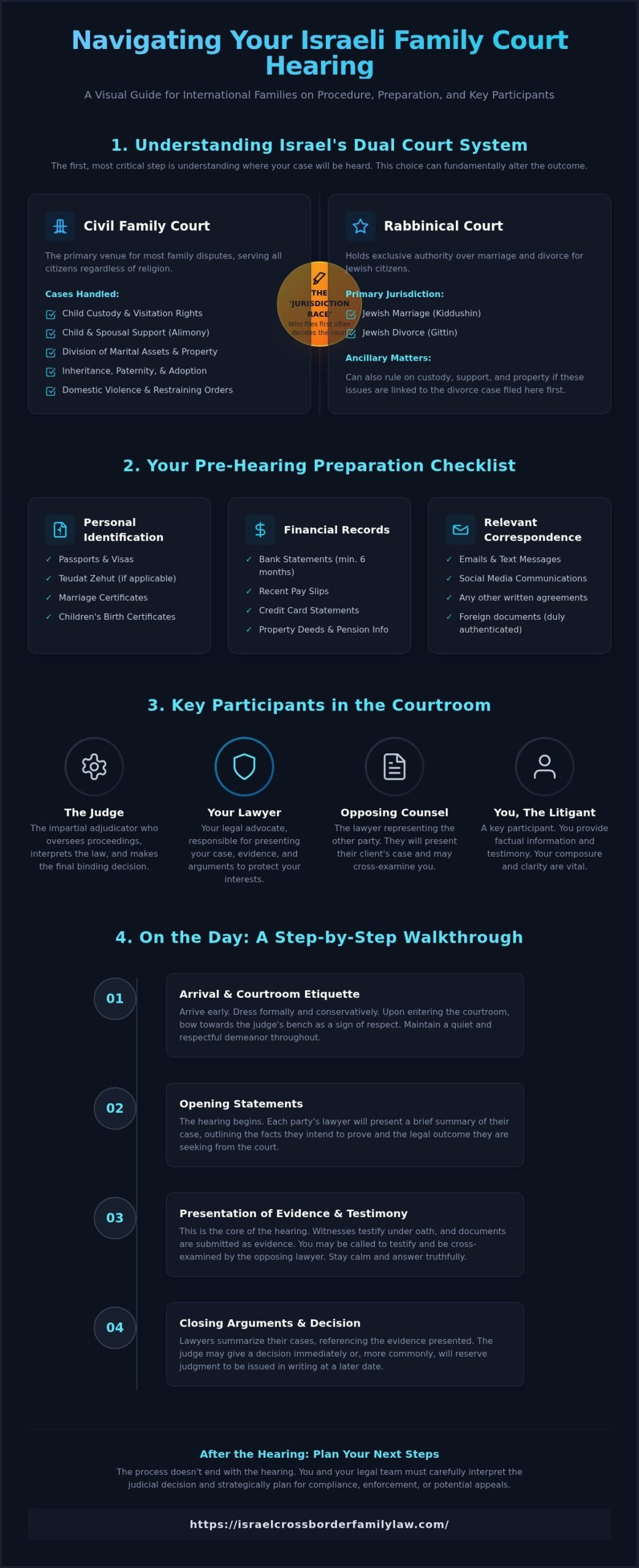
For individuals from the United States or Europe, navigating family law in Israel presents a unique and often complex challenge due to its dual-jurisdiction structure. Unlike the singular secular court systems common in many Western countries, Israel operates with both civil Family Courts and religious courts (such as the Rabbinical Court for Jewish citizens). This framework is a core component of the Israeli Judicial System and understanding its intricacies is the first critical step in preparing for your family court hearing israel. The choice of where to file first can have profound and lasting consequences on the outcome of your case, making expert legal guidance not just advisable, but essential. To better understand the complexities of cross-border custody matters, this video provides a helpful overview:
Family Court vs. Rabbinical Court: The ‘Jurisdiction Race’
The Rabbinical Court holds exclusive jurisdiction over matters of Jewish marriage and divorce (gittin). However, the civil Family Court is empowered to hear all other family-related disputes. Crucially, matters such as child custody, spousal and child support, and the division of marital property can be linked to the primary divorce case. This creates a strategic “jurisdiction race,” where the party who files first in their preferred court often secures that venue for the ancillary matters, significantly influencing the legal framework and potential outcome of the entire dispute.
Types of Cases Heard in the Family Court
The Family Court’s authority is broad, encompassing a wide range of disputes beyond religious divorce. It is the primary venue for adjudicating matters for all Israeli citizens, regardless of religion, as well as for non-married couples. Common cases include:
- Child custody and visitation rights (parental responsibility)
- Child and spousal support (alimony)
- Equitable division of marital assets and property
- Inheritance and succession disputes
- Paternity suits, adoption, and surrogacy agreements
- Domestic violence and restraining orders
Many divorce proceedings for international families, particularly those involving mixed-faith couples or foreign nationals, are managed primarily through this court.
Unique Considerations for International and Cross-Border Cases
When a case involves foreign nationals or assets located abroad, the complexity increases. The Israeli Family Court is adept at applying international law, including treaties like the Hague Convention on the Civil Aspects of International Child Abduction. However, litigants face challenges such as language barriers, authenticating foreign documents, and presenting evidence from abroad. Successfully navigating these multi-jurisdictional issues demands legal counsel with proven expertise in both Israeli and international family law, ensuring seamless representation across legal systems.
Before the Hearing: A Checklist for Critical Preparation
The outcome of your first family court hearing in Israel is often determined long before you enter the courtroom. Comprehensive preparation is not merely an administrative task; it is a critical strategic imperative that builds the foundation for a stronger case, significantly reduces personal stress, and empowers you to navigate the proceedings with confidence. Your focus should be structured around three core pillars: meticulous documentation, strategic legal collaboration, and personal readiness for the hearing itself.
Gathering Essential Documentation
A robust case is built upon a foundation of clear and organized evidence. Your legal counsel will require a comprehensive file containing all relevant documents. Ensure you gather and organize the following:
- Personal Identification: Passports, Teudat Zehut (if applicable), marriage certificates (Teudat Nisuin), and birth certificates for any children.
- Financial Records: At least six months of bank statements, recent pay slips, credit card statements, property deeds, and pension information.
- Relevant Correspondence: Organized copies of critical emails, text messages, or WhatsApp conversations that support your claims.
For any documents issued outside of Israel, obtaining an official, notarized translation accompanied by an Apostille is non-negotiable for them to be admissible. The required scope of these records is extensive, reflecting the broad jurisdiction of Israel’s Family Courts in matters of marital assets, custody, and support. Provide copies of everything to your lawyer well in advance.
Working Effectively With Your Lawyer
Your relationship with your legal counsel is a strategic partnership. Schedule a dedicated pre-hearing meeting to review the facts, finalize your strategy, and align on objectives. Be completely transparent; withholding information, however minor it may seem, can critically undermine your case. Clearly articulate your desired outcomes for the hearing-whether it’s a temporary custody order or a decision on preliminary financial support. Use this time to ask questions about the presiding judge’s judicial temperament and the anticipated arguments of the opposing counsel.
Preparing Your Testimony and Evidence
Your conduct and testimony inside the courtroom carry significant weight. Rehearse potential testimony with your lawyer, focusing on delivering clear, concise, and factual answers. Systematically organize any photographs, reports, or correspondence you intend to present as evidence. It is vital to maintain a strict focus on objective facts. While navigating a family court hearing in Israel is inherently emotional, judicial decisions are based on evidence and law, not on emotional appeals or outbursts. A composed and factual presentation will serve you best.
What to Expect on the Day of Your Hearing: A Step-by-Step Walkthrough
Navigating the day of your court appearance can be a source of significant anxiety. Understanding the logistical flow and procedural expectations demystifies the experience, allowing you to focus on the substance of your case. This guide provides a chronological walkthrough of a typical day, ensuring you are prepared and can project the necessary confidence and respect for the judicial process. Our objective is to provide you with a clear framework, transforming an unknown environment into a structured and manageable one.
Arriving at the Courthouse
We advise clients to arrive at the courthouse at least 45 minutes prior to the scheduled time for their family court hearing in Israel. This buffer is critical for navigating the mandatory security screening, which is thorough and similar to airport security, involving metal detectors and x-ray scanners for all bags. Once inside, you will locate your courtroom by consulting the electronic dockets (known as the “yoman”), which list cases by time and courtroom number. This early arrival also provides a crucial window to meet with your legal counsel for a final briefing, review key points, and align on the day’s strategy.
Courtroom Etiquette and Professional Conduct
Your demeanor and presentation inside the courtroom are of paramount importance. Adhering to established protocol demonstrates respect for the court and the gravity of the proceedings. Key principles of conduct include:
- Appropriate Attire: A conservative, business-formal dress code is required. This means suits or smart trousers and jackets, modest tops or dresses, and closed-toe shoes. Avoid casual clothing such as jeans, t-shirts, or sandals.
- Courtroom Decorum: All attendees must stand when the judge enters or exits the room. Mobile phones and all electronic devices must be completely switched off, not just silenced.
- Addressing the Judge: The judge must always be addressed with the proper formal Hebrew title: ‘Adoni HaShofet’ (Mr. Judge) or ‘Gvirti HaShofetet’ (Madam Judge).
- Speaking Order: Never interrupt the judge, opposing counsel, or any witness. You will be given a specific opportunity to speak; until then, listen carefully and communicate only with your lawyer.
The Structure of a Typical Hearing
While the specifics can vary, most hearings follow a standardized legal structure. The proceedings typically begin with the court clerk calling the case, followed by brief opening statements from each party’s counsel. The core of the hearing involves the presentation of evidence and witness testimony, where your attorney will conduct a direct examination to present your case. Subsequently, opposing counsel will have the opportunity to question your witnesses and you during cross-examination. Once all testimony has been heard, each side’s lawyer will present their closing arguments, summarizing the evidence and applying the relevant law to advocate for a favorable ruling.
Key Participants and Their Roles in the Courtroom
Navigating your first family court hearing Israel can feel overwhelming, largely due to the unfamiliar environment and number of official participants. Understanding who each person is and their specific function is a critical step in demystifying the process, empowering you to face the proceedings with confidence. This knowledge allows you to focus on your case, secure in the knowledge of how the courtroom operates.
The Judge (Shofet/Shofetet)
The Judge is the ultimate and impartial decision-maker in the courtroom. Seated at the front, their primary role is to listen to the evidence and legal arguments presented by both sides and apply Israeli family law to the facts of your case. The Judge may ask questions directly to you or your attorney to clarify points. It is imperative to always address the Judge with the utmost respect, standing when they enter or exit the room and referring to them as “Your Honor.”
Your Legal Representation and Opposing Counsel
Your lawyer is your dedicated advocate, responsible for presenting your case, submitting evidence, and making legal arguments on your behalf. Conversely, opposing counsel represents the interests of the other party. A fundamental rule of court conduct is that all communication with the opposing party must go through the lawyers. Do not speak directly to the other party or their counsel during the hearing; direct all comments and questions to your own attorney, trusting them to manage the legal dialogue and procedural objections.
Court Staff and Social Services Professionals
Beyond the judge and lawyers, several other professionals play key roles in the function of the court. Familiarizing yourself with them will provide a more complete picture of the proceedings:
- Court Clerk (Kalden/Kaldanit): This official manages the court’s administrative functions, including handling documents, scheduling, and maintaining the official case file.
- Court Reporter: Often present in substantive hearings, the reporter creates a verbatim transcript of everything said, which becomes the official record of the proceeding.
- Social Services Expert: In matters involving child custody or welfare, the court may appoint a social worker to conduct an evaluation and submit a formal report with recommendations, known as a Taskir.
- Expert Witnesses: Depending on the complexity of your case, specialists such as child psychologists, property appraisers, or forensic accountants may be called to provide expert testimony.
Successfully navigating these courtroom dynamics requires sophisticated legal counsel. For comprehensive representation adept at managing the complexities of a family court hearing Israel, our team provides the strategic guidance necessary to protect your interests.
After the Hearing: Understanding Decisions and Next Steps
Concluding your attendance at a family court hearing in Israel does not signify the end of the legal process. Rather, it marks a transition to a new phase focused on judicial deliberation, the issuance of orders, and strategic planning for subsequent actions. Understanding the potential outcomes and procedural timelines is critical for navigating this complex period effectively and ensuring your rights are protected.
Receiving the Court’s Decision (Psak Din)
It is uncommon to receive a final judgment on the day of the hearing. The judge will take time to review all evidence, testimony, and legal arguments presented. The court’s formal written decision, known as a Psak Din, will be issued and sent directly to your legal counsel. Our role is to then provide a comprehensive translation and a detailed explanation of its legal implications, ensuring you understand every aspect of the ruling and the obligations it imposes. Strict compliance with court orders is paramount to avoid potential penalties or further litigation.
Temporary Orders vs. Final Rulings
Many family law cases involve multiple stages, and the court may issue interim decisions or temporary orders (Hachlatot Beinayim) to address urgent matters like temporary child custody, visitation rights, or provisional financial support. These orders are not the final outcome but are legally binding directives designed to maintain stability while the case proceeds. Navigating these multi-stage proceedings requires a sophisticated approach, particularly for international clients. Our firm has a refined process detailing how it works for expats and foreign nationals, providing clarity at every step.
The Appeals Process and Enforcement
Should the final ruling be unfavorable, you have the right to appeal the decision to a higher judicial body, such as the District Court. However, the window for filing an appeal is governed by strict, non-negotiable deadlines, necessitating immediate consultation with your attorney. Conversely, if the other party fails to comply with a court order, we can initiate enforcement proceedings (Hotza’a Lapoal) to compel adherence. Whether you are considering an appeal or require enforcement after your family court hearing israel, proactive legal guidance is essential. If you need to determine your next steps, we invite you to request a confidential case review to understand your strategic options.
Secure Your Legal Standing in Israeli Family Court
Successfully navigating a family court hearing in Israel requires a comprehensive understanding of its unique legal framework, which often diverges significantly from Western judicial systems. For foreign nationals, this involves mastering not only procedural requirements but also cultural nuances within the courtroom. Meticulous preparation, from the strategic compilation of evidence to anticipating judicial lines of questioning, is not merely advantageous-it is fundamental to protecting your parental and financial rights. The complexities inherent in these multi-jurisdictional matters, particularly when navigating Israel’s intricate dual-court system of civil and religious law, demand sophisticated legal counsel. Our firm offers dedicated guidance for expats and foreign nationals, providing specialized expertise in US-Israel cross-border family law. We are committed to delivering the strategic representation necessary to guide you through every stage, ensuring your case is presented with precision and authority. Facing a family court hearing in Israel? Schedule a Confidential Case Review with our cross-border legal experts. With the right strategic partner, you can approach this challenge with clarity and confidence.
Frequently Asked Questions
Can a family court hearing in Israel be conducted in English?
The official language of the Israeli judiciary is Hebrew, and all formal proceedings are conducted accordingly. While a judge possesses the discretion to permit the use of English, particularly in complex cross-border cases where both parties are Anglophone, this is not a guaranteed right. The standard and most effective protocol is to engage a certified court translator. Our firm manages these procedural logistics to ensure language barriers do not impede the clear and forceful presentation of your case.
What is the appropriate dress code for an Israeli family court?
Adherence to a standard of professional decorum is essential when appearing before the Israeli judiciary. We advise all clients to adopt a business-casual dress code that conveys respect for the court and the gravity of the proceedings. For men, this typically involves trousers and a collared shirt; a jacket is advisable. For women, a conservative dress, skirt, or trousers paired with a modest blouse is appropriate. Casual attire such as shorts, open-toed sandals, or t-shirts is unacceptable.
How long does a typical family court hearing last?
The duration of a hearing is contingent upon its specific legal purpose and the complexity of the matters being adjudicated. A preliminary or procedural hearing may conclude within 30 to 90 minutes. In contrast, a comprehensive evidentiary hearing, which involves witness testimony, cross-examinations, and the presentation of sophisticated expert reports, can extend for several hours or may even be scheduled to continue across multiple days. We prepare clients for all potential timelines to ensure maximum efficiency.
Am I allowed to bring a friend or family member for support?
In principle, Israeli court proceedings are open to the public, which generally permits a supportive companion to be present in the courtroom gallery. However, given the sensitive nature of family law, the presiding judge holds the ultimate authority to declare a session private and close the courtroom. This is often done to protect the privacy of the litigants and any minor children involved. Your primary support and advocate within the courtroom remains your legal counsel.
What happens if I cannot attend my scheduled court hearing?
Failure to appear at a scheduled court hearing can result in severe legal repercussions, including the court issuing adverse rulings or judgments in your absence. It is imperative to provide immediate notification to your legal counsel the moment a conflict arises. Your attorney must then file a formal motion with the court, substantiating the reason for your absence and requesting a postponement. Proactive and procedurally correct communication through legal representation is critical to safeguarding your interests.
How are decisions from an Israeli family court enforced in the United States?
Enforcing a judgment from a family court hearing in Israel within the United States is a complex, multi-jurisdictional legal action. The process is governed by principles of international comity and specific state laws, such as the Uniform Interstate Family Support Act (UIFSA) for child and spousal support orders. For other decrees, it may be necessary to file a new action in a U.S. court to have the Israeli judgment recognized and domesticated, a sophisticated procedure requiring experienced cross-border legal expertise.

Article by
Gabriel Lior
A Personal Journey That Became a Mission The advisory was founded by an American father Gabriel Lior, LLB, MBA , global entrepreneur, and cross-border advisor who spent more than a decade navigating the Israeli family court system firsthand and now lives in Singapore with his son.
As a divorced parent in a cross-border family, Gabriel faced nearly every legal challenge a foreign parent can encounter in Israel — including child custody disputes, child support proceedings, property matters in Israel and abroad, false accusations, and complex immigration and relocation proceedings. Over the years, he learned the hard way how difficult it is for non-Israeli parents to understand the system, identify the right legal strategy, and choose the right legal representation — especially when language, culture, and jurisdictional differences are involved. He also witnessed how foreign parents and new immigrants are often disadvantaged or taken advantage of by service providers and institutions simply because they lack local knowledge or fluency. From Client to Advisor To truly understand — and survive — the system, Gabriel pursued formal legal education in Israel, completing two Israeli law degrees, alongside a BA and MBA earned in the United States. This was never about becoming a practicing attorney, but about gaining a deep, structural understanding of how the system works — and where it breaks down for foreign parents. This rare combination of: Firsthand client experience Israeli legal and US business education International business and negotiation training Decades of commercial execution created a unique perspective – one that understands both sides of the table. After years of litigation, persistence, and at times self-representation, he ultimately succeeded in securing custody of his son and relocating abroad through a rare legal victory in the Israeli Supreme Court — becoming one of the first fathers in Israel to do so under these circumstances.
Disclaimer
Important Disclaimer: The information provided on this website and in its content is for general informational and educational purposes only and does not constitute legal advice, legal opinion, or legal representation. Gabriel Lior is not licensed to practice law in Israel (nor is he interested in doing so) and does not provide legal services, despite having completed 2 Law Degrees. The services offered are advisory in nature and are intended to provide general guidance, strategic insight, and information regarding cross-border family law considerations. No attorney-client relationship is formed by accessing this website, reading its content, or communicating with us. Any decisions made based on this information are at your own discretion and risk. For legal advice specific to your situation, you should consult a licensed attorney in the relevant jurisdiction. Where appropriate, we may refer clients to independent, licensed attorneys or professionals. Such referrals do not constitute legal representation and no liability is assumed for services provided by third parties.