Navigating the complexities of a cross-border child relocation petition is one of the most challenging legal endeavors a parent can face. The apprehension of being unable to return to your home country, coupled with deep uncertainty surrounding the judicial process and a fear of inherent bias, can be overwhelming. Successfully representing your position requires a sophisticated understanding of what makes a strong relocation case for Israeli courts. This is not merely about expressing a desire to move; it involves presenting a meticulously prepared argument that comprehensively addresses the multi-faceted legal standard of the “child’s best interests.” This comprehensive guide serves as your strategic roadmap through this intricate legal terrain. We will dissect the key legal factors and judicial precedents that guide Israeli family courts in these sophisticated international disputes. You will gain a clear understanding of the evidentiary requirements, learn how to structure a compelling narrative, and build the confidence needed to navigate this complex process, ultimately empowering you to advocate effectively for a future that supports both a healthy co-parenting relationship and your child’s global well-being.
Key Takeaways
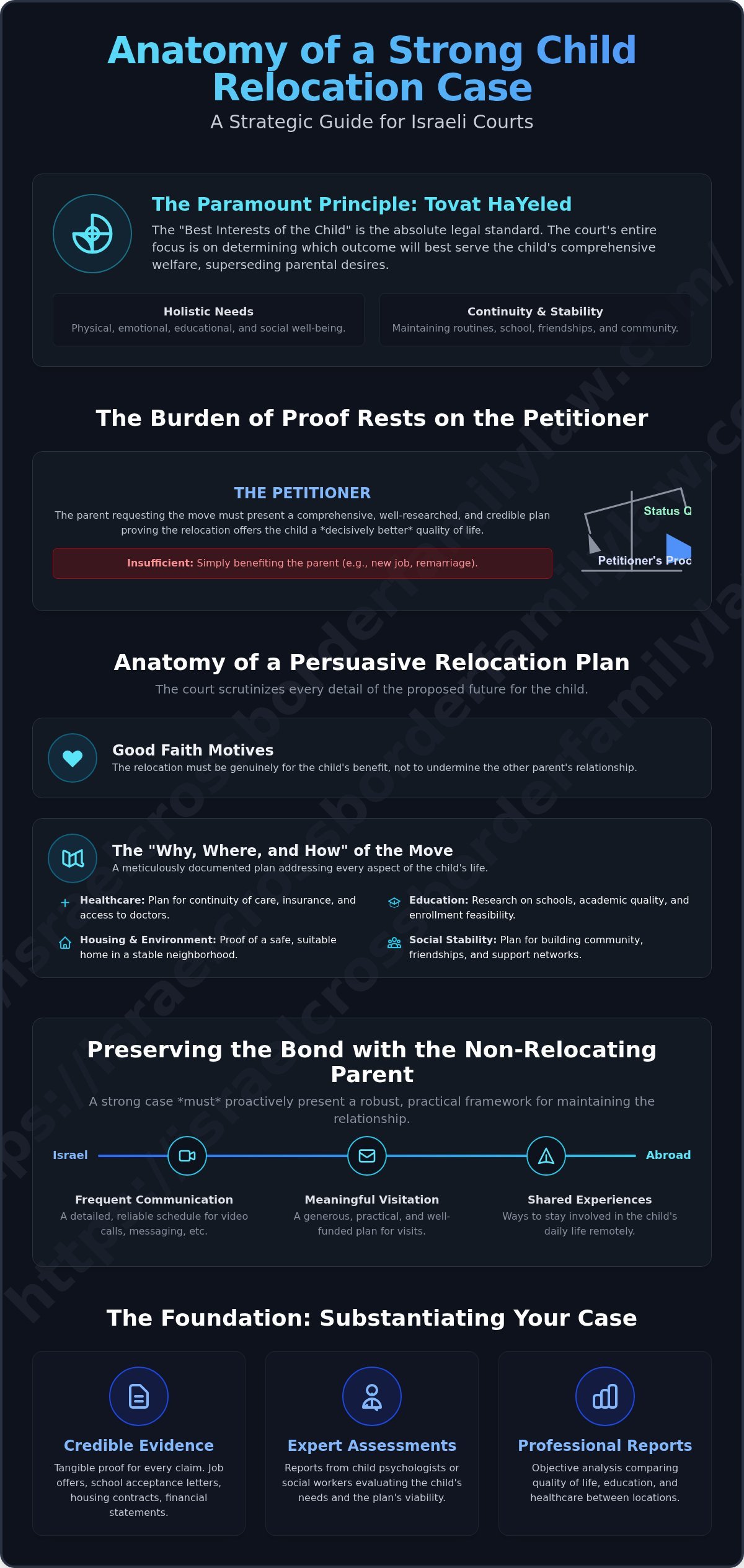
- Learn why Israeli courts unequivocally prioritize the ‘Best Interests of the Child’ (Tovat HaYeled) doctrine, making it the central pillar of any successful legal argument.
- Discover what makes a strong relocation case for Israeli courts by preparing a meticulously detailed and documented plan addressing the child’s future education, healthcare, and social stability.
- A persuasive case must proactively address the non-relocating parent’s role and present a robust, practical framework for preserving their ongoing relationship with the child.
- Recognize that a compelling relocation strategy requires substantiation through credible evidence, expert assessments, and professional reports to prove your plan’s viability to the court.
The Guiding Principle: ‘Best Interests of the Child’ in Relocation Law
In any matter of Israeli family law, particularly those involving complex, cross-border disputes, all judicial considerations are subordinate to a single, paramount principle: Tovat HaYeled, or ‘The Good of the Child’. This doctrine is not merely a guideline but the absolute legal standard by which all evidence is weighed. The court’s function is to set aside the personal desires, career aspirations, and even the perceived rights of the parents, focusing exclusively on determining which outcome will best serve the child’s comprehensive welfare. Understanding this core tenet is the first step in building a persuasive argument for or against a proposed move. To better understand the factors a court examines, this overview provides valuable context:
Unlike standard custody arrangements where the focus is on allocating time with both parents within the same geographic area, relocation cases present a far more profound challenge. The stakes are exponentially higher, as granting permission to relocate internationally can fundamentally alter, and potentially sever, the child’s relationship with the non-relocating parent, their extended family, and their cultural environment. The gravity of such a decision is underscored by international treaties; an unauthorized removal of a child can trigger complex legal proceedings under the Hague Convention on International Child Abduction. Consequently, the court’s goal is to conduct a meticulous, forward-looking analysis of which scenario-remaining in Israel or moving abroad-offers the most stable and beneficial future for the child.
What ‘Best Interests’ Means in Practice
The court’s assessment of a child’s best interests is a holistic inquiry into their entire world. It is not a simple checklist but a nuanced evaluation of multiple interconnected factors. The judge, often aided by reports from social workers or child psychologists, will consider:
- The child’s holistic needs: This includes their physical safety, emotional stability, psychological well-being, and educational and social development.
- Continuity and stability: The court places significant weight on maintaining the child’s existing routines, school environment, friendships, and community ties.
- The move’s benefits vs. harms: Any potential advantages of the new location are carefully weighed against the profound harm of disrupting the child’s bond with the non-relocating parent.
The Court’s Starting Point: The Burden of Proof
In Israeli relocation proceedings, the legal starting point is clear: the parent petitioning to move bears the heavy burden of proof. It is their responsibility to convince the court that uprooting the child is decisively in that child’s best interest. Simply demonstrating that the move would benefit the parent-for a new job, remarriage, or proximity to family-is insufficient. Success hinges on presenting a comprehensive, well-researched, and credible plan that proves the relocation itself offers the child a better quality of life. This evidentiary standard is central to what makes a strong relocation case for Israeli courts and requires meticulous preparation and strategic legal representation.
Key Factors in a Persuasive Relocation Plan
A successful relocation petition is not an emotional appeal but a comprehensive business plan for a child’s future. The Israeli family courts meticulously scrutinize the logistical and practical details of the proposed move, demanding a foundation of thorough planning and extensive documentation. Understanding what makes a strong relocation case for Israeli courts begins with presenting a clear, evidence-based proposal that addresses the ‘why,’ ‘where,’ and ‘how’ of the move, with every element unequivocally linked to the child’s best interests, not merely the parent’s convenience or preference.
The Motives of the Relocating Parent
The court must be convinced that the relocation is motivated by ‘good faith’ intentions that will ultimately enhance the child’s life. Legitimate motives include significant career opportunities, returning to a country of origin with a robust family support system, or pursuing unique educational programs. Conversely, any petition perceived as a strategy to marginalize or alienate the other parent will be viewed with extreme prejudice and is highly likely to fail. A persuasive case demonstrates how the parent’s improved well-being-such as increased financial stability or proximity to grandparents-creates a more secure and nurturing environment for the child.
The Proposed Quality of Life in the New Location
Abstract promises are insufficient; the court requires concrete evidence of a superior or at least equivalent quality of life in the destination country. Your relocation plan must present detailed, verifiable research on several key areas:
- Housing and Community: Information on a specific, suitable residence in a safe neighborhood, including rental agreements or property listings, and details about the local community, parks, and amenities.
- Education and Integration: Identification of specific schools, their curriculum, admission status, and a clear plan for the child’s linguistic and cultural integration, including any necessary tutoring or support services.
- Support Networks: Evidence of an established support system, such as close relatives, and access to quality healthcare, extracurricular activities, and social opportunities for the child.
Maintaining the Relationship with the Non-Relocating Parent
This is arguably the most critical component of any relocation plan. The court’s primary duty is to protect the child’s right to a meaningful relationship with both parents. A vague offer of “reasonable access” is inadequate. The relocating parent must present a detailed, generous, and financially viable plan that actively fosters this connection. Failure to do so may be interpreted as an attempt to sever the child’s bond with the other parent, a matter the state treats with the utmost seriousness, as reflected in the Israeli Ministry of Justice guidance on child abduction. A strong plan will proactively outline:
- A specific and generous visitation schedule, including significant time during summer and school holidays.
- A clear budget for travel costs, demonstrating financial feasibility (e.g., allocating ₪10,000-₪20,000 annually for flights).
- A robust schedule for regular communication, such as daily messages and video calls at designated times.
Presenting such a comprehensive plan demonstrates respect for the non-relocating parent’s role, a factor that weighs heavily in the court’s final determination.
Addressing Objections from the Non-Relocating Parent
In any child relocation proceeding, Israeli family courts give significant and deliberate weight to the rights and role of the non-relocating parent. A parent seeking to move abroad must understand that their application is not reviewed in a vacuum; it is assessed against the potential disruption to the child’s relationship with the parent who remains. Proactively anticipating and addressing the valid concerns of the other parent is therefore not just a courtesy-it is a critical component of what makes a strong relocation case for Israeli courts. The most successful petitions acknowledge the profound bond the child shares with the other parent and frame the relocation not as an end to that relationship, but as a necessary change to its structure.
The Quality and Extent of the Current Relationship
The court will conduct a thorough examination of the non-relocating parent’s current level of involvement in the child’s life. An objection from a parent who is deeply integrated into the child’s daily and weekly routines-attending school events, managing medical appointments, and sharing significant parenting time-carries far more legal weight. Your relocation plan must demonstrate a sophisticated and sincere strategy for preserving this high level of contact despite the geographical distance.
The Feasibility of the Proposed Visitation Plan
A theoretical visitation schedule is insufficient. Your plan must be a practical, logistical, and financial roadmap that proves your commitment to fostering the child’s bond with the other parent. Key considerations include:
- Financial Responsibility: Clearly outline who will bear the costs of international travel. Will you cover all flights, or will costs be shared? A round-trip flight can easily cost ₪5,000-₪10,000 or more, and your proposal must be financially sustainable.
- Logistical Soundness: Address the realities of travel time, jet lag, and school holidays. Propose extended visits during longer school breaks rather than frequent, disruptive short trips.
- Technological Contact: Detail a robust schedule for daily or near-daily video calls, ensuring the parent remains a consistent presence in the child’s life.
A meticulously crafted plan signals to the court that you are serious about maintaining the parental bond. For a deeper analysis of these complex arrangements, we invite you to explore our resources on international custody and relocation.
The Child’s Own Wishes and Preferences
While the child’s preference is a factor, its importance is directly tied to their age and emotional maturity. Israeli courts are extremely cautious about placing a child in the middle of a parental dispute. Consequently, a judge will rarely ask a child for their opinion directly. Instead, if deemed necessary, the court will appoint an independent expert, such as a psychologist or social worker, to assess the child’s true and authentic wishes, free from parental influence.
Building Your Case: Evidence, Experts, and Legal Strategy
A successful relocation petition is founded on more than just a well-articulated plan; it requires a meticulously constructed case built upon credible, verifiable evidence. Your legal strategy must transition your proposal from an abstract concept into a tangible reality for the court. Understanding what makes a strong relocation case for Israeli courts is to understand the paramount importance of substantiation. Without concrete proof, even the most compelling arguments may fail to persuade the judge.
The Role of a Professional Opinion (Tazkir)
The Israeli Family Court heavily relies on the impartial assessment of a court-appointed expert, typically a child psychologist or social worker. This professional prepares a comprehensive report (Tazkir) after evaluating the family dynamic, each parent’s capacity, and the specific needs of the child. The expert’s final recommendation on whether the relocation serves the child’s best interests is profoundly influential and often guides the court’s ultimate decision.
Gathering Documentary Evidence
Your claim must be supported by a robust portfolio of documents that validates every component of your proposed move. This evidence demonstrates your preparedness and commitment to providing a stable and enriching environment for your child. Key documents include:
- A formal job offer or employment contract in the destination location.
- Acceptance letters from schools and detailed information on the proposed educational framework.
- Proof of secured or prospective housing, such as a rental agreement or property details.
- Sworn affidavits from family members or friends in the new location, confirming their role as a support system.
- Comprehensive financial statements and a detailed budget, often in ILS, proving your ability to support the child and finance the costs of visitation for the other parent.
Common Pitfalls to Avoid
Procedural missteps or poor judgment can severely undermine your case. It is critical to avoid actions that the court may view as detrimental to the child or disrespectful of the legal process. Be mindful to:
- Never threaten to relocate without permission. Any unilateral action or threat can be construed as an intent to commit parental kidnapping, leading to severe legal consequences under the Hague Convention on Child Abduction.
- Avoid presenting a vague or incomplete plan. The court expects a detailed, well-researched proposal that addresses all facets of the child’s life.
- Refrain from speaking negatively about the other parent. Disparaging remarks made to the court-appointed expert or in legal filings can damage your credibility and suggest you may not support the child’s relationship with the other parent post-relocation.
Navigating these complex evidentiary standards requires sophisticated legal guidance. An experienced cross-border family lawyer is essential for strategically assembling your evidence and effectively presenting your case. For expert assistance with your relocation matter, contact our legal team.
Why Expert Legal Counsel is Non-Negotiable
Child relocation petitions are among the most complex and emotionally charged matters within Israeli family law. These multi-jurisdictional cases involve intricate legal standards, cross-border procedural challenges, and a profound analysis of a child’s best interests. Attempting to navigate this sophisticated legal landscape without seasoned representation is a significant risk, as the outcome carries permanent consequences for your family. The difference between a successful petition and a denial often rests upon the strategic guidance of an attorney who specializes in international family law. An experienced lawyer does more than file paperwork; they frame your personal story and motivations within the precise legal structure required by the court. They understand the judicial temperament and the specific criteria that judges and court-appointed experts prioritize. This insider knowledge of the Israeli family court system is invaluable, ensuring your case is presented not just with passion, but with the legal and psychological arguments that resonate most effectively.
Navigating the Israeli Court System
Expert counsel is essential for guiding you through the labyrinth of procedural requirements and critical deadlines that can otherwise derail a case. Your attorney’s role is to ensure all evidence, from financial documents to psychological evaluations, is presented in a compelling and admissible format. Furthermore, they provide indispensable preparation for your interviews with court-appointed experts, helping you articulate the key factors that support your relocation plan and demonstrate your commitment to the child’s well-being.
Developing a Winning Strategy
Ultimately, what makes a strong relocation case for Israeli courts is a comprehensive and forward-thinking strategy. Your legal counsel will work with you to build a detailed relocation plan that proactively addresses every key factor, from housing and education to preserving the child’s relationship with the non-relocating parent. They anticipate the opposing party’s arguments, preparing robust counter-arguments and providing objective, strategic advice during what is an intensely emotional time. If you are facing this challenge, start with a Confidential Case Review to understand your options.
Strategic Counsel for Your International Relocation Case
Navigating an international child relocation requires a meticulously prepared strategy centered on the paramount principle of the child’s best interests. Success hinges upon a comprehensive and persuasive relocation plan that proactively addresses potential objections from the non-relocating parent. Ultimately, understanding what makes a strong relocation case for Israeli courts is the critical first step, but executing that strategy with robust evidence and expert testimony is what secures a favorable judgment. The stakes are profoundly high, and the legal landscape is exceptionally complex. Our firm provides the sophisticated legal guidance necessary for these multi-jurisdictional challenges. With deep expertise in US-Israel cross-border family law and a proven track record in complex international custody cases, we deliver strategic guidance tailored to the unique procedures of the Israeli Family Court system. Facing a complex international relocation issue? Schedule a Confidential Case Review to protect your family’s future and take the first step toward your new beginning.
Frequently Asked Questions
Does being a foreign national put me at a disadvantage in an Israeli relocation case?
Israeli family courts adjudicate relocation matters based on the paramount principle of the child’s best interests, irrespective of a parent’s nationality. A foreign national is not inherently at a disadvantage; rather, the court’s analysis focuses on factors such as the parent’s ability to provide a stable and supportive environment. Demonstrating a well-structured plan for the child’s life abroad is a key component of what makes a strong relocation case for Israeli courts, regardless of parental citizenship.
How much weight will the court give to my child’s opinion about moving?
The weight afforded to a child’s opinion is directly correlated with their age and level of maturity. While there is no definitive age, the views of an adolescent are typically given substantial consideration by the court. In these complex matters, the court will often appoint a psychological expert or social worker to professionally assess the child’s true and independent wishes, which then informs the court’s final determination based on the child’s overall welfare.
What happens if the other parent violates the visitation plan after relocation?
Should the non-relocating parent violate the court-ordered visitation plan, the custodial parent has several legal remedies. This includes initiating contempt of court proceedings, which can result in fines or other sanctions. Furthermore, enforcement can be sought through the Israeli Execution Office (Hotza’a Lapoal). For international cases, provisions under the Hague Convention may also be invoked to ensure compliance with the access rights stipulated in the relocation order, a process requiring sophisticated cross-border legal guidance.
How long does a typical child relocation case take to resolve in Israel?
The timeline for resolving a child relocation case in Israel is highly variable, contingent upon the complexity of the matter and the court’s docket. A straightforward case might be resolved within several months, but contested international relocations often require 12 to 18 months or longer. Delays can stem from the need for extensive expert evaluations, gathering evidence from abroad, and accommodating multi-jurisdictional legal procedures, all of which require meticulous and strategic navigation.
Can a relocation order be granted on a temporary or trial basis?
Indeed, Israeli courts possess the discretion to grant a relocation order on a temporary or trial basis. This approach is often utilized in complex cases where the court seeks to assess the relocation’s real-world impact on the child’s well-being and the parent-child relationship before issuing a final, permanent order. Such a trial period allows the court to gather empirical evidence on the new arrangement’s success, providing a crucial safeguard for the child’s best interests.
What if my original divorce or custody agreement already forbids relocation?
While a pre-existing agreement that explicitly forbids relocation is a significant factor, it is not an insurmountable obstacle. The court retains the authority to modify such clauses if the moving parent can demonstrate a material change in circumstances and prove that the relocation is decisively in the child’s best interests. The petitioner must present a compelling and evidence-based argument to persuade the court that overriding the original contractual agreement is justified for the child’s welfare.

Article by
Gabriel Lior
A Personal Journey That Became a Mission The advisory was founded by an American father Gabriel Lior, LLB, MBA , global entrepreneur, and cross-border advisor who spent more than a decade navigating the Israeli family court system firsthand and now lives in Singapore with his son.
As a divorced parent in a cross-border family, Gabriel faced nearly every legal challenge a foreign parent can encounter in Israel — including child custody disputes, child support proceedings, property matters in Israel and abroad, false accusations, and complex immigration and relocation proceedings. Over the years, he learned the hard way how difficult it is for non-Israeli parents to understand the system, identify the right legal strategy, and choose the right legal representation — especially when language, culture, and jurisdictional differences are involved. He also witnessed how foreign parents and new immigrants are often disadvantaged or taken advantage of by service providers and institutions simply because they lack local knowledge or fluency. From Client to Advisor To truly understand — and survive — the system, Gabriel pursued formal legal education in Israel, completing two Israeli law degrees, alongside a BA and MBA earned in the United States. This was never about becoming a practicing attorney, but about gaining a deep, structural understanding of how the system works — and where it breaks down for foreign parents. This rare combination of: Firsthand client experience Israeli legal and US business education International business and negotiation training Decades of commercial execution created a unique perspective – one that understands both sides of the table. After years of litigation, persistence, and at times self-representation, he ultimately succeeded in securing custody of his son and relocating abroad through a rare legal victory in the Israeli Supreme Court — becoming one of the first fathers in Israel to do so under these circumstances.
Disclaimer
Important Disclaimer: The information provided on this website and in its content is for general informational and educational purposes only and does not constitute legal advice, legal opinion, or legal representation. Gabriel Lior is not licensed to practice law in Israel (nor is he interested in doing so) and does not provide legal services, despite having completed 2 Law Degrees. The services offered are advisory in nature and are intended to provide general guidance, strategic insight, and information regarding cross-border family law considerations. No attorney-client relationship is formed by accessing this website, reading its content, or communicating with us. Any decisions made based on this information are at your own discretion and risk. For legal advice specific to your situation, you should consult a licensed attorney in the relevant jurisdiction. Where appropriate, we may refer clients to independent, licensed attorneys or professionals. Such referrals do not constitute legal representation and no liability is assumed for services provided by third parties.