Navigating the loss of a loved one is a profound challenge, compounded significantly when their estate includes cross-border assets. For foreign heirs and executors, the prospect of managing an inheritance located in Israel can feel overwhelming, fraught with concerns about a complex legal system, language barriers, and the perceived necessity of international travel. The specific legal process for probate in Israel presents unique procedures and multi-jurisdictional requirements that are difficult to manage from abroad without expert guidance, often leading to potential delays and costly missteps.
This comprehensive guide is designed to demystify this sophisticated process. We provide a clear, step-by-step framework for initiating a succession or probate order, managing estate assets remotely, and ensuring full compliance with Israeli law. Our objective is to equip you with the authoritative knowledge to proceed with confidence, transforming a daunting legal task into a structured, manageable process. This will enable you to securely and efficiently transfer the assets to which you are legally entitled, without the need to travel to Israel.
Key Takeaways
- Understand the legal framework governing Israeli succession, based on the Succession Law of 1965, and the precise steps required to validate a will from abroad.
- Learn how the entire process for probate in Israel can be managed remotely by an experienced legal representative, eliminating the need for international travel.
- Identify common cross-border complications, such as authenticating foreign documents and navigating tax implications, and discover strategies to mitigate potential delays.
- Recognize the critical difference between a general practitioner and a cross-border specialist in navigating multi-jurisdictional estate matters to secure and distribute assets efficiently.
Foundations of the Israeli Probate and Succession Process
Probate is the formal legal process through which a deceased person’s will is validated by a court, allowing for the lawful distribution of their assets to the designated heirs. In Israel, this entire framework is governed by the comprehensive Succession Law of 1965. This legislation mandates that any individual, regardless of their nationality or residency, who passes away while owning assets within Israel must have their estate administered through the Israeli legal system. The requirement for probate in Israel is triggered by the presence of local assets, which can encompass a wide range of holdings, including:
- Real estate properties (apartments, land)
- Funds held in Israeli bank accounts
- Stocks, bonds, and other securities in Israeli companies
- Pensions or insurance policies
- Other tangible personal property
For a detailed visual overview of this complex process, the following video provides valuable insights:
Probate Order vs. Inheritance Order: A Crucial Distinction
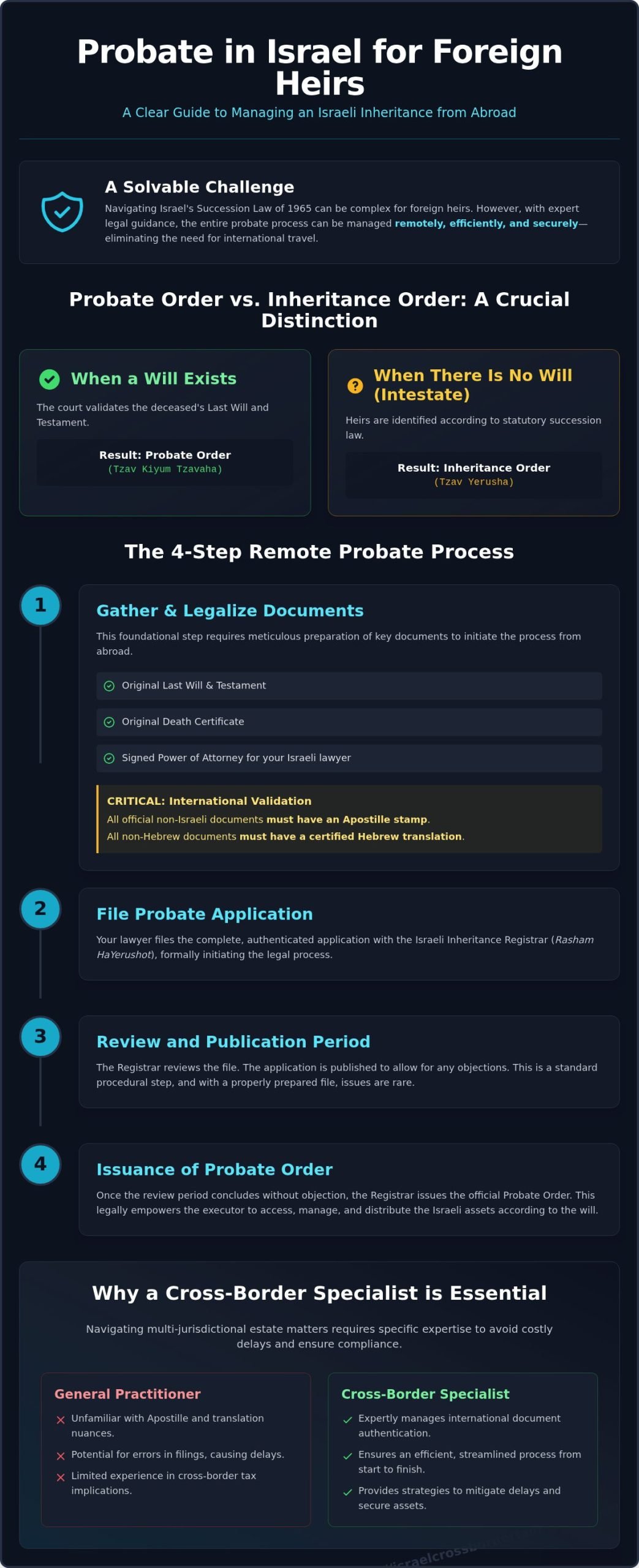
The Israeli legal system makes a critical distinction based on the existence of a valid will. When a will is present, the court issues a Probate Order (Tzav Kiyum Tzavaha), which confirms the will’s validity and empowers the executor to distribute assets according to its terms. Conversely, if the deceased passed away intestate (without a will), the court issues an Inheritance Order (Tzav Yerusha). This order identifies the legal heirs based on the statutory rules of succession. This guide focuses specifically on the probate process for estates with a valid will.
Jurisdiction: When Israeli Courts Handle an Estate
Israeli courts hold jurisdiction over an estate under two primary conditions: if the deceased was an Israeli resident at the time of their death, or if the deceased, irrespective of their residency, left any assets located within Israel. This second condition is why many foreign nationals and expats with investments or property in the country require Israeli probate proceedings. This principle aligns with the global Foundations of Inheritance Law, where jurisdiction is often tied to the physical location of assets. Importantly, Israeli courts are equipped to recognize and probate foreign wills, provided they meet the legal requirements for validity under either Israeli law or the law of the jurisdiction where the will was executed.
The Step-by-Step Guide to the Probate Process in Israel
Navigating the legal framework for probate in Israel from abroad can appear complex, but it is a structured, procedural matter. The process involves three key parties: the petitioner (typically an heir or the executor), the beneficiaries named in the will, and the official Inheritance Registrar (Rasham HaYerushot). With experienced legal counsel, this entire multi-stage process can be managed remotely and efficiently, typically concluding within several months, provided no complex disputes arise.
Step 1: Gathering and Legalizing Essential Documents
The initial phase is foundational and requires meticulous preparation of all necessary documentation. Your legal representative will require several key items to initiate the process. Understanding which documents are valid is a critical first step, and this practical guide to Israeli inheritance provides valuable context for non-residents. Key documents include:
- The original, signed Last Will and Testament.
- An original Death Certificate of the testator.
- A signed Power of Attorney authorizing your Israeli lawyer to act on your behalf.
Crucially, any official documents issued outside of Israel must bear an Apostille stamp for international validation. Furthermore, all non-Hebrew documents must be accompanied by a certified Hebrew translation.
Step 2: Filing the Probate Application
Once all documents are collated and properly authenticated, your lawyer will file a formal probate petition with the Inheritance Registrar. This application is a comprehensive submission containing details of the deceased, the known heirs and beneficiaries, and an inventory of the estate’s assets within Israel. Modern procedural advancements allow for this petition to be filed electronically, streamlining the initial submission. The filing must be accompanied by the payment of the required government processing fees.
Step 3: The Review and Publication Period
Upon receipt, the Inheritance Registrar’s office conducts a thorough review of the application to ensure it is complete and compliant with Israeli law. The application is then published in the official gazette (Reshumot), initiating a mandatory objection period that typically lasts for two weeks. This allows any interested party with a potential claim against the estate to file a formal objection. Should a valid objection be filed, the case is transferred to the Family Court for adjudication.
Step 4: Issuance of the Final Probate Order
Assuming the review period concludes without any successful objections, the Inheritance Registrar will issue the final Probate Order (Tzav Kiyum Tzava’a). This legally binding document officially validates the will and grants the named executor the authority to manage and distribute the estate’s assets. Armed with this order, the executor is empowered to approach Israeli banks, the Land Registry (Tabu), and other government bodies to legally transfer assets to the designated beneficiaries as stipulated in the will.
Navigating Probate from Abroad: Key Challenges for Foreigners
For heirs and executors residing outside of Israel, the prospect of managing an estate can appear daunting. The logistical complexities of distance, language, and an unfamiliar legal framework present significant challenges. However, it is crucial to understand that administering an Israeli estate from abroad is a standard, well-established procedure. With strategic legal guidance, the process of probate in israel can be navigated efficiently and effectively, entirely removing the burden of international travel. Proactive and transparent communication with your legal counsel is the key to a seamless cross-border estate administration.
Appointing a Local Attorney with a Power of Attorney
The cornerstone of a successful remote probate is the appointment of local Israeli counsel via a limited Power of Attorney (PoA). This legal instrument empowers your attorney to act decisively on your behalf, negating any need for you to be physically present in Israel. This is the single most critical step for a smooth process. A properly executed PoA authorizes your legal representative to:
- Sign and submit the application for a Probate Order or Inheritance Order.
- Communicate directly with the Inheritance Registrar and Administrator General.
- Represent your interests before all relevant Israeli authorities.
- Manage the distribution of assets upon receiving the final order.
The Apostille Process: Authenticating Foreign Documents
Israeli authorities require that official documents issued by foreign governments be properly authenticated. This is accomplished through an Apostille, an international certification under the Hague Convention that validates a document’s authenticity. Key documents, such as the decedent’s death certificate, must bear an Apostille. This certification must be obtained in the country where the document was issued before it is sent to Israel. For example, a U.S. citizen would typically secure an Apostille from the Secretary of State in the state where the death certificate was issued.
Communicating with Israeli Institutions
Attempting to engage directly with Israeli institutions such as banks, government offices, and the Israel Land Registry (Tabu) from overseas is exceptionally difficult. Significant hurdles include language barriers, as most official business is conducted in Hebrew, and substantial time zone differences. Your Israeli attorney acts as your professional representative on the ground, managing all correspondence and navigating these complex bureaucracies. The final Probate Order, once secured by your counsel, serves as the definitive legal instrument compelling these institutions to recognize your rights as an heir and release the estate’s assets accordingly.
Common Complications in Israeli Probate and How to Resolve Them
While many inheritance cases proceed smoothly, international heirs must maintain realistic expectations. The cross-border nature of an estate can introduce sophisticated legal and administrative hurdles. Acknowledging these potential issues is the first step in developing a proactive legal strategy to mitigate delays and protect the estate’s value. When managed by experienced counsel, even the most complex challenges in the process for probate in Israel can be navigated effectively.
Will Contests and Objections
An objection to a will, known as a “hitnagdut,” can arise on several grounds, including claims of undue influence, lack of testamentary capacity, or improper execution of the will. Upon the filing of an objection, the case is transferred from the Inheritance Registrar to the Family Court for litigation. This immediately extends the timeline by months or even years and substantially increases legal costs. Retaining robust legal representation is mission-critical to either defend the will’s validity or challenge it successfully in court.
Locating Undisclosed or ‘Lost’ Israeli Assets
Heirs residing abroad often possess an incomplete picture of the decedent’s financial portfolio in Israel. It is not uncommon for Israeli bank accounts, investment portfolios, or real estate properties to be unknown to the family. Our firm conducts comprehensive asset searches, liaising with the Land Registry Office (Tabu) and financial institutions to uncover and verify all estate holdings. This crucial step ensures every asset is included in the probate order, preventing future claims and the risk of property becoming “unclaimed” by the state.
Navigating Estate Debts and Liabilities
Under Israeli law, an estate is responsible for settling the decedent’s debts before any assets can be distributed to beneficiaries. This includes everything from mortgages and loans to unpaid taxes and utility bills. A critical function of the estate administrator, guided by legal counsel, is to formally notify creditors and validate all claims. Properly managing this phase of the probate in Israel process protects the heirs and the executor from personal liability and future legal disputes from creditors.
Anticipating and managing these multi-jurisdictional complexities is the hallmark of a dedicated cross-border legal team. For strategic guidance on navigating the intricacies of your inheritance matter, we invite you to contact our legal experts for a consultation.
Why Choose a Specialist Cross-Border Firm for Israeli Probate
Navigating the complexities of the probate in Israel process from abroad presents a unique set of challenges. While the process is manageable, the key to a successful and stress-free outcome lies in selecting the right legal partner. The distinction between a general practitioner and a firm specializing in multi-jurisdictional estate law is not merely academic-it is the difference between an efficient resolution and a protracted, costly ordeal.
A specialist firm moves beyond simply filing documents; we provide a strategic, comprehensive solution designed for the specific needs of international heirs. Our focus is on delivering efficiency, security, and above all, peace of mind when you cannot be here in person.
Expertise in Both Israeli and Foreign Legal Systems
An international inheritance does not occur in a vacuum. A specialist firm possesses a deep understanding of how Israeli inheritance law intersects with the legal and tax frameworks of your home country. This dual expertise is critical for advising on tax implications, avoiding potential double taxation, and ensuring seamless asset transfers across borders. We act as a vital bridge between jurisdictions, a core component of our advisory services for international families.
A Streamlined and Efficient Process
Firms dedicated to cross-border estates have developed refined, proven systems for managing these complex cases. We proactively anticipate bureaucratic hurdles at the Israeli Inheritance Registrar, ensure all foreign documents are correctly authenticated and translated, and manage communications with all relevant authorities. This methodical approach minimizes delays and prevents costly errors. You can understand how it works when you partner with our dedicated team.
Your Trusted Partner on the Ground in Israel
For heirs residing overseas, the greatest asset is a trusted representative in Israel. We serve as your dedicated team on the ground, providing clear, consistent communication and handling every detail on your behalf. Our commitment is to protect your inheritance, honor your loved one’s final wishes, and provide the security that allows you to manage this difficult time from a distance. Your peace of mind is our primary objective. Begin with a confidential case review to discuss your specific needs.
Secure Your Inheritance with Expert Cross-Border Guidance
Navigating the Israeli succession process from abroad presents a formidable set of legal and logistical challenges. As this guide has detailed, the pathway is intricate, and for foreign heirs, the potential for procedural delays and complex disputes is significant. Successfully managing the process of probate in Israel requires more than a general understanding of the law; it demands specialized, multi-jurisdictional legal acumen to protect your interests effectively across international lines.
Our firm provides this dedicated focus. With specialized expertise in US-Israel cross-border law and a proven track record of assisting foreign nationals with Israeli estates, our team is uniquely positioned to guide you. We offer clear communication and seamless remote handling of your case, ensuring you are supported at every step. To ensure your rights are protected and the estate is administered efficiently, we invite you to take the next step.
Schedule a Confidential Consultation to Discuss Your Israeli Estate Matter and let our dedicated team provide the clarity and direction you need. With the right legal partner, you can confidently secure your inheritance and achieve peace of mind.
Frequently Asked Questions About Probate in Israel
How long does the probate process typically take in Israel?
The timeline for the probate process in Israel is contingent upon the complexity of the estate and whether the will is contested. A straightforward, uncontested probate application can often be concluded within three to six months. However, for more complex, multi-jurisdictional estates or in cases where beneficiaries raise objections, the proceedings can extend significantly, sometimes lasting over a year. Our firm is adept at navigating these complexities to ensure an efficient resolution for our international clients.
What are the estimated costs and legal fees for probating a will in Israel?
The costs associated with probating a will in Israel comprise two primary components: government filing fees and legal counsel fees. The official court filing fee is a fixed amount, currently around ₪500. Legal fees for comprehensive representation are typically structured as a percentage of the estate’s value, generally ranging from 1% to 3%, or as a predetermined fixed fee, depending on the case’s complexity. We provide our clients with a clear and transparent fee structure from the outset.
What happens if a person dies with assets in Israel but without a will?
In the absence of a valid will, an individual’s Israeli assets are distributed according to the Israeli Succession Law of 1965. This legal framework dictates a statutory order of inheritance, typically prioritizing the deceased’s spouse and children. Heirs must file an application for a Succession Order, a judicial decree that legally confirms their inheritance rights. Navigating this intestate succession process requires meticulous documentation and adherence to statutory requirements, a core competency of our cross-border practice.
Is a will created in the United States or another country valid in Israel?
A will drafted and executed in a foreign jurisdiction, such as the United States, can be recognized as valid in Israel, provided it complies with the legal formalities of either the place it was made, the testator’s domicile, or Israeli law itself. The Israeli Succession Law is designed to accommodate such international instruments. However, to ensure a seamless process, it is critical that the foreign will is professionally reviewed to confirm its compliance and enforceability within Israel’s legal system.
Can I sell an inherited property in Israel while living abroad?
Absolutely. Foreign beneficiaries can manage and execute the sale of inherited Israeli property from abroad. This is typically facilitated through a limited Power of Attorney granted to an Israeli lawyer. Our firm is experienced in representing international clients in all facets of these real estate transactions, from negotiating the sale and handling regulatory approvals to managing the transfer of funds, ensuring a secure and efficient process without requiring your physical presence in Israel.
Does Israel have an inheritance tax on assets passed to foreign beneficiaries?
Israel does not impose an inheritance or estate tax, a policy that extends to assets inherited by foreign beneficiaries. This is a significant advantage in the cross-border probate in Israel. However, it is crucial to understand that while the inheritance itself is not taxed, any capital gains realized from the subsequent sale of an inherited asset, such as real estate, may be subject to Capital Gains Tax. Strategic tax planning is essential to mitigate such liabilities.

Article by
Gabriel Lior
A Personal Journey That Became a Mission
The advisory was founded by an American father Gabriel Lior, LLB, MBA , global entrepreneur, and cross-border advisor who spent more than a decade navigating the Israeli family court system firsthand and now lives in Singapore with his son.
As a divorced parent in a cross-border family, Gabriel faced nearly every legal challenge a foreign parent can encounter in Israel — including child custody disputes, child support proceedings, property matters in Israel and abroad, false accusations, and complex immigration and relocation proceedings.
Over the years, he learned the hard way how difficult it is for non-Israeli parents to understand the system, identify the right legal strategy, and choose the right legal representation — especially when language, culture, and jurisdictional differences are involved. He also witnessed how foreign parents and new immigrants are often disadvantaged or taken advantage of by service providers and institutions simply because they lack local knowledge or fluency.
From Client to Advisor
To truly understand — and survive — the system, Gabriel pursued formal legal education in Israel, completing two Israeli law degrees, alongside a BA and MBA earned in the United States. This was never about becoming a practicing attorney, but about gaining a deep, structural understanding of how the system works — and where it breaks down for foreign parents.
This rare combination of:
Firsthand client experience
Israeli legal and US business education
International business and negotiation training
Decades of commercial execution
created a unique perspective – one that understands both sides of the table.
After years of litigation, persistence, and at times self-representation, he ultimately succeeded in securing custody of his son and relocating abroad through a rare legal victory in the Israeli Supreme Court — becoming one of the first fathers in Israel to do so under these circumstances.
Disclaimer
Important Disclaimer:
The information provided on this website and in its content is for general informational and educational purposes only and does not constitute legal advice, legal opinion, or legal representation.
Gabriel Lior is not licensed to practice law in Israel (nor is he interested in doing so) and does not provide legal services, despite having completed 2 Law Degrees. The services offered are advisory in nature and are intended to provide general guidance, strategic insight, and information regarding cross-border family law considerations.
No attorney-client relationship is formed by accessing this website, reading its content, or communicating with us.
Any decisions made based on this information are at your own discretion and risk. For legal advice specific to your situation, you should consult a licensed attorney in the relevant jurisdiction.
Where appropriate, we may refer clients to independent, licensed attorneys or professionals. Such referrals do not constitute legal representation and no liability is assumed for services provided by third parties.