Navigating the end of a marriage involves confronting sophisticated legal and financial challenges that can generate considerable anxiety. The fear of future instability, concerns over a spouse’s financial transparency, and the overwhelming complexity of Israeli property law are valid and significant pressures. For individuals contemplating this transition, the critical question is how to protect myself financially before a divorce. Answering this requires more than just defensive measures; it demands a proactive, strategic approach to secure your future and ensure an equitable division of assets.
This comprehensive guide is engineered to provide that strategic framework. We will provide authoritative counsel on the essential first steps, from meticulously documenting your complete financial landscape to understanding the nuances of marital versus separate property under Israeli law. By following this action plan, you will gain a sense of control over your financial destiny, build confidence for the legal process ahead, and establish a stable foundation for your next chapter.
Key Takeaways
- A meticulously compiled inventory of all assets and liabilities is the foundational step for ensuring a fair and equitable division of property.
- Understanding the critical legal distinctions between marital and separate property under Israeli law is paramount to safeguarding your pre-marital and inherited assets.
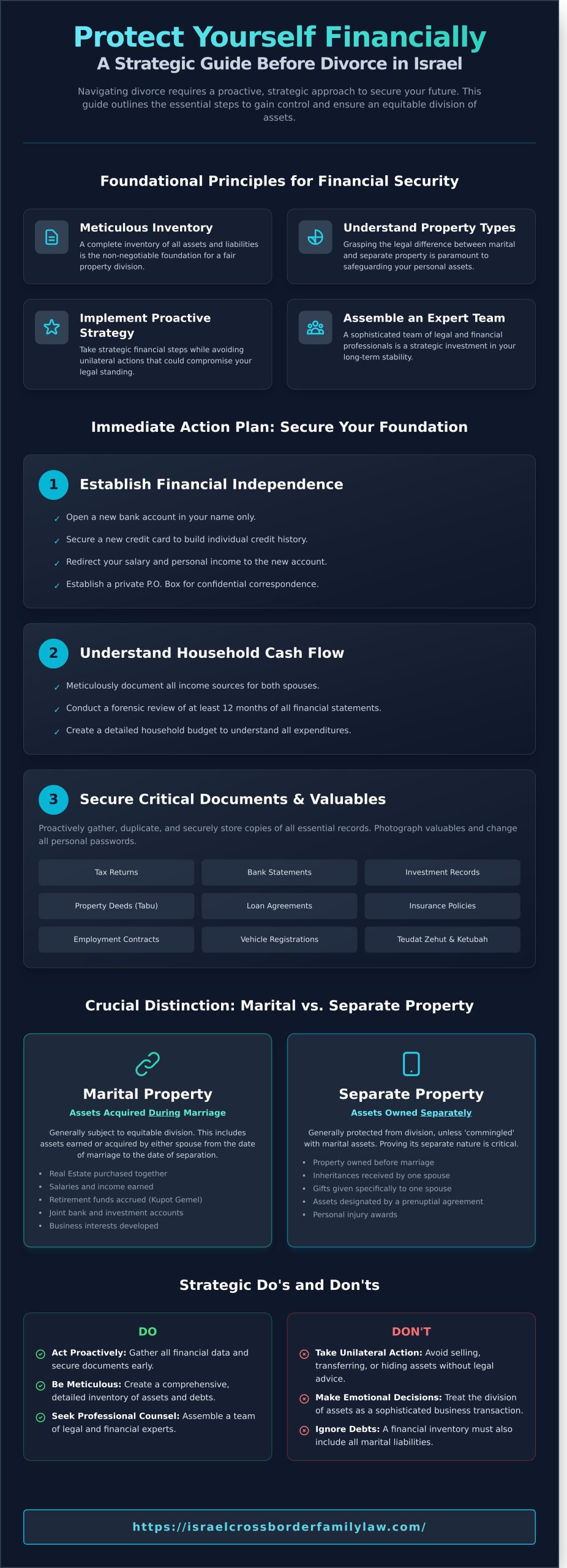
- To effectively answer the question of how to protect myself financially before a divorce, you must implement proactive strategies while avoiding unilateral actions that could compromise your legal standing.
- Assembling a sophisticated team of legal and financial professionals is a strategic investment in navigating the complexities of the process and securing your long-term financial stability.
Immediate First Steps: Secure Your Financial Foundation
Navigating the complexities of a marital dissolution requires strategic preparation, not emotional reaction. The process is a marathon, and your long-term financial well-being depends on the foundational steps you take now. For anyone asking, how to protect myself financially before a divorce, the initial phase is about gaining clarity, control, and stability. This is not about initiating conflict; it is about approaching the division of assets as a sophisticated business transaction, ensuring transparency and a fair outcome.
For a practical overview of these initial considerations, the following video provides valuable guidance:
Establish Your Financial Independence
Begin by creating a distinct financial identity. This involves opening a new bank account, in your name only, at an institution separate from any joint accounts. Concurrently, secure a credit card solely in your name to establish or maintain your individual credit history, which will be vital for future financial needs. It is prudent to redirect your salary and any other personal income to this new account and establish a private mailing address, such as a P.O. Box from Israel Post, to ensure confidential correspondence.
Understand Your Household Cash Flow
A comprehensive understanding of your marital financial landscape is non-negotiable. You must meticulously document all income sources for both spouses and conduct a thorough analysis of at least 12 months of all bank and credit card statements. This forensic review will form the basis of a detailed household budget, accounting for all expenditures from mortgage payments and Arnona (municipal tax) to daily expenses of several hundred shekels. This data is critical for navigating the principles of equitable distribution under Israeli law, which governs how marital assets and debts are divided.
Secure Critical Documents and Valuables
Proactively gather and duplicate all essential financial and legal documents. This includes, but is not limited to:
- Tax returns and assessments from the Israel Tax Authority
- Bank, credit card, and investment statements
- Property deeds (Tabu) and vehicle registrations
- Loan agreements, insurance policies, and employment contracts
- Your Teudat Zehut and Ketubah
Store these copies securely off-site with your legal counsel or in a safe deposit box. Furthermore, photograph all valuable personal property and immediately change the passwords on your personal digital accounts to safeguard your private information.
Create a Comprehensive Financial Inventory
To effectively answer the question of how to protect myself financially before a divorce, a complete and meticulously organized financial inventory is non-negotiable. This comprehensive audit of your marital estate is not merely an administrative task; it forms the foundational pillar of your entire legal strategy. Gathering this documentation proactively prevents costly delays, minimizes disputes, and empowers your legal team to advocate effectively for a fair and equitable settlement. This rigorous discovery process is a core part of how our advisory works to build a robust and defensible case on your behalf.
Document All Marital Assets
The first step is to create an exhaustive list of all property acquired during the marriage. Understanding the legal distinctions between Marital vs. Separate Property is a critical concept, particularly in complex cross-border cases involving different legal jurisdictions. A thorough asset inventory is essential for anyone seeking to understand how to protect themselves financially before a divorce. Your inventory should include:
- Real Estate: Deeds, mortgage statements, and recent property tax assessments for all residential and commercial properties.
- Financial Accounts: Complete statements for all bank accounts (checking, savings), investment and brokerage accounts, and retirement accounts (Kupot Gemel, Keran Hishtalmut, pensions).
- Titled Property: Ownership documents and valuation estimates for vehicles, boats, and any other significant personal property.
- Business Interests: Documentation detailing ownership percentages, shareholder agreements, business valuations, and stock option grants.
Identify and List All Liabilities
A complete financial picture includes not only assets but also all outstanding debts. Both joint and individual liabilities must be documented to determine the marital estate’s net worth and ensure a fair division of responsibilities. Compile recent statements for:
- Mortgages and home equity lines of credit (HELOCs).
- All credit card debts, carefully noting which accounts are held jointly versus individually.
- Vehicle financing, personal loans, and any outstanding student loans.
- Any tax liabilities owed to Israeli or foreign tax authorities.
Verify Income and Employment Benefits
Accurate calculations for spousal and child support depend on a transparent and verified record of both parties’ income and earning capacity. This goes beyond base salary to include all forms of compensation and benefits. Be prepared to gather:
- Pay stubs (Tlush Maskoret) for both spouses, ideally for the last two years.
- Personal and business tax returns for the past three to five years.
- Documentation of bonuses, commissions, profit-sharing, and other variable compensation.
- Statements for benefits such as health insurance, life insurance policies, and employer-sponsored retirement plans.
Understand Marital vs. Separate Property
A central question for anyone asking how to protect myself financially before a divorce revolves around which assets are subject to division. A common misconception is that every asset owned during the marriage will be split equally. The reality is far more nuanced and is governed by the critical legal distinction between marital and separate property. This classification is a cornerstone of family law in Israel and abroad, and understanding it is fundamental to safeguarding your financial future, as it directly impacts the final settlement agreement.
Defining Marital Property
Under Israel’s Spouses’ Property Relations Law, marital property generally includes all assets, rights, and even debts accumulated by either spouse during the marriage. This is often referred to as the “community of property” or the “balancing of resources” arrangement. This pool of assets is typically subject to equal division upon divorce, regardless of whose name an asset is registered in. Marital property commonly includes:
- Income earned and savings accrued by both partners during the marriage.
- Real estate, such as the family home, purchased during the marriage.
- Investments, pension rights, and severance pay accumulated during the marital period.
- Any increase in the value of a separate asset that resulted from the active efforts of either spouse.
Defining Separate Property
Separate property consists of assets that belong exclusively to one spouse and are not subject to division. Properly identifying and preserving the character of these assets is a key strategy in protecting your finances. Separate property typically includes assets owned by a spouse before the marriage, as well as inheritances or gifts received by one spouse personally during the marriage. However, the most critical step is to avoid “commingling” these funds. For instance, depositing a substantial inheritance of ₪500,000 into a joint bank account where marital funds are also deposited can risk converting that separate property into a marital asset. A comprehensive guide to Protecting Your Assets in Divorce will always emphasize the importance of maintaining separate accounts and clear documentation for these specific funds.
Complexities in Cross-Border (US-Israel) Cases
For multi-jurisdictional families, the distinction between marital and separate property becomes profoundly more complex. The legal frameworks in the United States and Israel differ significantly, and determining which jurisdiction’s laws apply to which asset is a sophisticated legal challenge. An apartment in Tel Aviv may be subject to Israeli law, while a 401(k) or stock portfolio in the U.S. could be governed by state-specific laws, such as community property or equitable distribution rules. For international families facing divorce, securing expert legal counsel is not a recommendation but a necessity. A well-drafted multi-jurisdictional prenuptial agreement can also proactively define these terms, providing clarity and protection across borders.
Strategic Financial Decisions to Make (and Avoid)
Navigating the financial complexities preceding a divorce requires a measured and strategic approach. The actions you take now can significantly influence the final settlement and your long-term economic stability. Understanding how to protect myself financially before a divorce involves both prudent proactive measures and the avoidance of detrimental actions. The primary objective is to preserve the integrity of the marital estate for equitable division, not to deplete or obscure it. It is imperative to consult with your attorney before making any significant financial moves, as actions perceived as hostile or deceptive can have severe legal ramifications in Israeli family courts.
What You Should Do
To safeguard your financial position, consider these essential, stabilizing actions:
- Maintain the status quo. Continue paying the mortgage, utilities, arnona (municipal tax), and other joint obligations. This protects your credit rating and demonstrates good faith, preventing accusations of financial misconduct or abandonment.
- Consider freezing joint credit lines. To prevent your spouse from incurring substantial new debt for which you could be held partially responsible, speak with your bank about freezing joint credit cards and lines of credit. This is a defensive measure to cap shared liability.
- Estimate your post-divorce budget. Realistically calculate your future living expenses, including housing, transportation, and childcare. This forward-thinking analysis is critical for negotiating spousal support (mezonot) and planning for your independent financial future.
- Update your estate plan. Revise your will, trusts, and powers of attorney to ensure your assets are directed to your intended beneficiaries, not your soon-to-be-ex-spouse, in the event of your death before the divorce is finalized.
What You Should Avoid
Certain actions can irreparably damage your case and credibility. It is crucial to avoid the following:
- Do not hide or transfer assets. Attempting to move funds to secret accounts or transfer ownership of property to friends or family is viewed extremely unfavorably by the courts. Such actions almost always come to light and can result in severe penalties.
- Avoid unusual financial transactions. Refrain from making large, uncharacteristic purchases, liquidating significant investment portfolios, or taking substantial loans. These activities can be interpreted as an attempt to dissipate marital assets before they can be divided.
- Refrain from incurring new debt. Do not take out significant personal loans or accumulate large credit card balances. Complicating the marital balance sheet with new liabilities can work against you during settlement negotiations.
- Do not make drastic career changes. Voluntarily quitting your job or reducing your income can be perceived as a strategic maneuver to avoid support obligations. The court may impute income based on your earning capacity, rendering the move ineffective and harmful to your case.
For sophisticated guidance tailored to the complex cross-border financial regulations in Israel, consulting with experienced counsel is a critical step in securing your financial future.
Assembling Your Professional Team
Navigating the complexities of a divorce without professional guidance presents a significant risk to your financial future. The most effective answer to the question of how to protect myself financially before a divorce is to assemble a dedicated team of experts. This collaborative approach ensures that every legal, financial, and long-term planning angle is meticulously covered. Your divorce attorney serves as the quarterback of this team, coordinating strategies and ensuring all professional advice aligns with your primary legal objectives for a secure outcome.
The Role of a Cross-Border Divorce Attorney
Your attorney is the cornerstone of your legal strategy, providing sophisticated guidance through every stage of the dissolution process. For individuals with international ties, a specialist in cross-border family law is indispensable. They possess a deep understanding of the nuances involved in multi-jurisdictional asset division, international treaties, and the enforcement of orders across different legal systems. Their primary role is to advocate fiercely for your rights during negotiation and litigation. You can learn more about our advisory and our specialized expertise in navigating these complex matters.
Engaging a Forensic Accountant
When a marital estate involves complex business finances, international investments, or the suspicion of hidden assets, engaging a forensic accountant is a critical strategic move. These financial investigators are adept at tracing funds through intricate corporate structures, performing accurate business valuations, and uncovering undisclosed income or assets. Their detailed, impartial analysis provides the clarity needed to ensure a fair division of property and can serve as crucial, compelling evidence in court proceedings.
Consulting with a Financial Advisor
While your attorney secures your settlement, a financial advisor helps you build your future. This professional provides essential guidance on structuring your post-divorce financial life for long-term stability and growth. They assist in creating a realistic budget based on your new financial reality, advise on the prudent management and investment of settlement assets, and help you plan for major life goals such as retirement. This forward-looking counsel is vital for transitioning from the legal process to a secure and independent financial future.
Ultimately, assembling the right team is the most powerful step you can take to protect your financial interests. By combining specialized legal, accounting, and financial planning expertise, you create a comprehensive defense for your assets and a clear path toward a stable future. To discuss how our expertise can form the foundation of your professional team, we invite you to contact our advisory.
Navigating Your Financial Transition with Confidence
Proactively preparing for the financial complexities of a marital dissolution is the most critical step you can take. As we have detailed, this involves creating a comprehensive financial inventory and understanding the crucial distinction between marital and separate property. These foundational actions provide the clarity needed to answer the question of how to protect myself financially before a divorce and ensure you approach negotiations from a position of strength and knowledge.
When circumstances involve complex or high-value assets, particularly in a cross-border context between the U.S. and Israel, this strategic preparation requires specialized legal guidance. With decades of experience protecting our clients’ financial interests, our firm provides the sophisticated counsel necessary for these intricate situations. We deliver strategic guidance for complex, high-value asset division, leveraging our specialized expertise in US-Israel cross-border divorce to safeguard what you have built.
Take the definitive step toward securing your financial future. Request a Confidential Case Review to Secure Your Financial Future and partner with a team dedicated to protecting your interests. Empowering yourself with the right professional counsel is the first step toward building a stable and prosperous new beginning.
Frequently Asked Questions About Financial Protection in Divorce
Can my spouse legally cut me off financially before the divorce is filed?
Under Israeli law, a spouse cannot unilaterally sever financial access to marital funds required for essential living expenses. Such actions can be considered a form of economic coercion, and the Family Court has the authority to intervene. Should this occur, it is imperative to seek immediate legal counsel to petition for temporary relief orders, which can mandate continued financial support and ensure access to necessary funds while proceedings are initiated, thereby safeguarding your stability.
What should I do if I suspect my spouse is hiding assets?
If you suspect the concealment of assets, a proactive and strategic approach is required. The initial step involves compiling all available financial documentation, including bank statements, tax filings, and investment records. Engaging a forensic accountant is a prudent next measure; these specialists possess the expertise to conduct in-depth investigations, trace transferred funds, and uncover undisclosed assets, ensuring a comprehensive and accurate valuation of the marital estate for equitable division.
Is a prenuptial agreement the only way to protect my pre-marital assets?
While a prenuptial agreement offers the most definitive protection, it is not the sole mechanism. Israel’s Spouses’ Property Relations Law generally presumes that assets owned prior to the marriage remain separate property. However, this protection can be compromised if those assets were commingled with marital funds or if their value appreciated due to joint spousal efforts. A prenuptial agreement provides contractual clarity that supersedes these potential ambiguities, definitively securing pre-marital wealth.
How does debt get divided in a divorce?
In Israel, the division of debt mirrors the division of assets. Liabilities incurred during the marriage for the benefit of the family unit, such as mortgages, car loans, and joint credit card balances, are typically considered marital debt and are divided equally between the spouses. Conversely, debt incurred by one party for their exclusive, non-familial benefit may be assigned solely to that individual. A thorough financial disclosure is critical to achieving a fair allocation of liabilities.
Should I close our joint bank accounts and credit cards right now?
Unilaterally closing joint accounts is strongly discouraged, as it can be viewed unfavourably by the court and may disrupt essential household payments. The more prudent course of action is to seek a court order. This legal measure can either freeze the accounts to prevent one party from depleting them or establish clear guidelines for their use pending the divorce settlement. This is a fundamental component of understanding how to protect myself financially before a divorce.
How will a divorce impact my credit score and what can I do about it?
A divorce itself does not directly alter your credit score; however, the financial arrangements that follow can have a significant impact. The primary risk stems from joint liabilities. If your former spouse defaults on payments for a shared mortgage or loan that remains in both names, your credit history will be negatively affected. To mitigate this risk, ensure the divorce decree explicitly assigns each debt and work to formally remove your name from any obligation assigned to your ex-spouse.

Article by
Gabriel Lior
A Personal Journey That Became a Mission
The advisory was founded by an American father Gabriel Lior, LLB, MBA , global entrepreneur, and cross-border advisor who spent more than a decade navigating the Israeli family court system firsthand and now lives in Singapore with his son.
As a divorced parent in a cross-border family, Gabriel faced nearly every legal challenge a foreign parent can encounter in Israel — including child custody disputes, child support proceedings, property matters in Israel and abroad, false accusations, and complex immigration and relocation proceedings.
Over the years, he learned the hard way how difficult it is for non-Israeli parents to understand the system, identify the right legal strategy, and choose the right legal representation — especially when language, culture, and jurisdictional differences are involved. He also witnessed how foreign parents and new immigrants are often disadvantaged or taken advantage of by service providers and institutions simply because they lack local knowledge or fluency.
From Client to Advisor
To truly understand — and survive — the system, Gabriel pursued formal legal education in Israel, completing two Israeli law degrees, alongside a BA and MBA earned in the United States. This was never about becoming a practicing attorney, but about gaining a deep, structural understanding of how the system works — and where it breaks down for foreign parents.
This rare combination of:
Firsthand client experience
Israeli legal and US business education
International business and negotiation training
Decades of commercial execution
created a unique perspective – one that understands both sides of the table.
After years of litigation, persistence, and at times self-representation, he ultimately succeeded in securing custody of his son and relocating abroad through a rare legal victory in the Israeli Supreme Court — becoming one of the first fathers in Israel to do so under these circumstances.
Disclaimer
Important Disclaimer:
The information provided on this website and in its content is for general informational and educational purposes only and does not constitute legal advice, legal opinion, or legal representation.
Gabriel Lior is not licensed to practice law in Israel (nor is he interested in doing so) and does not provide legal services, despite having completed 2 Law Degrees. The services offered are advisory in nature and are intended to provide general guidance, strategic insight, and information regarding cross-border family law considerations.
No attorney-client relationship is formed by accessing this website, reading its content, or communicating with us.
Any decisions made based on this information are at your own discretion and risk. For legal advice specific to your situation, you should consult a licensed attorney in the relevant jurisdiction.
Where appropriate, we may refer clients to independent, licensed attorneys or professionals. Such referrals do not constitute legal representation and no liability is assumed for services provided by third parties.