For foreign residents, US citizens, and international testators, managing an estate in Israel can present a formidable set of cross-border challenges. The legal system, with its unique procedures, can seem unfamiliar and complex, giving rise to valid concerns about the recognition of a foreign will or the risk of a procedural error that could jeopardize a rightful inheritance. Successfully navigating this landscape requires a sophisticated and precise understanding of israeli inheritance law and its multi-jurisdictional implications.
This comprehensive guide is designed to demystify these complexities and provide a clear path forward. We will guide you through the core principles of Israel’s Succession Law, clarifying the critical distinctions between inheriting via a will versus by statutory default. You will gain a clear understanding of the probate and succession order process, the practical requirements for foreign heirs, and the strategic considerations for testators with assets in Israel, empowering you to manage your affairs with confidence and security.
Key Takeaways
- Comprehend the two fundamental paths of succession in Israel: distribution according to a legally valid will or, in its absence, the default framework established by statute.
- Ascertain the specific requirements for drafting a valid will to ensure your testamentary wishes are executed and avoid the complications of intestate succession.
- For foreign residents and US citizens, determine when israeli inheritance law has jurisdiction over an estate by understanding the critical ‘center of life’ test applied by the courts.
- Navigate the statutory inheritance hierarchy, which provides a non-discretionary system for asset distribution when an individual dies without leaving a valid will.
Foundations of Israeli Inheritance: The Succession Law of 1965
Navigating cross-border estate matters requires a deep understanding of local legislation. In Israel, the primary legal framework governing all succession and estate matters is the Succession Law of 1965. This comprehensive statute provides the definitive foundations of Israeli inheritance, dictating how a person’s assets are transferred upon their passing. The law applies to all assets located within Israel, regardless of the deceased’s nationality or residency status, making it a critical piece of legislation for foreign nationals with property, bank accounts, or other investments in the country.
For a deeper insight into the practical importance of this legal framework, the following video provides a valuable overview:
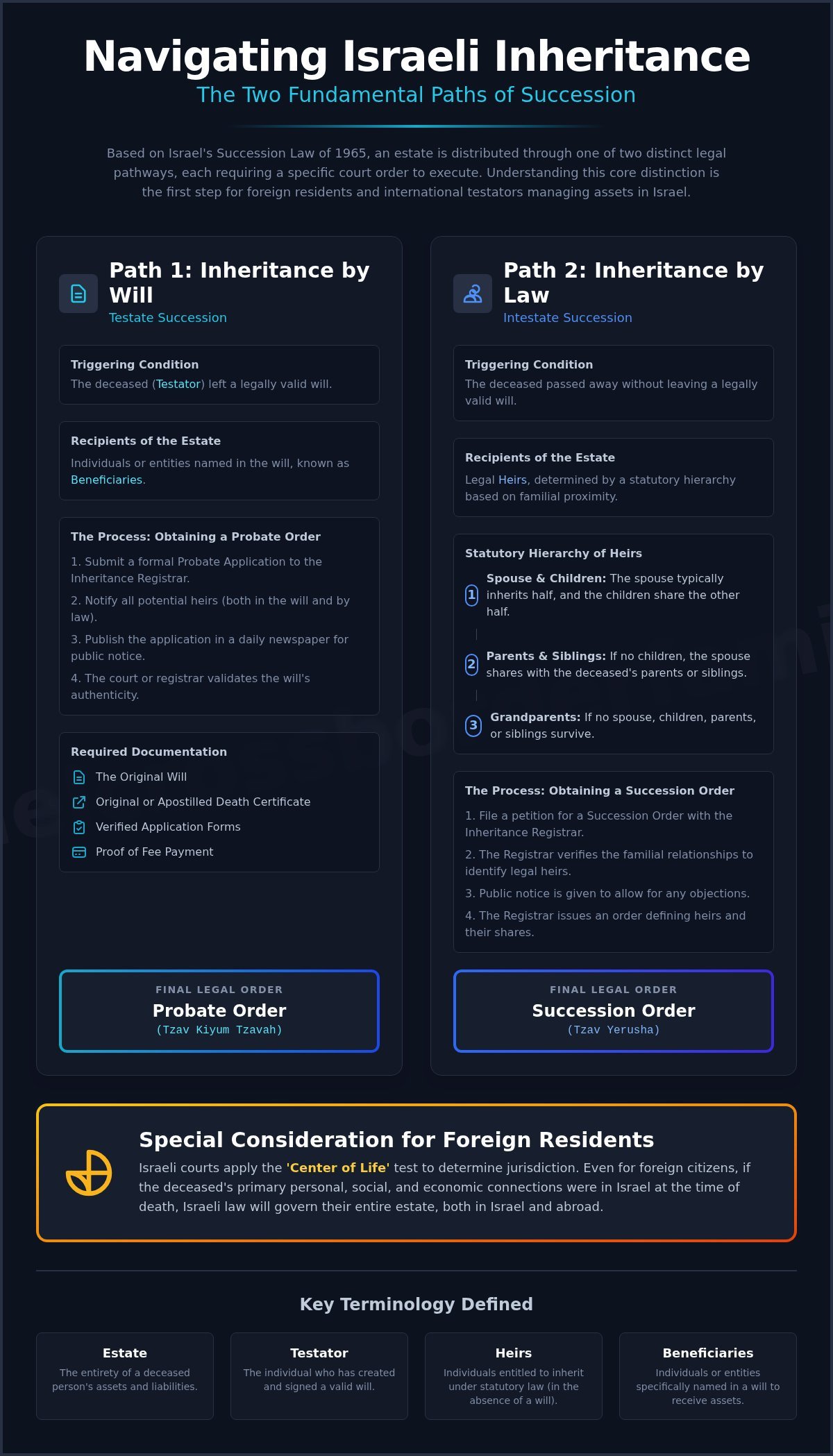
The core principle of israeli inheritance law is that an estate is distributed through one of two fundamental paths: by will (testate succession) or by law (intestate succession). To administer the estate, it’s essential to understand these key terms:
- Estate: The entirety of the deceased person’s assets and liabilities.
- Testator: The individual who has created a valid will.
- Heirs: Individuals entitled to inherit under the law (in the absence of a will).
- Beneficiaries: Individuals or entities named in a will to receive assets.
Each path requires a distinct legal order from the Israeli Inheritance Registrar or Family Court. A Probate Order (Tzav Kiyum Tzavah) legally validates a will, while a Succession Order (Tzav Yerusha) identifies the legal heirs according to statute when no will exists. Understanding which order is required is the first step in the complex process of administering an Israeli estate.
Inheritance by Will (Testate Succession)
Israeli law champions the principle of testamentary freedom, granting a testator the right to bequeath their assets as they see fit. A will allows for precise control over the distribution of an estate, overriding the default statutory rules. To be valid, a will must conform to one of the forms prescribed by law, which include a handwritten will, a will made before witnesses, a will made before an authority, or an oral will under specific circumstances. This path requires a court-approved Probate Order to execute the will’s instructions.
Inheritance by Law (Intestate Succession)
When a person passes away without leaving a valid will, their estate is distributed according to the default framework set forth in the Succession Law. This is known as intestate succession. The law establishes a clear hierarchy of heirs based on familial proximity to the deceased, typically prioritizing the spouse and children. Navigating this process requires petitioning the Inheritance Registrar for a Succession Order, which officially identifies the legal heirs and their respective shares of the estate.
The Process of Inheritance by Will: Obtaining a Probate Order
When an individual leaves a valid will, it serves as the primary legal instrument dictating the distribution of their Israeli assets, superseding the default rules of intestate succession. However, a will is not self-executing. To be legally enforced, it must be validated by an Israeli court or the Inheritance Registrar through a Probate Order (Tzav Kiyum Tzavah). This order confirms the will’s authenticity and grants the named executor the authority to manage and distribute the estate according to the testator’s wishes. The framework of israeli inheritance law mandates this formal process to ensure the orderly and lawful transfer of property.
Submitting the Probate Application
Initiating the probate process requires submitting a formal application to the Inheritance Registrar. This comprehensive submission must be meticulously prepared and include several critical documents:
- The original will.
- An original or apostilled copy of the death certificate.
- Completed application forms, signed and verified before an Israeli lawyer.
- Proof of payment of the requisite government fees.
Once filed, the Registrar mandates that all potential heirs, both those named in the will and those who would inherit by law, be formally notified. The application is also published in a daily newspaper and the official gazette (Reshumot) to allow for a waiting period during which any interested party may file an objection. The official government Process of Inheritance resource provides further detail on the systems for locating and claiming assets, a crucial step for beneficiaries.
Contesting a Will in Israel
Challenges to a will’s validity are not uncommon and are handled with significant legal scrutiny. An objection can be filed by any party with a legal interest in the estate, such as a disinherited legal heir or a beneficiary of a previous will. Common grounds for contesting a will include allegations of undue influence, the testator’s lack of testamentary capacity at the time of signing, or procedural defects in the will’s execution. If an objection is filed, the case is automatically transferred from the Registrar to the Family Court for full adjudication.
Recognition of Foreign Wills
The complexities of israeli inheritance law are particularly evident in cross-border estates. Israel generally recognizes the validity of a foreign will if it was validly executed according to the laws of the place it was made, the testator’s domicile, or their country of citizenship. However, validating a foreign will requires submitting a certified Hebrew translation and, crucially, a legal opinion from a qualified attorney in the foreign jurisdiction confirming the will’s validity there. This is a sophisticated area where expert legal guidance is indispensable for expats and foreign nationals navigating the process.
Inheritance by Law: Navigating the Default Rules of Succession
When an individual passes away without a valid will (intestate), their estate is not left in a legal void. Instead, its distribution is governed by the default rules of intestate succession under Israeli inheritance law. This process is initiated by petitioning the Israeli Inheritance Registrar for a Succession Order (Tzav Yerusha). This legally binding document identifies the statutory heirs and specifies their respective shares of the estate, providing a clear, non-discretionary framework for asset allocation as mandated by the Israeli Inheritance Law (1965).
The Statutory Order of Heirs
The law establishes a clear hierarchy of succession based on familial proximity. The estate is distributed among the closest living relatives in the following order of precedence:
- First in Line: The deceased’s surviving spouse and children, who inherit in equal shares (with the spouse taking half and the children sharing the other half).
- Second in Line: If there are no children, the deceased’s parents and their descendants (i.e., the deceased’s siblings).
- Third in Line: If there are no heirs in the first two categories, the deceased’s grandparents and their descendants (i.e., aunts and uncles).
Heirs in a lower category will only inherit if there are no surviving heirs in any of the preceding categories.
The Rights of the Surviving Spouse
The surviving spouse’s share is a cornerstone of the statutory framework. Their entitlement varies based on the presence of other heirs:
- With Children or Parents of the Deceased: The spouse inherits 50% of the estate.
- With Siblings or Grandparents of the Deceased: The spouse’s share increases to two-thirds of the estate.
- With No Other Heirs: The spouse inherits the entire estate.
In addition to their percentage share, the spouse is entitled to inherit the deceased’s share of the family vehicle and all movable property associated with the matrimonial household.
Impact of Marital Status on Inheritance
The legal status of a marriage at the time of death is a critical determinant of inheritance rights. A final divorce decree unequivocally terminates a spouse’s right to inherit by law. However, situations involving legal separation or pending divorce proceedings can introduce significant complexity, particularly for cross-border couples. Navigating these nuanced issues is central to our work in divorce for international families, where the interplay between marital and inheritance law demands sophisticated legal guidance.
Special Considerations for Foreign Heirs and US Citizens
For foreign nationals dealing with an estate in Israel, the primary question is one of jurisdiction. The governing law is determined by the deceased’s domicile at the time of death. Israeli courts apply a “center of life” test, a comprehensive analysis of the deceased’s primary residence, family location, and economic ties to determine domicile. If the deceased’s center of life was established in Israel, Israeli law will generally apply to their estate.
Heirs residing abroad face significant practical challenges, from language barriers to navigating Israeli bureaucracy. Official documents issued outside of Israel, such as death certificates or birth certificates, require legal authentication, typically via an Apostille. To overcome these hurdles, granting a power of attorney to a local Israeli law firm is essential. This empowers your legal representative to act on your behalf, liaising with the Inheritance Registrar and other institutions to manage the process efficiently.
Inheritance Taxation: Israel vs. The United States
A key advantage of israeli inheritance law is that Israel does not levy any inheritance or estate tax. Beneficiaries receive their share of the estate without any tax liability in Israel. However, for beneficiaries who are US citizens or residents, this is not the final consideration. The United States may impose federal estate or inheritance taxes on assets received from abroad. Consulting a tax professional with expertise in the US-Israel tax treaty is critical to ensure compliance and understand any potential tax obligations.
Managing Inherited Israeli Assets from Abroad
Before any assets can be managed or transferred, the heirs must secure a Probate Order (if a will exists) or a Succession Order (in cases of intestacy) from the appropriate Israeli authority. This legally recognized order is the key to administering the estate. Once obtained, the order allows the heirs or their legal representative to:
- Present the order to Israeli banks to access and distribute funds from the deceased’s accounts.
- Register the transfer of title for any real estate property with the Israel Land Registry (Tabu).
Why Cross-Border Expertise is Essential
Navigating the complexities of israeli inheritance law from abroad, while simultaneously managing foreign tax implications, demands sophisticated legal counsel. The intersection of these distinct legal and financial systems requires specialized, multi-jurisdictional knowledge. Our firm provides the deep experience necessary to manage these unique cross-border situations, ensuring a seamless and efficient process for our international clients. To understand how we can assist, learn more about our advisory.
Navigating Your Cross-Border Inheritance with Confidence
Navigating the framework of israeli inheritance law requires a sophisticated understanding of its core tenets, from the critical distinction between succession by will and by law to the specific procedures for obtaining Probate Orders. As we have explored, these matters become particularly complex in cross-border scenarios, presenting unique challenges and considerations for foreign heirs, expatriates, and U.S. citizens with assets in Israel.
For those managing these multi-jurisdictional estates, securing expert legal counsel is not merely advisable-it is essential for a seamless process. Our firm provides comprehensive support, leveraging specialized expertise in US-Israel cross-border law to offer clear, strategic guidance. We are dedicated to providing foreign nationals and expats with the sophisticated representation required to protect their interests and honor the testator’s legacy.
Do not leave your family’s future to chance. Schedule a Confidential Case Review to discuss your cross-border inheritance matter. Allow our dedicated team to provide the clarity and direction needed to secure your inheritance and move forward with confidence.
Frequently Asked Questions
Is there an inheritance tax in Israel for foreign residents?
Israel does not impose an inheritance or estate tax on assets passed to beneficiaries, irrespective of their residency status. However, it is critical for foreign nationals to understand that while the inheritance itself is not taxed, the subsequent sale of an inherited asset, such as real estate or securities, may be subject to Israeli Capital Gains Tax. Navigating these complex tax implications requires sophisticated, cross-border financial and legal counsel to ensure full compliance and strategic planning.
How long does the Israeli inheritance process typically take?
The duration of the Israeli inheritance process is contingent upon the complexity of the estate and whether the will is contested. A straightforward, uncontested probate or succession order can often be obtained within three to six months. However, for complex, multi-jurisdictional estates involving significant assets, or in cases where the will is challenged, the proceedings can extend for a year or significantly longer, demanding experienced legal guidance to navigate the Israeli court system efficiently.
Can my last will and testament from the United States be used in Israel?
Yes, a will executed in a foreign jurisdiction, such as the United States, can be recognized as valid in Israel. According to Israel’s Inheritance Law of 1965, a will is legally effective if it was valid in the location where it was made, the testator’s domicile, or where the assets are situated. For enforcement, the foreign will must be submitted to the Israeli Inheritance Registrar along with a legal opinion, a notarized translation, and other formal documentation for probate.
What happens to an inheritance if the deceased had significant debts?
Under Israeli law, the estate of the deceased is responsible for settling all outstanding debts and liabilities before any assets are distributed to the heirs. Creditors have priority, and the estate’s assets will be used to satisfy these obligations, including taxes and contractual debts. Beneficiaries are not personally liable for the deceased’s debts beyond the value of the assets they are set to inherit. Only the net estate, after all liabilities are cleared, is distributed to the heirs.
What are the legal rights of a surviving spouse if there is no will?
In the absence of a valid will (intestacy), Israeli law provides substantial protections for a surviving spouse. The spouse is entitled to inherit the deceased’s movable property, including automobiles and household effects. Furthermore, the spouse inherits 50% of the remaining estate, with the other 50% being divided among the deceased’s children. This statutory distribution framework highlights the critical importance of proactive, bespoke estate planning for individuals with assets in Israel.
How can I find out if a deceased relative left assets in Israel?
Identifying a deceased relative’s assets in Israel is a complex undertaking that requires professional legal assistance. The process involves conducting comprehensive searches through official channels such as the Israel Land Registry (Tabu), the Israeli Corporations Authority, and contacting financial institutions. Obtaining a succession or probate order is often a prerequisite to compel banks and other entities to release confidential information regarding the deceased’s holdings, a procedure best managed by a law firm with a team on the ground.
What are the primary grounds for contesting a will in an Israeli court?
Contesting a will in Israel requires demonstrating specific legal grounds before the Family Court. The primary arguments for challenging a will under Israeli inheritance law include a lack of testamentary capacity of the testator, the exertion of undue influence or duress, a formal defect in the will’s execution (such as improper witnessing), or forgery. Successfully litigating such a claim demands the presentation of substantial evidence and requires sophisticated representation from counsel experienced in Israeli probate disputes.

Article by
Gabriel Lior
A Personal Journey That Became a Mission
The advisory was founded by an American father Gabriel Lior, LLB, MBA , global entrepreneur, and cross-border advisor who spent more than a decade navigating the Israeli family court system firsthand and now lives in Singapore with his son.
As a divorced parent in a cross-border family, Gabriel faced nearly every legal challenge a foreign parent can encounter in Israel — including child custody disputes, child support proceedings, property matters in Israel and abroad, false accusations, and complex immigration and relocation proceedings.
Over the years, he learned the hard way how difficult it is for non-Israeli parents to understand the system, identify the right legal strategy, and choose the right legal representation — especially when language, culture, and jurisdictional differences are involved. He also witnessed how foreign parents and new immigrants are often disadvantaged or taken advantage of by service providers and institutions simply because they lack local knowledge or fluency.
From Client to Advisor
To truly understand — and survive — the system, Gabriel pursued formal legal education in Israel, completing two Israeli law degrees, alongside a BA and MBA earned in the United States. This was never about becoming a practicing attorney, but about gaining a deep, structural understanding of how the system works — and where it breaks down for foreign parents.
This rare combination of:
Firsthand client experience
Israeli legal and US business education
International business and negotiation training
Decades of commercial execution
created a unique perspective – one that understands both sides of the table.
After years of litigation, persistence, and at times self-representation, he ultimately succeeded in securing custody of his son and relocating abroad through a rare legal victory in the Israeli Supreme Court — becoming one of the first fathers in Israel to do so under these circumstances.
Disclaimer
Important Disclaimer:
The information provided on this website and in its content is for general informational and educational purposes only and does not constitute legal advice, legal opinion, or legal representation.
Gabriel Lior is not licensed to practice law in Israel (nor is he interested in doing so) and does not provide legal services, despite having completed 2 Law Degrees. The services offered are advisory in nature and are intended to provide general guidance, strategic insight, and information regarding cross-border family law considerations.
No attorney-client relationship is formed by accessing this website, reading its content, or communicating with us.
Any decisions made based on this information are at your own discretion and risk. For legal advice specific to your situation, you should consult a licensed attorney in the relevant jurisdiction.
Where appropriate, we may refer clients to independent, licensed attorneys or professionals. Such referrals do not constitute legal representation and no liability is assumed for services provided by third parties.