What if your carefully crafted US will is challenged in an Israeli court, leaving your child’s inheritance inaccessible for years? It’s a valid concern for any US-Israel family. You’ve worked hard to build a legacy, and the thought of it being eroded by conflicting legal systems, unexpected taxes, or complex probate proceedings is a source of genuine anxiety.
This guide provides a clear roadmap for the strategic process of securing my child’s inheritance across borders. We will explain how to navigate the sophisticated intersection of American and Israeli inheritance laws to ensure your child’s legacy remains protected, accessible, and tax-efficient. You will learn the critical steps required to create a seamless multi-jurisdictional estate plan that stands strong in both countries.
We’ll cover the recognition of foreign wills in Israel, effective strategies for appointing guardians who can immediately access funds for your child’s care, and how to structure your assets to minimize the bureaucratic friction that can delay or diminish an inheritance.
Key Takeaways
Understand the fundamental differences between US common law and Israel’s Succession Law to avoid common inheritance conflicts and delays.
Discover why a "Dual Will" strategy, with separate wills for each country, is often the most effective approach for international families.
Learn the critical steps for securing my child’s inheritance across borders, including how to navigate Israeli guardianship rules to protect assets for a minor.
Find out why evolving tax treaties make 2026 a critical year to review your international estate plan for maximum tax efficiency and compliance.
Recognize the importance of developing a clear strategy before drafting any legal documents to ensure your legacy is managed according to your exact wishes.
Table of Contents
The Strategic Importance of Securing a Cross-Border Inheritance in 2026
Understanding the Conflict of Laws Between the US and Israel
Protecting Minor Children: Guardianship and Financial Management
The Path to Clarity: Strategic Advisory for International Families
The Strategic Importance of Securing a Cross-Border Inheritance in 2026
For American families with assets in Israel, true inheritance security isn’t just about having a will. It’s about the strategic alignment of US and Israeli legal instruments to create a seamless transfer of wealth. This complex process involves ensuring that an estate plan drafted under US common law is recognized and executed efficiently within Israel’s civil law framework, a challenge that requires specialized, forward-looking guidance.
To better understand the core principles of protecting your family’s assets, this overview provides a helpful starting point:
The year 2026 represents a critical juncture for reviewing international estate plans. Global tax frameworks, influenced by initiatives like the OECD’s ongoing review of tax treaties, are continuously evolving. While the U.S.-Israel tax treaty has remained static since its effective date in 1994, increasing global pressure for financial transparency means that assumptions made even five years ago may no longer be valid. Proactively reviewing your strategy ensures you are prepared for potential shifts in how cross-border assets are treated, making the task of securing my child’s inheritance across borders a matter of timely diligence.
For many US citizens, or Anglos, the Israeli inheritance system can feel counter-intuitive. It operates on principles that differ fundamentally from the American concept of near-absolute testamentary freedom. The legal system here places different emphasis on family rights and residence, which can lead to unexpected outcomes if a US-centric plan is applied without adaptation. This divergence creates a classic Conflict of Laws scenario, where the rules of one jurisdiction clash with another, requiring expert navigation to determine which legal system governs your estate.
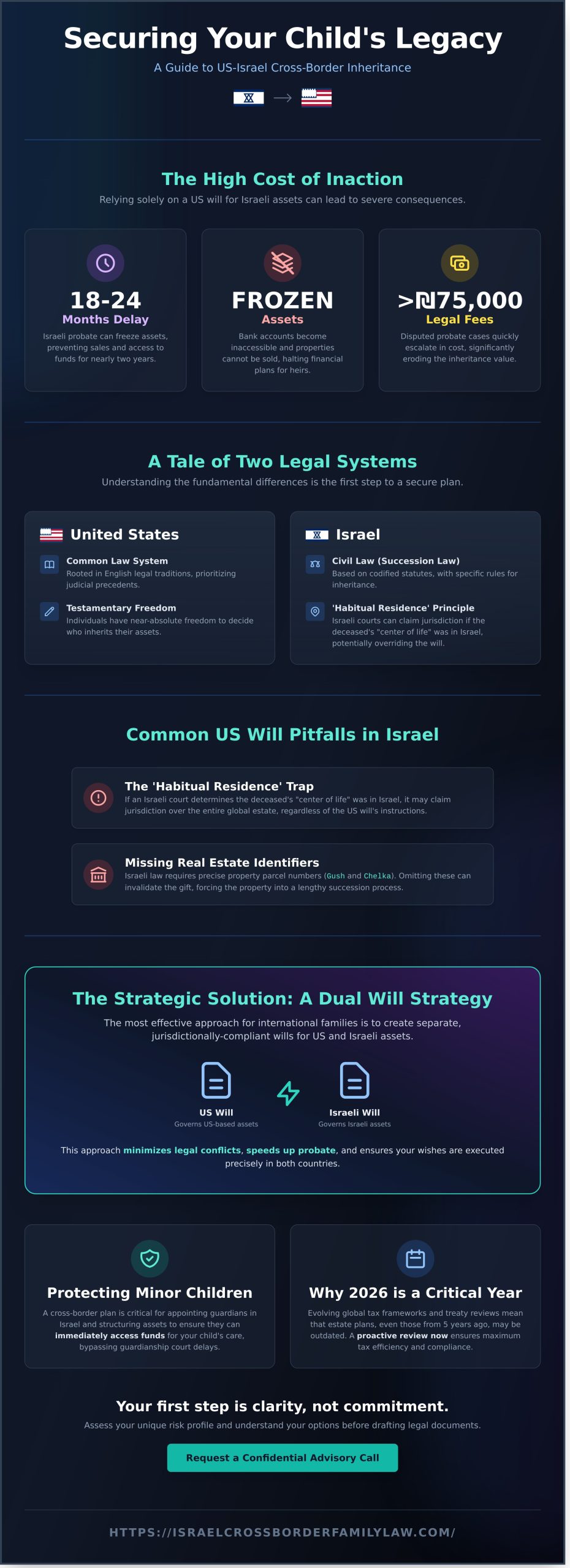
The cost of inaction is both financial and emotional. "Doing nothing," or relying on an un-reviewed US will, often leads to significant probate delays in Israel, potentially freezing assets for 18 to 24 months. During this time, property cannot be sold and bank accounts may be inaccessible. Legal challenges can quickly escalate costs, with disputed probate cases often exceeding ₪75,000 in legal fees, eroding the very inheritance you sought to protect.
Why a Standard US Will is Often Insufficient in Israel
A will drafted in the United States often fails to clear Israeli legal hurdles. A primary reason is the ‘habitual residence’ trap; Israeli courts may claim jurisdiction over the entire estate if the deceased’s center of life was determined to be in Israel, regardless of what a US will states. Furthermore, Israeli law has specific requirements for bequeathing real estate that many US wills overlook, such as precise property parcel numbers (gush and chelka), which can invalidate the intended gift and force the property into a lengthy succession process.
Succession in Israel is the legal process of transferring a deceased person’s assets and liabilities to their heirs according to Israeli law or a valid will.
Identifying Your Cross-Border Risk Profile
Your first step in securing my child’s inheritance across borders is to assess your unique risk profile. This involves evaluating your asset mix; Israeli real estate is governed by different rules than financial accounts in a Tel Aviv bank or intellectual property from a start-up. You must also consider the ‘Beneficiary Gap’-the common scenario where heirs are US residents, unfamiliar with Israeli bureaucracy, while the assets are firmly under Israeli jurisdiction. Understanding these factors early provides the clarity needed before committing to a specific legal strategy.
Get clarity before you commit. Request a confidential advisory call to discuss your situation.
Understanding the Conflict of Laws Between the US and Israel
Successfully securing your child’s inheritance across borders depends on a clear understanding of the profound legal differences between the United States and Israel. The two nations operate on distinct legal foundations. The US, with its roots in English Common Law, prioritizes testamentary freedom, allowing an individual broad discretion in distributing their assets via a will. In contrast, Israeli inheritance is governed by a civil code, The Succession Law of 1965, which establishes a default order of succession for spouses and children. While a valid will can override these default rules, the legal frameworks for creating and executing that will are distinct and must be carefully navigated.
A critical factor in determining which country’s law applies is the legal principle of ‘situs,’ or the physical location of the assets. Real estate in Tel Aviv falls under the jurisdiction of Israeli courts, regardless of the owner’s citizenship. Conversely, a brokerage account held with a firm in New York will be subject to US federal and New York state laws. This distinction becomes even more complex when considering different US state laws. For example, California operates under a ‘community property’ system where marital assets are generally considered co-owned, while New York is a ‘common law’ state. These differences can dramatically alter how assets are classified and distributed from an estate with ties to both jurisdictions.
While many are aware of Israel’s Religious Courts (the Rabbinical Courts), their jurisdiction in inheritance matters is specific and limited. They may preside over a case only if all involved parties consent in writing and are members of the same religious community. For the vast majority of international families and foreign residents, inheritance matters are adjudicated in Israel’s civil Family Courts, which apply The Succession Law.
The Israeli Probate Process for Foreign Residents
For heirs living abroad, accessing Israeli assets requires obtaining an Israeli Succession Order or Probate Order from the Registrar of Inheritance. This process validates the will (if one exists) or officially confirms the legal heirs according to statute. From outside Israel, this involves appointing a licensed Israeli attorney to manage the application, which includes:
Filing a formal petition with the Registrar of Inheritance.
Publishing a notice of the filing to allow for any objections.
Responding to any inquiries or requests from the Administrator General.
Receiving the final, legally recognized Order to present to banks, land registries, and other institutions.
Navigating these administrative steps requires experienced local counsel, a crucial consideration For Expats & Foreign Nationals seeking to manage an Israeli inheritance efficiently.
How Treaties and International Agreements Apply
International agreements can simplify certain aspects of cross-border inheritance, but they don’t eliminate the underlying legal conflicts. The US-Israel Estate Tax Treaty, for instance, is designed to prevent double taxation on the same assets. However, with Israel having no estate or inheritance tax as of 2024, its primary function is to provide US citizens with credits against their US estate tax liability for certain Israeli assets. It’s crucial to understand that while the treaty addresses taxes, your US-based child will still have compliance duties, including specific IRS reporting requirements for foreign inheritances exceeding $100,000.
Another pivotal agreement is The Hague Convention on the Form of Testamentary Dispositions, which Israel has ratified. This convention makes it easier to validate a will across borders by recognizing it as formally valid if it meets the legal requirements of the country where it was made. This means a will properly executed in Florida can be accepted by an Israeli court. Yet, this only addresses the will’s form, not its substance or its interaction with local property laws. This is why a ‘bicultural’ legal strategy, one that integrates both US and Israeli legal expertise, is far more effective than relying on local-only advice. A siloed approach risks overlooking critical tax implications or succession rules, undermining the core objective of securing my child’s inheritance across borders. Developing a cohesive plan requires a nuanced understanding of how both systems interact.
Protecting Minor Children: Guardianship and Financial Management
For parents with assets in both the United States and Israel, the most pressing concern is often straightforward: Who will manage my child’s inheritance if I am gone? The complexities of securing my child’s inheritance across borders are most acute when they are minors. Without a clear, legally sound plan that is enforceable in both jurisdictions, the default Israeli system may take control, leading to a situation far from what you intended.
In Israel, if a minor inherits assets without a designated trust or other management structure in place, the state appoints the Administrator General and Official Receiver, known as the Apotropos Klali, to oversee the funds. This government body’s role is to protect the child’s financial interests, which involves supervising the assets, requiring detailed annual reports from the guardian, and approving any significant expenditures. While well-intentioned, this process introduces a layer of bureaucracy, potential delays, and costs that most parents would prefer to avoid for their children and chosen guardians.
Naming Guardians Across Borders
A critical first step is to understand the distinction between two key roles. A ‘Guardian of the Person’ is responsible for the child’s daily care, upbringing, and welfare. A ‘Guardian of the Estate’ is responsible for managing the child’s financial assets. While often the same person, they can be different. Simply naming a US-based relative in your American will is not sufficient. An Israeli court must ratify the appointment for a minor residing in Israel. The court’s primary consideration is the child’s best interest, and it will require evidence that your chosen guardian is fit and capable. This is particularly relevant in scenarios involving potential International Custody & Relocation, where the ‘Guardian of the Person’ must navigate two distinct legal systems.
Financial Protection Tools for Heirs
Proactive estate planning offers sophisticated tools to bypass direct court supervision and protect your child’s assets. The most effective of these is a trust. By transferring assets into a trust for the benefit of your child, you appoint a trustee (who can be your chosen guardian) to manage the funds according to your specific instructions. This structure operates outside the probate system and avoids the oversight of the Apotropos Klali. Strategic use of trusts is a powerful tool for securing my child’s inheritance across borders without direct and ongoing court intervention.
You can also build protective measures directly into your inheritance plan:
Conditional Inheritance: You can structure the will or trust so that your child doesn’t receive their entire inheritance at age 18. You might specify staged distributions, such as one-third at age 25, one-third at age 30, and the final third at age 35, protecting them from youthful inexperience.
Ensuring Liquidity: The probate process can take months. To provide for your child’s immediate needs, you can designate a life insurance policy to pay out directly to the trust or a named adult beneficiary, providing immediate access to funds for the guardian.
Managing Obligations: Pre-existing child support obligations from a previous relationship do not vanish. They can become a priority claim against the estate, impacting the net amount available for your heirs. This liability must be accounted for in your financial planning.
Strategic Tools for a Seamless Cross-Border Legacy
Successfully transferring wealth across jurisdictions requires more than a standard will. It demands a sophisticated, multi-layered approach that utilizes specific legal and financial instruments designed for complex international scenarios. For families with ties to both the US and Israel, deploying the right tools is the critical factor in securing my child’s inheritance across borders, ensuring a smooth transition rather than a protracted legal battle.
A cornerstone of this strategy is the ‘Dual Will’. Relying solely on a US will to distribute Israeli assets, such as real estate in Tel Aviv or an Israeli bank account, is a common but costly mistake. The Israeli Inheritance Registrar requires a notarized translation and an expert legal opinion confirming the US will’s validity under its originating state’s laws. This process can add 12-18 months of delay and tens of thousands of shekels in expenses. A separate, validly executed Israeli will, dealing exclusively with your Israeli assets, bypasses these hurdles entirely, allowing for a direct and efficient probate process in Israel.
Comparing Trusts vs. Wills for US-Israel Families
While an Israeli will handles asset distribution, an International Asset Protection Trust offers superior control, privacy, and protection. Unlike a will, which becomes a public record during probate, a trust maintains your family’s financial privacy. For your heirs, a trust managed by a professional trustee eliminates the burden of navigating a foreign legal system, making the administration far simpler than the court-supervised probate process required for a will.
The Role of Life Insurance in Cross-Border Planning
Life insurance acts as a powerful non-probate tool, providing immediate liquidity to your beneficiaries. The death benefit is paid directly to the named person, bypassing the often-lengthy inheritance process. This cash injection is vital for covering immediate expenses, such as legal fees, property maintenance costs, and potential tax liabilities, without forcing your children to sell inherited assets under pressure. Understanding the Pricing and Strategic Costs of estate administration highlights the value of this immediate financial access.
A final, crucial instrument for proactive planning is the Israeli Lasting Power of Attorney, or Yipuy Koach Mitmashech. This is not a standard power of attorney. It is a specific legal document that allows you to appoint a trusted individual to manage your financial and personal affairs in Israel if you become incapacitated. Establishing one ensures your Israeli assets are managed according to your wishes, preventing the courts from appointing a guardian and protecting your legacy long before inheritance is even a consideration. It is an essential component for any comprehensive plan for securing my child’s inheritance across borders.
Each of these tools serves a distinct purpose. Integrating them correctly creates a robust framework that protects your assets and simplifies the transfer of your legacy to the next generation. Explore how to build a tailored cross-border inheritance strategy.
The Path to Clarity: Strategic Advisory for International Families
Navigating multi-jurisdictional inheritance law is inherently complex. The previous sections have outlined the potential conflicts between Israeli and U.S. legal frameworks, from differing succession laws to unforeseen tax implications. The solution isn’t to rush into drafting documents. The most effective approach begins with a comprehensive strategy designed to anticipate challenges before they arise, providing a clear and stable path for securing my child’s inheritance across borders.
For many Anglos, the Israeli legal system can feel unpredictable. It often operates with a "Start-up Nation" mentality, characterized by a fast-paced, less formal, and sometimes improvisational approach that starkly contrasts with the more rigid, process-driven systems in the United States or the UK. This cultural gap can create significant misunderstandings and risks. Without bicultural and bilingual guidance, families may misinterpret procedures or fail to appreciate unwritten rules, leading to costly errors. An advisor who is fluent in both the language and the culture acts as an essential bridge, translating not just words, but expectations.
The Israel Cross Border Advisory Model
Our advisory model prioritizes strategy over documentation. Before any legal instrument is drafted, we focus on comprehensive risk mitigation and the preservation of long-term family harmony. We integrate seamlessly with your existing U.S. legal and accounting teams, ensuring all professional guidance is aligned. This collaborative approach provides a holistic view of your family’s global situation. You can learn more About the Advisory and our unique methodology for international families.
Next Steps: Clarity Before You Commit
Taking control of your family’s future doesn’t have to be an overwhelming process. It begins with two simple actions: self-education and organization. By understanding the core issues and gathering the necessary information, you replace anxiety with agency. A confidential case review can then identify the specific risks your family faces, allowing you to make informed decisions with confidence and clarity.
The first step toward a coherent plan is to gather the essential documents for a cross-border review. This initial organization provides the foundation for a productive strategic analysis. Your checklist should include:
Copies of all existing wills, trusts, and powers of attorney from every jurisdiction.
A detailed list of global assets, including property deeds, bank and investment account statements (from the last 3 months), and business ownership records.
Citizenship and residency documents for all relevant family members.
Any existing prenuptial, postnuptial, or marital agreements.
You can build a strong foundational knowledge at your own pace. We offer extensive educational materials, including our firm’s YouTube resources, which provide clear, plain-English explanations of complex cross-border family law topics. A few hours of self-education can demystify the process of securing my child’s inheritance across borders and empower you to ask the right questions. A confidential case review is the critical next step to apply this knowledge to your unique circumstances and build a protective strategy for your loved ones.
Your Path to a Secure Cross-Border Legacy
Navigating the legal frameworks of both the United States and Israel presents unique challenges for international families. As you plan for 2026 and beyond, your primary concerns-understanding the conflict of laws and establishing clear guardianship-are foundational to protecting your family’s future. The goal of securing my child’s inheritance across borders requires more than a standard will; it demands a sophisticated, bicultural legal strategy tailored to your specific circumstances.
As an independent advisory platform focused on risk management, we provide dedicated support for Anglo expats and international families. We help you understand the critical differences between the systems so you can make confident, informed choices. Our expertise is in clarifying the complexities of multi-jurisdictional estate planning before you engage legal counsel.
Get clarity before you commit. Request a confidential consultation to build your strategic roadmap. Making the right decisions today ensures a seamless legacy for your children tomorrow.
Frequently Asked Questions
Is my US will valid for my apartment in Tel Aviv?
Yes, a US will can be valid for your property in Tel Aviv if it meets the requirements of Israel’s Inheritance Law of 1965. The will must be legally valid in the location it was signed or where you were a citizen or resident. However, it must still go through the Israeli probate court, a process which can be complex and lengthy for foreign documents. A separate, properly drafted Israeli will is often the most efficient strategy.
Does Israel have an inheritance tax for US citizens?
No, Israel does not impose an inheritance tax or an estate tax on assets located within the country, regardless of the deceased’s or the beneficiary’s citizenship. Your heirs will receive their inheritance without any Israeli tax deduction. It’s important to note that as a US citizen, your global estate may still be subject to US federal estate tax, making professional cross-border tax advice essential for comprehensive planning.
How do I ensure my US-based sister can be the guardian of my kids in Israel?
You can nominate your US-based sister as guardian in your will, but this appointment is not automatically binding on an Israeli Family Court. The court’s decision will be based on the principle of the "child’s best interests." To support your choice, your will should include a detailed plan explaining why she is the best choice and how the children’s transition would be managed. This demonstrates foresight and provides clear guidance for the court’s consideration.
What happens if I die in the US without an Israeli will but have assets in Israel?
If you die without a specific Israeli will, your assets in Israel are distributed according to the country’s default intestate succession laws. This means your property will be divided in fixed proportions between your spouse and children, which may not align with your personal wishes. Your US will must be probated in the US and then recognized in Israel, a multi-step process that causes significant delays. Proactive planning is vital for securing my child’s inheritance across borders.
Can a US trust own real estate in Israel?
Yes, it is legally possible for a US trust to hold title to real estate in Israel, but this is a sophisticated legal and financial maneuver. The structure of the trust must be carefully reviewed to ensure it is recognized by the Israel Land Authority and compliant with Israeli tax regulations. Improper structuring can lead to significant tax liabilities and challenges when trying to manage or sell the property, so expert guidance is critical for this complex transaction.
How long does the Israeli probate process typically take for foreigners?
For a foreigner’s will, the Israeli probate process generally takes between 12 and 24 months to complete. The timeline is extended by the need for official, authenticated translations (Apostille), and sometimes expert opinions on foreign law. If the will is contested or the estate is particularly complex, the process can take even longer. A valid, separate Israeli will can often shorten this timeframe to under 12 months.
What is an Israeli ‘Financial Agreement’ and do I need one for my kids?
An Israeli ‘Financial Agreement’ (heskem mamon) is a marital agreement, similar to a prenuptial or postnuptial agreement, that dictates asset division between spouses in case of divorce or death. It is not an instrument for your children’s inheritance. While it clarifies what assets belong to the inheritable estate, it does not replace a will. A will is the specific legal document you need to direct how your assets are distributed to your children.
How can I avoid my child’s inheritance being stuck in the Israeli Administrator General’s office?
You can prevent your child’s assets from being managed by the Administrator General (Ha’apotropos Ha’klali) by appointing a trustee or executor in a valid Israeli will. This situation typically arises when a minor inherits assets without a clear structure for management. By naming a trusted individual to manage the funds until your child reaches legal adulthood (age 18), you create a clear framework. This is a crucial step in securing my child’s inheritance across borders and ensuring your wishes are carried out seamlessly.

Article by
Gabriel Lior
A Personal Journey That Became a Mission
The advisory was founded by an American father Gabriel Lior, LLB, MBA , global entrepreneur, and cross-border advisor who spent more than a decade navigating the Israeli family court system firsthand and now lives in Singapore with his son.
As a divorced parent in a cross-border family, Gabriel faced nearly every legal challenge a foreign parent can encounter in Israel — including child custody disputes, child support proceedings, property matters in Israel and abroad, false accusations, and complex immigration and relocation proceedings.
Over the years, he learned the hard way how difficult it is for non-Israeli parents to understand the system, identify the right legal strategy, and choose the right legal representation — especially when language, culture, and jurisdictional differences are involved. He also witnessed how foreign parents and new immigrants are often disadvantaged or taken advantage of by service providers and institutions simply because they lack local knowledge or fluency.
From Client to Advisor
To truly understand — and survive — the system, Gabriel pursued formal legal education in Israel, completing two Israeli law degrees, alongside a BA and MBA earned in the United States. This was never about becoming a practicing attorney, but about gaining a deep, structural understanding of how the system works — and where it breaks down for foreign parents.
This rare combination of:
Firsthand client experience
Israeli legal and US business education
International business and negotiation training
Decades of commercial execution
created a unique perspective – one that understands both sides of the table.
After years of litigation, persistence, and at times self-representation, he ultimately succeeded in securing custody of his son and relocating abroad through a rare legal victory in the Israeli Supreme Court — becoming one of the first fathers in Israel to do so under these circumstances.
Disclaimer
Important Disclaimer:
The information provided on this website and in its content is for general informational and educational purposes only and does not constitute legal advice, legal opinion, or legal representation.
Gabriel Lior is not licensed to practice law in Israel (nor is he interested in doing so) and does not provide legal services, despite having completed 2 Law Degrees. The services offered are advisory in nature and are intended to provide general guidance, strategic insight, and information regarding cross-border family law considerations.
No attorney-client relationship is formed by accessing this website, reading its content, or communicating with us.
Any decisions made based on this information are at your own discretion and risk. For legal advice specific to your situation, you should consult a licensed attorney in the relevant jurisdiction.
Where appropriate, we may refer clients to independent, licensed attorneys or professionals. Such referrals do not constitute legal representation and no liability is assumed for services provided by third parties.