For families with ties to both the United States and Israel, the most critical decision in a dispute isn’t about who is right; it’s about where you fight. A single misstep in choosing a venue, like filing in a Tel Aviv Rabbinical Court when a New York civil court offers a superior position, can irrevocably alter your financial future and custodial rights. It’s a complex, multi-jurisdictional landscape, and the anxiety over staggering legal fees, which can exceed ₪350,000 in contested cases, is a valid and pressing concern.
This guide provides the strategic clarity you need, moving beyond the emotional turmoil to deliver a concrete framework for deciding when to mediate and when to litigate. We will dissect the critical factors, from jurisdictional advantages to the unique dynamics of Israel’s dual civil and religious court system, empowering you to protect your family, secure your assets, and achieve financial certainty across borders.
Key Takeaways
Discover how mediation provides a strategic framework for creative, confidential resolutions that are often unattainable in formal Israeli or U.S. court systems.
Learn to recognize the critical red flags, including domestic abuse or asset concealment, that render mediation ineffective and necessitate formal litigation to protect your rights.
Understand the core factors for deciding when to mediate and when to litigate, beginning with a tactical assessment of the opposing party’s willingness to negotiate in good faith.
Evaluate the significant financial distinctions, comparing the manageable, shared costs of mediation against the potential for litigation expenses to escalate into hundreds of thousands of shekels.
Table of Contents
Understanding the Choice: Mediation vs. Litigation in a Cross-Border Context
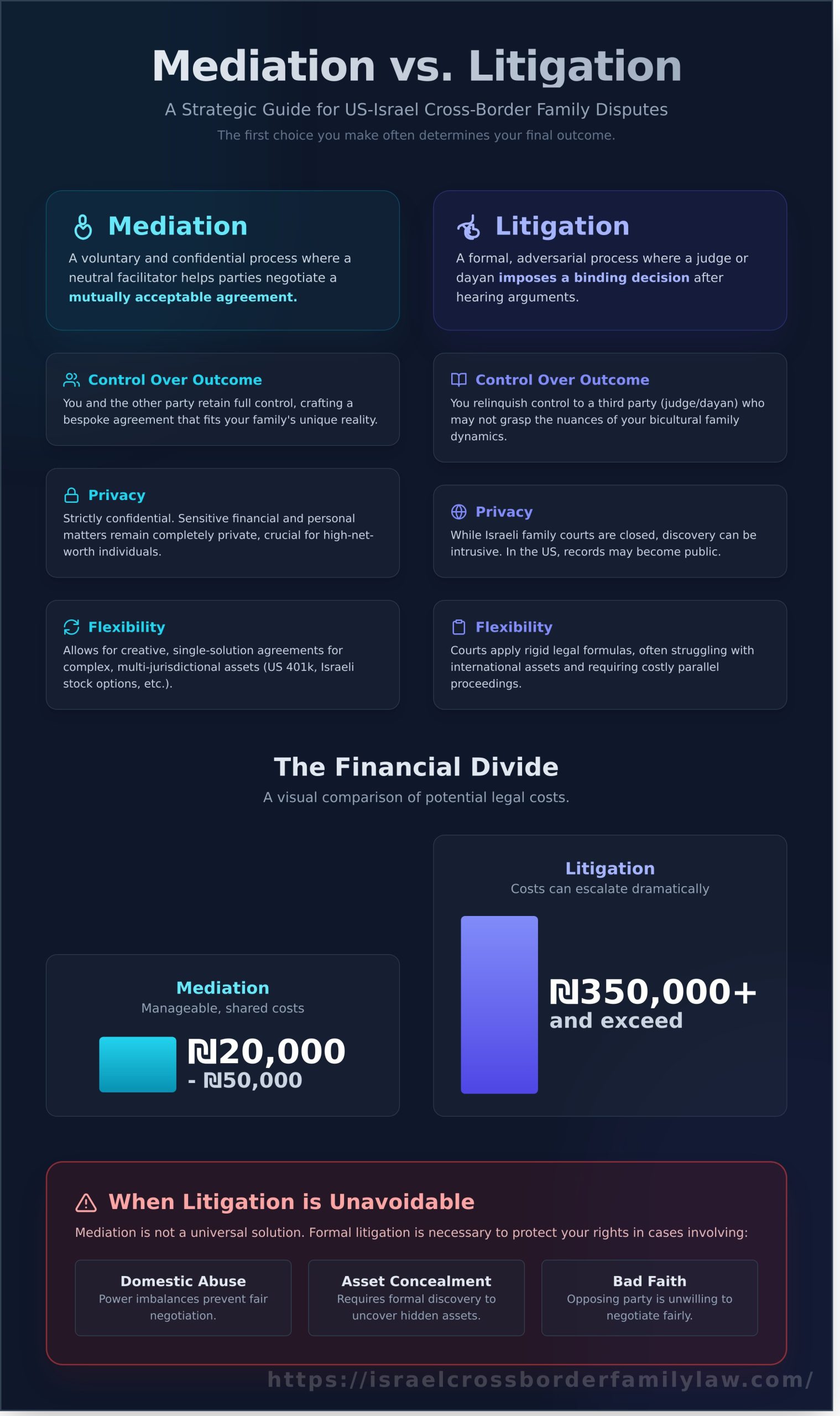
For US-Israel families facing disputes, the initial decision between mediation and litigation is not merely a procedural choice; it is a strategic imperative that dictates the trajectory of the entire conflict. Mediation is a voluntary and confidential process where a neutral third-party facilitator helps parties negotiate a mutually acceptable agreement. You can find a comprehensive overview of what is mediation and its principles in this foundational resource. In stark contrast, litigation is a formal, adversarial process where a judge or, in certain family matters in Israel, a dayan (Rabbinical judge), imposes a binding decision after hearing arguments and evidence. The outcome is rendered, not agreed upon.
To better understand the fundamental differences in these approaches, this overview provides critical context:
The unique complexity of US-Israel cases, involving multi-jurisdictional assets, disparate legal systems, and deep cultural nuances, renders a "one-size-fits-all" approach ineffective and potentially catastrophic. Whether dealing with a divorce, an inheritance dispute, or a business disagreement, your first move determines your final outcome. An ill-considered rush to the courts can trigger years of expensive, public, and emotionally draining conflict across two continents. Understanding when to mediate and when to litigate is the primary determinant of a successful resolution.
The Advisory Perspective
This guide is provided by an independent advisory platform, not a law firm. Our objective is not to offer legal representation but to deliver sophisticated strategic guidance. We focus on risk assessment, cost-benefit analysis, and empowering you to make the most informed decision for your family’s future. We believe that a well-considered strategy, chosen with clarity and foresight, is infinitely more powerful than reflexive, aggressive legal posturing.
Core Differences for International Families
The decision of when to mediate and when to litigate carries unique weight for families with ties to both the United States and Israel. The core differences are not just legal, they are intensely personal and financial.
Privacy vs. Public Record: While Israeli family court proceedings are held behind closed doors, the discovery process can still be intrusive. Mediation, however, is governed by strict confidentiality. For high-net-worth families, particularly those in Israel’s tech sector or with public profiles, keeping sensitive financial data and personal matters entirely private is paramount. The cost differential is also stark; a comprehensive mediation process might cost between ₪20,000 and ₪50,000, whereas a contested cross-border litigation can easily surpass ₪300,000 in legal fees alone.
Control over the Outcome: In litigation, you relinquish control to a third party. A judge in New York or a dayan in Tel Aviv, however competent, may lack a nuanced understanding of your family’s unique bicultural dynamics or the specific nature of your international assets. Mediation keeps control in your hands. You and the other party, guided by a mediator, craft a bespoke agreement that reflects your reality, not a court’s rigid interpretation of the law.
Flexibility with Multi-Jurisdictional Assets: Cross-border families often hold a complex portfolio: a 401(k) and real estate in the US, a pension fund and vested stock options from an Israeli "start-up nation" company, and perhaps bank accounts in both countries. Litigation struggles with this complexity, often requiring parallel proceedings. Mediation provides the flexibility to create a single, elegant solution that creatively addresses the division and management of these assets in a way that is tax-efficient and practical across both legal systems.
When Mediation Wins: The Strategic Advantages for Expats
For US-Israel families facing separation, the decision of when to mediate and when to litigate is not merely a procedural choice; it is a fundamental strategic determination with long-term consequences for assets, finances, and parental relationships. While litigation presents a familiar, adversarial path, mediation offers a sophisticated, confidential, and highly effective alternative that is particularly advantageous in complex cross-border disputes. It empowers families to architect their own solutions, preserving capital and relationships that multi-year court battles often destroy.
The core power of mediation lies in its flexibility. A family court in Tel Aviv or New York is constrained by statutory limitations. It can divide assets according to a fixed legal formula but cannot mandate creative, tax-efficient solutions tailored to multi-jurisdictional realities. In mediation, parties can design bespoke agreements that courts simply cannot order. For example, a mediated settlement can structure a buyout of an Israeli property using funds from a US 401(k) in a way that minimizes tax liabilities in both nations, or create a unique educational trust for children funded by assets held in two different currencies. This creative latitude is invaluable.
Financially, the difference is stark. A contested international divorce proceeding through the Israeli courts can easily extend for two to four years, with legal fees for each party often exceeding ₪350,000. Mediation, by contrast, is a process measured in months, not years, with total costs typically ranging from ₪30,000 to ₪70,000. This dramatic reduction in time and expense allows families to preserve their estate for the future rather than depleting it on legal conflict.
Perhaps most critically, mediation preserves the co-parenting relationship. The adversarial nature of litigation is designed to create a winner and a loser, an approach that inflicts lasting damage on the ability of parents to cooperate across continents. Mediation fosters a collaborative environment focused on the children’s best interests. It is the ideal forum for crafting detailed, practical international parenting plans. While this collaborative approach is powerful, it isn’t a panacea; it is wholly unsuitable for cases involving abuse or concealment of assets, and it offers no remedy in dire situations governed by strict international parental child abduction laws, where litigation becomes an absolute necessity.
The Singapore Convention Advantage
A pivotal development enhancing the power of mediation is the Singapore Convention on Mediation. Ratified by both the United States and Israel, this treaty simplifies the enforcement of mediated settlement agreements across international borders. Further bolstering this framework, a 2024 amendment to Israel’s Courts Law provides a clear mechanism for registering a mediated agreement, giving it the full force of a court judgment. For a family with a condominium in Tel Aviv and a brokerage account in New York, this means their single mediated agreement is now robustly enforceable in both jurisdictions.
Cultural Sensitivity and Language
Navigating the Israeli legal system can be a challenging experience for "Anglos" whose expectations are shaped by American legal norms. A bicultural, bilingual mediator is essential for bridging this gap, translating not just language but also legal culture and procedure. This prevents misunderstandings that can derail negotiations. Understanding the nuances of divorce and separation for international families requires a team on the ground that is fluent in both the law and the culture. Having experienced counsel guiding you toward the optimal strategy ensures that American expectations are properly aligned with Israeli legal realities from the outset.
When Litigation is Unavoidable: Protecting Your Rights
While mediation is frequently advocated for its collaborative nature and cost-effectiveness, it is not a universally appropriate solution for every US-Israel family dispute. Certain high-conflict situations contain distinct "red flags" that render mediation ineffective or, in some cases, dangerous. In these complex scenarios, the decision of when to mediate and when to litigate shifts decisively toward the courtroom. Formal litigation ceases to be an act of aggression; instead, it becomes an essential, strategic tool for protecting your legal rights, your financial security, and your children’s welfare across international borders.
The necessity for litigation arises when the foundational requirements for mediation, such as good faith and transparency, are absent. This is particularly evident in cases involving:
Domestic Abuse or Coercion: Where a history of domestic violence or significant power imbalance exists, the neutral environment of mediation can be compromised, potentially placing a vulnerable party at risk. Israeli authorities, including the Ministry of Welfare and Social Affairs, have documented a consistent rise in domestic violence reports since 2020, underscoring the need for court-mandated protective orders that mediation cannot provide.
Complete Communication Collapse: If one party refuses to negotiate rationally or uses communication channels for harassment, the structured, judge-enforced protocols of litigation are required to establish clear boundaries and compel progress.
Incapacity to Negotiate: Severe mental health challenges or active substance abuse can make good-faith negotiation impossible, necessitating judicial intervention to ensure a fair and binding outcome.
The Risk of Hidden Assets
Mediation operates on a principle of voluntary financial disclosure. This collaborative framework collapses when one party has reason to believe the other is concealing assets in either the United States or Israel. When a spouse isn’t transparent about a 401(k) in New York, an undeclared rental property in Ra’anana generating thousands of shekels monthly, or interests in a "start-up nation" tech company, litigation provides the only mechanism for enforcement. The court-supervised discovery process, known in Israel as Gilui Mismachim, empowers your legal team to issue subpoenas and court orders compelling the full disclosure of bank accounts, property deeds, and corporate holdings that would otherwise remain hidden.
Urgent Protection and Hague Convention Issues
In high-stakes, cross-border custody disputes, a "Race to Court" can become a necessary defensive maneuver to establish jurisdiction and protect a child’s residency. If there is a credible threat of international parental child abduction, immediate litigation is non-negotiable. The Israeli courts can issue an emergency exit-prevention order (Tzav Ikuv Yetzia Min Ha’Aretz) in a matter of hours, while a US court can order the seizure of passports. These powerful protective measures are exclusively available through litigation and are critical for enforcing the terms of the Hague Convention. Navigating these complex international treaties is a specialized field; our firm provides comprehensive Hague Convention and child abduction guidance to protect your parental rights.
Ultimately, the strategic choice of when to mediate and when to litigate hinges on the specific facts of your multi-jurisdictional case. When faced with bad faith, hidden assets, or immediate threats to safety, the robust and authoritative framework of the court system is not just an option; it is your primary shield. Engaging experienced cross-border legal counsel is the first step in assessing these risks and deploying the correct legal strategy to safeguard your future.
The Tactical Comparison: Mediation vs. Litigation
For US-Israel families facing divorce or custody disputes, the decision of when to mediate and when to litigate is not merely a preference; it is a foundational strategic choice with profound and lasting consequences. Evaluating these paths requires a granular analysis of their impact on your finances, timeline, family dynamics, and legal standing across two distinct jurisdictions. A clear-eyed comparison reveals stark differences in every critical metric.
The divergence begins with the allocation of resources. Mediation is a collaborative process designed for efficiency, with total costs for a comprehensive agreement often ranging from ₪15,000 to ₪30,000, typically shared between the parties. Litigation is an adversarial, open-ended commitment. For a complex cross-border case, legal fees for each party can easily escalate beyond ₪150,000, with some contentious disputes exceeding ₪300,000 per person. The timeline reflects this disparity; a successful mediation can be concluded within 3 to 6 months, while multi-jurisdictional litigation can extend for 2 to 5 years, trapping a family in a state of prolonged uncertainty.
Ultimately, the nature of the outcome is fundamentally different:
Mediated Agreements: These are custom-built solutions developed by the parties themselves. The goal is a mutually acceptable "win-win" arrangement that addresses the unique needs of the family, fostering a foundation for co-parenting.
Litigated Judgments: A judge imposes a decision based on legal arguments and evidence. This inherently creates a "win-lose" dynamic, which can entrench animosity and make future cooperation exceptionally difficult.
The "Race to Court" in Israel
In Israel, a unique jurisdictional conflict exists between the secular Family Courts and the religious Rabbinical Courts (Batei Din). The first spouse to file a comprehensive claim often secures their preferred forum, a tactical maneuver known as the "race to court." Critically, engaging in mediation does not automatically halt this race. A party can participate in mediation while simultaneously filing a claim to secure jurisdiction. To prevent this, your legal counsel must petition the court for a formal "stay of proceedings" (עיכוב הליכים), a vital step to protect the integrity of the mediation process.
Decision Factors for International Custody
Nowhere are the stakes higher than in matters of international child custody. A request for relocation, for example, is handled with far greater nuance in mediation, where parents can design creative, phased plans. In court, it becomes a contentious battle with a binary outcome. For families navigating frequent US-Israel travel, mediation allows for the creation of detailed, flexible parenting plans that litigation simply cannot replicate. Developing a comprehensive International custody and relocation strategy is paramount before committing to either path.
Understanding these tactical differences is the first step in protecting your family’s future across continents. The choice of process dictates not just the immediate cost and duration but the very structure of your post-divorce life. Guiding your family through these multi-jurisdictional challenges requires sophisticated legal counsel. Contact our cross-border team to assess your strategic options.
Making the Decision: Your Strategy for Moving Forward
The choice between mediation and litigation is not merely procedural; it is the most critical strategic decision you will make in your US-Israel family law case. An incorrect path can result in years of wasted time, significant financial loss in the hundreds of thousands of shekels, and unfavorable outcomes that are difficult to reverse. A structured, four-step approach is essential to protect your interests across both jurisdictions.
Step 1: Conduct a Cross-Border Risk Assessment
Before any negotiation begins, you must have a complete inventory of your legal and financial exposure. This is not a simple listing of assets; it is a sophisticated analysis of how each asset is treated under two different legal frameworks. A comprehensive assessment includes:
Asset Characterization: Is a US-based 401(k) or a brokerage account considered marital property under Israeli law? How will an Israeli court value and divide a Keren Hishtalmut or pension funds accumulated before Aliyah?
Real Estate Jurisdiction: An apartment in Tel Aviv is governed by Israel’s Spouses’ Property Relations Law, while a condo in Florida is subject to equitable distribution principles. Understanding which court has jurisdiction and how they will rule is paramount.
Custody and Relocation Risks: Analyze the practical implications of the Hague Convention. A custody order from a New York court may face specific challenges for enforcement in the Israeli Family Court system, and vice versa. Your strategy must anticipate and mitigate these multi-jurisdictional conflicts.
Step 2: Evaluate the Other Party’s Willingness to Engage in Good Faith
Mediation’s success hinges entirely on the good faith participation of both parties. An honest evaluation of your spouse’s behavior is critical. Are they providing complete and transparent financial disclosures, including bank statements from both countries? Or are they delaying, hiding assets in one jurisdiction, or refusing to communicate directly? A pattern of obstruction is a clear signal that litigation may be the only viable path to compel disclosure and protect your rights.
Step 3: Consult with an Advisory Expert Who Understands Both Systems
Engaging a legal professional who is only licensed in one country creates a significant blind spot. A US attorney may not grasp the powerful discretion of the Israeli Family Court, while an Israeli lawyer might misinterpret the binding nature of a US prenuptial agreement. You require an advisor with deep, practical experience navigating both the American common law and Israeli civil law systems to develop a truly integrated global strategy.
Step 4: Draft a "Safety Net" Agreement if Choosing Mediation
If you determine that mediation is worth attempting, do not proceed without a formal "mediation participation agreement." This legally-grounded document acts as a safety net. It should clearly define the scope of the mediation, establish firm deadlines for reaching a resolution (e.g., 90 or 120 days), and stipulate which jurisdiction will be used for court filings if mediation fails. This prevents the process from being used as a delay tactic and provides a clear, predetermined path forward, which is a vital component in deciding when to mediate and when to litigate.
Clarity Before Commitment
Signing any document, even a seemingly informal memorandum of understanding, without a full grasp of its long-term, cross-border implications can be a catastrophic error. It could inadvertently waive your rights to significant assets or create an unenforceable custody plan. A confidential case review is the foundational step to mapping your unique legal landscape. You can learn how the advisory process works to see how we build this strategic foundation for our clients.
Requesting a Confidential Consultation
Don’t let the system decide for you. The complexities of US-Israel family law demand a proactive, strategic approach where you are in control of the process. For more detailed analysis and insights into these sophisticated matters, we invite you to explore the resources on our US-Israel Family Law YouTube channel.
The ultimate determination of when to mediate and when to litigate must be a calculated, informed decision, not a reaction. Get clarity before you commit to a path. Take the most important first step and request a confidential consultation to secure your future.
Securing Your Family’s Future Across Jurisdictions
Navigating a family dispute that spans both the U.S. and Israel presents a complex set of challenges. The strategic decision of when to mediate and when to litigate is paramount, often defining the emotional and financial trajectory for your family. While mediation offers a collaborative path to preserve relationships and manage outcomes, litigation remains the essential tool to enforce legal rights and protect against non-compliance in high-conflict situations.
This decision shouldn’t be made in a vacuum. Our firm provides the critical advantage of an independent advisory focus, dedicated exclusively to navigating these intricate legal landscapes. We offer plain English guidance for international families, grounded in our deep expertise in US-Israel jurisdictional conflicts. Get clarity before you commit. Request a confidential consultation to build a strategy tailored to your unique circumstances.
Your family’s future is too important for uncertainty. A clear, strategic path forward is possible.
Frequently Asked Questions
Is mediation legally binding in Israel?
Yes, a mediation agreement becomes legally binding and enforceable in Israel once it is submitted to and ratified by the appropriate court. The signed agreement itself is a private contract. To give it the power of a court judgment, legal counsel must file a motion for its approval by either the Family Court or the Rabbinical Court. This judicial validation is a critical step for ensuring the agreement’s enforceability, particularly in a cross-border context.
Can I switch from mediation to litigation if it is not working?
Absolutely. Mediation is a voluntary process, and you retain the right to terminate the proceedings at any point and pivot to litigation. All communications and offers made during mediation are confidential and conducted on a "without prejudice" basis. This means they cannot be submitted as evidence in subsequent court hearings, allowing for candid negotiations without jeopardizing your legal position should litigation become necessary.
What happens if we reach an agreement in mediation but one person lives in the US?
An Israeli mediation agreement, once approved by an Israeli court, can be registered and enforced in the United States. After the agreement attains the status of a formal court judgment in Israel, it must be "domesticated" in the relevant US state court. This process, governed by state law and principles of international comity, renders the Israeli order enforceable in the US for matters like asset division and spousal support, bridging the multi-jurisdictional gap.
How much does mediation cost compared to going to court in Israel?
Mediation offers a substantial cost advantage, typically costing 70-80% less than a contested litigation process in Israel. A comprehensive cross-border mediation may range from ₪20,000 to ₪50,000 total. In stark contrast, complex litigation spanning both Israeli and US jurisdictions can rapidly accumulate legal fees exceeding ₪200,000. This financial disparity is a primary factor when advising clients on when to mediate and when to litigate.
Do I need a lawyer for mediation in a cross-border case?
While not legally required to enter mediation, it is strategically essential to retain independent legal counsel for any cross-border dispute. The mediator’s role is to be a neutral facilitator and they cannot provide legal advice to either party. Your attorney’s role is to protect your specific interests, advise you on the legal consequences of proposals, and ensure the final drafted agreement is robust, unambiguous, and enforceable in both Israel and the US.
What is the "Singapore Convention" and does it apply to my divorce?
No, the Singapore Convention on Mediation does not apply to divorce or other family law disputes. This international treaty, which Israel ratified in 2020, facilitates the enforcement of mediated settlement agreements in commercial matters only. Its scope explicitly excludes family, inheritance, and employment law. Enforcement of a mediated divorce agreement across borders relies on domesticating the Israeli court order in a foreign jurisdiction, not this convention.
How does the Israeli Rabbinical Court view mediation agreements?
The Israeli Rabbinical Court, or Beit Din, generally respects and will ratify privately mediated agreements. However, the court will review the agreement to ensure its terms are compliant with Jewish Law (Halakha), particularly concerning the issuance of a Get (religious divorce decree) and any settlement related to the Ketubah. Provided the agreement does not contradict these fundamental principles, the Rabbinical Court will typically grant it the full authority of a court judgment.
Can mediation help with child support enforcement across borders?
Yes, mediation is a highly effective first step for establishing an enforceable cross-border child support arrangement. A detailed agreement reached in mediation, once ratified by an Israeli court, becomes a legal judgment. This judgment can then be enforced in the United States through international treaties, including the Hague Convention on the International Recovery of Child Support, to which both nations have been party since 2017, providing a clear legal pathway for enforcement.

Article by
Gabriel Lior
A Personal Journey That Became a Mission
The advisory was founded by an American father Gabriel Lior, LLB, MBA , global entrepreneur, and cross-border advisor who spent more than a decade navigating the Israeli family court system firsthand and now lives in Singapore with his son.
As a divorced parent in a cross-border family, Gabriel faced nearly every legal challenge a foreign parent can encounter in Israel — including child custody disputes, child support proceedings, property matters in Israel and abroad, false accusations, and complex immigration and relocation proceedings.
Over the years, he learned the hard way how difficult it is for non-Israeli parents to understand the system, identify the right legal strategy, and choose the right legal representation — especially when language, culture, and jurisdictional differences are involved. He also witnessed how foreign parents and new immigrants are often disadvantaged or taken advantage of by service providers and institutions simply because they lack local knowledge or fluency.
From Client to Advisor
To truly understand — and survive — the system, Gabriel pursued formal legal education in Israel, completing two Israeli law degrees, alongside a BA and MBA earned in the United States. This was never about becoming a practicing attorney, but about gaining a deep, structural understanding of how the system works — and where it breaks down for foreign parents.
This rare combination of:
Firsthand client experience
Israeli legal and US business education
International business and negotiation training
Decades of commercial execution
created a unique perspective – one that understands both sides of the table.
After years of litigation, persistence, and at times self-representation, he ultimately succeeded in securing custody of his son and relocating abroad through a rare legal victory in the Israeli Supreme Court — becoming one of the first fathers in Israel to do so under these circumstances.
Disclaimer
Important Disclaimer:
The information provided on this website and in its content is for general informational and educational purposes only and does not constitute legal advice, legal opinion, or legal representation.
Gabriel Lior is not licensed to practice law in Israel (nor is he interested in doing so) and does not provide legal services, despite having completed 2 Law Degrees. The services offered are advisory in nature and are intended to provide general guidance, strategic insight, and information regarding cross-border family law considerations.
No attorney-client relationship is formed by accessing this website, reading its content, or communicating with us.
Any decisions made based on this information are at your own discretion and risk. For legal advice specific to your situation, you should consult a licensed attorney in the relevant jurisdiction.
Where appropriate, we may refer clients to independent, licensed attorneys or professionals. Such referrals do not constitute legal representation and no liability is assumed for services provided by third parties.