This article is published on an independent advisory platform (not a law firm). It provides strategy, risks, and decision-making guidance rather than legal representation or legal advice. For personalized support, please reach out via our advisory call or WhatsApp.
The court that receives your filing first could influence your financial future more than the actual facts of your marriage. If you’re an expat living in Israel, you likely already feel the pressure of a legal system that splits authority between civil family courts and religious rabbinical tribunals. It’s natural to worry about how your foreign income or property might be treated under local rules. Mastering the nuances of spousal support laws in Israel is essential because a single procedural misstep can lead to maintenance obligations that look very different from what you’d expect in your home country.
You’ll gain the clarity needed to handle these cross-border complexities with strategic foresight. This guide explains the different types of support available, how the “Race of Jurisdiction” functions in practice, and what steps you can take to mitigate financial risks. We’ll walk through the specific criteria judges use to evaluate international assets and income so you can make informed decisions before you commit to a legal path. Get the facts you need to protect your global interests and ensure your family’s stability during this transition.
Key Takeaways
- Understand the complexities of Israel’s unique “Personal Status” system and how the dual court structure impacts international families.
- Learn the critical distinctions between religious and civil alimony under spousal support laws in israel to determine the most appropriate path for your situation.
- Identify how specific factors, such as standard of living and independent income, influence the calculation of support obligations in the IL court system.
- Gain strategic insight into how Israeli judges evaluate cross-border assets, including US-based 401(k)s, pensions, and Social Security benefits.
- Discover the essential financial documentation and cross-border considerations needed to achieve clarity and protect your interests before filing.
The Dual Legal System: Why Spousal Support in Israel is Unique
Israel’s legal framework for divorce and maintenance differs significantly from Western systems. It’s rooted in the “Personal Status” system, a legacy of the 1922 British Mandate. This structure grants religious courts exclusive jurisdiction over marriage and divorce for their respective communities. When examining Israel’s dual court system, it’s clear that secular law doesn’t always take precedence in family matters. Instead, your religious affiliation often dictates which rules apply to your separation. This duality creates a complex environment where strategy must precede any legal action.
To better understand the general concepts of alimony and how they might differ from the Israeli approach, watch this helpful video:
The Role of Religious Law in Modern Israel
Jewish residents are governed by Halacha (Jewish law) regarding marriage and divorce. For other recognized communities, Sharia, Druze, or Christian ecclesiastical laws apply. This means spousal support laws in israel aren’t unified under one civil code. For Jewish couples, “Mezonot” (support) is traditionally viewed as a husband’s religious obligation to maintain his wife’s standard of living until the final divorce decree. If a couple has no recognized religious affiliation, the 1959 Family Law Amendment (Maintenance) provides a civil alternative based on financial need rather than religious duty. This distinction is vital for expats and mixed-faith couples who may not realize their personal law follows them into the courtroom.
Rabbinical Court vs. Family Court: The Strategic Choice
The most critical phase of an Israeli divorce is often called the “Race of Jurisdiction.” Since both Rabbinical Courts and Civil Family Courts have parallel authority, the first party to file usually determines which court hears the case. A Rabbinical Court might view spousal maintenance through the lens of religious “fault,” potentially denying support if a spouse is deemed “rebellious.” Conversely, Civil Family Courts focus on equitable distribution and financial capacity.
Strategic timing is essential. Once a claim for spousal support is “bound” to a divorce suit in a Rabbinical Court, the Civil Court loses its ability to intervene in that specific issue. In 2023, data indicated that filing location significantly impacts the final ₪ amount awarded for monthly support. Understanding spousal support laws in israel requires recognizing that the venue often dictates the outcome more than the facts of the case themselves. Making an uninformed choice at the start can lead to long-term financial risks that are difficult to reverse.
- Rabbinical Courts: Focus on Halachic obligations and marital conduct.
- Family Courts: Focus on civil rights, gender equality, and economic reality.
- The First Filer: Gains the “home court advantage” by choosing the legal framework.
This article is published on an independent advisory platform (not a law firm). The information provided focuses on strategy, risks, and decision-making guidance. It does not constitute legal representation or legal advice. If you need assistance with your specific situation, reach out via WhatsApp for an advisory call to discuss your options.
Get clarity before you commit. Request a confidential consultation.
This article is published on an independent advisory platform (not a law firm). It does not constitute legal representation or legal advice. Our focus is on strategy, risk management, and decision-making guidance for international families. For specific legal assistance, consider a strategy session to discuss your options.
Types of Spousal Support: Religious Alimony vs. Civil Alimony
Understanding the dual nature of the Israeli legal system is vital for anyone navigating a divorce. The country operates under a “split jurisdiction” where religious courts and civil courts share authority. This division directly impacts how spousal support laws in israel are applied to different couples. While Jewish couples typically fall under Rabbinical jurisdiction for matters of personal status, the 1959 Family Amendment Law (Alimony) ensures that those outside the religious framework still have access to financial protection. This legal structure creates two distinct paths: traditional religious alimony and modern civil support.
Wife’s Alimony (Mezonot Isha) Explained
For Jewish couples married according to religious law, the husband’s obligation to provide support is rooted in the Ketubah and centuries of Halakhic tradition. The guiding principle is “Olah Imo Ve’ayna Yoredet Imo,” which translates to “she rises with him but does not fall with him.” This means a husband is legally required to maintain the wife’s accustomed standard of living during the marriage and the separation period. If the couple lived in a home valued at ₪5,000,000 and spent ₪20,000 monthly on living expenses, the support levels must reflect that reality.
This obligation is not indefinite. It generally ends when the “Get” (religious divorce document) is delivered. Specific circumstances can also terminate this right earlier. If a wife is earning a sufficient salary that covers all her needs, the court may rule “Tzei Ma’aseh Yadeha Bimzonoteha,” meaning her earnings offset the husband’s obligation. Additionally, proven misconduct or the refusal to live with the husband without a justified legal reason can lead to the loss of these rights. The Family Court’s role in these cases often involves determining the exact scope of “needs” versus “luxuries” when couples cannot agree on a settlement.
Civil and Restorative Alimony for Modern Families
The landscape of spousal support laws in israel has expanded significantly to protect common-law partners, known as Yeduim BeTsibur, and same-sex couples. Since religious courts do not recognize these unions, the civil Family Courts step in using contractual principles and the 1959 Family Amendment Law. This “civil alimony” is often restorative. It aims to bridge the economic gap created during the relationship, especially if one partner sacrificed career growth to manage the household.
For common-law couples, support is not a fundamental right but a contractual one. Courts look at the length of the relationship and the level of financial interdependence. If a couple lived together for 15 years, a court might order monthly payments of ₪4,000 for a period of three to five years to allow the lower-earning partner to achieve financial independence. This also applies to same-sex couples, where the court focuses on fairness and the prevention of economic collapse for the weaker party after a long-term commitment.
One of the most striking differences for expats from the US or UK is the duration of support. In many US states, “permanent alimony” can last for decades or until remarriage. In Israel, spousal support is almost always time-limited. It serves as a temporary bridge until the divorce is finalized or as a short-term rehabilitative tool. It’s rare to see support payments continue for more than a few years after the relationship ends. This makes early strategic planning essential to ensure your post-divorce financial standing is secure.
Get clarity before you commit. Request a confidential consultation.
This article is published on an independent advisory platform (not a law firm). Do NOT use language that implies attorney-client relationship, legal representation, or giving legal advice. Focus on strategy, risks, and decision-making guidance. Soft CTA to advisory call / WhatsApp.
Calculating the Amount: Factors that Influence Support Rulings
Determining the financial scope of support in Israel requires a granular analysis of the family’s established lifestyle. Judges don’t simply look at a flat rate; they distinguish between “essential needs” and the broader “standard of living.” Essential needs typically cover the bare minimum for subsistence, such as ₪1,800 to ₪2,200 for basic nutrition and ₪600 for clothing. However, spousal support laws in israel prioritize the preservation of the status quo. If the marriage involved frequent international travel, premium health insurance, and monthly discretionary spending exceeding ₪15,000, the court will likely set support levels to match that reality. The legal principle of “rises but does not fall” dictates that a woman’s entitlement to support reflects the peak lifestyle enjoyed during the marriage, effectively preventing a forced reduction in her standard of living after separation.
The calculation also weighs the couple’s total asset portfolio, including real estate holdings, liquid savings, and pension funds. If a couple owns multiple properties in areas like Herzliya or Tel Aviv, the potential rental yield is factored into the wife’s financial standing. A critical element is the concept of “handiwork” or ma’aseh yadeiha. If a wife earns an independent income, her salary is deducted from the husband’s support obligation. In many cases involving dual-income households, if the wife’s salary covers her personal needs according to the established standard, the husband’s direct spousal support obligation may be reduced to zero, though child support remains a separate calculation.
Income and Earning Capacity
Israeli courts look beyond the current monthly payslip to evaluate “earning capacity.” If a high-earning professional in the “start-up nation” tech sector suddenly takes a lower-paying role or stops working during the divorce, the court may still calculate support based on their potential to earn ₪50,000 or ₪70,000 per month. Judges scrutinize bonuses, stock options, and RSUs as integral parts of the compensation package. Transparency is non-negotiable; failing to disclose global assets or business interests can lead to severe financial sanctions. Providing a clear, documented financial history is the only way to ensure a predictable ruling in spousal support laws in israel.
Housing and Maintenance (Mador)
The right to “Mador” is a specific, enforceable component of spousal support that ensures the wife has adequate housing. The court must decide whether she remains in the family home or if the husband must fund a rental equivalent. In central Israel, where a three-bedroom apartment can easily rent for ₪9,500 per month, the “Mador” payment becomes a significant portion of the total award. This calculation includes Mador Achzaka, which covers the costs of household maintenance like electricity, water, and municipal taxes (Arnona). Typically, if children are involved, the husband pays a percentage of these costs, ranging from 30% for one child to 50% for three or more, in addition to any direct spousal housing entitlement.
Navigating complex spousal support matters requires expert legal guidance. For personalized advice regarding spousal support laws in Israel, contact Israel Cross Border Law Firm for a confidential consultation.
The information provided in this article by Israel Cross Border Law Firm is for general informational purposes only and does not constitute legal advice. While we strive for accuracy, the law is complex and constantly evolving. For advice specific to your situation under spousal support laws in Israel, it is essential to consult with a qualified attorney. Reading this article does not create an attorney-client relationship.
Cross-Border Complications: US Assets and International Families
Managing divorce when assets are scattered across continents creates a unique set of hurdles. When applying spousal support laws in israel, the court must account for the global financial standing of both parties. This process often begins with the challenge of asset disclosure. Israeli courts don’t have the same “discovery” powers as US courts to subpoena American banks or investment firms. If a spouse hides a 401(k) or a brokerage account in New York, the Israeli judge relies heavily on the other party’s ability to provide proof or hire international forensic accountants. Valuing these assets is equally complex; a pension plan in the US may be subject to specific tax penalties for early withdrawal that an Israeli judge might overlook without expert testimony.
Israeli judges typically view US Social Security benefits and 401(k) distributions as part of the “available resource pool” when determining support. However, they may struggle to categorize these correctly under Israeli law. For example, a Roth IRA’s tax-free status doesn’t always translate perfectly into the Israeli tax system. If the court issues a support order based on the gross value of a US pension without accounting for the mandatory 20% or 30% US federal withholding, the payer could be left with insufficient funds to live. Enforcement adds another layer of difficulty. While Israel and the US have various bilateral agreements, enforcing an Israeli support order against income located entirely in the US requires domesticating the judgment in a US state court, a process that can take 12 to 18 months and cost thousands of shekels in additional fees.
Strategic planning is vital when income streams cross borders. You should understand how these orders interact with international treaties. To explore how this affects your children, learn more about child support cross-border enforcement.
Jurisdictional Conflicts between IL and US Courts
If a support case is open in both Israel and a US state, a “race to the courthouse” often ensues. Under the “first to file” rule, the court where the action was first initiated generally retains jurisdiction. However, a party can argue Forum Non Conveniens, suggesting that the other country is a more appropriate venue because the evidence and witnesses are located there. This conflict can lead to contradictory orders, where one spouse is ordered to pay ₪8,000 in Israel while a US court simultaneously orders $2,500. Resolving these overlaps requires a sophisticated understanding of both spousal support laws in israel and international comity.
Currency Fluctuations and Tax Implications
The volatility of the NIS/USD exchange rate can turn a fair support agreement into a financial burden. If an agreement is pegged to a specific shekel amount, a 10% drop in the dollar’s value can significantly reduce the recipient’s purchasing power. Furthermore, the US Tax Cuts and Jobs Act of 2017 changed how alimony is treated; it’s no longer deductible for the payer or taxable for the recipient under US federal law. Israel, however, has different rules for dual citizens. It’s essential to coordinate with a tax professional who understands both systems to avoid double taxation or unexpected liabilities. We help expats and foreign nationals navigate these exact scenarios every day.
Don’t leave your financial future to chance in a complex international system. Get expert strategy for your cross-border family matter.
Get clarity before you commit. Request a confidential consultation.
This article is published on an independent advisory platform (not a law firm). Do NOT use language that implies attorney-client relationship, legal representation, or giving legal advice. Focus on strategy, risks, and decision-making guidance. Soft CTA to advisory call / WhatsApp.
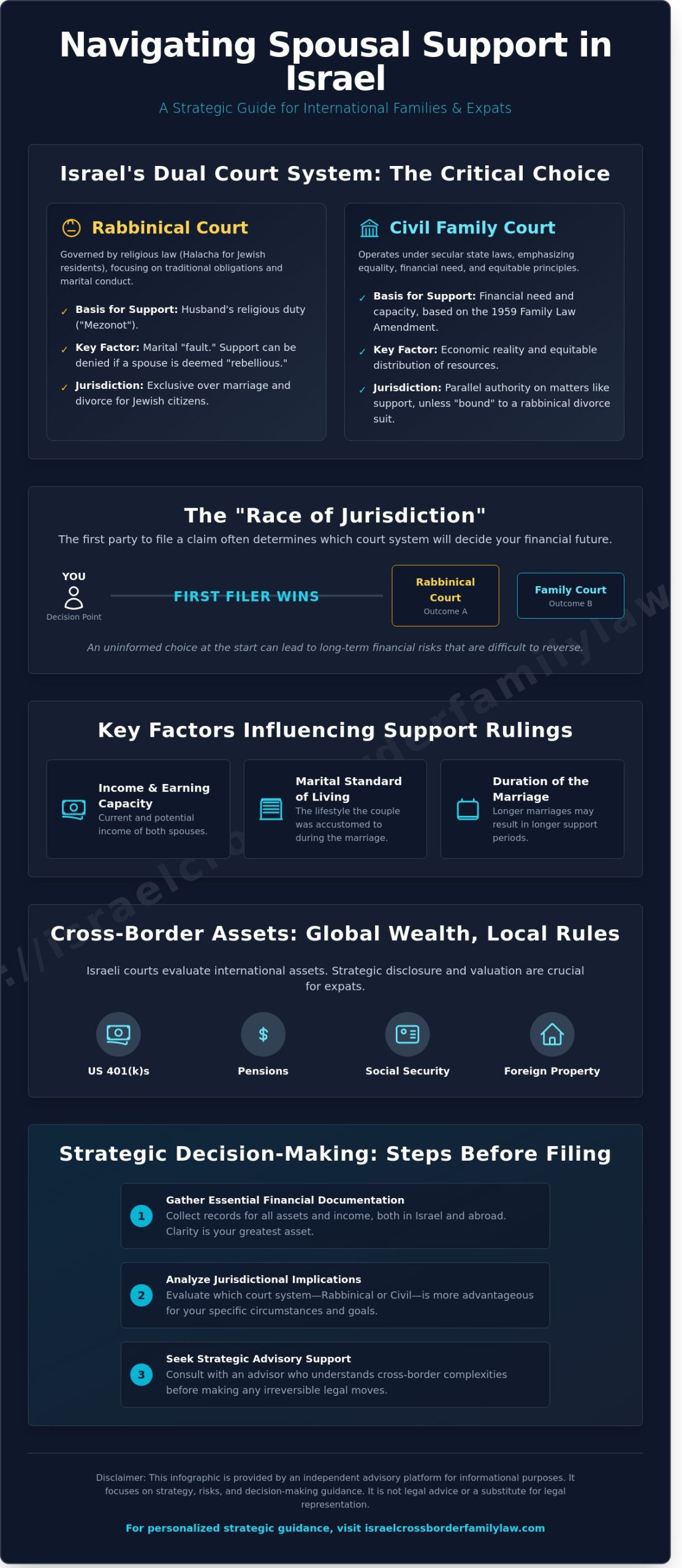
Strategic Decision-Making: Steps to Take Before Filing
Strategy is the most critical asset in any international separation. In Israel, the “Race of Jurisdiction” is a procedural reality that dictates which court system handles your case. If one spouse files in the United States and the other files in Israel, the resulting conflict can lead to years of litigation. Understanding how spousal support laws in israel interact with foreign jurisdictions is the first step toward a stable outcome. You shouldn’t wait for a crisis to begin your preparation; proactive planning is the only way to protect your global interests.
Gathering comprehensive financial documentation is your primary objective. This includes three years of tax returns, bank statements, and pension valuations from both countries. If you’re managing assets worth over ₪500,000, specialized forensic accounting may be necessary to track international transfers. In Israel, courts require transparency regarding all global income. Failing to disclose a ₪20,000 monthly consulting fee from a foreign entity can lead to severe credibility issues and heavy financial sanctions in the Family Court.
You must also assess the “Personal Law” that applies to your marriage. In Israel, matters of marriage and divorce are often governed by religious law. Whether you’re Jewish, Muslim, Christian, or Druze, the religious affiliation of both parties dictates which court has authority. This creates a dual-track system where the Rabbinical Court and the Civil Family Court may have concurrent jurisdiction. The rules for alimony and maintenance differ significantly between these two systems, making early analysis essential for your financial future.
Mediation offers a viable alternative to the dual court battle. Since the 2016 Mandatory Mediation Law, most families in Israel must attend several “Information, Coordination, and Success” (Mahut) sessions before litigation begins. This process aims to resolve disputes without the ₪60,000 to ₪100,000 price tag often associated with contested cross-border litigation. Evaluating this path early can save your family from the emotional and financial exhaustion of a protracted legal fight.
Clarity Before Commitment
A “wait and see” approach often leads to unfavorable jurisdictional outcomes. If you delay, you risk your spouse filing in a jurisdiction that’s less favorable to your financial position. You can see how it works when you map out these risks before a single document is signed. A pre-filing strategy for international families ensures that you aren’t reacting to a summons but are instead moving forward with a clear, calculated roadmap for your ₪2,000 to ₪5,000 monthly support expectations.
Informed Choice and Expert Guidance
Bilingual and bicultural advice is indispensable in IL litigation. You don’t just need a translator; you need a strategist who understands the cultural gap between Western expectations and Israeli legal realities. For a visual breakdown of these complexities, watch our detailed breakdown of Israeli family law on YouTube. Your ultimate goal should be long-term stability. A short-term “win” in court that costs ₪80,000 in legal fees is rarely a true victory if it leaves your family’s future in ruins. Focus on sustainable agreements that reflect the reality of spousal support laws in israel.
Get clarity before you commit. Request a confidential consultation.
This article is published on an independent advisory platform (not a law firm). Do NOT use language that implies attorney-client relationship, legal representation, or giving legal advice. Focus on strategy, risks, and decision-making guidance. Soft CTA to advisory call / WhatsApp.
Strategize Your Path Forward in the Israeli Legal Landscape
Navigating the intersection of Rabbinical and Civil courts means that spousal support laws in israel present unique challenges for expats. You’ve learned that jurisdictional choices can shift financial outcomes by thousands of shekels. It’s common for monthly support figures to fluctuate between ₪3,000 and ₪15,000 based on which court system takes precedence. International families must also reconcile US-based assets, such as 401(k) plans or real estate, with IL regulations to avoid double-taxation or undervalued settlements. Our team provides bilingual and bicultural advisory services rooted in deep cross-border jurisdictional strategy. We prioritize risk mitigation so you can make choices based on facts rather than pressure. For more visual guidance on these complex topics, visit our YouTube channel. Taking the right steps now ensures your long-term financial stability remains intact throughout the process.
Get clarity before you commit. Request a confidential consultation.
This article is published on an independent advisory platform (not a law firm). Do NOT use language that implies attorney-client relationship, legal representation, or giving legal advice. Focus on strategy, risks, and decision-making guidance. Soft CTA to advisory call / WhatsApp.
Frequently Asked Questions
Does a husband ever receive spousal support in Israel?
Yes, a husband can receive support, though it’s relatively rare under traditional frameworks. While Jewish law usually obligates the man, Israeli civil family law allows for “rehabilitative” support if the wife is the primary high-earner and the husband lacks independent means. Courts focus on preventing a massive drop in living standards, especially in marriages lasting over 15 years where a significant income gap exists.
How long does the obligation to pay spousal support last in IL?
The obligation generally ends when the final divorce decree, known as the Get, is issued. In civil cases or for “common-law” couples, courts often set a specific timeframe based on the duration of the relationship. For example, a spouse might receive support for 36 to 60 months to allow for career retraining. It’s rarely a lifelong commitment and aims to provide a bridge to financial independence.
Can spousal support be waived in a prenuptial agreement?
You can definitely waive or limit support obligations through a properly drafted prenuptial agreement (Shtar Mamon). For the waiver to be valid, a judge or notary must confirm both parties understand the terms. Data from the Ministry of Justice shows that about 15% of couples now use these agreements to create certainty and bypass the standard spousal support laws in israel during a future separation.
What happens to spousal support if the wife remarries?
Spousal support payments typically stop immediately the moment the recipient remarries. Under Israeli law, the legal duty of the former spouse is replaced by the new marital union. Even if the recipient doesn’t officially remarry but lives in a “common-law” relationship for more than 6 months, the payor can petition the court to cancel the support. Courts view this as a fundamental change in financial circumstances.
How does the “Race of Jurisdiction” affect the amount of alimony?
The “Race of Jurisdiction” refers to whether the case is filed first in the Rabbinical Court or the Family Court, which can change the financial outcome by 20% to 30%. Rabbinical courts follow Halachic rules that might disqualify a wife from support if she’s deemed “rebellious.” Family courts apply civil spousal support laws in israel, focusing more on the actual economic needs and the “good faith” of both parties.
Can I enforce a US alimony order in an Israeli court?
You can enforce a US order by filing for “recognition” under the Foreign Judgments Enforcement Law of 1958. This process ensures the order doesn’t violate Israeli public policy and usually takes between 6 and 12 months to complete. Once recognized, the Israeli Enforcement and Collection Authority can garnish wages or bank accounts in ₪ (shekels) to satisfy the debt, bridging the gap between the two legal systems.
What is “Restorative Alimony” and when is it granted?
Restorative alimony is a payment meant to compensate a spouse who sacrificed their earning potential for the family’s benefit. It’s often granted in civil marriages where one partner stayed home while the other built a career. If a spouse has been out of the workforce for 10 years, the court might award ₪5,000 to ₪8,000 monthly for a set period of 24 to 48 months to fund education or professional certification.
How are US retirement accounts factored into Israeli support calculations?
US retirement accounts like 401(k)s or IRAs are treated as marital assets that must be balanced during the divorce. While support is based on monthly cash flow, a spouse holding a ₪400,000 retirement fund might receive less monthly alimony because they have greater long-term security. Israeli courts look at the “total economic basket,” including global assets, to determine if the requested support level is actually necessary for the recipient’s survival.
For more detailed insights on navigating these complex transitions, explore our video guides at: https://www.youtube.com/@IsraelFamilyLaw
Get clarity before you commit. Request a confidential consultation.

Article by
Gabriel Lior
A Personal Journey That Became a Mission
The advisory was founded by an American father Gabriel Lior, LLB, MBA , global entrepreneur, and cross-border advisor who spent more than a decade navigating the Israeli family court system firsthand and now lives in Singapore with his son.
As a divorced parent in a cross-border family, Gabriel faced nearly every legal challenge a foreign parent can encounter in Israel — including child custody disputes, child support proceedings, property matters in Israel and abroad, false accusations, and complex immigration and relocation proceedings.
Over the years, he learned the hard way how difficult it is for non-Israeli parents to understand the system, identify the right legal strategy, and choose the right legal representation — especially when language, culture, and jurisdictional differences are involved. He also witnessed how foreign parents and new immigrants are often disadvantaged or taken advantage of by service providers and institutions simply because they lack local knowledge or fluency.
From Client to Advisor
To truly understand — and survive — the system, Gabriel pursued formal legal education in Israel, completing two Israeli law degrees, alongside a BA and MBA earned in the United States. This was never about becoming a practicing attorney, but about gaining a deep, structural understanding of how the system works — and where it breaks down for foreign parents.
This rare combination of:
Firsthand client experience
Israeli legal and US business education
International business and negotiation training
Decades of commercial execution
created a unique perspective – one that understands both sides of the table.
After years of litigation, persistence, and at times self-representation, he ultimately succeeded in securing custody of his son and relocating abroad through a rare legal victory in the Israeli Supreme Court — becoming one of the first fathers in Israel to do so under these circumstances.
Disclaimer
Important Disclaimer:
The information provided on this website and in its content is for general informational and educational purposes only and does not constitute legal advice, legal opinion, or legal representation.
Gabriel Lior is not licensed to practice law in Israel (nor is he interested in doing so) and does not provide legal services, despite having completed 2 Law Degrees. The services offered are advisory in nature and are intended to provide general guidance, strategic insight, and information regarding cross-border family law considerations.
No attorney-client relationship is formed by accessing this website, reading its content, or communicating with us.
Any decisions made based on this information are at your own discretion and risk. For legal advice specific to your situation, you should consult a licensed attorney in the relevant jurisdiction.
Where appropriate, we may refer clients to independent, licensed attorneys or professionals. Such referrals do not constitute legal representation and no liability is assumed for services provided by third parties.