This article is published on an independent advisory platform and does not constitute legal representation or an attorney-client relationship. Legal services are only provided by licensed attorneys under a separate engagement.
Imagine checking your mobile banking app on a Tuesday morning only to find your balance frozen and a cryptic Hebrew notification mentioning an “Ikul.” For many expats in Israel, this is the first time they encounter the Israeli Levy system, and the experience is often as disorienting as it is stressful. You’ve worked hard to establish your life and assets here, so it’s natural to feel a sense of panic when the state or a private creditor suddenly restricts your access to funds or property. We recognize that the sudden threat of asset seizure can feel like an insurmountable hurdle when you aren’t familiar with the local legal landscape.
This guide explains exactly how the Israeli seizure process works, from the initial notice to the final resolution. You’ll learn to distinguish between temporary and permanent orders, understand the risks to your cross-border holdings, and discover a strategic roadmap to protect your financial interests. We’ll provide a clear overview of the steps required to respond to these notices effectively, ensuring you have the bicultural perspective needed to bridge the gap between Israeli regulations and your global financial goals. Get clarity before you commit. Request a confidential consultation.
Key Takeaways
- Understand the mechanics of the Israeli “Ikul” system and how the Execution Office manages the strategic freezing of local assets.
- Identify which assets are most vulnerable to enforcement, including why bank accounts are typically the primary target when a Levy is first issued.
- Learn the five critical actions to take within the first 48 hours of discovery to navigate the Israeli legal bureaucracy with clarity and composure.
- Gain professional insight into the complexities of cross-border enforcement and how international treaties impact the recognition of Israeli judgments abroad.
- Discover why proactive risk management and early intervention are essential to avoiding the escalating costs of an unaddressed legal seizure.
What is a Legal Levy (Ikul) in the Israeli System?
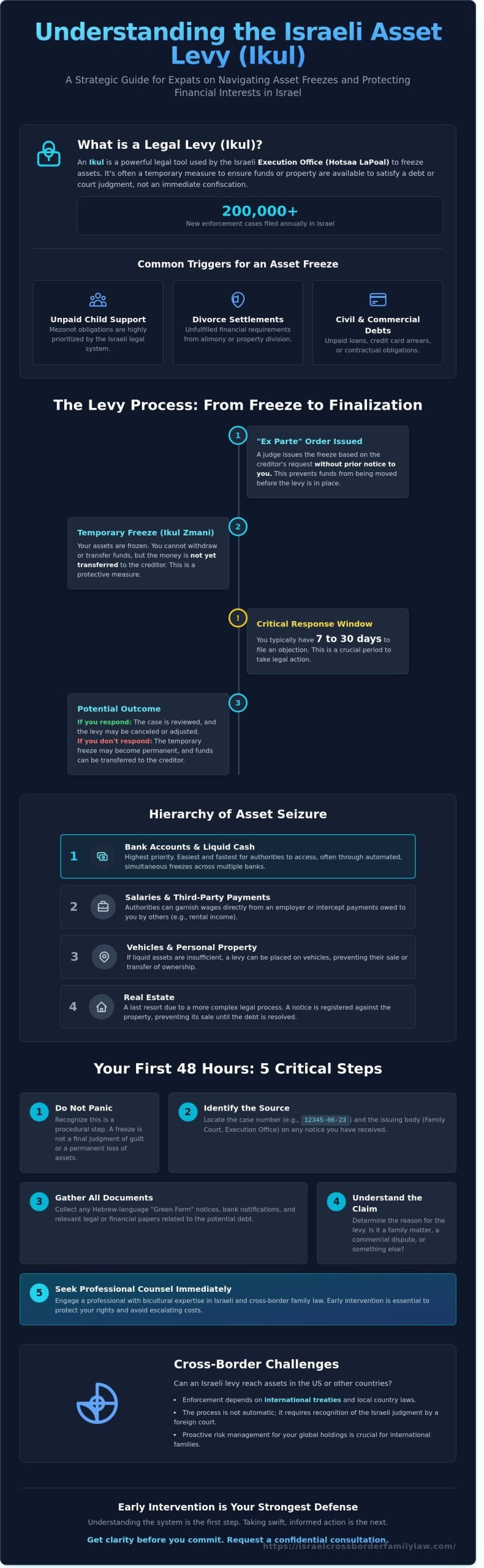
In the Israeli legal framework, a Levy, known locally as an Ikul, is a powerful procedural tool used to “freeze” or seize assets. It isn’t always a final confiscation. Instead, it often serves as a protective measure to ensure that funds or property remain available to satisfy a debt or a court judgment. The Execution Office (Hotsaa LaPoal) serves as the primary administrative body responsible for managing and enforcing these orders. According to reports from the Israeli Enforcement and Collection Authority, this office manages a significant volume of cases, often exceeding 200,000 new files in a single calendar year.
Common triggers for an asset freeze include:
- Unpaid child support (mezonot) obligations, which are prioritized in the Israeli system.
- Unfulfilled financial requirements from divorce settlements or alimony.
- Civil debts arising from commercial contracts, unpaid bank loans, or credit card arrears.
International families and expats are frequently caught off guard by these notices. This often happens because they aren’t familiar with the Hebrew-language “Green Form” notices or because their registered address with the Ministry of Interior hasn’t been updated. When a bank account is suddenly frozen, it can disrupt a family’s daily life in Israel instantly, often without any prior phone call or warning from the bank.
Temporary vs. Permanent Levies
Most levies begin as “Ex Parte” orders. This means a judge or registrar issues the order based on the creditor’s request without notifying you first. The logic is practical; if you knew a freeze was coming, you might move the money. Initially, the levy acts as a freeze. It prevents you from withdrawing or transferring funds, but it doesn’t mean the money is gone yet. Generally, a temporary order remains in place while the case is being heard. You typically have a window of 7 to 30 days to file an objection before a temporary freeze potentially converts into a permanent transfer of funds to the creditor.
The Legal Basis for Seizure
The Israeli Family Court frequently issues these orders to provide financial security for spouses or children during ongoing litigation. This represents a unique intersection where civil enforcement rules meet sensitive family law matters in IL. To resolve the issue, you must identify the specific case number, which usually follows a format like 12345-06-23, and the specific court or Execution Office branch that issued it. Understanding the underlying legal claim is the first step in managing cross-border enforcement effectively and protecting your financial standing.
Get clarity before you commit. Request a confidential consultation.
This article is published on an independent advisory platform (not a law firm) and does not imply an attorney-client relationship. Legal services are only provided by licensed attorneys under a separate engagement.
Types of Assets Subject to a Levy in Israel
When the Enforcement and Collection System Authority (ECA), known in Hebrew as Hotzaa LePoal, initiates a collection process, they prioritize assets that are easily accessible and liquid. A Levy is the primary tool used to secure these assets. The goal is to ensure the debt is covered before an individual can move funds or transfer ownership of property. In the digital age, this process is often automated, meaning a freeze can occur across multiple institutions simultaneously without prior warning to the debtor.
The priority of enforcement usually follows a specific path. Authorities target bank accounts and liquid cash first because these actions require the least amount of logistical effort. If these funds don’t cover the debt, the focus shifts to third-party payments, vehicles, and eventually real estate. Understanding which assets are vulnerable helps you assess your risk level within the Israeli system.
Financial Assets and Salaries
Most expats first encounter a Levy when their Israeli debit card is declined at a grocery store or ATM. The ECA issues electronic orders to every major Israeli bank, including Bank Leumi, Hapoalim, and Discount. These orders immediately freeze checking accounts, savings, and even foreign currency sub-accounts. If you hold an investment portfolio with Israeli stocks or bonds, those assets are also flagged to prevent any liquidation or withdrawal.
Salary garnishment is another common tactic. Under the Wage Protection Law of 1958, a creditor can order your employer to divert a portion of your monthly pay directly to the ECA. However, the law protects a minimum subsistence amount that must remain in your pocket. As of 2024, the protected amount for a single person is approximately ₪3,120 of their net monthly income; this figure increases if you have a spouse or children. Pension funds and life insurance policies are more difficult for creditors to reach, but they aren’t entirely immune, especially if the funds have already reached a point where they can be withdrawn.
Tangible Property and Real Estate
For debts that aren’t resolved through bank seizures, the authorities turn to registered property. The most common action is placing a “Caution Note” (He’arat Azhara) on a property title within the Tabu (Land Registry). This doesn’t mean you’re evicted immediately. Instead, it creates a legal block that prevents you from selling the apartment, transferring it to a family member, or taking out a mortgage. If a significant debt remains unpaid for a long period, a creditor might ask the court to appoint a receiver to sell the property at auction.
- Vehicles: The ECA coordinates with the Ministry of Transport to place a lien on your car’s registration, preventing any transfer of ownership.
- Third-Party Levies: These occur when the ECA orders anyone who owes you money, such as a tenant paying you rent or a business client, to pay the government instead of you.
- Movable Goods: While less common today, authorities still have the power to seize physical items from a home, though basic necessities like refrigerators and beds are legally protected from seizure.
The complexity of cross-border financial interests means that a freeze in Israel can have a ripple effect on your global standing. Get clarity before you commit. Request a confidential consultation to understand how these regulations apply to your specific situation.
This article is published on an independent advisory platform and does not constitute legal representation or legal advice. Legal services are only provided by licensed attorneys under a separate engagement.
How to Respond to a Levy Notice: 5 Critical Steps
Discovering a Levy on your Israeli bank account or physical assets requires a disciplined, strategic response. The first 48 hours are vital for containing the damage and preventing a temporary freeze from becoming a permanent loss. You should immediately contact your financial institution to confirm the exact amount frozen and the specific case number associated with the action. Once identified, you must obtain the complete Case File (Tik Hotsaa LaPoal) from the Execution Office. This file contains the original judgment and the history of the debt, which is essential for identifying procedural flaws or accounting errors.
- Verify the Debt: Confirm if the underlying court order is valid or if the debt was already settled through previous payments.
- Analyze Interest: Israeli statutory interest rates can cause a small debt to balloon by 15% or more annually; check the math for discrepancies.
- Assess Service: Determine if you were legally served with the initial warnings before the seizure occurred, as lack of service is a primary ground for objection.
- File a Stay: Submit a motion to stay proceedings to prevent the immediate transfer of funds from your bank to the creditor.
- Propose a Settlement: Offer a structured payment plan in exchange for lifting the freeze on your daily operational accounts.
Filing a Motion to Cancel (Bitul Ikul)
A motion to cancel a Levy, known as Bitul Ikul, is a formal request to the Registrar to reverse the seizure. Success often hinges on proving extreme financial hardship or demonstrating that the creditor failed to follow mandatory notification protocols. If the debt is ₪25,000 but the frozen assets exceed ₪150,000, you can argue the measure is disproportionate and punitive. In some instances, providing alternative security, such as a bank guarantee or third-party collateral, allows for the release of essential assets while the legal dispute continues.
Working with the Execution Office
The Execution Office operates with a high degree of bureaucracy that can be overwhelming for those unfamiliar with Israeli administrative law. Language barriers often complicate the process for expats. It’s critical to verify the “service of process” to see if the notice was delivered to your correct address or an old one. You can use the how-it-works framework to understand how these administrative steps fit into a broader strategy. Managing expectations is key; the system prioritizes debt collection, so your objections must be grounded in specific legal or procedural errors rather than general frustration. The Registrar has the power to adjust payment orders based on your current income and expenses, provided you submit a full disclosure of your global financial standing.
Get clarity before you commit. Request a confidential consultation.
This article is published on an independent advisory platform and does not constitute legal representation or an attorney-client relationship. Legal services are only provided by licensed attorneys under a separate engagement.
Cross-Border Challenges: Can an Israeli Levy Reach the US?
The reality of international enforcement is that an Israeli court cannot simply press a button to seize funds in a New York or California bank account. A levy issued by the Israeli Enforcement and Collection Authority stops at the border because US financial institutions are governed by state and federal laws, not Israeli mandates. However, this doesn’t mean your US assets are invisible or untouchable. The process involves a complex legal bridge known as the recognition of foreign judgments. If a creditor wants to reach your US holdings, they must typically domesticate the Israeli order. This process is time-consuming and expensive, often requiring legal fees between ₪20,000 and ₪60,000 before a single dollar is recovered.
International treaties play a pivotal role in how these financial judgments travel. While there’s no universal treaty for all civil debts, specific frameworks exist for family law and support. For expats and foreign nationals, understanding that your financial footprint is interconnected is vital. Strategy must begin the moment a claim is filed in Israel, not after a judgment has already crossed the Atlantic.
The Hague Convention and Reciprocal Agreements
Israel and the US cooperate closely on child support cross-border enforcement through the 2007 Hague Convention, which Israel ratified in 2013. Under this treaty, the Israeli Ministry of Justice works with the US Office of Child Support Enforcement to recognize and enforce support orders. US banks won’t freeze an account based on an Israeli document alone; they require a local court order from a US judge. This domestication process ensures due process but significantly increases the risk for those with assets in both jurisdictions.
Protecting US-Based Assets
Risk assessment is essential for dual citizens. An unpaid levy in Israel can eventually impact your financial standing in the US if the creditor is a global bank with branches in both countries. While a separate legal entity or a properly structured trust may offer some protection, these must be established well before any legal conflict arises. Waiting until a debt is active to move assets can lead to claims of fraudulent transfer, which carries heavy legal penalties in both systems. Strategic planning helps mitigate these risks before they escalate into multi-jurisdictional crises.
Get clarity before you commit. Request a confidential consultation to understand your cross-border exposure.
This article is published on an independent advisory platform (not a law firm). The content provided is for informational and advisory purposes only and does not imply an attorney-client relationship. Legal services are only provided by licensed attorneys under a separate engagement.
Strategic Risk Management and Next Steps
Receiving a formal notice from the Israeli Enforcement and Collection Authority is a high-stakes moment that requires immediate attention. The most expensive mistake an expat can make is ignoring a Levy notice. In the Israeli system, silence is often interpreted as consent or evasion. If you fail to respond within the statutory 21 to 45 day windows, the court can move from temporary freezes to the permanent seizure of assets without further warning. This process is swift and difficult to reverse once funds have been transferred to a creditor.
Early decisions in a divorce or debt case dictate your long-term asset security. The first 72 hours after discovering a legal claim against you are critical. If you wait until your bank account is already frozen to seek help, your leverage in any potential settlement negotiations vanishes. Moving from a reactive state to a proactive legal strategy allows you to protect your liquidity and maintain your daily life in Israel. It’s about controlling the narrative before the court dictates your financial future.
Seeking Professional Clarity
Cross-border cases require a specific type of advisory expertise because they involve navigating the friction between different legal cultures. You need to understand the pricing and engagement models that apply to complex international matters to avoid unexpected costs. Most expats find that the Israeli legal system operates with a level of aggression they aren’t used to in their home countries. A confidential case review is the most effective way to assess your specific exposure. This review helps you identify whether a Levy is procedurally sound or if there are grounds to have it stayed or canceled based on your unique status as a foreign national.
Final Recommendations
Navigating the intersection of Israeli law and international asset management requires a disciplined approach. To protect your interests, follow these practical steps:
- Always verify the source and the exact file number of the claim before sending any funds in ₪ (ILS).
- Keep meticulous records of all communication with the Israeli courts and the Enforcement Authority; digital logs are essential.
- Don’t assume that foreign asset protections apply within the borders of Israel.
- Act within the first 14 days of receiving any notice to ensure your right to appeal remains intact.
The complexity of the Israeli legal landscape doesn’t have to result in financial loss. By seeking clarity early, you can manage risks effectively and ensure that your assets remain secure. Strategy is your best defense against the uncertainty of a foreign legal system.
Get clarity before you commit. Request a confidential consultation.
Protecting Your Financial Future Through Informed Strategy
Encountering a legal Levy in Israel requires immediate action to prevent the seizure of assets like bank accounts. The Israeli Enforcement and Collection Authority manages over 2.4 million active files; it’s often a matter of how quickly you respond that determines the outcome. Understanding the 21 day window for filing an opposition is critical for expats with assets in multiple jurisdictions. Your strategy must account for the fact that Israeli courts often coordinate with international bodies for debt recovery.
Decisions made today will resonate across your financial life in both Israel and the US. We provide specialized advisory focused on risk-based decision making, drawing on expertise in US-Israel cross-border family law and international child support enforcement. By prioritizing clarity, you can navigate these complex hurdles with confidence. You don’t have to manage these legal differences without a roadmap. View our latest guidance on the Israel Family Law YouTube channel.
Get clarity before you commit. Request a confidential consultation.
Taking the right steps now helps ensure your long-term security and peace of mind.
This article is published on an independent advisory platform and does not constitute a law firm or an attorney-client relationship. Legal services are only provided by licensed attorneys under a separate engagement.
Frequently Asked Questions
What is the first thing I should do if I find a levy on my Israeli bank account?
Contact your bank and the Enforcement and Collection Authority immediately to identify the specific case number and the creditor involved. You’ll need to obtain the “Tik” (case file) details to understand if the debt originates from a court judgment, a municipality, or a private entity. Swift action is necessary because a bank levy often freezes all funds up to the debt amount, which can disrupt your daily financial obligations and cross-border transactions.
Can the Israeli government seize my US social security payments or pension?
Yes, once funds are deposited into an Israeli bank account, they’re generally subject to seizure regardless of their original source. While Israeli law protects a minimum subsistence amount, which is currently ₪2,452 for an individual as of 2024, the origin of the funds as a US pension doesn’t grant them automatic immunity. Navigating the complex intersection of international income and local enforcement requires a clear strategy to protect your essential living expenses.
How long does it take to remove a levy once the debt is paid?
It typically takes 7 to 14 business days for a bank to process a release order after the debt is settled and the authority issues a cancellation notice. You can often expedite this by hand-delivering the certified “Bitul Ikul” document to your specific bank branch. Delays sometimes occur if the digital communication between the Enforcement Authority and the bank’s backend system isn’t instantaneous, so following up with your banker is a prudent step.
Is it possible to contest a levy if I was never served with the original court papers?
You can file a motion to set aside the judgment based on lack of proper service under the Israeli Civil Procedure Regulations. If you weren’t legally served at your registered address, the court may stay the levy while the case is reopened for a fresh defense. Many expats successfully challenge old debts by proving they were residing outside of Israel during the period when the alleged service took place, though this requires sophisticated legal documentation.
Will an Israeli levy show up on my US credit report?
No, Israeli bank levies and civil debt judgments aren’t currently reported to US credit bureaus like Equifax or Experian. The Israeli Credit Data Law of 2016 created a localized credit registry, but this system doesn’t share data across borders with American financial institutions. However, the underlying debt could still impact your global financial standing if the creditor seeks international enforcement or if you’re applying for a mortgage within the Israeli marketplace.
Can an Israeli levy be placed on a joint account if only one owner owes the debt?
A levy can be placed on a joint account even if only one owner is the debtor. The Enforcement and Collection Authority operates on the assumption that the debtor owns 50% of the funds in the account. The non-debtor partner must then file a third-party claim in court to prove that the specific funds in the account belong solely to them to prevent the seizure of their portion of the assets.
What happens to my Israeli property if a levy is placed on the title?
A levy on a property title registered at the Land Registry (Tabu) prevents you from selling, transferring, or mortgaging the asset. It doesn’t result in immediate eviction, but it acts as a formal warning note that secures the creditor’s rights against the property’s value. If the debt remains unpaid, the creditor can eventually petition the court for a receivership to sell the property and recover the funds, making early intervention critical.
Does the Reciprocal Enforcement of Support Orders Act apply to Israeli levies?
Yes, the principles of reciprocal enforcement apply to child support and maintenance levies between Israel and many US states. Israel is a signatory to the 1956 Hague Convention, which means foreign support orders can be converted into local Israeli orders. Once registered, these orders allow for the same multi-jurisdictional collection tools used for domestic debts, including salary attachments, bank seizures, and even potential travel bans for the debtor.
Get clarity before you commit. Request a confidential consultation.
For more insights on navigating the Israeli legal system, visit: https://www.youtube.com/@IsraelFamilyLaw

Article by
Gabriel Lior
A Personal Journey That Became a Mission
The advisory was founded by an American father Gabriel Lior, LLB, MBA , global entrepreneur, and cross-border advisor who spent more than a decade navigating the Israeli family court system firsthand and now lives in Singapore with his son.
As a divorced parent in a cross-border family, Gabriel faced nearly every legal challenge a foreign parent can encounter in Israel — including child custody disputes, child support proceedings, property matters in Israel and abroad, false accusations, and complex immigration and relocation proceedings.
Over the years, he learned the hard way how difficult it is for non-Israeli parents to understand the system, identify the right legal strategy, and choose the right legal representation — especially when language, culture, and jurisdictional differences are involved. He also witnessed how foreign parents and new immigrants are often disadvantaged or taken advantage of by service providers and institutions simply because they lack local knowledge or fluency.
From Client to Advisor
To truly understand — and survive — the system, Gabriel pursued formal legal education in Israel, completing two Israeli law degrees, alongside a BA and MBA earned in the United States. This was never about becoming a practicing attorney, but about gaining a deep, structural understanding of how the system works — and where it breaks down for foreign parents.
This rare combination of:
Firsthand client experience
Israeli legal and US business education
International business and negotiation training
Decades of commercial execution
created a unique perspective – one that understands both sides of the table.
After years of litigation, persistence, and at times self-representation, he ultimately succeeded in securing custody of his son and relocating abroad through a rare legal victory in the Israeli Supreme Court — becoming one of the first fathers in Israel to do so under these circumstances.
Disclaimer
Important Disclaimer:
The information provided on this website and in its content is for general informational and educational purposes only and does not constitute legal advice, legal opinion, or legal representation.
Gabriel Lior is not licensed to practice law in Israel (nor is he interested in doing so) and does not provide legal services, despite having completed 2 Law Degrees. The services offered are advisory in nature and are intended to provide general guidance, strategic insight, and information regarding cross-border family law considerations.
No attorney-client relationship is formed by accessing this website, reading its content, or communicating with us.
Any decisions made based on this information are at your own discretion and risk. For legal advice specific to your situation, you should consult a licensed attorney in the relevant jurisdiction.
Where appropriate, we may refer clients to independent, licensed attorneys or professionals. Such referrals do not constitute legal representation and no liability is assumed for services provided by third parties.