This article is published on an independent advisory platform, not a law firm, and is for informational purposes only. It does not constitute legal advice or establish an attorney-client relationship.
What if the most effective way to manage your legal affairs in Israel didn’t require a single trip to Ben Gurion Airport? Since 2022, the shift toward remote legal proceedings in Israel has fundamentally changed how international families manage their cases. You likely feel that resolving property disputes or family law matters across oceans is a recipe for expensive mistakes and exhausting late-night phone calls. It is natural to worry that a decision made in one jurisdiction might inadvertently jeopardize your standing in the other. This guide explains how engaging an israeli attorney in the us provides a strategic bridge between these two distinct systems, ensuring your interests remain protected. You’ll learn how to align your US and Israeli legal goals while avoiding the high costs and logistical hurdles of frequent international travel. We will explore how a cross-border approach provides clarity on your assets and family matters without the need to leave your home.
Key Takeaways
- Discover how an israeli attorney in the us acts as a vital bridge between legal systems, enabling you to resolve complex Israeli matters from abroad.
- Learn to navigate the unique challenges of cross-border estate planning and family law to protect assets located in both jurisdictions.
- Identify critical risks such as conflicting court orders and understand the implications of the Hague Convention on international child custody.
- Gain insights into the essential verification process for selecting a cross-border professional with the necessary dual-jurisdiction expertise.
- Understand why a comprehensive legal strategy must be established before any formal filing to prevent long-term jurisdictional complications.
The Role of an Israeli Attorney in the US
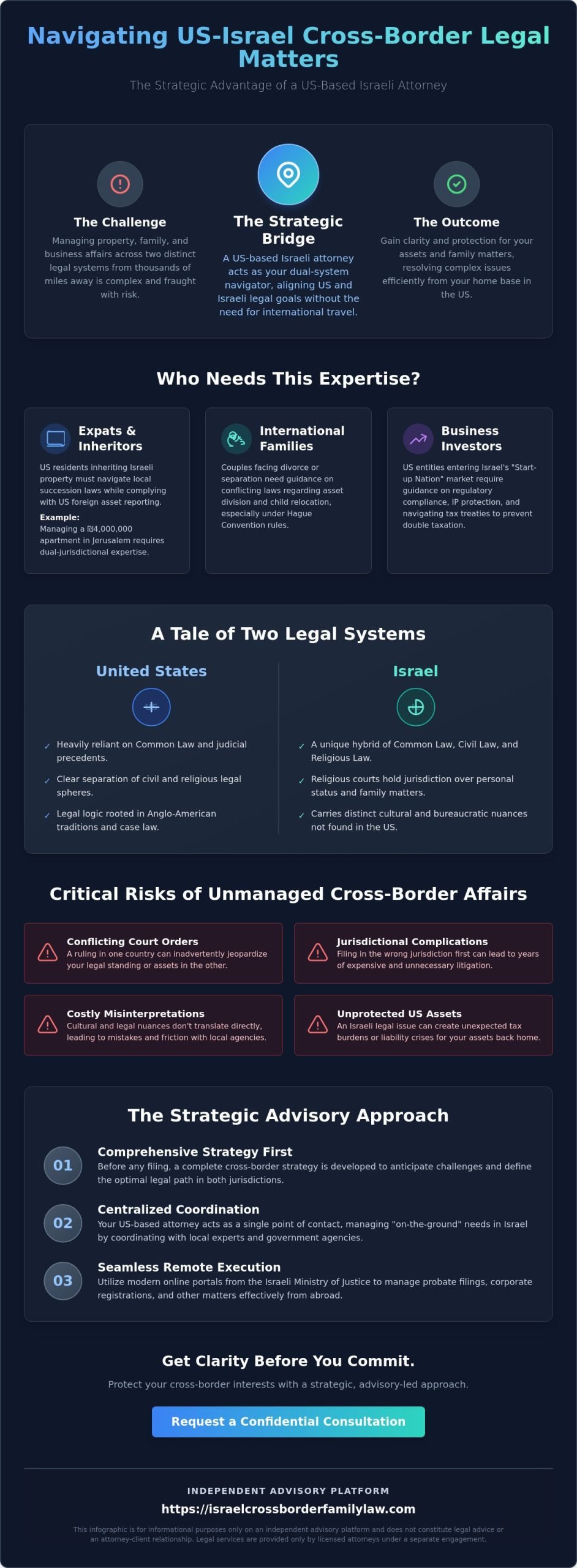
An israeli attorney in the us acts as a vital strategic bridge for individuals and corporations managing interests across two distinct legal jurisdictions. This professional isn’t merely a lawyer who speaks Hebrew; they’re a dual-system navigator who understands how a decision made in a U.S. court might trigger unintended consequences in Israel. In the digital age, physical proximity to a courthouse is less important than deep jurisdictional expertise. A lawyer based in North America can now manage Israeli probate filings or corporate registrations through the Israeli Ministry of Justice’s online portals just as effectively as someone in Tel Aviv.
Bicultural and bilingual representation is essential for the Anglo-Israeli community. Legal terminology in Israel often carries cultural nuances that don’t translate directly into English. Without a representative who understands both environments, clients risk misinterpreting local requirements. These attorneys focus on protecting U.S.-based assets from Israeli legal complications, ensuring that an inheritance or a business venture in Israel doesn’t create a tax or liability crisis at home. The foundation of this work rests on the long-standing Israel-United States relations, which have created a complex web of treaties and reciprocal agreements that govern everything from tax to child custody.
Bridging the Gap Between Two Legal Systems
The U.S. legal system relies heavily on Common Law and judicial precedents. Israel’s framework is a unique hybrid of common law, civil law, and religious law, especially regarding personal status and family matters. An israeli attorney in the us manages “on-the-ground” needs in Israel by coordinating with local experts and government agencies. They provide a “legal home” for clients, offering a space where business and family cultures are understood in their original context. This prevents the friction that often occurs when a U.S. client tries to apply American legal logic to an Israeli bureaucrat’s requirements.
Who Benefits from Cross-Border Legal Counsel?
Several specific groups find this dual expertise indispensable:
- Expats and Inheritors: Individuals living in the U.S. who inherit property in Israel, such as an apartment in Jerusalem valued at ₪4,000,000, must navigate Israeli succession laws while remaining compliant with U.S. foreign asset reporting.
- International Families: Those facing divorce or separation often deal with conflicting laws regarding asset division and child relocation.
- Investors: U.S. entities looking to enter the Israeli “Start-up Nation” market require guidance on local regulatory compliance and intellectual property protections.
Early strategy is the most effective way to manage these risks. Understanding the differences in how each system views contracts, property, and family rights saves time and prevents expensive litigation later.
Get clarity before you commit. Request a confidential consultation.
Essential Legal Services for the International Community
Managing legal affairs across two countries requires more than just translating documents. It demands a strategic understanding of how different systems interact. An israeli attorney in the us acts as a vital resource for those who hold assets or family ties in both nations. The strategic partnership between the two nations is deeply codified, as seen in the U.S. law on Israel cooperation, yet individual legal matters remain subject to local jurisdictional nuances that can catch the unprepared off guard.
Businesses operating in both markets must address regulatory compliance and international tax treaty implications. The 1975 U.S.-Israel Income Tax Treaty helps prevent double taxation, but it’s not a self-executing shield. Companies often need to structure their entities to satisfy both Israeli corporate law and US state-level requirements. Securing the services of an israeli attorney in the us ensures that your cross-border strategy is cohesive. This complexity extends to intellectual property and transactional law, where the “start-up nation” culture often moves faster than the legal frameworks designed to govern it.
Cross-Border Family Law and Divorce
Divorce involving international families often triggers a “race to court.” In Israel, the first spouse to file in either the Family Court or the Rabbinical Court can significantly influence the outcome of the case. This choice affects everything from property division to child support enforcement. If one spouse is in the US and the other is in Israel, the jurisdictional battle becomes even more complex. Decisions made in the first 48 hours can determine which country’s laws will govern the family’s future for years. You can learn more about divorce and separation for international families to understand these risks.
Wills, Estates, and Inheritance
A standard US will is often insufficient for managing assets located in Israel. The Israeli Inheritance Law of 1965 has specific requirements that a US-based document might not satisfy. For example, 100% of real estate in Israel must go through a local probate process even if it’s already been settled in a US court. US-based beneficiaries often face delays and unexpected costs when trying to claim an inheritance in Israel without a locally compliant strategy. Protecting international assets often requires sophisticated trust structures that account for both the US tax code and Israeli land registry rules. Get clarity before you commit. Request a confidential consultation.
Navigating Jurisdictional Conflicts and Risks
When legal proceedings occur in two countries simultaneously, the risk of “conflicting orders” becomes a tangible threat to family stability. It’s common for a US court to grant a parent permission to travel while an Israeli court issues a stay-of-exit order. These contradictions create a legal deadlock that leaves families in limbo. Without a coordinated strategy, a judgment obtained in New York or California might be completely unenforceable in Tel Aviv. Working with an israeli attorney in the us helps bridge this gap by ensuring that motions filed in one jurisdiction don’t inadvertently sabotage the case in the other.
The 1980 Hague Convention on the Civil Aspects of International Child Abduction is the primary framework for these disputes. It’s designed to return children to their country of “habitual residence.” However, the interpretation of this term varies between systems. Israeli courts often look at the child’s center of life, which includes school enrollment and social ties. If a parent relocates without a clear, court-approved plan, they risk being accused of international abduction. You can learn more about managing these transitions through our guide on international custody and relocation.
The Complexity of Cross-Border Child Custody
Israeli courts take a protective stance on relocation. They prioritize the child’s best interests, but they also weigh the parent’s right to move. If you’re living in the US and seeking visitation in Israel, the court might require financial guarantees or bonds. These bonds can sometimes exceed ₪75,000 to ensure the child’s return to their primary residence. Enforcement is another hurdle. While Israel is a signatory to international treaties, collecting payments requires specific filings in the Enforcement and Collection Authority. For details on how to navigate these financial obligations, see our resources on child support cross-border enforcement.
Risk-Based Decision Making in International Law
Winning a motion in a US court feels like a victory, but it can be a strategic loss if it triggers an aggressive response in Israel. International law isn’t just about winning arguments; it’s about analyzing the long-term impact of every filing. An israeli attorney in the us provides the necessary foresight to see how a US judge’s decision will play out under Israeli Rabbinical or Family Court scrutiny. Don’t make commitments until you understand the jurisdictional risks. Every early decision sets a precedent that’s difficult to reverse later. Seeking clarity before making legal commitments is the only way to protect your long-term interests.
Get clarity before you commit. Request a confidential consultation.
This article is published on an independent advisory platform (not a law firm) and does not imply an attorney-client relationship. Legal services are only provided by licensed attorneys under a separate engagement.
How to Choose an Israeli Attorney in the US
Selecting an israeli attorney in the us involves more than finding a professional who speaks Hebrew. You’re looking for a bridge between two distinct legal cultures. The first step is to verify their licensing. An attorney must be an active member of the Israel Bar Association (Lishkat HaOrchim) to practice Israeli law. You can verify this status through the Bar’s official online database. Without this, they cannot represent your interests in Israeli courts or sign official legal documents that the Israeli government will recognize.
Assess their cross-border experience by asking about specific dual-jurisdiction cases they’ve handled. Israeli law often intersects with US law in unexpected ways, particularly regarding tax obligations and asset distribution. A lawyer who only understands one system might inadvertently create a tax liability in the other. Look for a firm that prioritizes a strategic approach rather than immediate, aggressive litigation. In Israel, the legal process can be slow; a strategist who seeks resolution through mediation or calculated negotiation often achieves better results than one who pushes for high-conflict court battles.
A “team on the ground” is a non-negotiable requirement. While your primary contact might be an israeli attorney in the us, the firm needs a physical presence in Israel. Local staff in Tel Aviv or Jerusalem are essential for filing physical documents, appearing at short-notice hearings, and navigating the specific bureaucracies of Israeli land registries or Rabbinical courts. Without local support, your case could suffer from significant delays and increased administrative costs.
Questions to Ask During a Consultation
During your initial meeting, focus on the logistics of international representation. Ask these specific questions:
- How do you handle the 7 to 10 hour time difference between the US and Israel for urgent filings?
- What is your recent experience with the specific court, such as the Rabbinical versus Civil court, in my type of case?
- How do you coordinate with my existing US legal team to ensure our global strategy is consistent?
Understanding Remote Legal Representation
Since the regulatory shifts in 2020, the Israeli legal system has become more accessible for those living abroad. Technology now allows for remote testimony in many family and civil matters via secure video conferencing. You can often handle document signing through the Israeli consulate or via specific digital authentication methods recognized by Israeli authorities.
Billing for international matters requires transparency. Costs are often influenced by the complexity of managing two jurisdictions and the involvement of local counsel in Israel. Most firms will provide a breakdown of fees in Israeli Shekel (₪) for the work performed within the Israeli system. You can learn more by understanding our pricing and advisory model. This helps you plan your budget without surprises from fluctuating exchange rates or hidden administrative fees.
Get clarity before you commit. Request a confidential consultation.
Strategic Planning: The Advisory Approach
Strategy must be the foundation of any cross-border case. Many families rush to file in their local court, whether in New York or Tel Aviv, without realizing the permanent consequences of that first move. An israeli attorney in the us often sees the fallout from these premature filings. Jurisdiction determines everything from child support amounts to how pensions are divided. Once a process begins in one country, reversing course is difficult, expensive, and sometimes impossible.
An independent advisory platform offers a neutral space to evaluate options. Unlike a law firm that might push for immediate litigation to secure a retainer, this approach prioritizes clarity and risk assessment. It functions as a strategic bridge between your current life in America and the specific requirements of the Israeli legal system. Early intervention stops jurisdictional mistakes that lead to years of conflict. It ensures you aren’t fighting a battle in a court that lacks the power to enforce its own rulings.
Getting Clarity Before You Commit
A confidential case review identifies hidden risks before they become part of a public court record. You might face issues with property valuation or the enforcement of support payments that exceed ₪7,000 per month. Moving from a state of confusion to a structured legal plan protects your assets and your family’s future. You can learn more about how the advisory process works to determine if this path fits your specific needs.
The advisory model focuses on data rather than emotion. It provides a realistic look at how Israeli courts view foreign assets and US-based income. This preparation prevents the shock many expats feel when they realize the Israeli system operates on different cultural and legal assumptions than the one they’ve grown used to in the United States.
Next Steps for Your Cross-Border Matter
For more detailed insights, watch the video “Planning Your Cross-Border Strategy” on our YouTube channel. International legal issues feel overwhelming, but they’re entirely solvable when you have the right map. You don’t have to navigate two different cultures and legal codes without guidance. When you have the right data, the inherent complexity of the situation becomes a manageable set of steps. Working with an israeli attorney in the us who understands both worlds ensures your strategy is robust and culturally nuanced.
Legal systems are tools. If you use them correctly, they provide protection and resolution. If you use them without a plan, they become a source of stress. Take the time to understand the landscape before you take action.
Get clarity before you commit. Request a confidential consultation.
This article is published on an independent advisory platform, not a law firm, and does not imply an attorney-client relationship. It is informational and advisory only, not legal representation or legal advice. Legal services are only provided by licensed attorneys under a separate engagement.
Securing Your Interests Across Borders
Success in international legal matters isn’t just about following rules. It’s about understanding how those rules interact when you’re dealing with both Israeli and American jurisdictions. Early decisions often have a lasting impact on your assets and legal standing. This is why a bilingual and bicultural legal advisory is so critical for the international community. We’ve seen how the right israeli attorney in the us provides a necessary bridge between these two systems.
This independent advisory platform offers a space to explore options without the immediate pressure of litigation. You’ll benefit from decades of cross-border experience while gaining a clear view of the risks involved. Choosing the right path requires strategy and a deep understanding of the differences between the “start-up nation” and US legal cultures. For more insights, visit our YouTube channel. With the right support, you can navigate these complexities with confidence.
Get clarity before you commit. Request a confidential consultation.
This article is published on an independent advisory platform and is not a law firm. The information provided is for educational purposes and does not constitute legal advice or an attorney-client relationship. Legal services are only provided by licensed attorneys under a separate engagement.
Frequently Asked Questions
Do I need to travel to Israel if my legal case is being handled there?
You generally don’t need to travel to Israel for your case to proceed. Most administrative tasks and court filings are handled electronically by an israeli attorney in the us who coordinates with local teams. Since the 2020 updates to Israeli court regulations, many hearings allow for remote testimony via video conference, provided you follow specific procedural requirements for international witnesses.
Can an Israeli attorney in the US represent me in an Israeli court?
An attorney can only represent you in an Israeli court if they hold an active license from the Israel Bar Association. Many practitioners acting as an israeli attorney in the us maintain dual certification, allowing them to bridge the gap between American legal expectations and Israeli procedural law. You should verify that your representative is authorized to appear before the relevant Israeli tribunal before proceeding.
Is a US prenuptial agreement valid in Israel?
A US prenuptial agreement isn’t automatically valid in Israel and often requires a specific validation process under the Financial Relations Law of 1973. For the agreement to be enforceable during an Israeli divorce, it must typically be approved by an Israeli Family Court judge or a notary, depending on when it was signed. Without this formal validation, the Israeli courts might apply the standard balancing of resources rule instead of your US contract.
How long does the probate process take in Israel for US residents?
The probate process in Israel for US residents usually takes between 6 and 12 months, depending on the complexity of the estate. If the deceased held assets in both countries, your attorney must file a petition with the Inheritance Registrar and potentially obtain a specialized legal opinion on US law. Delays often occur if there are errors in the translation or notarization of US death certificates and wills.
What is the difference between the Rabbinical court and the Family court in Israel?
The primary difference lies in the source of law and the scope of authority. The Family Court operates under civil law and handles matters like property division and child custody for all citizens. The Rabbinical Court has exclusive jurisdiction over the act of marriage and divorce for Jews in Israel. This creates a race to the court where the first party to file can often determine which legal system governs certain aspects of the separation.
Can I enforce a US child support order in Israel?
You can enforce a US child support order in Israel by filing a petition under the Foreign Judgments Enforcement Law of 1958. The Israeli court will check if the US court had the authority to give the order and if the decision is final and no longer appealable. It’s a technical process that ensures the best interests of the child are protected across borders while respecting the original US ruling.
How much does it cost to hire an Israeli attorney while living in the US?
Legal fees for cross-border matters are typically structured as flat fees for specific filings or hourly rates that align with the Israel Bar Association’s recommended minimum tariff. While simple filings might start at a few thousand ₪, complex litigation involving multiple jurisdictions will naturally require a higher investment. You’ll also need to account for costs like court fees, professional translations, and apostille certifications.
What happens if I have conflicting court orders from the US and Israel?
Conflicting orders create a significant legal challenge known as a clash of jurisdictions. In these cases, the court must decide which country is the most appropriate place to hear the case, a concept known as forum non-conveniens. If you’re facing this situation, you must act quickly to stay proceedings in one jurisdiction to avoid contradictory rulings that could be impossible to enforce.
For more information on navigating these complex issues, you can view educational resources here: https://www.youtube.com/@IsraelFamilyLaw
Get clarity before you commit. Request a confidential consultation.

Article by
Gabriel Lior
A Personal Journey That Became a Mission
The advisory was founded by an American father Gabriel Lior, LLB, MBA , global entrepreneur, and cross-border advisor who spent more than a decade navigating the Israeli family court system firsthand and now lives in Singapore with his son.
As a divorced parent in a cross-border family, Gabriel faced nearly every legal challenge a foreign parent can encounter in Israel — including child custody disputes, child support proceedings, property matters in Israel and abroad, false accusations, and complex immigration and relocation proceedings.
Over the years, he learned the hard way how difficult it is for non-Israeli parents to understand the system, identify the right legal strategy, and choose the right legal representation — especially when language, culture, and jurisdictional differences are involved. He also witnessed how foreign parents and new immigrants are often disadvantaged or taken advantage of by service providers and institutions simply because they lack local knowledge or fluency.
From Client to Advisor
To truly understand — and survive — the system, Gabriel pursued formal legal education in Israel, completing two Israeli law degrees, alongside a BA and MBA earned in the United States. This was never about becoming a practicing attorney, but about gaining a deep, structural understanding of how the system works — and where it breaks down for foreign parents.
This rare combination of:
Firsthand client experience
Israeli legal and US business education
International business and negotiation training
Decades of commercial execution
created a unique perspective – one that understands both sides of the table.
After years of litigation, persistence, and at times self-representation, he ultimately succeeded in securing custody of his son and relocating abroad through a rare legal victory in the Israeli Supreme Court — becoming one of the first fathers in Israel to do so under these circumstances.
Disclaimer
Important Disclaimer:
The information provided on this website and in its content is for general informational and educational purposes only and does not constitute legal advice, legal opinion, or legal representation.
Gabriel Lior is not licensed to practice law in Israel (nor is he interested in doing so) and does not provide legal services, despite having completed 2 Law Degrees. The services offered are advisory in nature and are intended to provide general guidance, strategic insight, and information regarding cross-border family law considerations.
No attorney-client relationship is formed by accessing this website, reading its content, or communicating with us.
Any decisions made based on this information are at your own discretion and risk. For legal advice specific to your situation, you should consult a licensed attorney in the relevant jurisdiction.
Where appropriate, we may refer clients to independent, licensed attorneys or professionals. Such referrals do not constitute legal representation and no liability is assumed for services provided by third parties.