This article is published on an independent advisory platform and does not constitute a law firm or an attorney-client relationship.
What if the custody agreement you signed in a US state court loses its primary enforcement power the moment your child lands at Ben Gurion Airport? You probably recognize that international coparenting involves more than just syncing calendars across time zones. It’s a high-stakes legal strategy where a single oversight in jurisdiction can lead to years of litigation in conflicting civil or Rabbinical courts.
This guide provides the clarity you need to structure an arrangement that remains stable across borders, ensuring your rights are protected by both the Hague Convention and the Israeli Foreign Judgments Enforcement Law of 1958. We’ll examine the specific steps to prevent unilateral relocation, the impact of the February 27, 2026 travel advisory, and the critical five-year window for enforcing foreign orders in Israel. You’ll see how to align your goals with the 103 parties currently signed to the Hague Convention while reviewing strategies shared on the Israel Family Law YouTube channel. Get clarity before you commit. Request a confidential consultation.
Key Takeaways
- Learn why “Habitual Residence” is the most critical legal concept when determining which country’s laws govern your family’s future and custody arrangements.
- Manage the logistical hurdles of international coparenting by establishing clear, enforceable protocols for travel costs, flight escorts, and the 7-10 hour time difference.
- Understand the strategic importance of securing “Mirror Orders” to ensure your parenting agreement is legally recognized and binding in both the United States and Israel.
- Navigate the unique jurisdictional risks within the Israeli legal system, including the significant procedural differences between Civil Family Courts and Religious Courts.
- Develop a long-term strategy that accounts for conflicting international school calendars and provides robust protection against the risk of unilateral relocation.
This article is published on an independent advisory platform and does not constitute a law firm or an attorney-client relationship. Legal services are only provided by licensed attorneys under a separate, formal engagement.
Defining International Coparenting in a Cross-Border Context
International coparenting is the management of a child’s upbringing across two or more distinct legal jurisdictions and cultural environments. For families split between the United States and Israel, this involves more than just long-haul flights or coordinating schedules. It requires a sophisticated understanding of how two different legal systems view parental rights. Families often face unique stressors, including the 7 to 10 hour time difference and the complexities of Israeli religious law. Without a clear divorce and separation strategy for international families, parents risk falling into jurisdictional traps that can take years to resolve.
The distance between New York or Los Angeles and Tel Aviv creates a logistical burden that few domestic parenting plans can accommodate. Language barriers in the Israeli court system and the influence of the Rabbinical courts add layers of complexity for those accustomed to US civil proceedings. Success in this environment depends on making informed choices before conflicts arise.
The Unique Challenges for Anglo and Expat Families
Anglo and expat families often encounter a significant “cultural gap” when entering the Israeli legal system. US expectations of 50/50 custody or specific mediation styles may not align with Israeli judicial realities. In Israel, the “tender years presumption” and the dual-court system can create a sense of being an “outsider” for the non-Israeli parent. This tension affects the legal and practical relationship between the parents and the state. Children growing up in this context often develop a dual identity, which requires a parenting plan that respects both their American heritage and their Israeli daily life.
Logistics vs. Legal Strategy: Why Both Matter
It’s easy to focus on daily logistics like WhatsApp video calls or flight costs. However, the underlying legal strategy is what provides long-term security. Early decisions, such as where a child spends a summer or which school they are enrolled in, can inadvertently establish “Habitual Residence.” This term determines which country’s courts have the power to make decisions about your child’s life. Understanding these risks is essential for maintaining future mobility. Parents should learn more for expats and foreign nationals to ensure their early agreements don’t limit their rights under the 1958 Foreign Judgments Enforcement Law. Every choice made today impacts your ability to move or travel tomorrow. Get clarity before you commit. Request a confidential consultation.
The Legal Pillars: Jurisdiction, Habitual Residence, and the Hague Convention
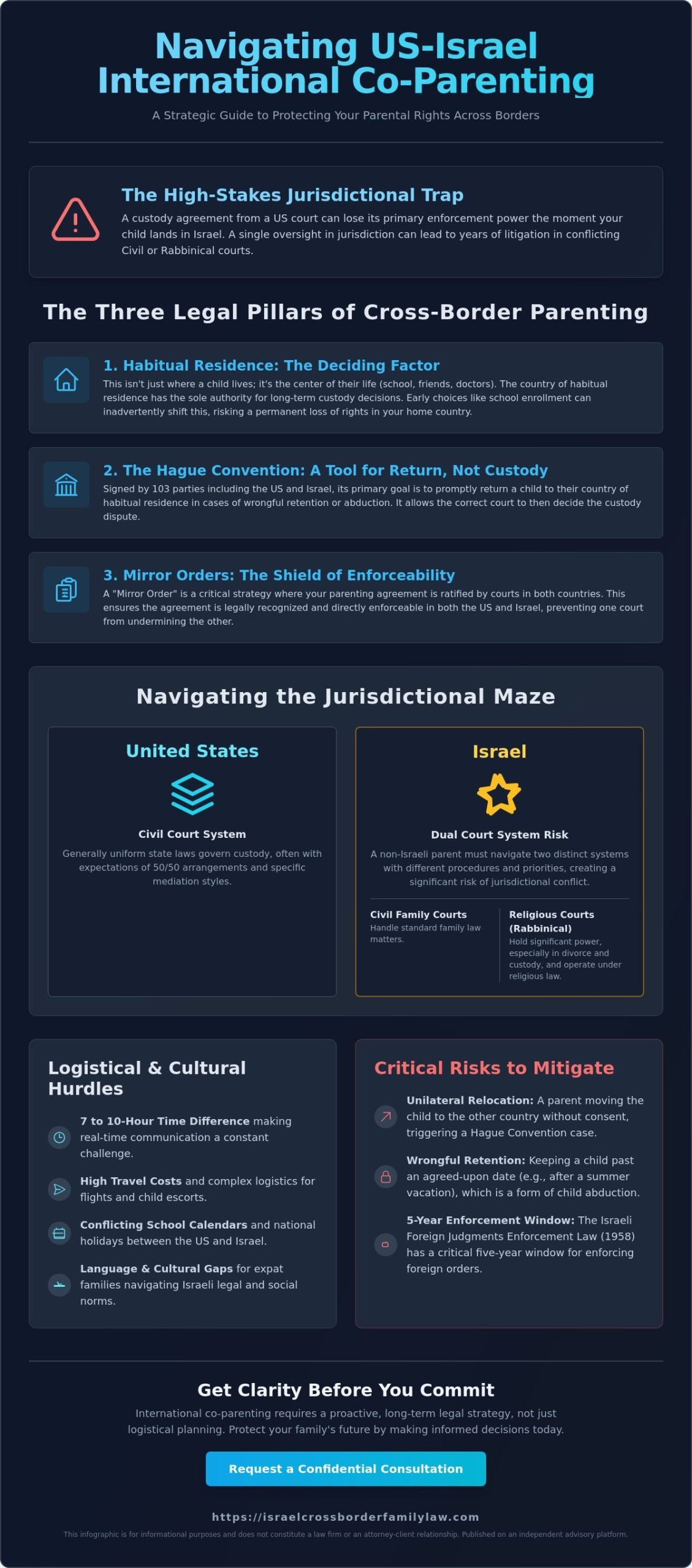
Effective international coparenting rests on three foundational pillars: jurisdiction, habitual residence, and the Hague Convention. Among these, “Habitual Residence” is the most critical term. It doesn’t simply refer to where a child currently lives. Instead, it’s a fact-based determination of where the child’s life is centered, including their school, social circle, and medical care. In cross-border law, the country of habitual residence is usually the only one with the authority to make long-term decisions about the child’s welfare. Misunderstanding this concept can lead to a loss of rights if a child stays in one country long enough for that nation to be considered their new legal home.
Both the United States and Israel are signatories to the Hague Convention on the Civil Aspects of International Child Abduction. This treaty isn’t designed to settle custody disputes. Its primary purpose is to return a child to their country of habitual residence so the proper courts can hear the case. International parental child abduction often involves “wrongful retention,” where a parent keeps a child past an agreed-upon date, such as the end of a summer vacation. Because legal systems move slowly, many parents engage in a “race to the court.” Filing first in a specific jurisdiction can sometimes determine which country’s laws will govern the family’s future. This makes understanding international custody and relocation a prerequisite for any parent considering a move.
Navigating the Hague Convention in US-Israel Cases
When a parent refuses to return a child to Israel after a visit to the US, or vice versa, the other parent can file a Hague petition. These cases are intense and fast-paced. Common defenses include proving the left-behind parent consented to the move or showing that returning the child would create a “grave risk” of harm. You can find more details on these defenses in our Hague Convention child abduction resource. Strategy at this stage is vital because a failed petition can permanently shift jurisdiction to the new country.
Jurisdictional Conflicts: Israel Courts vs. US State Courts
Israeli Family Courts and US State courts often use different definitions for “Legal Custody” and “Physical Custody.” In Israel, the “Best Interests of the Child” is the primary standard, but it’s interpreted through a lens that may prioritize the child’s connection to the Jewish state or local family support. Conflicts arise when a US court issues an order that an Israeli court refuses to recognize under the Foreign Judgments Enforcement Law of 1958. This happens most often when the US order contradicts Israeli public policy or when the Israeli court believes it has primary jurisdiction. If you’re facing conflicting orders, it’s helpful to review your options with a professional who understands both systems. Get clarity before you commit. Request a confidential consultation.
Strategic Logistics: Time Zones, Travel, and Communication
While the legal pillars of jurisdiction provide the framework for your family’s future, the logistical execution of international coparenting often presents the most immediate daily challenges. Managing a household in Israel while the other parent resides in the United States requires a level of coordination that domestic agreements rarely address. The 7 to 10 hour time difference is a significant factor. It’s not merely a scheduling nuisance; it’s a legal consideration. If a parenting plan mandates “daily evening calls” without specifying the time zone, a parent in Tel Aviv might find themselves receiving calls at 3:00 AM. Clear agreements must define specific windows for communication that respect the child’s sleep and school schedule in their country of habitual residence.
Structuring international travel is another area where ambiguity leads to conflict. A robust agreement specifies who is responsible for booking flights, who accompanies the child, and at what age the child may travel as an “unaccompanied minor” according to airline regulations. These “escort” requirements can add thousands of shekels to the annual travel budget. For visual guides on how to manage these complex travel logistics, the YouTube channel @IsraelFamilyLaw offers practical walkthroughs for families navigating these transitions. Incorporating virtual visitation rights into the legal agreement ensures that the bond between the child and the long-distance parent remains protected by the court, regardless of physical distance.
The Financial Burden of International Visitation
The high cost of transcontinental flights often necessitates a reassessment of traditional child support models. In many cases, travel expenses are treated as a significant factor in child support cross-border enforcement. Parents must decide if these costs will be shared on a fixed basis or a percentage-based model. For example, the parent living abroad might cover 100% of the child’s flight while the parent in Israel covers the cost of the escort. Since airfare fluctuates, some families choose to cap the total annual contribution at a specific amount of Israeli Shekels (₪) to maintain financial predictability. Get clarity before you commit. Request a confidential consultation.
Digital Coparenting: Tools and Boundaries
Technology serves as a bridge, but it also creates a digital trail that can be used in future litigation. Using recorded communication platforms is a strategic way to protect against accusations of “alienation” or “interference” with visitation. These tools help maintain boundaries by establishing “blackout periods” where neither parent may contact the child except in emergencies. Additionally, parents must be aware that social media activity is increasingly scrutinized in Israeli family courts. Photos or posts that suggest a parent is planning a permanent relocation without consent can be used as evidence in a Hague Convention petition. Clear digital boundaries prevent small misunderstandings from escalating into multi-jurisdictional legal battles.
Creating an Enforceable International Parenting Plan
Drafting a document is only the first step toward a stable future. Successful international coparenting relies on an agreement that translates effectively across two different legal systems. While a standard US agreement might suffice for domestic moves, cross-border situations require specific clauses that address the conflict between Israeli and US laws. A robust plan must follow five essential steps to remain enforceable.
- Step 1: Define Visitation Dates: You must account for conflicting school calendars. Israeli schools follow the Jewish calendar, meaning Pesach break is often longer and occurs at a different time than US Spring Break. Specify exact start and end dates rather than using vague terms like “Spring Vacation.”
- Step 2: Implement Mirror Orders: Writing an agreement isn’t enough. You must register the agreement as a “Mirror Order” in both Israel and the relevant US state. This ensures that if one parent violates the terms, the local court in either country has the immediate authority to act.
- Step 3: Choice of Law and Forum: Explicitly state which country’s laws govern the agreement and which court has the exclusive jurisdiction to modify it. This prevents the “race to the court” mentioned in previous sections.
- Step 4: Passport Control: Define who holds the child’s passport and how much notice is required before international travel. Standard notice periods are often 30 to 60 days to allow the other parent time to verify travel details.
- Step 5: Dispute Resolution: Require mediation in a specific location before either parent can file a new motion in court. This reduces the risk of expensive, multi-jurisdictional litigation.
Passport Management and Travel Consents
In Israel, the risk of a “No-Exit Order” (Tzav Ikur Yetzia Min Ha’aretz) is a reality for many parents. This order can prevent a child from leaving the country even for a short vacation. To balance this, US orders often include “Ne Exeat” clauses, which prohibit child removal without written consent. To avoid allegations of international child abduction, parents should use a formal “Notice of Intent to Travel.” This document should include flight numbers, hotel addresses, and emergency contact numbers. Get clarity before you commit. Request a confidential consultation.
Enforcement: What Happens When Rules are Broken?
Enforcement differs significantly between the two nations. In the US, a parent might face “contempt of court,” which can lead to fines or even jail time. In Israel, custody and visitation orders are often enforced through the “Execution Office” (Lishkat HaHotza’a LaPo’al). However, the Execution Office’s power is limited if the original US order wasn’t properly recognized under the Foreign Judgments Enforcement Law of 1958. Remember that a petition for recognition must be filed within five years of the foreign order’s establishment to remain valid in Israel. Clarity before commitment is the only way to ensure long-term compliance. Before you finalize any agreement, secure your parenting plan with a professional review.
This article is published on an independent advisory platform and does not constitute a law firm or an attorney-client relationship.
Long-Term Strategy: Risk Mitigation and Informed Decision-Making
Successful international coparenting is a marathon, not a sprint. The legal and logistical framework you establish today must be robust enough to survive years of shifting needs as your children grow. An agreement that works for a toddler won’t necessarily address the complexities of a teenager’s school schedule or their desire for social autonomy across two continents. Because cross-border situations are inherently volatile, relying on “DIY” agreements or generic templates is a high-risk strategy. These documents often lack the specific jurisdictional triggers required by Israeli Family Courts or US State courts, which leads to expensive failures in enforcement when life changes occur.
Periodic reviews of your parenting plan are essential. This isn’t about looking for conflict; it’s about maintaining clarity before life events force your hand. Strategy-based decision-making allows you to anticipate risks rather than reacting to them in a courtroom. Every early decision, from school enrollment to summer travel dates, builds the foundation of “Habitual Residence.” Protecting that foundation requires consistent attention to the details of your original order. Get clarity before you commit. Request a confidential consultation.
Adapting to Life Changes: Relocation and Modification
The desire for a parent to move to a third country or relocate within their current nation can destabilize even the most detailed international coparenting arrangement. In Israel, the legal threshold for modifying a custody order is high. You must demonstrate a “material change in circumstances” that aligns with the best interests of the child. When facing these shifts, parents must choose between compromise and litigation. Risk-based decision-making involves weighing the potential for ₪ 10,000s in legal fees against the long-term stability of the family. Modification should be approached as a strategic realignment of the “Mirror Orders” mentioned previously, ensuring that any changes remain enforceable in both jurisdictions simultaneously.
The Advisory Role: Navigating the Complexity
Navigating the “Start-up Nation” and the US legal landscape simultaneously requires more than just a lawyer; it requires a bridge between cultures. This advisory platform serves that role by providing a bicultural and bilingual strategy that accounts for the nuances of both systems. We help families understand how an Israeli court’s view of parental roles might differ from a US judge’s expectations. By focusing on strategy rather than just forms, we ensure that your family’s unique needs are reflected in a plan that courts in both nations will respect. You can explore how it works to see how our advisory process helps you avoid common pitfalls and secure your rights through informed, strategic choices.
Securing Your Family’s Future Across Borders
Managing a family between Israel and the United States requires more than a standard agreement; it demands a proactive approach to risk management. You’ve seen how the concepts of “Habitual Residence” and the implementation of “Mirror Orders” serve as the ultimate safeguards against jurisdictional disputes. By addressing the 7 to 10 hour time difference and establishing clear travel protocols early, you prevent minor logistical friction from becoming a multi-jurisdictional legal crisis. International coparenting is sustainable only when it’s built on a foundation of strategy rather than hope.
Our advisory platform provides the specialized bicultural and bilingual expertise needed to bridge the significant gap between IL and US legal systems. We focus on cross-border family strategy to help you navigate these complexities with the confidence that your rights are protected in both nations. This high-stakes environment requires precise wording and an understanding of how both civil and religious courts operate. Get clarity before you commit. Request a confidential consultation. With the right strategy in place, you can build a stable and predictable environment for your children, regardless of the miles between you.
Frequently Asked Questions
What is the Hague Convention and how does it affect my coparenting?
The Hague Convention is the primary international treaty designed to protect children from the harmful effects of abduction and retention across international borders. It affects your international coparenting by ensuring that a child’s “habitual residence” remains the place where custody decisions are made. As of November 2022, 103 nations, including Israel and the US, are parties to this agreement. It provides a legal mechanism to return a child if they are moved without consent.
Can I move back to the US from Israel with my child without the other parent’s consent?
No, you cannot legally relocate a child from Israel without either the other parent’s written consent or a specific court order. Doing so may be classified as a felony under the US International Parental Kidnapping Crime Act or a violation of Israeli law. Courts in IL prioritize the status quo. Moving without authorization often triggers immediate Hague Convention proceedings and can severely damage your long-term custodial rights.
How do we handle child support if the parents live in different countries?
Child support is typically handled by civil courts in the country where the child resides. A US child support order can be enforced in IL after being recognized by an Israeli Family Court under the Foreign Judgments Enforcement Law of 1958. You must file a petition for recognition within five years of the foreign order’s establishment. This process ensures that financial obligations are met across borders through the Israeli Execution Office.
What happens if the other parent refuses to return the child after a vacation in the US?
This situation is legally defined as “wrongful retention” under the Hague Convention. You should immediately file an application with the central authorities in either the US or Israel. There are no fees for filing these applications with the government, though you are responsible for your own attorney fees. If you cannot afford an attorney in IL, you may apply for Israeli legal aid to facilitate the child’s return to their habitual residence.
Which court has jurisdiction over our custody agreement: Israel or the US?
Jurisdiction is generally held by the court in the child’s country of habitual residence. In 2026, courts are expected to use even clearer rules to determine where a child’s life is centered to decide which laws apply. While a US state court may have issued the original order, an Israeli court may claim jurisdiction if the child has lived in IL long enough to establish a new habitual residence. Get clarity before you commit. Request a confidential consultation.
How can I ensure my US custody order is recognized and enforced in Israel?
You must domesticate the US order through the Israeli Family Court system using the 1958 Foreign Judgments Enforcement Law. This process involves proving that the order is final, that the other party had a fair chance to present their case, and that the order does not contradict Israeli public policy. Without this formal recognition, the Israeli Execution Office cannot help you enforce visitation or custody terms if a dispute arises.
What should be included in a cross-border visitation schedule?
A successful international coparenting schedule must include specific travel dates that account for conflicting holiday calendars, such as the difference between Pesach and US Spring Break. It should also detail who pays for flights, who accompanies the child, and specific windows for video calls to respect the 7 to 10 hour time difference. Including these details prevents ambiguity and reduces the need for future litigation in either country.
Is it possible to have “joint custody” when parents live on different continents?
Legal joint custody is common, meaning both parents share the right to make major decisions about education, health, and religious upbringing. However, physical joint custody is practically impossible due to the distance. In these cases, the “best interests of the child” standard drives the arrangement. The non-resident parent typically receives extended visitation during summer and winter breaks to maintain a meaningful relationship with the child.

Article by
Gabriel Lior
A Personal Journey That Became a Mission
The advisory was founded by an American father Gabriel Lior, LLB, MBA , global entrepreneur, and cross-border advisor who spent more than a decade navigating the Israeli family court system firsthand and now lives in Singapore with his son.
As a divorced parent in a cross-border family, Gabriel faced nearly every legal challenge a foreign parent can encounter in Israel — including child custody disputes, child support proceedings, property matters in Israel and abroad, false accusations, and complex immigration and relocation proceedings.
Over the years, he learned the hard way how difficult it is for non-Israeli parents to understand the system, identify the right legal strategy, and choose the right legal representation — especially when language, culture, and jurisdictional differences are involved. He also witnessed how foreign parents and new immigrants are often disadvantaged or taken advantage of by service providers and institutions simply because they lack local knowledge or fluency.
From Client to Advisor
To truly understand — and survive — the system, Gabriel pursued formal legal education in Israel, completing two Israeli law degrees, alongside a BA and MBA earned in the United States. This was never about becoming a practicing attorney, but about gaining a deep, structural understanding of how the system works — and where it breaks down for foreign parents.
This rare combination of:
Firsthand client experience
Israeli legal and US business education
International business and negotiation training
Decades of commercial execution
created a unique perspective – one that understands both sides of the table.
After years of litigation, persistence, and at times self-representation, he ultimately succeeded in securing custody of his son and relocating abroad through a rare legal victory in the Israeli Supreme Court — becoming one of the first fathers in Israel to do so under these circumstances.
Disclaimer
Important Disclaimer:
The information provided on this website and in its content is for general informational and educational purposes only and does not constitute legal advice, legal opinion, or legal representation.
Gabriel Lior is not licensed to practice law in Israel (nor is he interested in doing so) and does not provide legal services, despite having completed 2 Law Degrees. The services offered are advisory in nature and are intended to provide general guidance, strategic insight, and information regarding cross-border family law considerations.
No attorney-client relationship is formed by accessing this website, reading its content, or communicating with us.
Any decisions made based on this information are at your own discretion and risk. For legal advice specific to your situation, you should consult a licensed attorney in the relevant jurisdiction.
Where appropriate, we may refer clients to independent, licensed attorneys or professionals. Such referrals do not constitute legal representation and no liability is assumed for services provided by third parties.