This article is published on an independent advisory platform and is not a law firm. The content is for informational purposes only and does not imply an attorney-client relationship. Legal services are only provided by licensed attorneys under a separate engagement.
Under Israeli Land Law, you have a fundamental, absolute right to demand the dissolution of a co-owned property at any time, regardless of whether other heirs agree. Many international families struggle with how to dissolve estate in israel because they assume they’re trapped in a permanent deadlock with siblings or former spouses. You likely feel overwhelmed by Hebrew legal documents and the uncertainty of how Israeli regulations differ from US expectations. We understand that the fear of a long, hostile court battle often leads to paralysis.
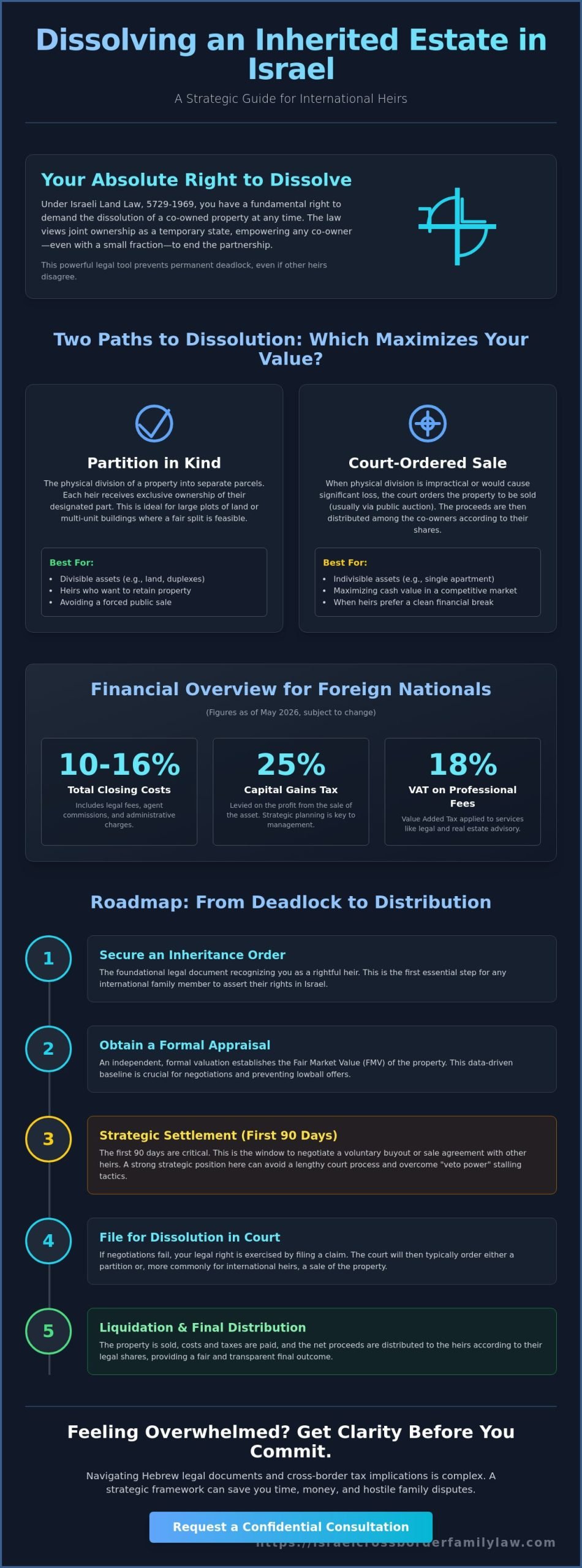
This guide provides a clear, strategy-based framework to help you navigate these complexities and move toward a fair distribution of inheritance. We’ll explore the practical paths to liquidating assets, from partition in kind to court-ordered sales, while managing the 10% to 16% total closing costs typical for foreign nationals as of May 2026. You’ll learn how to address the 25% capital gains tax and the 18% VAT on professional fees. For visual guidance on these procedures, please visit our YouTube channel at https://www.youtube.com/@IsraelFamilyLaw. Get clarity before you commit. Request a confidential consultation.
Key Takeaways
- Learn how to dissolve estate in israel by exercising your absolute legal right under the Israel Land Law, 5729-1969, even if other co-owners oppose the move.
- Understand the critical differences between physical partition and a court-ordered sale to determine which method maximizes the value of your inherited assets.
- Discover the essential administrative steps for international heirs, including securing a local Inheritance Order and a formal appraisal to establish fair market value.
- Identify why the first 90 days are vital for a strategic settlement and how to navigate “veto power” tactics used by other parties to stall distribution.
- Gain a clear roadmap to move from legal deadlock to a final liquidation of property, ensuring a fair and transparent outcome for all family members.
Understanding Estate Dissolution in Israel
This article is published on an independent advisory platform and does not imply an attorney-client relationship. Legal services are only provided by licensed attorneys under a separate engagement.
In the Israeli legal context, dissolution refers to the formal termination of joint ownership, known in Hebrew as shutafut. This process applies when multiple parties hold rights to inherited assets or marital property. Understanding how to dissolve estate in israel requires a shift in perspective, especially for families accustomed to common law systems. Under the framework of Israeli land and property laws, co-owners typically hold what is called an “undivided interest.” This means you don’t own a specific bedroom or a designated floor; rather, you own a mathematical percentage of every grain of sand and every brick within the property.
An estate in IL is not limited to real estate. It encompasses bank accounts, securities, and personal property. If you don’t seek clarity early in the process, you risk falling into an emotional deadlock. This often leads to hostile court battles that can last for years. Strategic planning helps you avoid these pitfalls and ensures that assets are distributed fairly among all heirs or parties involved.
To better understand how these principles apply in practice, watch this helpful video regarding property division:
Common Scenarios for Dissolving an Estate
Involuntary partnerships are the most frequent trigger for dissolution. This often happens during inheritance, where siblings or cousins suddenly find themselves co-managing a property they didn’t choose to own together. Another common scenario involves divorce and separation, where the liquidation of a family home or investment portfolio becomes a legal necessity. In some cases, municipal land reapportionment can also force multiple owners into a single plot, requiring a formal partition to separate their interests.
The Role of International Advisory
International families often struggle with the Hebrew-centric nature of the Israeli legal system. Documents, court protocols, and tax filings are primarily managed in Hebrew, creating a significant barrier for those living abroad. A “team on the ground” in cities like Tel Aviv or Jerusalem is essential to manage local logistics and provide a bridge between different legal cultures. Early decisions carry weight. For instance, the way you structure a property sale can trigger a 25% capital gains tax or a 50% betterment levy if municipal zoning has changed. Engaging with a strategic framework early allows you to make informed choices based on risk management rather than impulse. Get clarity before you commit. Request a confidential consultation.
The Legal Framework: Land Law and Inheritance in IL
The primary statute governing property rights and their termination is Israel’s Land Law, 1969. This legislation establishes a powerful principle known as the “Right to Dissolve.” Essentially, the law views joint ownership as a temporary state. It grants every co-owner a vested legal right to demand the end of a partnership at any time. If you own even a small fraction of a property, the court generally won’t force you to remain tied to other owners against your will. This right serves as the foundation for anyone learning how to dissolve estate in israel when negotiations with other heirs have reached an impasse.
While the right to dissolve is broad, it isn’t entirely absolute. It intersects closely with the Inheritance Law, 5729-1965, particularly for families living outside of Israel. The court also applies the principle of “good faith.” You cannot initiate a dissolution solely to harass or cause financial ruin to other co-owners. The legal system seeks a balance between your right to liquidate your share and the fair treatment of the other partners. Understanding these statutory boundaries is essential before filing any formal claims in the Magistrate’s Court.
The “Undivided Interest” Challenge
Israeli property ownership is typically recorded as an undivided interest, or mosh’a. You don’t own a specific corner of a lot; you own a percentage of the entire entity. This differs significantly from owning shares in a company. In a business, you might sell your stake without affecting the daily operations. In Israeli real estate, your “shares” are physically bound to the asset. You cannot simply sell “your half” of an apartment to a stranger without the cooperation of the other owners. This abstract structure is exactly what leads to management deadlocks, as every major decision requires a level of consensus that international families often find difficult to achieve across different time zones and cultures.
Cross-Border Jurisdiction Issues
For international families, the most common hurdle is the interaction between foreign estate plans and Israeli requirements. A US-based will or trust does not automatically grant you the power to sell property in Tel Aviv or Haifa. You must first bridge the jurisdictional gap by obtaining an Israeli Inheritance Order or a Probate Order. This process verifies your legal standing under local law before the dissolution can proceed. For a deeper look at how these regulations apply specifically to those living abroad, you may find our guide on Inheritance Law in Israel for US Residents helpful. Get clarity before you commit. Request a confidential consultation to understand your specific risks.
Methods of Dissolution: Physical Partition vs. Sale
Once you’ve established your legal right to end the co-ownership, the court must determine the most equitable method for how to dissolve estate in israel. The law prioritizes physical partition over a sale, but this is only possible if the land can be legally subdivided according to local zoning laws. In many urban settings, physical division is technically impossible or would significantly reduce the property’s total value. When physical partition isn’t feasible, the court orders a sale and distributes the proceeds. The following table compares these two primary paths:
| Feature | Physical Partition (Haluka be-eyn) | Sale (Mechira) |
|---|---|---|
| Primary Use | Large land plots or agricultural land | Apartments, small homes, urban assets |
| Legal Requirement | Must meet minimum subdivision zoning | Standard default for inseparable units |
| Timeline | Extended (requires planning approval) | Predictable market-driven timeframe |
| Financial Outcome | Ownership of a specific parcel | Cash proceeds based on share percentage |
In cases where physical partition is possible but creates an unequal distribution of value, the court may order “Balancing Payments” (tashlumei izun). This mechanism ensures that the party receiving a more valuable portion of the land compensates the other owners in cash. It’s a strategic tool used to achieve fairness without forcing a total liquidation of the asset.
When is Physical Partition Possible?
The Land Registry, or “Tabu,” and local planning authorities dictate whether a property can be physically divided. For most international families owning apartments in Tel Aviv or Jerusalem, physical partition is rarely an option. Israeli building codes usually prevent an apartment from being split into two separate legal entities. Subdivision proceedings for larger plots are often expensive and can take several years to finalize. Because of these hurdles, most families find that a sale is the only practical way to resolve how to dissolve estate in israel efficiently.
The Reality of Public Auctions
If the parties cannot agree on a private sale, the court will appoint a receiver (usually a lawyer) to manage a public auction. This process involves a court-supervised bidding system. While it ensures transparency, a public auction can sometimes result in a lower sale price than a traditional market listing. There’s also the added cost of the receiver’s fees, which are typically deducted from the proceeds. Reaching a private agreement before court intervention is almost always the more cost-effective strategy. This is particularly relevant in cases of divorce and separation for international families, where preserving the asset’s value is a top priority. Get clarity before you commit. Request a confidential consultation.
The Step-by-Step Process for International Heirs
This article is published on an independent advisory platform and does not imply an attorney-client relationship. Legal services are only provided by licensed attorneys under a separate engagement.
Executing a strategy for how to dissolve estate in israel requires a precise sequence of administrative and legal actions. For international families, these steps must be coordinated across borders to ensure that local Israeli requirements are met without the need for constant travel. The process generally follows this five-step framework:
- Obtain an Israeli Inheritance Order: Before you can partition or sell property, the Land Registry must recognize you as a legal heir. This involves a formal application to the Inheritance Registrar to verify the will or apply the laws of intestacy.
- Conduct a Formal Appraisal (Shama’ut): You’ll need a certified Israeli appraiser to determine the “fair market value” of the assets. This ₪2,500 to ₪5,000 investment provides a neutral baseline for negotiations or court proceedings.
- Attempt a Negotiated Dissolution: Reaching a private agreement is the most cost-effective path. It allows heirs to sell the property on the open market or buy out each other’s shares without the high costs of a court-appointed receiver.
- File a Statement of Claim for Dissolution: If negotiations fail, you must file a claim in the Magistrate Court. As of January 2026, the court fee for non-monetary claims is ₪2,012, or 2.5% of the value for monetary claims.
- Execution and Distribution: The court orders the sale or partition. Once the asset is liquidated, the proceeds are distributed among the heirs after settling taxes and professional fees.
Managing the Process from Abroad
You don’t need to be physically present in Tel Aviv to manage these proceedings. Most international heirs use a specific Power of Attorney (PoA) that has been signed at an Israeli consulate or authenticated via an apostille. This document allows your local representative to handle Hebrew communications and court appearances on your behalf. You can learn more about how we coordinate these moving parts by reviewing How It Works. This remote management ensures that your interests are protected while you remain in your home country.
Costs and Hidden Fees to Consider
Transparency regarding the financial impact of dissolution is essential for risk-based decision-making. If the court appoints a receiver to manage the sale, their commission typically ranges from 4% to 10% of the total sale price. This is in addition to the standard 2% real estate agent commission and the 0.5% to 1.5% legal fees. The most significant impact often comes from Capital Gains Tax (Mas Shevach), which is currently 25% of the real profit. You can find more details on how these costs are structured by visiting our Pricing page. Get clarity before you commit. Request a confidential case review to map out your potential expenses.
Strategic Decision-Making: Avoiding the Deadlock
The first 90 days after a conflict surfaces are critical for a successful resolution. This window represents a prime opportunity for an “Early Settlement” before positions harden and legal costs escalate. When families understand how to dissolve estate in israel through a strategic, negotiated framework, they often avoid the heavy administrative burden of the court system. Delaying the process frequently allows a single co-owner to exercise a perceived “Veto Power.” While the law eventually overrides such stalls, a reluctant partner can effectively freeze assets for months, leading to property deterioration and significant missed market opportunities.
Determining how to dissolve estate in israel requires a balance of legal knowledge and family diplomacy. You must adopt a risk-based approach by weighing potential legal fees against the final sale price. If a court-appointed receiver manages the sale, their commission typically ranges from 4% to 10% of the property’s value. When you include the standard 2% agent fee and the 18% VAT on all professional services, the “cost of conflict” can easily consume a large portion of your inheritance. Viewing the dissolution as a business transaction helps preserve the estate’s value. For further guidance on these strategic choices, you can explore the educational resources available on our YouTube channel, IsraelFamilyLaw.
The Emotional vs. Financial Balance
Family dynamics frequently complicate the dissolution process. This is especially true when one sibling feels a deep sentimental connection to an “ancestral home” while others prefer liquidation. These emotional stakes often lead to high-conflict litigation that drains the estate’s liquidity through court fees and appraisal costs. Mediation serves as a vital tool in these instances. It provides a structured environment where parties can discuss buy-out options or private payment plans without the rigid constraints of a Magistrate Court ruling. Protecting your interests doesn’t require an aggressive stance; it requires a clear-eyed understanding of the financial risks involved.
Your Next Steps
Dissolving an estate across borders is a sophisticated exercise in risk management. The significant differences between international expectations and Israeli Land Law create a complex environment for those without a “team on the ground.” Early clarity is your most effective protection against the administrative hurdles and tax liabilities that often surprise foreign heirs. Professional guidance ensures you make decisions based on strategy rather than impulse.
Please be advised that the information provided in this article is for educational and advisory purposes only. It does not constitute legal representation or legal advice. Legal services are exclusively provided by licensed attorneys under a separate engagement. Get clarity before you commit. Request a confidential consultation to evaluate your specific situation and strategy.
Secure Your Family’s Financial Future in Israel
Mastering how to dissolve estate in israel depends on your ability to bridge the gap between foreign expectations and local statutory requirements. You now understand that the Israel Land Law of 1969 protects your right to exit a partnership. You also recognize that avoiding court-appointed receivership fees, which can reach 10% of the sale price as of May 2026, requires proactive negotiation and strategic timing. Early clarity helps you manage the 25% capital gains tax and 18% VAT on professional services without the stress of a long court battle.
Our team on the ground in Tel Aviv provides the authoritative expertise needed to manage these cross-border complexities in plain English. We focus on risk-based decision-making to help you navigate the Israeli legal system from abroad. It’s possible to achieve a fair distribution and protect your interests through a clear, strategy-based framework. Get clarity before you commit. Request a confidential consultation. By taking these steps today, you ensure a smoother transition and a more secure outcome for your entire family.
Frequently Asked Questions
Can one co-owner force the sale of a property in Israel if the others object?
Yes, any co-owner has a fundamental legal right to demand the dissolution of a partnership under the Land Law of 1969. The court generally prioritizes your right to exit the joint ownership over the objections of other heirs. While the process must be conducted in good faith, it’s very difficult for other owners to block a sale indefinitely. This principle is a cornerstone of how to dissolve estate in israel when family negotiations have stalled.
How long does the legal process of dissolving an estate in Israel typically take?
The timeline depends on the level of cooperation between the parties and the complexity of the assets. A negotiated dissolution can often be completed in 4 to 8 months. However, if the case proceeds to a contested hearing in the Magistrate’s Court, the timeline typically extends to 12 or 24 months. Factors such as obtaining a formal Inheritance Order or waiting for municipal tax clearances can also impact the final duration of the case.
Do I need to be physically present in Israel to dissolve an inherited estate?
You don’t need to be physically present in Israel to manage the dissolution of an estate. Most international families use a specific Power of Attorney signed at an Israeli consulate or authenticated via an apostille. This document allows a local representative in Tel Aviv to handle all Hebrew communications, court appearances, and property management tasks. This remote framework is designed to help international heirs protect their interests without the burden of frequent travel.
What happens if the co-owners cannot agree on a listing price for the property?
If the co-owners cannot reach a consensus on the price, the court will appoint an independent appraiser to determine the fair market value. This professional valuation serves as the legal baseline for any subsequent sale or buy-out. If a private agreement still isn’t reached, the property is typically sold through a court-supervised public auction. Reaching a settlement based on a neutral appraisal is usually the most efficient way to resolve how to dissolve estate in israel.
Are there specific taxes for US citizens when liquidating an Israeli estate?
US citizens are subject to taxation on their worldwide income, which includes the proceeds from liquidating an Israeli estate. While Israel does not currently levy an inheritance tax, a 25% capital gains tax applies to the real profit at the time of sale. You may be eligible for a foreign tax credit on your US tax return to mitigate double taxation. It is essential to coordinate with cross-border experts to manage these multi-jurisdictional tax obligations effectively.
What is a “Receiver” in an Israeli property dissolution case, and who pays them?
A Receiver is a court-appointed officer, typically an attorney, who is tasked with managing the sale of the property to ensure a fair process. Their responsibilities include marketing the asset and conducting the bidding process. The Receiver’s commission, which the court usually sets between 4% and 10% of the sale price, is deducted from the estate’s total proceeds. This means all co-owners share the cost of the receivership proportionally based on their ownership percentage.
Can a prenuptial agreement from the US affect estate dissolution in Israel?
A US prenuptial agreement is not automatically binding in Israel and often requires a formal validation process to be recognized by local courts. Israeli judges evaluate such agreements against the standards of the Spousal Property Relations Law, 1973. If the document was not properly approved by a court or a notary, its terms might be challenged during a dissolution proceeding. Understanding these jurisdictional differences is vital for international families seeking to protect their assets.

Article by
Gabriel Lior
A Personal Journey That Became a Mission
The advisory was founded by an American father Gabriel Lior, LLB, MBA , global entrepreneur, and cross-border advisor who spent more than a decade navigating the Israeli family court system firsthand and now lives in Singapore with his son.
As a divorced parent in a cross-border family, Gabriel faced nearly every legal challenge a foreign parent can encounter in Israel — including child custody disputes, child support proceedings, property matters in Israel and abroad, false accusations, and complex immigration and relocation proceedings.
Over the years, he learned the hard way how difficult it is for non-Israeli parents to understand the system, identify the right legal strategy, and choose the right legal representation — especially when language, culture, and jurisdictional differences are involved. He also witnessed how foreign parents and new immigrants are often disadvantaged or taken advantage of by service providers and institutions simply because they lack local knowledge or fluency.
From Client to Advisor
To truly understand — and survive — the system, Gabriel pursued formal legal education in Israel, completing two Israeli law degrees, alongside a BA and MBA earned in the United States. This was never about becoming a practicing attorney, but about gaining a deep, structural understanding of how the system works — and where it breaks down for foreign parents.
This rare combination of:
Firsthand client experience
Israeli legal and US business education
International business and negotiation training
Decades of commercial execution
created a unique perspective – one that understands both sides of the table.
After years of litigation, persistence, and at times self-representation, he ultimately succeeded in securing custody of his son and relocating abroad through a rare legal victory in the Israeli Supreme Court — becoming one of the first fathers in Israel to do so under these circumstances.
Disclaimer
Important Disclaimer:
The information provided on this website and in its content is for general informational and educational purposes only and does not constitute legal advice, legal opinion, or legal representation.
Gabriel Lior is not licensed to practice law in Israel (nor is he interested in doing so) and does not provide legal services, despite having completed 2 Law Degrees. The services offered are advisory in nature and are intended to provide general guidance, strategic insight, and information regarding cross-border family law considerations.
No attorney-client relationship is formed by accessing this website, reading its content, or communicating with us.
Any decisions made based on this information are at your own discretion and risk. For legal advice specific to your situation, you should consult a licensed attorney in the relevant jurisdiction.
Where appropriate, we may refer clients to independent, licensed attorneys or professionals. Such referrals do not constitute legal representation and no liability is assumed for services provided by third parties.