This article is published on an independent advisory platform and does not constitute a law firm or an attorney-client relationship. Legal services are only provided by licensed attorneys under a separate engagement.
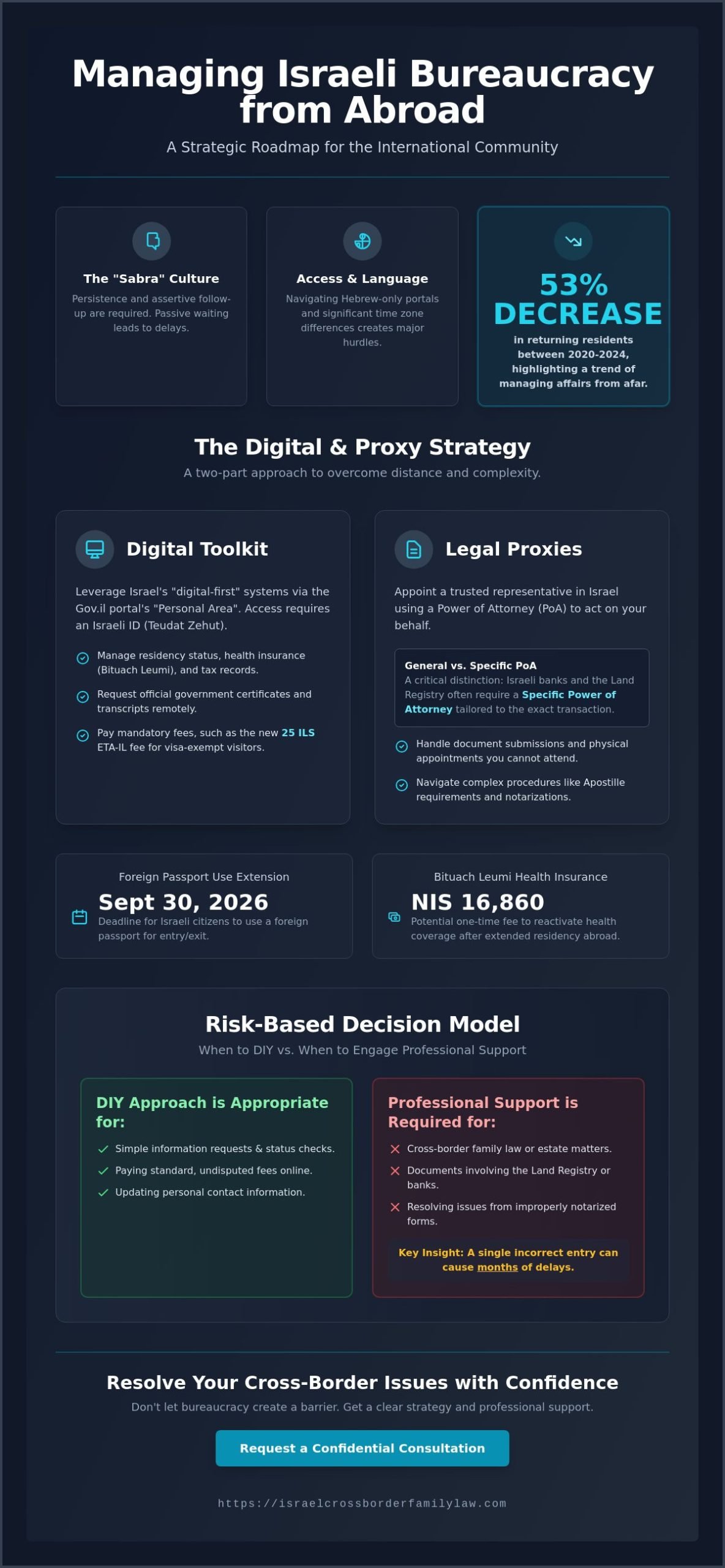
You don’t need a plane ticket to Tel Aviv to settle your affairs with the Ministry of Interior or Bituach Leumi. While the 53% decrease in returning residents between 2020 and 2024 suggests many are staying away, managing your legal obligations doesn’t have to stop at the border. Dealing with israeli bureaucracy from abroad has evolved into a strategic exercise in remote management. We understand that facing Hebrew-only portals and navigating time zone differences can feel like a major barrier when you’re trying to secure a document or update your status.
This article provides a clear roadmap for managing administrative tasks without immediate travel. You’ll learn how to utilize a Digital and Proxy strategy to handle everything from Apostille requirements to the new 25 ILS ETA-IL fee. We will examine the specific roles of consulates versus local agents and explain how to manage the NIS 16,860 health insurance waiver fee. We also cover the extension allowing foreign passport use through September 30, 2026. By the end, you’ll have a strategy to resolve complex cross-border issues with confidence and clarity.
Key Takeaways
- Understand how to navigate the unique “Sabra” administrative culture and why persistence is a strategic necessity when managing Israeli systems from a distance.
- Identify the specific digital tools and authentication steps required to access the Gov.il “Personal Area” and manage government services without a physical presence in the country.
- Learn the critical differences between general and specific Powers of Attorney to ensure your legal documents are recognized by Israeli banks and the Land Registry.
- Establish a clear roadmap for dealing with Israeli bureaucracy from abroad, including the remote registration of life events and requests for official government certificates.
- Apply a risk-based decision model to determine when a DIY approach is appropriate and when the complexity of cross-border situations requires professional, bicultural support.
This article is published on an independent advisory platform and does not imply an attorney-client relationship. Legal services are only provided by licensed attorneys under a separate engagement.
Understanding the Landscape of Israeli Bureaucracy from a Distance
Succeeding in your administrative goals requires more than just filling out forms; it requires an understanding of the “Sabra” administrative culture. In the Israeli system, directness and persistence are not just personality traits but functional requirements. Unlike Western systems that often prioritize a “first-come, first-served” queue, the Israeli system often responds best to proactive follow-up. When you are dealing with israeli bureaucracy from abroad, you cannot rely on passive waiting. The historical inefficiencies in Israeli public administration have led to a culture where clear, assertive communication is often the only way to move a file from the bottom of a stack to the top.
Every decision you make in the early stages of a cross-border matter carries significant weight. A single incorrect entry on a Ministry of Interior form or an improperly notarized document doesn’t just cause a minor hiccup. It often results in months of delays as files are bounced between departments. This complexity is magnified in family law or estate matters where assets and heirs are located in different jurisdictions. You must treat every administrative step as a strategic move that affects your long-term legal standing in Israel.
To better understand this concept, watch this helpful video:
The Reality of Remote Processing in IL
By 2026, the Ministry of Interior (Misrad HaPnim) has adopted a “digital-first” standard for many of its services. While this is an improvement, the Israeli Consulate remains your primary physical link to the state for tasks requiring biometric verification or original signatures. It’s vital to manage your expectations. Remote processing is more convenient than flying to Israel, but it isn’t always instant. Processing times for documents like birth certificates or marital status updates can vary significantly depending on the current workload of the specific government branch involved.
Common Pitfalls for the International Community
A frequent mistake is assuming that US or European legal standards apply to Israeli bureaucratic processes. This is rarely the case. In all government dealings, “IL” refers strictly to the State of Israel, and the rules governing its residents abroad are specific and often rigid. Many expats fall into the “wait and see” trap, especially with time-sensitive estate or family documents. Because the Israeli system operates on its own calendar and cultural logic, delaying a request for a document or a status update can lead to the loss of specific rights or the imposition of avoidable fees. Get clarity before you commit. Request a confidential consultation.
This article is published on an independent advisory platform and does not imply an attorney-client relationship. Legal services are only provided by licensed attorneys under a separate engagement.
Your Digital Toolkit: Accessing Israeli Government Services Remotely
The Israeli government’s digital transformation has accelerated, making the Gov.il portal the primary gateway for administrative tasks. For citizens with a Teudat Zehut, the “Personal Area” provides a sophisticated hub for managing residency, health insurance, and tax records remotely. This portal allows you to update your address, request official transcripts, and even pay certain fees like the mandatory 25 ILS ETA-IL application fee. If you do not possess an Israeli ID number, your access is more restricted. However, you can still access public information and download specific forms required for status changes. The transition toward paperless filing in Israeli courts and ministries now allows for digital signatures on many documents. This shift significantly streamlines dealing with israeli bureaucracy from abroad by reducing the reliance on physical mail and international couriers. To visualize these complex administrative steps, you can explore the IsraelFamilyLaw YouTube channel, which offers detailed guides on cross-border family and estate matters.
Navigating the Consular System
While digital tools are expanding, the Ministry of Foreign Affairs Consular Services remain the essential physical link for the international community. Scheduling appointments at regional consulates, such as New York or Los Angeles, is necessary for high-stakes tasks like notary services, passport renewals, and registering life events. For example, if you are an Israeli parent living abroad, you must register a child born outside of Israel within 30 days. Understanding how our advisory works can help clarify the remote process and bridge the gap between digital portals and consular visits. This collaborative approach ensures that your paperwork meets the exact standards required by the consulate before you arrive for your appointment.
The Apostille Requirement Explained
An Apostille is a specialized certificate that authenticates the origin of a public document, such as a birth certificate or a power of attorney, for use in another country. Under the Hague Convention, this is mandatory for US documents to be legally recognized in Israel. The “Chain of Authentication” typically follows a strict path: it moves from a local notary to the Secretary of State and finally to the relevant Israeli ministry. Common mistakes that lead to rejection include using expired notary stamps, failing to include a professional Hebrew translation, or missing a signature on a multi-page document. Clerks in Israel are often very specific about the format of these certificates. Ensuring these details are correct early on prevents the need for costly document re-issuance and avoids months of administrative delays. Get clarity before you commit. You can request a confidential consultation to review your specific document requirements.
This article is published on an independent advisory platform and does not imply an attorney-client relationship. Legal services are only provided by licensed attorneys under a separate engagement.
The Role of Legal Proxies: Using a Power of Attorney Effectively
When digital tools reach their limit, a legal proxy becomes your most powerful asset for managing affairs in Israel. A Power of Attorney (PoA) is a legal instrument that grants a trusted individual or professional the authority to act in your name. This is often the only viable path for finalize high-stakes transactions without boarding a flight. You must distinguish between a General PoA, which provides broad authority over your affairs, and a Specific PoA, which limits actions to a single task like closing a bank account or requesting a specific document from the Population Authority. For many, this is the gold standard for dealing with israeli bureaucracy from abroad because it bridges the gap between remote intent and local action.
A common mistake for the international community is assuming a US-formatted “Durable Power of Attorney” will be accepted by Israeli institutions. Israeli banks and the Land Registry (Tabu) are notoriously rigid regarding document formats. They typically require a PoA drafted in Hebrew or a bilingual format that adheres to specific Israeli legal standards. To ensure your document is recognized, you generally must sign it in the presence of an Israeli consul. The Official Consular Services for Israelis Abroad provides the necessary framework for these notarizations. This process verifies your identity and ensures the document meets the requirements of the receiving ministry in Israel. You can find more guidance for expats and foreign nationals to help determine which PoA type fits your specific administrative needs.
Appointing a Representative in Israel
The primary benefit of a legal proxy is having a “team on the ground” that can physically visit government offices. In 2026, despite increased digitization, certain complex files still require a face-to-face explanation with a clerk. A local representative can bypass the “digital divide” that often frustrates those who don’t have full Hebrew fluency. It’s vital to maintain control by setting clear expiration dates or specific limits on your proxy’s authority. This strategic approach ensures your security while allowing your representative to navigate the system effectively on your behalf.
Special Considerations for Family and Estates
In matters of inheritance or probate, a PoA is essential for managing files that involve multiple heirs across different time zones. A proxy can submit applications to the Inheritance Registrar and handle the distribution of assets according to a will or Israeli law. This is particularly relevant for sensitive issues like child support and cross-border enforcement, where local representation is often mandatory. Always seek clarity before signing broad legal authorizations. Understanding the scope of what you are signing prevents future disputes and ensures your representative can act decisively when time-sensitive decisions are required. Get clarity before you commit. Request a confidential consultation.
This article is published on an independent advisory platform and does not imply an attorney-client relationship. Legal services are only provided by licensed attorneys under a separate engagement.
Step-by-Step: Managing Common Bureaucratic Tasks Remotely
Successfully dealing with israeli bureaucracy from abroad requires a transition from understanding general strategy to executing specific administrative workflows. By 2026, the Population Authority (Misrad HaPnim) has standardized many of its remote document requests, yet the burden remains on the applicant to provide authenticated evidence for every status change. Whether you are requesting birth, marriage, or death certificates, you must ensure that your application includes the necessary Apostille certifications discussed in previous sections. These documents are essential for maintaining your legal standing and ensuring that your records in Israel match your current life circumstances in the US or elsewhere.
Updating your marital status or registering a child born abroad to an Israeli parent is a time-sensitive task. Under Israeli law, these life events must be reported to the nearest consulate within 30 days. This process involves submitting original documents, such as a local birth certificate or marriage license, which have been properly authenticated. For international families, these early administrative decisions prevent future complications regarding citizenship and residency rights. Managing these tasks remotely allows you to maintain a “seamless Israeli/U.S. professional home” without the logistical burden of immediate travel.
Managing real estate interests and inheritance matters also demands a methodical approach. You can check the Land Registry (Tabu) remotely to verify ownership records or identify any liens on a property. For those managing inherited assets, filing a Succession Order (Tsav Yerusha) from outside Israel involves coordinating with the Inheritance Registrar. This process requires a specific set of documents, including the original death certificate and a valid Power of Attorney for your representative in Israel. Ensuring these steps are handled correctly is vital for the smooth transfer of assets across borders.
Document Procurement and Verification
- Step 1: Identify the specific ministry responsible for your request, such as the Population Authority for personal status or the Inheritance Registrar for estate matters.
- Step 2: Determine if a digital application is available through the Gov.il portal or if a formal consular visit is required for biometric verification.
- Step 3: Arrange for certified Hebrew translations if the document is intended for use within Israeli government offices, as English documents are not always accepted.
Financial and Property Management
Dealing with Israeli banks from abroad remains one of the most complex challenges due to strict anti-money laundering (AML) and “Know Your Customer” (KYC) regulations. Remote access to bank accounts is often heavily restricted, requiring a specific Power of Attorney or a physical presence for high-value transactions. However, you can manage many government fees and property taxes (Arnona) via the online ‘Shoham’ system. This digital platform allows for secure payments, helping you avoid penalties for late filings. For those with more complex corporate or investment needs, understanding the regulatory landscape is essential. To ensure your property and financial interests are protected, you should request a confidential consultation to review your specific administrative requirements.
This article is published on an independent advisory platform and does not imply an attorney-client relationship. Legal services are only provided by licensed attorneys under a separate engagement.
Strategic Planning and Knowing When to Engage Professional Support
Success in dealing with israeli bureaucracy from abroad isn’t just about finishing a checklist. It’s about knowing when a task is a simple administrative step and when it’s a legal minefield. We suggest a risk-based decision model to guide this choice. For instance, requesting a standard birth certificate via the MyGov portal is generally a safe “do-it-yourself” task. However, matters involving the registration of a divorce or the filing of a succession order carry high risks. One incorrect statement on a government form can “lock” your legal status, leading to complications that take years to unravel. You must prioritize strategy before execution to ensure your long-term interests remain protected.
Identifying “red flags” early on is critical. If you’re facing a Hebrew-only portal, conflicting instructions from different ministries, or a situation where US and Israeli laws overlap, you likely need a bicultural and bilingual professional. These experts understand the “unwritten rules” of the system. They act as a bridge between the “start-up nation” and your local jurisdiction. Bureaucracy in Israel is a strategy game. It requires patience, directness, and a deep understanding of how different government entities interact with one another. It’s not just a series of forms; it’s a multi-jurisdictional puzzle that requires a steady hand.
Building Your Remote Strategy
Effective planning requires a realistic timeline. In Israel, administrative processes often take longer than expected due to specific holiday cycles or staffing levels at the Ministry of Interior. You should also budget for mandatory costs. This includes the 25 ILS fee for the ETA-IL application or the NIS 16,860 fee for returning residents to waive the health insurance waiting period. Factor in costs for Apostilles and professional representation to avoid surprises. You can start by requesting a confidential case review to map out your specific requirements.
Next Steps for Clarity
A consultation helps you navigate the nuances that aren’t listed on official websites. When vetting an international lawyer, look for those qualified to practice in both jurisdictions. They should possess a “team on the ground” in Israel to handle physical filings while you remain abroad. Don’t forget that the current policy allowing Israeli citizens to enter and exit using valid foreign passports expires on September 30, 2026. Planning your administrative tasks around these hard deadlines is essential for a smooth process. Get clarity before you commit. Request a confidential consultation.
Securing Your Interests Across Borders
Managing administrative tasks from a distance requires a shift from reactive problem-solving to proactive strategy. You’ve seen that the combination of digital tools and well-drafted legal proxies provides a robust framework for maintaining your legal standing in Israel. Success in dealing with israeli bureaucracy from abroad depends on ensuring every document, from a birth certificate to a power of attorney, meets the exact standards required by the Population Authority and other ministries. By addressing these requirements early, you avoid the common pitfalls that lead to significant delays and administrative rejection.
Navigating this landscape is often easier with a partner who understands the cultural and legal nuances of both systems. Our advisory offers bicultural and bilingual expertise, supported by a dedicated team on the ground in Tel Aviv and New York. With over a decade of experience in cross-border family and estate law, we provide the authoritative guidance necessary to help you make informed, risk-based decisions. Get clarity before you commit. Request a confidential consultation today to ensure your family’s interests are professionally managed and secure.
This article is published on an independent advisory platform and does not imply an attorney-client relationship. Legal services are only provided by licensed attorneys under a separate engagement.
Frequently Asked Questions
Can I renew my Israeli passport at a consulate without traveling to Israel?
You can renew your Israeli passport at a consulate, though it requires a pre-booked appointment for biometric data collection. It’s important to remember that the current regulation allowing Israeli citizens to use foreign passports for entry remains valid until September 30, 2026. This extension provides flexibility if your Israeli travel documents are expired while you’re managing other administrative tasks remotely.
How do I get an Apostille for my US birth certificate to use it in Israel?
To get an Apostille for a US birth certificate, you must contact the Secretary of State in the specific state where the document was issued. This certification confirms the notary’s signature and is a mandatory step in the “chain of authentication” required by Israeli ministries. Without this gold seal, your US documents won’t be legally recognized when dealing with israeli bureaucracy from abroad.
Is it possible to open an Israeli bank account remotely in 2026?
Opening an Israeli bank account remotely in 2026 remains nearly impossible due to strict anti-money laundering protocols. Most major banks require a face-to-face meeting for the initial “Know Your Customer” verification. While some digital tools exist for existing customers, new accounts typically necessitate a physical trip or a highly specialized Power of Attorney signed at the consulate.
What happens if I need to sign a document for the Israeli Land Registry from abroad?
If you need to sign a document for the Land Registry (Tabu), you must do so at an Israeli consulate in the presence of a consul. The consul acts as the verifying authority, ensuring your signature is authentic and the document meets Israeli legal standards. Once signed and stamped, the original document is sent to your representative in Israel for physical submission to the registry office.
How can I check if I have an outstanding debt or ‘stay of exit’ order in Israel?
You can check for a “stay of exit” order or outstanding debts through the “Personal Area” on the Gov.il portal if you have an Israeli ID number. If you don’t have digital access, a representative with a valid Power of Attorney can query the Enforcement and Collection Authority on your behalf. This is a vital step before planning any travel to ensure you aren’t detained at the border.
Do I need a lawyer to request a succession order for an estate in Israel?
While you aren’t legally required to hire a lawyer for a succession order, cross-border estates involving foreign heirs are inherently complex. The Inheritance Registrar requires specific documentation, including verified death certificates and often an affidavit of foreign law. Errors in these filings frequently cause delays of 6 months or more, making professional guidance a strategic choice to ensure the correct distribution of assets.
Can I register a foreign divorce in the Israeli Population Registry remotely?
You can register a foreign divorce remotely by submitting an Apostilled copy of the final judgment to the Israeli consulate. This update is necessary to change your status in the Population Registry from “married” to “divorced.” Handling these matters ensures your Israeli records remain accurate, which is essential for future inheritance or personal status changes within the Israeli system.
What is the difference between an Israeli Consulate and the Ministry of Interior?
The Israeli Consulate serves as the administrative bridge between you and the state, while the Ministry of Interior is the central authority in Israel that processes your requests. The consulate collects biometric data and verifies signatures, but the final approval for status changes happens within the ministry’s departments in Israel. Knowing this distinction helps you manage expectations regarding processing times when dealing with israeli bureaucracy from abroad.

Article by
Gabriel Lior
A Personal Journey That Became a Mission
The advisory was founded by an American father Gabriel Lior, LLB, MBA , global entrepreneur, and cross-border advisor who spent more than a decade navigating the Israeli family court system firsthand and now lives in Singapore with his son.
As a divorced parent in a cross-border family, Gabriel faced nearly every legal challenge a foreign parent can encounter in Israel — including child custody disputes, child support proceedings, property matters in Israel and abroad, false accusations, and complex immigration and relocation proceedings.
Over the years, he learned the hard way how difficult it is for non-Israeli parents to understand the system, identify the right legal strategy, and choose the right legal representation — especially when language, culture, and jurisdictional differences are involved. He also witnessed how foreign parents and new immigrants are often disadvantaged or taken advantage of by service providers and institutions simply because they lack local knowledge or fluency.
From Client to Advisor
To truly understand — and survive — the system, Gabriel pursued formal legal education in Israel, completing two Israeli law degrees, alongside a BA and MBA earned in the United States. This was never about becoming a practicing attorney, but about gaining a deep, structural understanding of how the system works — and where it breaks down for foreign parents.
This rare combination of:
Firsthand client experience
Israeli legal and US business education
International business and negotiation training
Decades of commercial execution
created a unique perspective – one that understands both sides of the table.
After years of litigation, persistence, and at times self-representation, he ultimately succeeded in securing custody of his son and relocating abroad through a rare legal victory in the Israeli Supreme Court — becoming one of the first fathers in Israel to do so under these circumstances.
Disclaimer
Important Disclaimer:
The information provided on this website and in its content is for general informational and educational purposes only and does not constitute legal advice, legal opinion, or legal representation.
Gabriel Lior is not licensed to practice law in Israel (nor is he interested in doing so) and does not provide legal services, despite having completed 2 Law Degrees. The services offered are advisory in nature and are intended to provide general guidance, strategic insight, and information regarding cross-border family law considerations.
No attorney-client relationship is formed by accessing this website, reading its content, or communicating with us.
Any decisions made based on this information are at your own discretion and risk. For legal advice specific to your situation, you should consult a licensed attorney in the relevant jurisdiction.
Where appropriate, we may refer clients to independent, licensed attorneys or professionals. Such referrals do not constitute legal representation and no liability is assumed for services provided by third parties.