This article is published on an independent advisory platform and does not constitute legal representation or an attorney-client relationship.
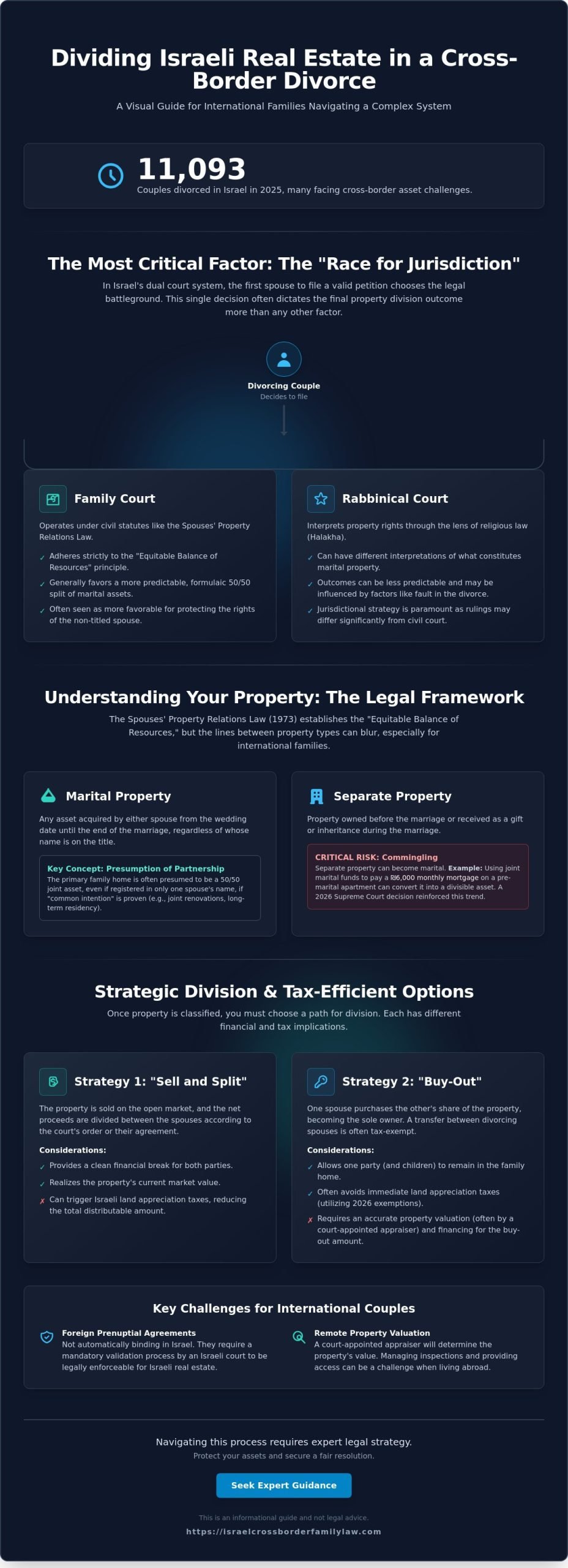
In a cross-border divorce involving assets in Tel Aviv or Jerusalem, the specific court that first gains jurisdiction often dictates the final outcome more than the length of the marriage itself. You are likely feeling the pressure of the “Race for Jurisdiction” while worrying that a home you purchased before your wedding could be at risk. These concerns are common for international families, especially considering that 11,093 couples divorced in Israel in 2025. Successfully dividing israeli real estate in divorce requires a sophisticated strategy that accounts for both Israeli statutes and your unique international status.
We understand you want a fair division of assets and a transfer process that avoids unnecessary tax burdens. This guide provides an honest look at the Spouses’ Property Relations Law of 1973 and how the dual court system impacts your rights. We will preview the 2026 tax exemptions for property transfers and the essential steps you can take to protect your separate property and reach a secure resolution.
Key Takeaways
- Understand how the Spouses’ Property Relations Law of 1973 applies the “Equitable Balance of Resources” to ensure a fair distribution of marital assets.
- Learn why the “Race for Jurisdiction” is the most critical factor when dividing israeli real estate in divorce and how choosing the right court impacts your property rights.
- Discover why foreign prenuptial agreements aren’t automatically binding in Israel and the mandatory validation process required for legal protection.
- Prepare for the practicalities of property valuation, including the role of the court-appointed appraiser and managing inspections while living outside Israel.
- Evaluate tax-efficient strategies such as “Sell and Split” versus “Buy-Out” to maximize your financial recovery while navigating Israeli land appreciation taxes.
This article is published on an independent advisory platform and does not constitute an attorney-client relationship. Legal services are only provided by licensed attorneys under a separate engagement.
The Legal Framework for Dividing Israeli Real Estate in Divorce
The primary statute governing the distribution of assets for couples married after January 1, 1974, is the Spouses’ Property Relations Law of 1973. This law establishes a regime known as “Equitable Balance of Resources” (Izun Mashabim). Under this framework, dividing israeli real estate in divorce doesn’t necessarily mean a physical split of the land; instead, it involves a financial balancing of the total value of assets accumulated during the marriage. In Israel, marital property is defined as any asset acquired by either spouse from the date of the marriage until the legal end of the partnership, regardless of which spouse’s name appears on the deed.
To better understand how these assets are evaluated and split, watch this helpful video:
Marital vs. Separate Property in Israeli Land Law
While the 1973 law presumes an equal split of marital assets, it excludes “separate property” owned prior to the wedding or received as an inheritance. However, for international families, the line between separate and joint property often blurs through a process called “commingling.” If you owned an apartment in Netanya before marrying but used joint marital funds to pay a ₪6,000 monthly mortgage, the court may rule that the property has become a joint asset. A 2026 Supreme Court decision reinforced this trend, suggesting that pre-marital real estate is no longer automatically excluded from division, especially if the couple lived in the home for a significant period. You can find more detail on these risks in our guide for divorce and separation for international families.
The Presumption of Partnership
Israeli courts frequently apply a “presumption of partnership” to the primary family residence. Even if the property is registered solely in the Tabu (Israel Land Registry) under one spouse’s name, the other spouse may claim a 50% share if they can prove a “common intention” to share the asset. Evidence of this intention includes joint renovations, long-term residency, or the absence of a valid financial agreement. Because Israel operates a dual legal system, Choosing the Right Forum: Family Court vs. Rabbinical Court is a strategic decision that influences how strictly these partnership presumptions are applied. While the Family Court adheres to civil statutes, the Rabbinical Court may interpret property rights differently under religious law, making early jurisdictional strategy essential when dividing israeli real estate in divorce.
This article is published on an independent advisory platform and does not constitute legal representation or an attorney-client relationship. Legal services are only provided by licensed attorneys under a separate engagement.
Choosing the Right Forum: Family Court vs. Rabbinical Court
The decision of where to file for divorce in Israel is not a mere formality; it is a strategic choice that fundamentally alters the outcome of dividing israeli real estate in divorce. Unlike many Western jurisdictions, Israel operates a dual court system where both the civil Family Court and the religious Rabbinical Court have concurrent authority over property matters. This creates the “Race for Jurisdiction,” a legal reality where the court that first receives a valid petition generally gains the exclusive power to decide on asset division. For an Anglo expat, the timing of this filing is the single most important factor in protecting Israeli land assets.
The “Race for Jurisdiction” and Property Filing
Filing first allows a spouse to select the forum that best suits their financial interests. If a spouse files for divorce in the Rabbinical Court (Beit Din Rabbany) and specifically “attaches” the property division to the divorce claim, that court assumes jurisdiction over the real estate. While the Ministry of Justice manages the administrative side of property registration, The Legal Framework for Dividing Israeli Real Estate is ultimately interpreted by the judges in these two distinct systems. For those living outside Israel, the race doesn’t start until the other party is legally served with the papers. International service of process can be a slow, complex hurdle that requires specific expertise to navigate correctly.
Differences in Judicial Philosophy
The Family Court (Beit Mishpat LeMishpacha) adheres strictly to civil law and the principles of equitable distribution. Its focus is on a neutral, financial balancing of resources regardless of the conduct of the spouses. In contrast, the Rabbinical Court applies Jewish law (Halacha). While it generally respects civil statutes, it may factor in the financial obligations of the Ketubah (marriage contract) or consider “fault” in ways that can complicate property rights. Properly dividing israeli real estate in divorce requires knowing which court will apply the most favorable rules to your specific asset structure, especially if you have significant pre-marital property or inheritances. This distinction remains a critical pillar of divorce for international families. Strategic planning helps you avoid the fear of losing assets to an unfavorable forum. You should get clarity on your specific jurisdictional standing before any paperwork is filed.
This article is published on an independent advisory platform and does not constitute an attorney-client relationship. Legal services are only provided by licensed attorneys under a separate engagement.
Valuation and Practical Challenges for Cross-Border Couples
Accurate valuation is the bedrock of any settlement. When dividing israeli real estate in divorce, parties often disagree on the property’s worth, especially in a volatile market like Tel Aviv or Jerusalem. A Shama’i is a licensed real estate appraiser appointed by the court to provide a neutral, binding valuation of the property’s market value. This expert report serves as the definitive financial basis for the court’s decision. Because the law governing the division of property in Israel mandates an equitable balance, getting the appraisal right is paramount to a fair outcome.
Appraising Property in the Israeli Market
Israeli appraisers calculate value differently than realtors in the United States or Europe. While foreign agents often rely on recent sales of similar homes, a Shama’i looks deep into the property’s legal and developmental potential. They evaluate building rights (Zchuyot Bniya) and the current status of TAMA 38 or Pinui Binui urban renewal projects. These factors can increase a home’s value by hundreds of thousands of shekels. For a spouse living abroad, managing these inspections remotely is a major challenge. It is vital to ensure the appraiser has full access to the property and any relevant municipal permits. This ensures that “hidden” value, such as unutilized roof rights or future zoning changes, is properly reflected in the total marital pot before any final distribution occurs.
Mortgages and Joint Title Logistics
The transition period is often complicated by the requirements of Israeli banks. Removing a spouse from a mortgage, a process known as Gira’at Ba’alim, is not automatic even with a court judgment. The bank must approve the remaining spouse’s financial capacity to carry the debt alone. If a “buy-out” is the chosen strategy for dividing israeli real estate in divorce, refinancing may be necessary to pay out the other spouse’s share. This involves updated income verification and potentially new mortgage terms. For those residing outside Israel, signing land registry documents or a Power of Attorney (Yipuy Koach) must be performed at an Israeli consulate or through an apostille process. These logistics require precise coordination between your legal team and the bank to avoid costly delays. For more information on how these logistics work for those living abroad, visit our page on services for expats and foreign nationals. Navigating these technical requirements requires a strategic approach to ensure your financial interests remain protected. You can speak with an advisor about your property valuation to understand the potential risks.
This article is published on an independent advisory platform and does not constitute an attorney-client relationship. Legal services are only provided by licensed attorneys under a separate engagement.
The Impact of Foreign Prenuptial Agreements on Israeli Land
Many international couples assume a prenuptial agreement signed in New York or London provides a universal shield for their assets. This is a dangerous misconception when dividing israeli real estate in divorce. Under the Spouses’ Property Relations Law of 1973, any financial agreement must be validated (Ishur) by an Israeli court to be legally binding. Without this validation, a judge may choose to ignore the foreign contract entirely. This often happens if the court determines the agreement doesn’t meet Israeli standards of fairness or if the parties didn’t follow the specific procedural requirements mandated by local law.
A 2026 Jerusalem Family Court ruling highlighted the inherent complexity of these situations. In that case, a couple with a valid foreign prenuptial agreement underwent a religious wedding ceremony in Israel. The court interpreted this ceremony as an implicit agreement to be subject to Israeli law, which effectively overrode their foreign contract. This decision demonstrates that even a well-drafted international contract can fail to protect your Israeli apartment if it isn’t properly domesticated and recognized by the local judiciary.
Enforceability of US Agreements in Israel
Domesticating a foreign agreement involves a formal petition to the Family Court. While specific mention of Israeli land in your US prenup is a helpful starting point, it doesn’t guarantee enforcement. The court will examine whether both parties understood the terms and entered the agreement freely. For many expats and foreign nationals, the differences between legal systems are significant. A “Foreign Law” clause might be respected, but only if it doesn’t contradict fundamental Israeli public policy regarding asset division. If your agreement was signed decades ago, it may no longer reflect your current financial reality in the “start-up nation.”
Protecting Pre-marital Assets
Even without a prenup, you can take steps to protect property owned before the marriage. Israeli courts use a doctrine called “Specific Intent to Partner” (Kavanat Shituf) to determine if a separate asset has become joint. If you use joint funds for a ₪200,000 renovation or live in the property as a family for ten years, you’re at risk of a claim. To mitigate this, many couples sign a “Financial Agreement” (Heskem Mamon) during the marriage. This document specifically carves out separate property to ensure it remains outside the marital pot. You should request a review of your foreign agreement to ensure your Israeli real estate is fully protected under current local regulations.
This article is published on an independent advisory platform and does not constitute legal representation or an attorney-client relationship. Legal services are only provided by licensed attorneys under a separate engagement.
Strategic Steps for Asset Division and Tax Planning
The final phase of dividing israeli real estate in divorce shifts from legal theory to financial execution. Once the court validates your settlement or issues a judgment, the focus turns to liquidating the asset or transferring title. This stage requires meticulous coordination between your legal advisors, the Land Registry, and tax authorities. For international families, these steps aren’t merely administrative; they’re the last line of defense against equity loss due to poor timing or tax mismanagement. To see how these strategies play out in real-world scenarios, visit the Israel Family Law YouTube channel.
Selling vs. Buying Out a Spouse
Choosing between a “Sell and Split” or a “Buy-Out” strategy depends heavily on your post-divorce liquidity needs. If you agree to a sale, you must account for transaction costs that include agent commissions, which typically range from 1.5% to 2% plus VAT. If the relationship has deteriorated to the point where a cooperative sale is impossible, the court may appoint a Kones Nechasim (Receiver). This is often a last resort because the Receiver’s fees can reach up to 4% of the property value, significantly eroding the marital pot. Conversely, a buy-out requires the staying spouse to satisfy the bank’s underwriting criteria to remove the other party from the mortgage, a process that can be difficult for non-residents without local income.
Cross-Border Tax Implications (US-Israel)
Tax planning is the most overlooked aspect of dividing israeli real estate in divorce. Under 2026 regulations, a transfer of property between spouses during a divorce is exempt from Mas Shevach (Land Appreciation Tax). This allows you to transfer a ₪4,000,000 apartment without an immediate tax bill, though the liability is deferred until the property is eventually sold to a third party. For US citizens, the complexity doubles. While the US-Israel Tax Treaty aims to prevent double taxation, you still face IRS reporting obligations under Form 8938 and FBAR. If the property has appreciated significantly, the US capital gains tax may apply even if the Israeli portion is exempt under the ₪5,600,000 single-residence ceiling. Understanding these numbers before you sign a final agreement is the only way to ensure a truly equitable outcome. Get clarity before you commit. Request a confidential consultation to review your asset division strategy.
This article is published on an independent advisory platform and does not constitute legal representation or an attorney-client relationship. Legal services are only provided by licensed attorneys under a separate engagement.
Securing Your Financial Future in the Start-Up Nation
The complexities of dividing israeli real estate in divorce often stem from the friction between two very different legal cultures. While the technical steps of valuation and title transfer are vital, the overarching strategy must account for the unique jurisdictional risks inherent in the Israeli system. Making informed choices early in the process prevents the high costs of cross-border litigation and protects your separate assets from unintentional commingling. By focusing on risk-based decision-making rather than emotional reactions, you can navigate these challenges with a sense of security and professional support.
Our platform serves as a vital bridge between the “start-up nation” and global markets. Our team of bilingual and bicultural legal experts offers a specialized focus on US-Israel family law, bringing decades of cross-border experience to every case. We provide the steady guidance needed to help you understand the long-term impact of your decisions before they become final. Get clarity before you commit. Request a confidential consultation to ensure your property interests are fully protected.
This article is published on an independent advisory platform and does not constitute legal representation or an attorney-client relationship.
Frequently Asked Questions
Is Israeli real estate always split 50/50 in a divorce?
Israeli real estate acquired during the marriage is typically split equally under the Spouses’ Property Relations Law of 1973. This default rule applies unless you have a validated financial agreement stating otherwise. Separate property, such as an inheritance or an apartment owned before the wedding, generally remains yours unless you’ve demonstrated a “specific intent to partner” through joint renovations or long-term residency.
Can I stop my spouse from selling our Israeli apartment before the divorce is final?
You can prevent a unilateral sale by requesting a temporary restraining order or a “Caution Note” (He’arat Azhara) from the court. Once filed in the Tabu (Land Registry), this note blocks any transfer of rights without your consent or a court order. This is a critical step in dividing israeli real estate in divorce to ensure assets aren’t liquidated before a final settlement is reached.
Do I have to travel to Israel to divide our property if I live in the US?
You don’t necessarily have to travel to Israel to manage the division of your property. Most legal procedures, including signing land transfer documents, can be completed at an Israeli consulate abroad or through a notary with an apostille. Israeli courts have also increased the use of digital tools in 2026, allowing for remote testimony and electronic filing in many family law matters.
How long does the property division process take in Israeli courts?
The duration of the process depends on whether you reach a settlement or proceed to litigation. A mutual agreement through mediation can be finalized in three to six months. However, a contested case in the Family Court regarding complex assets often takes 12 to 24 months to reach a final judgment. Early strategic decisions significantly impact this timeline.
What is an “Oshat” (Appraisal) and why is it mandatory?
An “Oshat” refers to the professional appraisal (Shama’ut) conducted by a court-appointed expert. This process is mandatory when spouses don’t agree on a property’s value. The appraiser provides a neutral report that accounts for building rights and market conditions, ensuring the “Equitable Balance of Resources” is based on verified data rather than estimates.
Can a US court order the sale of property located in Israel?
A US court can order a spouse to cooperate with a sale, but it lacks the jurisdiction to directly change records in the Israeli Land Registry. To be effective in Israel, a foreign judgment must undergo a formal “domestication” process in an Israeli court. This ensures the order complies with local statutes before the Tabu will recognize the transfer of ownership.
What happens to the Israeli mortgage during the divorce proceedings?
The mortgage remains a joint obligation until the debt is either paid off through a sale or one spouse is formally released by the bank. In a buy-out, the bank will perform a rigorous credit review of the remaining spouse. It’s important to coordinate with the lender early, as they aren’t bound by your divorce agreement unless they’ve provided written consent.
Is there a tax benefit to transferring the property to a spouse instead of selling it?
There is a significant tax advantage to transferring property between spouses during a divorce. Under 2026 tax regulations, such transfers are exempt from the Mas Shevach (Capital Gains Tax), effectively deferring the liability. This allows for a more efficient dividing israeli real estate in divorce by preserving equity that would otherwise be lost to immediate taxation if the property were sold to a third party.

Article by
Gabriel Lior
A Personal Journey That Became a Mission
The advisory was founded by an American father Gabriel Lior, LLB, MBA , global entrepreneur, and cross-border advisor who spent more than a decade navigating the Israeli family court system firsthand and now lives in Singapore with his son.
As a divorced parent in a cross-border family, Gabriel faced nearly every legal challenge a foreign parent can encounter in Israel — including child custody disputes, child support proceedings, property matters in Israel and abroad, false accusations, and complex immigration and relocation proceedings.
Over the years, he learned the hard way how difficult it is for non-Israeli parents to understand the system, identify the right legal strategy, and choose the right legal representation — especially when language, culture, and jurisdictional differences are involved. He also witnessed how foreign parents and new immigrants are often disadvantaged or taken advantage of by service providers and institutions simply because they lack local knowledge or fluency.
From Client to Advisor
To truly understand — and survive — the system, Gabriel pursued formal legal education in Israel, completing two Israeli law degrees, alongside a BA and MBA earned in the United States. This was never about becoming a practicing attorney, but about gaining a deep, structural understanding of how the system works — and where it breaks down for foreign parents.
This rare combination of:
Firsthand client experience
Israeli legal and US business education
International business and negotiation training
Decades of commercial execution
created a unique perspective – one that understands both sides of the table.
After years of litigation, persistence, and at times self-representation, he ultimately succeeded in securing custody of his son and relocating abroad through a rare legal victory in the Israeli Supreme Court — becoming one of the first fathers in Israel to do so under these circumstances.
Disclaimer
Important Disclaimer:
The information provided on this website and in its content is for general informational and educational purposes only and does not constitute legal advice, legal opinion, or legal representation.
Gabriel Lior is not licensed to practice law in Israel (nor is he interested in doing so) and does not provide legal services, despite having completed 2 Law Degrees. The services offered are advisory in nature and are intended to provide general guidance, strategic insight, and information regarding cross-border family law considerations.
No attorney-client relationship is formed by accessing this website, reading its content, or communicating with us.
Any decisions made based on this information are at your own discretion and risk. For legal advice specific to your situation, you should consult a licensed attorney in the relevant jurisdiction.
Where appropriate, we may refer clients to independent, licensed attorneys or professionals. Such referrals do not constitute legal representation and no liability is assumed for services provided by third parties.