This article is published on an independent advisory platform and does not constitute legal representation or legal advice. It is not a law firm and does not imply an attorney-client relationship. Legal services are only provided by licensed attorneys under a separate engagement.
What if the most significant challenge of your move isn’t the physical distance, but the hidden legal and emotional shifts that follow? With 21,900 new immigrants arriving in Israel in 2025, many parents are currently weighing the long-term effects of relocation on children. You likely feel a deep sense of guilt about disrupting your child’s friendships or worry about how the Hague Convention might complicate your family’s future. These are valid concerns for any family navigating the complex bridge between the US and the Israeli legal systems.
This guide offers an authoritative look at how to manage the developmental and psychological impact of international moves. We’ll explore age-specific risks and provide strategies to minimize transition trauma while ensuring legal clarity. You’ll gain a better understanding of how to protect your child’s emotional health through careful planning. For further guidance, please visit our video resources at https://www.youtube.com/@IsraelFamilyLaw. Get clarity before you commit. Request a confidential consultation.
Key Takeaways
- Understand the psychological difference between voluntary Aliyah and contentious relocation to identify specific stress factors for your family unit.
- Analyze how your child’s developmental stage influences the long-term effects of relocation on children, particularly during the peer-focused years of adolescence.
- Discover why legal stability is a prerequisite for emotional well-being and how unresolved litigation can hinder a child’s sense of safety in a new country.
- Learn to create a Transition Roadmap that focuses on logistical milestones and continuity of care to minimize the trauma of moving.
- Navigate the unique legal and cultural differences of the US-Israel corridor to avoid common traps involving religious courts and multi-jurisdictional rules.
This article is published on an independent advisory platform (not a law firm) and does not imply an attorney-client relationship. Legal services are only provided by licensed attorneys under a separate engagement.
Understanding the Psychological Landscape of International Relocation
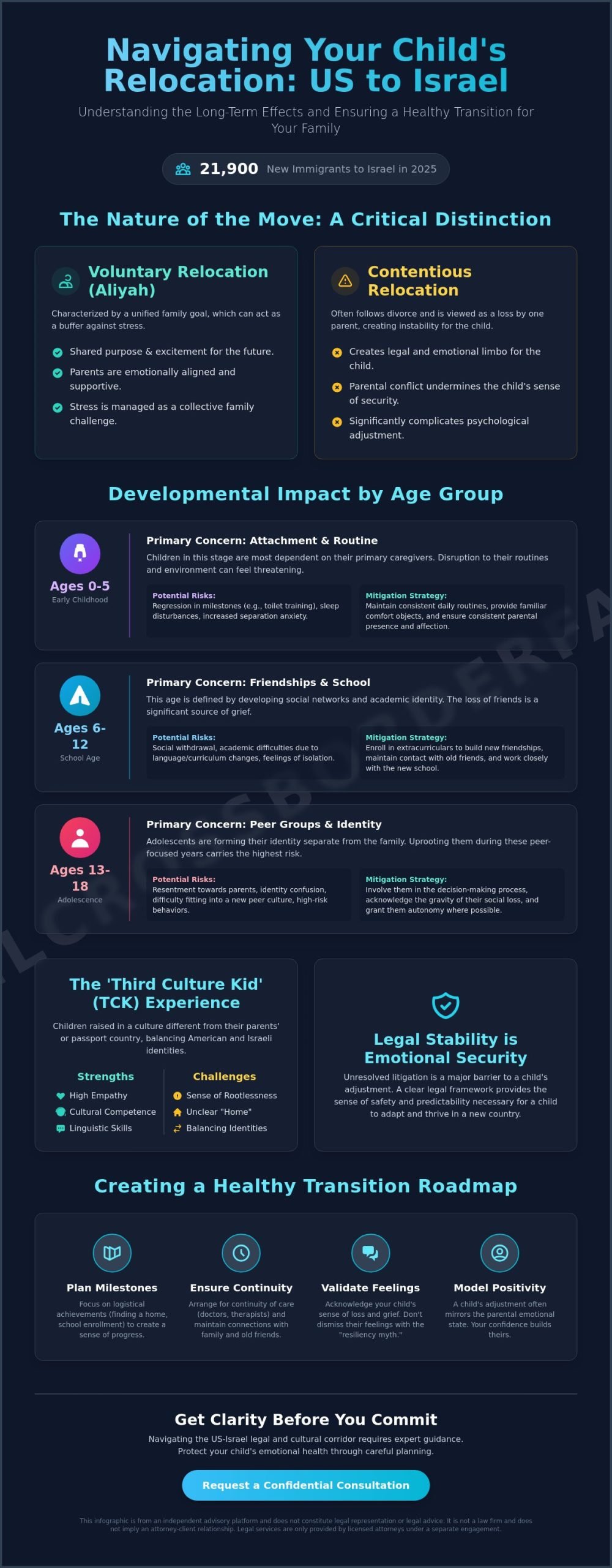
International relocation is more than a logistical hurdle; it is a macro-stressor that impacts every layer of the family unit. Unlike a domestic move, crossing borders involves a complete severance of social structures, linguistic familiarity, and legal protections. When families transition from the US to Israel, the long-term effects of relocation on children depend heavily on the nature of the move. There is a sharp distinction between voluntary moves, such as Aliyah or a career promotion, and contentious relocations following a divorce. In voluntary scenarios, a unified family goal can act as a buffer against stress. In contentious cases, the move is often viewed as a loss by one parent, creating a legal and emotional limbo that complicates the psychological effects of relocation for the child.
To better understand how these transitions impact development, watch this helpful video:
Many parents rely on the resiliency myth, believing children are naturally equipped to bounce back from major disruptions. This oversimplification often ignores the sustained effort required to process the loss of a primary social network and the long-term effects of relocation on children that can manifest years later. Relocation stress syndrome in cross-border transitions is a cluster of physiological and psychological symptoms resulting from the sudden loss of a familiar environment and the subsequent demand for rapid cultural integration.
The Concept of ‘Third Culture Kids’ (TCKs)
Children raised in a culture different from their parents’ or their passport country are often termed Third Culture Kids. These children frequently develop high levels of empathy, cross-cultural competence, and advanced linguistic skills. However, they may also struggle with a persistent sense of rootlessness. They often find it difficult to define exactly where home is as they balance American and Israeli identities. This dual identity is a hallmark of the cross-border experience, offering both unique strengths and specific emotional challenges.
Short-Term Shock vs. Long-Term Adjustment
The initial 6 to 18 months in Israel usually constitute a period of acute adjustment. While some initial culture shock is expected, parents should watch for red flag behaviors like regression in developmental milestones or prolonged social withdrawal. It’s vital to recognize that a child’s adjustment often mirrors the parental emotional state. If the parents feel secure and supported, the child is more likely to thrive. For those managing these transitions under legal pressure, understanding international custody relocation rules is a critical first step toward family stability.
This article is published on an independent advisory platform and does not constitute legal representation or legal advice. It is not a law firm and does not imply an attorney-client relationship. Legal services are only provided by licensed attorneys under a separate engagement.
Long-Term Developmental Impacts Across Different Age Groups
The age of a child at the moment of transition is perhaps the most significant predictor of their long-term adjustment. While the 21,900 immigrants who arrived in Israel in 2025 represent a diverse range of ages, each group faces distinct psychological hurdles. The long-term effects of relocation on children are often determined by whether the move disrupts a child’s primary support system. For younger children, the family remains the central pillar of security. For older children, the shift from a family-centered world to a peer-centered one makes the timing of an international move particularly sensitive.
Research into the long-term mental health of Third Culture Kids indicates that repeated moves, or hyper-mobility, can lead to attachment challenges in adulthood. When a child is uprooted multiple times, they may develop a defensive reluctance to form deep emotional bonds, fearing future loss. Preserving language proficiency in English is a critical tool for mitigating this sense of loss. It allows children to maintain a cognitive and emotional bridge to their previous life while they navigate the complexities of Hebrew immersion.
Early Childhood and School-Age Children (Ages 0-10)
For children under ten, the primary impact of relocation is the disruption of foundational security and routine. Israeli school systems often emphasize independence earlier than US systems, which can be jarring for a child accustomed to American classroom structures. To support academic performance and emotional health, parents should prioritize ‘transitional objects,’ such as familiar toys or books, and maintain strict family traditions. These small consistencies provide a sense of ‘place’ even when the external geography has changed entirely.
The Adolescent Challenge (Ages 11-18)
Adolescence is a critical window where identity formation is the primary developmental task. An international move during puberty can feel like a forced disruption of this process. Anglo-Israeli social gaps often manifest in different norms regarding independence and social hierarchies. If a move is perceived as ‘forced’ rather than a collaborative family decision, it can lead to increased rates of social withdrawal or anxiety. If you are concerned about how these dynamics might affect your family’s legal or emotional stability, you may wish to seek clarity on your specific situation before making a final commitment.
This article is published on an independent advisory platform and does not constitute legal representation or legal advice. It is not a law firm and does not imply an attorney-client relationship. Legal services are only provided by licensed attorneys under a separate engagement.
The Intersection of Legal Stability and Emotional Well-being
Legal stability serves as the silent engine of successful integration. When a family is caught in “legal limbo,” where litigation regarding residency or custody remains unresolved, children often struggle to fully commit to their new environment in Israel. This state of uncertainty is one of the most profound long-term effects of relocation on children. Without a clear legal status, a child may feel they are living out of a suitcase, even if they have physically moved into a permanent home. This psychological hesitation prevents them from forming deep bonds with peers or fully engaging in their new school system.
The impact of high-stakes legal tools, such as the Hague Convention, cannot be overstated. Since both the US and Israel are signatories to this treaty, proceedings for the “prompt return” of a child can be initiated quickly. For a child, the experience of being at the center of such a dispute creates a fundamental breach in their sense of safety. They may perceive the legal system not as a protector, but as a force that could uproot them again at any moment. Establishing a clear International Custody & Relocation strategy early in the process is essential to provide the emotional closure children need to thrive.
The Risk of Parental Alienation in Relocation Cases
Distance often acts as a catalyst for parental marginalization. When a child moves from the US to Israel, the “left-behind” parent can easily become a stranger if a proactive visitation strategy is not legally codified. The long-term psychological repercussions are significant for children who feel they must “choose” between a parent in New York and a parent in Tel Aviv. While technology allows for a “virtual” presence through video calls, it has clear limitations. It cannot replace the physical presence required for shared activities, leading to a sense of loss that persists into adulthood.
Legal Finality as a Psychological Catalyst
A clear, enforceable relocation agreement acts as the foundation for a child’s mental health. It distinguishes between a “temporary” stay and a permanent move, allowing the child to mentally “land” in their new country. Vague agreements often lead to future conflict, which restarts the cycle of stress for the child. For families navigating these waters, understanding the nuances of Divorce and Separation for International Families is critical. Finality in the legal realm grants the child permission to stop worrying about the “what ifs” and start focusing on their future in Israel. Get clarity before you commit. Request a confidential consultation.
This article is published on an independent advisory platform and does not constitute legal representation or legal advice. It is not a law firm and does not imply an attorney-client relationship. Legal services are only provided by licensed attorneys under a separate engagement.
Mitigating Risks: Strategies for a Healthy Transition
Proactive planning is the most effective way to manage the long-term effects of relocation on children. Families who successfully navigate the US-Israel corridor often treat the move as a multi-year transition rather than a single flight. Establishing a Transition Roadmap allows parents to map out emotional milestones, such as final visits with US relatives, alongside logistical ones like school registration. This structured approach provides children with a sense of predictability during an inherently unpredictable time. The success of an international move is often predicated on the left-behind parent’s active endorsement and continued emotional engagement in the child’s new life.
Prioritizing continuity of care is a critical part of this roadmap. Parents should identify English-speaking pediatricians and therapists in Israel months before the move occurs. Given that monthly family living expenses in Tel Aviv can reach ₪40,000 as of 2026, budgeting for specialized bicultural support is a necessary investment in the child’s stability. When it comes to the Transparency Principle, honesty is key but must be age-appropriate. Younger children need to know the “when” and “where” of the move to feel secure. Adolescents, however, require an understanding of the “why” to feel like respected participants in the family’s decision-making process.
Maintaining the ‘Bi-National’ Identity
Maintaining a dual identity is essential for preventing the sense of rootlessness often associated with Third Culture Kids. Parents can keep American culture alive in Israel through holiday celebrations, English-language media, and regular contact with extended family. Dual citizenship serves as a long-term psychological and legal anchor, ensuring the child feels they belong to both worlds. To better understand the legal and cultural landscape of these transitions, you can explore the resources on the Israel Family Law YouTube channel. If you need help structuring these transitions, you should consult with a professional advisor to review your specific family needs.
Co-Parenting Across Time Zones
Co-parenting between the US and Israel requires disciplined scheduling to account for the seven-hour time difference between the East Coast and Tel Aviv. Calls and video visits should be integrated into the child’s new routine so they don’t disrupt school or sleep. It’s vital to maintain a “No-Conflict Zone” where legal disagreements are kept entirely away from the child’s ears. Planning for long-term stability factors, such as “Summer in the US” or “Holidays in Israel,” helps the child look forward to maintaining their connection with the non-residential parent. These predictable periods of physical presence are the best defense against the erosion of the parent-child bond over time.
This article is published on an independent advisory platform and does not constitute legal representation or legal advice. It is not a law firm and does not imply an attorney-client relationship. Legal services are only provided by licensed attorneys under a separate engagement.
Navigating the Complexities of US-Israel Relocation
The US-Israel corridor presents a unique set of challenges that go beyond typical international moves. While the 3,500 immigrants who moved from the US to Israel in 2025 faced significant cultural shifts, they also entered a multi-layered legal environment. Israel’s system, which incorporates both civil courts and religious tribunals, creates a jurisdictional landscape that is fundamentally different from the US common law system. To safeguard against the negative long-term effects of relocation on children, families must navigate these differences with precision. Early strategic decisions, rather than emotional reactions, dictate the success of the transition and the child’s ultimate sense of security.
Clarity before commitment is the most significant gift parents can provide during a cross-border transition. The long-term effects of relocation on children are often mitigated when parents move from a place of informed strategy rather than reactive decision-making. By addressing the inherent complexity of the Israeli marketplace and legal system early, you create a buffer of stability for your family unit. This proactive stance ensures that the move is a step forward for your child’s development rather than a source of long-term trauma.
The Role of Professional Advisory
Generic legal advice often fails in cross-border scenarios because it lacks a bicultural perspective. A strategy that works in a US court may have unintended consequences when applied within the Israeli legal framework. Utilizing a Confidential Case Review allows families to assess multi-jurisdictional risks before they become crises. This advisory platform serves as a critical bridge for Expats and Foreign Nationals, providing the clarity needed to avoid common legal traps. Having a team that understands both the Israeli environment and US legal standards ensures that your family’s transition is built on a stable foundation.
Final Recommendation: Strategy Over Emotion
A “wait and see” approach to relocation is often the most developmentally risky path for a child. Uncertainty prolongs the adjustment period and can exacerbate the stress of the move, leading to sustained anxiety or social fragmentation. Establishing a professional “home” for your legal and emotional strategy is essential during this time. It transforms a period of upheaval into a managed transition with clear boundaries and expectations. Get clarity before you commit. Request a confidential consultation.
This article is published on an independent advisory platform and does not constitute legal representation or legal advice. It is not a law firm and does not imply an attorney-client relationship. Legal services are only provided by licensed attorneys under a separate engagement.
Securing Your Child’s Future in a Cross-Border World
Managing an international move requires a shift from short-term logistics to a multi-year developmental strategy. Successful transitions depend on recognizing that legal finality and emotional health are deeply linked. Families must prioritize age-specific needs to mitigate the long-term effects of relocation on children, ensuring that the move becomes a catalyst for growth rather than a source of instability. Strategy must lead. Emotion should follow.
This advisory platform provides specialized US-Israel cross-border expertise for international families and expats navigating complex legal landscapes. By focusing on risk-based decision-making, we help you build a professional home for your family’s legal strategy. The clarity you seek today is the best protection for your children’s tomorrow. You don’t have to navigate these sophisticated multi-jurisdictional challenges alone. Professional guidance ensures your family remains secure throughout the entire transition process.
Get clarity before you commit. Request a confidential consultation.
This article is published on an independent advisory platform and does not constitute legal representation or legal advice. It is not a law firm and does not imply an attorney-client relationship. Legal services are only provided by licensed attorneys under a separate engagement.
Frequently Asked Questions
Is relocation harder on younger children or teenagers?
International relocation is generally more challenging for adolescents because peer networks replace the family as their primary support system during these years. While younger children (ages 0 to 10) prioritize foundational security and routine, teenagers are in a critical window of identity formation. A move perceived as “forced” during puberty can lead to higher risks of social withdrawal. Understanding these age-specific long-term effects of relocation on children helps parents tailor their transition strategies to each child’s developmental stage.
How long does it typically take for a child to adjust to an international move?
Most children require between 6 and 18 months to fully adjust to the cultural and linguistic shifts of a move to Israel. This period involves navigating the “short-term shock” phase before reaching long-term stability in their new environment. Factors such as language proficiency and the maintenance of family traditions play a significant role in how quickly a child begins to feel “at home” in their new school and social circles.
What are the signs that my child is struggling with a cross-border move?
Red flag behaviors include regression in developmental milestones, prolonged social isolation, or a sudden drop in academic performance. Parents should also monitor for “relocation stress syndrome,” which manifests as physical symptoms like sleep disturbances or unexplained anxiety. These signs suggest the child is struggling to integrate and may require additional bicultural support or professional intervention to navigate the transition successfully. Early intervention is key to preventing these issues from becoming permanent stalls.
Can a child’s preference stop a relocation between the US and Israel?
A child’s preference is a factor in both Israeli and US courts, but it is rarely the sole determining factor in relocation cases. Courts typically weigh the child’s wishes against their age and maturity level, alongside the “best interests of the child” standard. In the US-Israel corridor, legal stability is prioritized to ensure the child does not remain in a state of jurisdictional limbo. Strategy should focus on presenting a unified plan that addresses the child’s concerns while meeting legal requirements.
How do I maintain my child’s relationship with the parent left behind in the US?
Maintaining a bond with a parent in the US requires a codified visitation schedule that includes both “virtual” presence and physical visits. Strategies like “Summer in the US” or “Holidays in Israel” provide the necessary continuity for the child’s emotional health. Technology allows for frequent communication, but it cannot replace shared physical activities. Legal agreements should explicitly define travel responsibilities and costs to prevent future conflict that could distress the child.
What happens if I move my child to Israel without the other parent’s consent?
Moving a child to Israel without the other parent’s written consent or a court order triggers significant legal risks under the Hague Convention. This treaty, which both the US and Israel follow, allows the left-behind parent to petition for the child’s prompt return. Such actions can lead to accusations of international child abduction, creating a fundamental breach in the child’s sense of safety. These situations often result in long-term legal instability that can severely impact a child’s emotional well-being.
Does moving frequently affect a child’s ability to form adult relationships?
Research indicates that hyper-mobility or repeated international moves can lead to attachment challenges in adulthood. When children are frequently uprooted, they may develop defensive mechanisms that make forming deep emotional bonds difficult later in life. Recognizing these long-term effects of relocation on children allows parents to prioritize “continuity of care” and emotional stability. Establishing a professional “home” for your legal and family strategy can buffer against these risks by providing much-needed finality.
What are the benefits of raising a ‘Third Culture Kid’ in Israel?
Raising a Third Culture Kid (TCK) in Israel fosters high levels of empathy, advanced linguistic skills, and cross-cultural competence. These children often possess a global perspective and the ability to navigate complex social environments with ease. While they may struggle with a sense of “rootlessness,” the bilingual and bicultural environment of Israel offers unique developmental advantages. These skills often translate into significant professional and personal strengths as they enter adulthood in an increasingly globalized world.

Article by
Gabriel Lior
A Personal Journey That Became a Mission
The advisory was founded by an American father Gabriel Lior, LLB, MBA , global entrepreneur, and cross-border advisor who spent more than a decade navigating the Israeli family court system firsthand and now lives in Singapore with his son.
As a divorced parent in a cross-border family, Gabriel faced nearly every legal challenge a foreign parent can encounter in Israel — including child custody disputes, child support proceedings, property matters in Israel and abroad, false accusations, and complex immigration and relocation proceedings.
Over the years, he learned the hard way how difficult it is for non-Israeli parents to understand the system, identify the right legal strategy, and choose the right legal representation — especially when language, culture, and jurisdictional differences are involved. He also witnessed how foreign parents and new immigrants are often disadvantaged or taken advantage of by service providers and institutions simply because they lack local knowledge or fluency.
From Client to Advisor
To truly understand — and survive — the system, Gabriel pursued formal legal education in Israel, completing two Israeli law degrees, alongside a BA and MBA earned in the United States. This was never about becoming a practicing attorney, but about gaining a deep, structural understanding of how the system works — and where it breaks down for foreign parents.
This rare combination of:
Firsthand client experience
Israeli legal and US business education
International business and negotiation training
Decades of commercial execution
created a unique perspective – one that understands both sides of the table.
After years of litigation, persistence, and at times self-representation, he ultimately succeeded in securing custody of his son and relocating abroad through a rare legal victory in the Israeli Supreme Court — becoming one of the first fathers in Israel to do so under these circumstances.
Disclaimer
Important Disclaimer:
The information provided on this website and in its content is for general informational and educational purposes only and does not constitute legal advice, legal opinion, or legal representation.
Gabriel Lior is not licensed to practice law in Israel (nor is he interested in doing so) and does not provide legal services, despite having completed 2 Law Degrees. The services offered are advisory in nature and are intended to provide general guidance, strategic insight, and information regarding cross-border family law considerations.
No attorney-client relationship is formed by accessing this website, reading its content, or communicating with us.
Any decisions made based on this information are at your own discretion and risk. For legal advice specific to your situation, you should consult a licensed attorney in the relevant jurisdiction.
Where appropriate, we may refer clients to independent, licensed attorneys or professionals. Such referrals do not constitute legal representation and no liability is assumed for services provided by third parties.