This article is published by Israel Cross Border Law Firm and does not constitute legal representation or an attorney-client relationship. Legal services are only provided by licensed attorneys under a separate engagement.
In 2025, 11,093 couples divorced in Israel, yet for many Anglos and expats, the path remains shrouded in technical complexity. You might feel a deep sense of unease regarding the “Race for Jurisdiction” or how a Rabbinical court might view assets you still hold in the US. It’s natural to seek stability when your family life feels uncertain and the legal system feels foreign. Understanding how to file for divorce in israel requires more than just filling out forms; it demands a strategic approach to a dual-court environment.
This guide from Israel Cross Border Law Firm provides an authoritative roadmap to help you navigate these complexities with confidence. We’ll explore the mandatory dispute resolution process, which begins with a 119 ₪ application fee, and explain the 2026 updates regarding child support jurisdiction and the division of global assets. By the end of this article, you’ll have the clarity needed to protect your financial interests and your children’s future across international borders.
Get clarity before you commit. Request a confidential consultation with Israel Cross Border Law Firm.
Key Takeaways
- Identify how the “Race for Jurisdiction” determines whether the secular Family Court or religious Rabbinical Court will govern your financial and custody arrangements.
- Navigate the mandatory “Mahut” dispute resolution process, which serves as the essential legal trigger for all matrimonial proceedings in Israel.
- Follow a structured roadmap on how to file for divorce in israel, distinguishing between the requirements for consensual and contested claims.
- Protect your parental rights and global interests by understanding the impact of “habitual residence” and the Hague Convention on cross-border custody.
- Learn why early strategic planning and the gathering of international financial documentation are critical for securing assets held across multiple jurisdictions.
This article is published on an independent advisory platform and does not constitute legal representation or an attorney-client relationship. Legal services are only provided by licensed attorneys under a separate engagement.
Understanding the Dual Court System in Israel
Israel’s legal framework for domestic relations is unique, stemming from historical roots that divide religious authority over divorce among different communities. For Jewish couples, this means your case will likely touch two distinct legal arenas: the secular Family Court and the religious Rabbinical Court. Understanding how to file for divorce in israel requires recognizing that while the Rabbinical Court has exclusive power to grant the actual divorce decree, known as the “Get,” other issues like property and custody can be heard in either court. This dual system often surprises expats who are used to a single unified family court system in their home countries.
To better understand how these laws apply when one spouse is abroad, watch this helpful video:
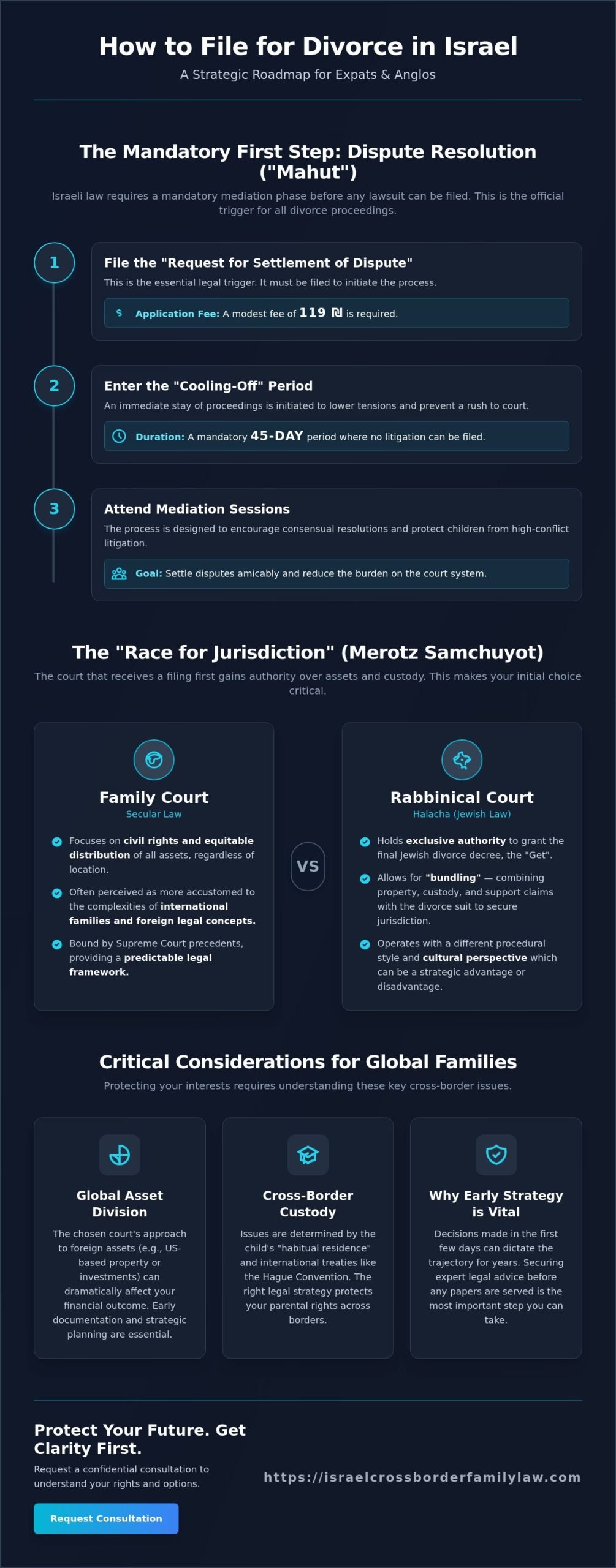
The “Race for Jurisdiction,” or Merotz Samchuyot, is perhaps the most critical concept for international families. In Israel, the court that receives a filing first generally gains the authority to decide ancillary matters like asset division or alimony. This creates a strategic environment where the timing and location of your initial filing can significantly impact the outcome of your case. It isn’t just about speed; it’s about choosing the forum that best understands the specific dynamics of your family and your assets.
Family Court vs. Rabbinical Court
The Family Court operates under secular law, focusing on civil rights and equitable distribution of property. In contrast, the Rabbinical Court applies Halacha (Jewish law). While both courts are bound by Supreme Court precedents regarding property, their procedural styles and cultural perspectives differ. A spouse might “bundle” claims for property or custody into a divorce suit at the Rabbinical Court to ensure that specific venue hears the entire case. This “bundling” is a tactical move that can shift the entire landscape of the legal process, making it essential to seek clarity before any papers are served.
Why Jurisdiction Matters for International Families
For those with assets in the US or other countries, the choice of court is not just a matter of religious preference. It’s about how each system views transnational property and cross-border custody. The Family Court is often perceived as more accustomed to the complexities of international families and foreign legal concepts. Deciding how to file for divorce in israel involves assessing which system will better respect the nuances of your specific financial and family structure. Early strategy is vital to ensure your rights are protected before the other party initiates proceedings. Decisions made in the first few days of a separation often dictate the trajectory of the next several years.
The Mandatory First Step: Dispute Resolution (Mahut)
Before you can proceed with a formal lawsuit, Israeli law requires you to enter a mandatory mediation phase. This requirement is governed by the Law for the Settlement of Family Disputes. It acts as a jurisdictional gatekeeper for the entire system. The official trigger for the process is filing a “Request for Settlement of Dispute.” This application carries a modest fee of 119 ₪ and immediately initiates a 45-day cooling-off period. During this window, neither spouse can file active litigation in the Family or Rabbinical courts. This stay of proceedings is designed to lower the temperature and encourage a consensual resolution before the “Race for Jurisdiction” intensifies.
Understanding how to file for divorce in israel means realizing that this phase is not optional. It is a structured attempt by the state to reduce the burden on the court system and protect children from high-conflict litigation. The Unit for the Settlement of Disputes, often referred to as “Mahut,” manages this process. It is staffed by social workers and legal professionals who guide the couple through their initial interactions with the legal system. This period is often the most critical time for strategic reflection.
What Happens During Mahut Meetings?
The process typically consists of four mandatory meetings. These sessions are designed to help you and your spouse identify the core issues of your separation. You’ll meet with social workers who assess the family dynamic and explore whether alternatives like mediation or collaborative divorce are viable. These meetings are entirely confidential. Nothing said during these sessions can be used as evidence if you later move to litigation. This safety net allows you to speak honestly about your goals without immediate fear of legal repercussions. It’s a critical time to assess the strategy you developed before filing.
Exceptions and Urgent Relief
While the 45-day stay is strict, the law recognizes that some situations cannot wait. If there’s a risk of child abduction or a need for immediate protection, you can file for urgent relief or temporary injunctions. Matters involving the Hague Convention on the Civil Aspects of International Child Abduction often bypass the standard stay. Additionally, you may apply for temporary child support or “maintenance” if the cooling-off period creates an immediate financial crisis. If no agreement is reached after the Mahut sessions, a 15-day “waiting period” follows. After this, the party who filed the initial request has the exclusive right to choose the jurisdiction for the next 15 days.
If you’re unsure about the implications of these meetings for your specific situation, it’s wise to seek professional guidance before the cooling-off period ends.
Once the mandatory cooling-off period concludes without a settlement, the legal process moves into the active litigation phase. Knowing how to file for divorce in israel involves more than just submitting a single document. You must prepare separate statements of claim for each issue, including the divorce itself, the division of assets, and child custody. A contested divorce requires meticulous documentation of your global financial footprint. For those who have reached an amicable solution, a consensual divorce is significantly more streamlined. The court fee for approving a divorce agreement in 2026 is 536 ₪, whereas individual claims for property (596 ₪) or child custody (417 ₪) carry separate costs.
Serving legal documents to a spouse residing outside of Israel adds another layer of procedural complexity. This typically requires adherence to the Hague Service Convention to ensure the Israeli court’s rulings are enforceable abroad. Failure to follow these international protocols can lead to jurisdictional challenges that delay your case for months. It’s vital to ensure that service is performed correctly to avoid having your claims dismissed on technical grounds.
The “Get” and Religious Requirements
For Jewish couples, the Rabbinical Court holds exclusive authority over the “Get,” or the religious writ of divorce. This remains true even if you were married civilly in the United States or elsewhere. The physical ceremony involves the husband hand-delivering the Get to the wife before a panel of three judges. While most cases proceed without incident, “Get refusal” remains a serious risk. Israeli law empowers the Rabbinical Court to impose severe sanctions on a recalcitrant spouse, such as freezing bank accounts or issuing stay-of-exit orders to prevent them from leaving the country.
Strategic Filing: Where to File What?
The decision of where to file specific claims is a cornerstone of your legal strategy. Many practitioners advise filing property claims in the secular Family Court to ensure a strictly equitable distribution of assets. This is particularly relevant for international families with stock options, pensions, or real estate located in the US. Conversely, certain alimony or maintenance issues might be handled differently in the Rabbinical Court, depending on the specific circumstances of the marriage. It’s essential to learn more about divorce for international families to understand how these choices impact your long-term financial security. Selecting the right venue isn’t about being aggressive; it’s about ensuring the legal framework applied to your life aligns with your commercial and personal realities.
This article is published on an independent advisory platform and does not constitute legal representation or an attorney-client relationship. Legal services are only provided by licensed attorneys under a separate engagement.
Handling Cross-Border Custody and International Assets
For international families, the dissolution of a marriage often involves assets and dependents spanning multiple continents. Understanding how to file for divorce in israel involves addressing the unique challenges of international families, particularly regarding the intersection of Israeli and foreign legal standards. One of the most critical factors is determining the “habitual residence” of the children. This legal concept determines which country has the authority to make decisions about their upbringing. If a child is settled in an Israeli community, Israeli courts will likely claim jurisdiction, regardless of where the parents were originally married or their country of citizenship.
The Hague Convention on the Civil Aspects of International Child Abduction provides a structured mechanism to protect against the unauthorized removal of children. If one parent attempts to relocate a child to the US without the other’s consent, the Convention requires a swift legal process to return the child to their habitual residence. It’s a complex area of law that requires immediate action and a clear understanding of international treaties. Strategy must be established early to ensure that the children’s residence is legally protected during the initial stages of separation.
International Custody and Relocation
Israeli courts prioritize the “best interests of the child” above all other considerations. This standard is applied through a secular lens in the Family Court, often involving professional evaluations from social workers. To prevent the unauthorized removal of a child during the divorce process, you may request a “Ne-Exeat” order. This order prevents the child from leaving Israel until the case is resolved. You can find more detailed information by understanding international custody and relocation protocols within the Israeli system.
Complex Asset Division Across Borders
Dividing marital property becomes significantly more complex when it includes US-based 401(k) accounts, real estate in North America, or stock options in Israeli high-tech firms. Israel generally follows the principle of “Balance of Resources,” where assets accumulated during the marriage are divided equally. However, valuing a US-based business or a portfolio of unvested RSUs requires specialized knowledge of both jurisdictions. You must also consider the tax implications of transferring wealth across borders; what seems like an equal split on paper may result in an unequal net value after international tax obligations are met. Additionally, while Israeli courts often respect prenuptial agreements signed in the US, these documents must be formally recognized and validated by an Israeli court to be enforceable.
If your situation involves significant assets in both the US and Israel, it is essential to request a confidential case review to protect your financial future.
This article is published on an independent advisory platform and does not constitute legal representation or an attorney-client relationship. Legal services are only provided by licensed attorneys under a separate engagement.
Preparing for Your Divorce: Next Steps and Strategy
The trajectory of a cross-border legal proceeding is often determined before the first document is ever filed with the court. For international families, the initial strategic phase is the most critical period for protecting long-term interests. You must move beyond simply learning how to file for divorce in israel and begin focusing on the preservation of evidence and the alignment of your global legal positions. Decisions made in haste, without considering the interplay between Israeli family law and foreign financial regulations, can lead to irreversible jurisdictional disadvantages. A calculated approach ensures that you aren’t merely reacting to events but are actively steering the process toward a stable resolution.
Managing the emotional toll of this transition is equally vital. The complexity of the Israeli dual-court system, combined with the nuances of religious law, can feel overwhelming for those who didn’t grow up within the system. Building a professional support network that understands the Anglo experience in Israel provides the steady guidance necessary to make logic-based decisions. This strategic foresight allows you to maintain focus on your commercial goals and your children’s well-being while the legal framework operates in the background.
Documentation Checklist
Success in a multi-jurisdictional divorce relies on a comprehensive and organized evidentiary record. You should begin gathering the following documents immediately:
- Original marriage certificates, birth certificates for all children, and documentation of dual citizenship or residency status.
- A detailed ledger of global assets, including US-based 401(k) statements, Israeli pension funds, and real estate valuations in both countries.
- Proof of “center of life” in Israel, such as utility bills, school enrollment records, and health insurance documentation, to support jurisdictional claims.
- Records of all debts, including mortgages held with foreign banks and private loans.
Seeking Expert Advisory
Cross-border situations involve a level of multi-jurisdictional complexity that standard domestic practices may not fully address. It’s essential to work with advisors who possess a nuanced understanding of both the Israeli Family Court and the specific requirements of international asset division. Identifying hidden risks, such as the tax implications of transferring ₪ between jurisdictions or the enforceability of US prenuptial agreements, requires a specialized lens. We recommend that you request a confidential case review to gain a clear understanding of your standing before taking formal legal steps. For additional educational resources on how to file for divorce in israel and related family law topics, you may explore the advisory’s dedicated YouTube channel at IsraelFamilyLaw.
Get clarity before you commit. Request a confidential consultation.
Securing Your Future Through Strategic Planning
The decision of how to file for divorce in israel involves far more than administrative paperwork; it is a complex navigation of two competing legal systems. You must account for the mandatory mediation phase and the strategic implications of the “Race for Jurisdiction” to protect your global assets. For international families, the intersection of Israeli law and US financial interests creates unique risks that require a specialized, risk-based approach to decision-making. Success depends on gathering comprehensive documentation and understanding how the Hague Convention affects your children’s residence.
This advisory platform provides authoritative guidance specifically tailored for the Anglo and expat community. We specialize in the nuances of US-Israel cross-border family law, ensuring that your strategy respects the cultural and legal differences of both nations. By prioritizing clarity and early planning, you can navigate this transition with confidence and stability. Your future security begins with making informed choices today.
Get clarity before you commit. Request a confidential consultation.
This article is published on an independent advisory platform and does not constitute legal representation or an attorney-client relationship. Legal services are only provided by licensed attorneys under a separate engagement.
Frequently Asked Questions
Can a US citizen file for divorce in Israel if they were married in the US?
Yes, a US citizen can file for divorce in Israel if they are considered residents, regardless of where the wedding took place. The Israeli court system determines jurisdiction based on where the couple’s “center of life” is currently located. If you live in Israel, the local courts have the authority to dissolve the marriage and rule on related financial matters and custody arrangements.
What is the “Race for Jurisdiction” and how does it affect my divorce?
The “Race for Jurisdiction” occurs when one spouse files a claim in the Family Court while the other files in the Rabbinical Court. The court that receives the filing first generally gains the authority to hear ancillary issues like property division and alimony. This makes the timing of how to file for divorce in israel a critical strategic decision for protecting your legal and financial rights.
How long does the average divorce process take in Israel?
A consensual divorce can be finalized in a few months, while contested cases often take one to two years or longer. The process begins with a mandatory 45-day dispute resolution period known as Mahut. If no agreement is reached during this cooling-off phase, the litigation phase begins. This stage involves multiple hearings to resolve complex issues like cross-border custody and global asset division.
Do I have to go to the Rabbinical Court if I am not religious?
Yes, Jewish couples must use the Rabbinical Court to obtain a “Get,” even if they aren’t religious or were married in a civil ceremony abroad. While secular Family Courts handle property and custody, the religious court holds exclusive jurisdiction over the marriage status itself. This is a fundamental part of the Israeli legal structure that applies to all Jewish citizens and residents regardless of their level of observance.
Can I enforce a US child support order in Israel?
You can enforce a US child support order in Israel through the Bureau of Enforcement or by filing a petition in the Family Court. Israel is a signatory to international conventions that facilitate the cross-border enforcement of support obligations. This process requires proper authentication of the US order to ensure it meets the specific requirements of the Israeli legal system and can be effectively collected.
What happens if my spouse moves back to the US during the process?
If your spouse relocates to the US after proceedings have begun, the Israeli court typically maintains jurisdiction over the case. However, this move can complicate the service of documents and the enforcement of rulings. If children are involved, the Hague Convention may be invoked to prevent unauthorized relocation or to ensure the children are returned to their habitual residence in Israel for the duration of the case.
Is a US prenuptial agreement valid in the Israeli Family Court?
A US prenuptial agreement is generally recognized by the Israeli Family Court if it was signed voluntarily and with full disclosure. To be enforceable in Israel, the agreement must often be validated or authenticated by an Israeli judge. It’s essential to have the document reviewed by a professional familiar with both legal systems to ensure it meets local standards for property division and is not considered unconscionable.
How are assets like 401(k)s and US real estate divided in an Israeli divorce?
Assets like 401(k)s and US real estate are typically divided equally under the “Balance of Resources” principle. When you learn how to file for divorce in israel, you’ll find that courts include global assets in the marital pool. Valuing these items requires expert analysis to account for US tax implications and currency fluctuations, ensuring the final distribution is truly equitable for both parties across both jurisdictions.

Article by
Gabriel Lior
A Personal Journey That Became a Mission
The advisory was founded by an American father Gabriel Lior, LLB, MBA , global entrepreneur, and cross-border advisor who spent more than a decade navigating the Israeli family court system firsthand and now lives in Singapore with his son.
As a divorced parent in a cross-border family, Gabriel faced nearly every legal challenge a foreign parent can encounter in Israel — including child custody disputes, child support proceedings, property matters in Israel and abroad, false accusations, and complex immigration and relocation proceedings.
Over the years, he learned the hard way how difficult it is for non-Israeli parents to understand the system, identify the right legal strategy, and choose the right legal representation — especially when language, culture, and jurisdictional differences are involved. He also witnessed how foreign parents and new immigrants are often disadvantaged or taken advantage of by service providers and institutions simply because they lack local knowledge or fluency.
From Client to Advisor
To truly understand — and survive — the system, Gabriel pursued formal legal education in Israel, completing two Israeli law degrees, alongside a BA and MBA earned in the United States. This was never about becoming a practicing attorney, but about gaining a deep, structural understanding of how the system works — and where it breaks down for foreign parents.
This rare combination of:
Firsthand client experience
Israeli legal and US business education
International business and negotiation training
Decades of commercial execution
created a unique perspective – one that understands both sides of the table.
After years of litigation, persistence, and at times self-representation, he ultimately succeeded in securing custody of his son and relocating abroad through a rare legal victory in the Israeli Supreme Court — becoming one of the first fathers in Israel to do so under these circumstances.
Disclaimer
Important Disclaimer:
The information provided on this website and in its content is for general informational and educational purposes only and does not constitute legal advice, legal opinion, or legal representation.
Gabriel Lior is not licensed to practice law in Israel (nor is he interested in doing so) and does not provide legal services, despite having completed 2 Law Degrees. The services offered are advisory in nature and are intended to provide general guidance, strategic insight, and information regarding cross-border family law considerations.
No attorney-client relationship is formed by accessing this website, reading its content, or communicating with us.
Any decisions made based on this information are at your own discretion and risk. For legal advice specific to your situation, you should consult a licensed attorney in the relevant jurisdiction.
Where appropriate, we may refer clients to independent, licensed attorneys or professionals. Such referrals do not constitute legal representation and no liability is assumed for services provided by third parties.