This article is published on an independent advisory platform (not a law firm) and does not imply an attorney-client relationship. This content is for informational and advisory purposes only, not legal representation or legal advice. Legal services are only provided by licensed attorneys under a separate engagement.
What if the distance between the United States and Israel isn’t the legal shield your former partner thinks it is? It’s common to feel frustrated by the slow pace of state agencies or worried that a payer will hide assets in a system you don’t recognize. You aren’t alone in the struggle of enforcing us child support arrears in israel, and the complexity of cross-border law doesn’t have to be a barrier to your family’s financial security.
This guide outlines the precise legal pathways and strategic steps required to recover what you’re owed. We will examine the Enforcement of Foreign Judgments Law of 1958 and the role of the Israeli Enforcement and Collection Authority, often called Hotzaa l’Poal. You’ll learn how to choose between administrative cooperation and private legal action, including how to use a Stay of Exit order to prevent a payer from leaving the country. For more insights on these topics, you can view our resources at https://www.youtube.com/@IsraelFamilyLaw. Get clarity before you commit. Request a confidential consultation.
Key Takeaways
- Understand how the 2007 Hague Convention facilitates the international recovery of child support between the US and Israel.
- Compare the differences between the administrative government route and the private legal route to determine the most effective strategy for your situation.
- Discover how the Israeli Enforcement and Collection Authority, or Hotzaa l’Poal, handles enforcing us child support arrears in israel once a judgment is recognized.
- Learn the essential steps for gathering certified documentation and official arrears statements to initiate your claim correctly in the Israeli Family Court.
- Evaluate the risks of potential re-litigation and the impact your early strategic decisions will have on long-term collection success.
This article is published on an independent advisory platform (not a law firm) and does not imply an attorney-client relationship. This content is for informational and advisory purposes only, not legal representation or legal advice. Legal services are only provided by licensed attorneys under a separate engagement.
The Legal Framework: The 2007 Hague Convention and Israel
The legal landscape for international debt recovery changed significantly when The 2007 Hague Convention was adopted by both the United States and Israel. This treaty provides the primary mechanism for enforcing us child support arrears in israel by establishing a clear system of reciprocity between the two nations. Because both countries are active signatories, an order issued by a US court is no longer viewed as a mere foreign request but as a judgment that deserves recognition under international law. This framework ensures that the geographic distance between the payer and the child doesn’t compromise the child’s right to financial support.
To better understand the practical application of these international laws, watch this helpful video:
Why the 2007 Convention Changed Everything
Before the implementation of this treaty, creditors faced a daunting legal hurdle known as “comity.” To enforce a foreign order, you often had to prove the specifics of US law within an Israeli courtroom, a process that was both expensive and unpredictable. The 2007 Convention replaced this complexity with standardized forms and streamlined recognition processes. The Convention serves as the primary legal bridge between US and Israeli family courts, ensuring that a support order issued in one jurisdiction is treated with the same authority as a local judgment in the other. For families seeking a deeper understanding of these procedures, our guide on child support cross-border enforcement offers additional strategic context.
The Role of the Central Authority
To facilitate the treaty’s goals, each country maintains a “Central Authority” to manage incoming and outgoing requests. In the US, this is the Office of Child Support Enforcement (OCSE), while in Israel, the responsibility lies with the Legal Aid Department of the Ministry of Justice. While these government bodies provide a vital service, it’s important to understand the limitations of relying solely on government-to-government communication. These agencies often manage thousands of cases simultaneously, which can lead to significant delays. Many parents find that while the administrative route is cost-effective, it lacks the aggressive speed required when a payer is actively attempting to hide assets or relocate within Israel. Understanding these institutional roles is the first step in deciding whether to pursue the government path or a private legal strategy. Get clarity before you commit. Request a confidential consultation.
This article is published on an independent advisory platform (not a law firm) and does not imply an attorney-client relationship. This content is for informational and advisory purposes only, not legal representation or legal advice. Legal services are only provided by licensed attorneys under a separate engagement.
Administrative vs. Private Enforcement: Choosing Your Path
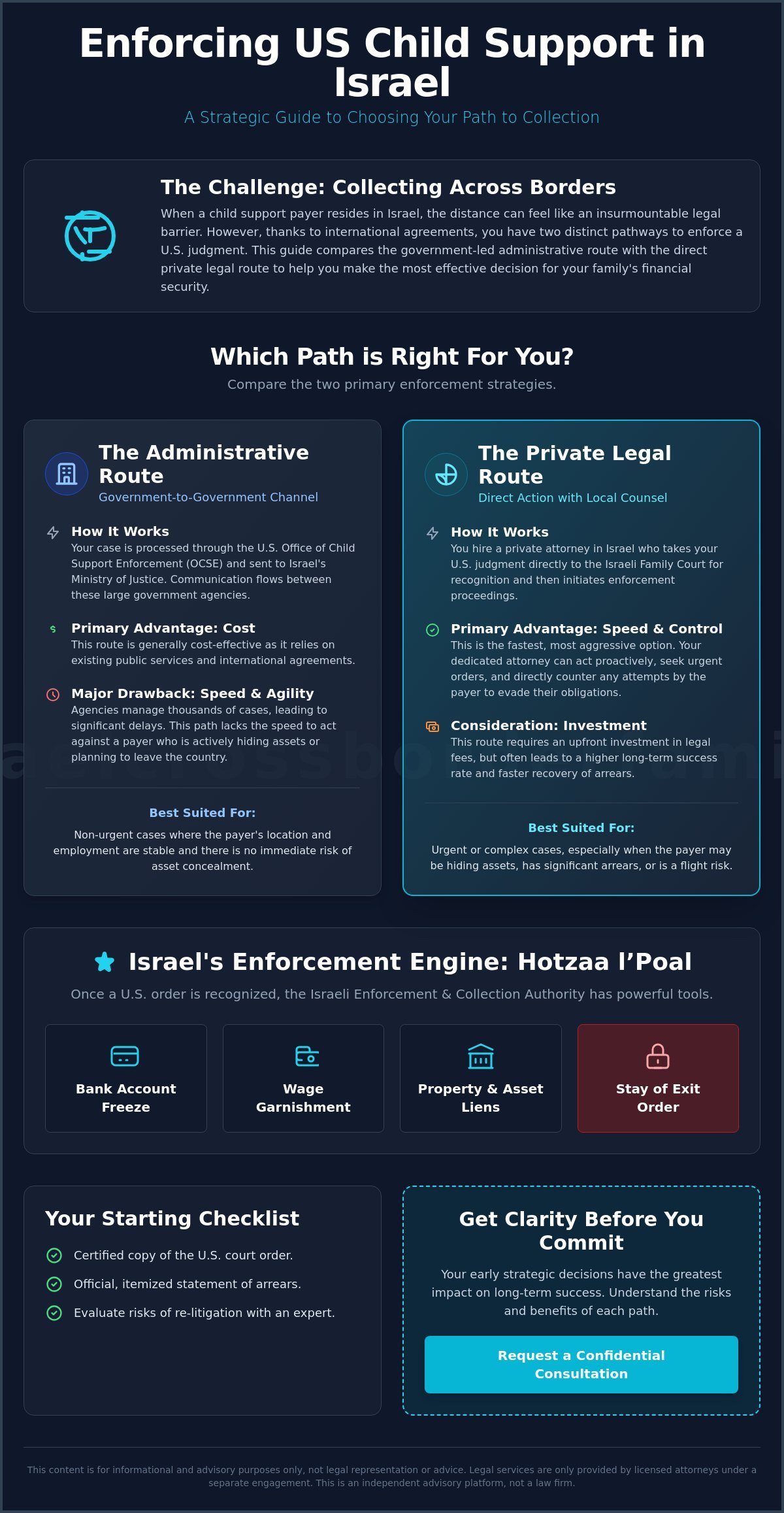
Choosing the right mechanism for enforcing us child support arrears in israel is a pivotal decision that impacts both the timeline and the ultimate success of your recovery efforts. It is not merely a matter of filing paperwork; it is a strategic choice between two distinct systems. The administrative route utilizes the established bilateral agreement between the US Office of Child Support Enforcement and the Israeli Ministry of Justice. While this path is financially accessible, it is often characterized by significant bureaucratic delays. According to the Caseworker’s Guide to Processing Cases with Israel, these government-to-government processes must follow strict formal channels, which often results in a timeline of 12 to 24 months before any meaningful collection occurs.
The private route offers a more direct alternative. By retaining an Israeli cross-border family lawyer, you can file your petition directly with the Israeli Family Court. This bypasses the lengthy queues of the Central Authority and allows for a more aggressive, tailored approach. While this path involves upfront legal fees, the cost-benefit analysis often favors private action when the arrears are substantial. The speed of recovery and the ability to secure assets before they are hidden can far outweigh the initial investment. Each case requires a careful weighing of the total debt against the urgency of the situation. Get clarity before you commit. Request a confidential consultation.
When the Administrative Route Makes Sense
The administrative path is often the most logical choice when the total arrears are relatively low. If legal fees would consume a significant portion of the debt, the state-provided services offer a necessary alternative. This route is also suitable for cases where the payer is not actively evading their responsibilities but simply lacks immediate liquidity. In these instances, the “free” nature of the government service provides a steady, albeit slow, progression toward resolution without the need for private capital. It serves as a reliable baseline for families who are not facing an immediate risk of asset dissipation.
The Strategic Advantage of Private Legal Action
For many international families, the risk of a payer disappearing or liquidating Israeli assets is too high to wait for government agencies. Private action grants direct access to the court for immediate “Stay of Exit” orders. This prevents the debtor from leaving Israel until the debt is addressed. A private advocate can also perform independent asset searches to uncover hidden bank accounts or real property. This proactive approach provides a level of responsiveness and personalized strategy that government caseworkers, burdened by massive caseloads, simply cannot provide. Making an informed choice early in the process is essential for long-term success.
This article is published on an independent advisory platform (not a law firm) and does not imply an attorney-client relationship. This content is for informational and advisory purposes only, not legal representation or legal advice. Legal services are only provided by licensed attorneys under a separate engagement.
How Israel Enforces Debt: Mechanisms of Hotzaa l’Poal
Once the Israeli Family Court recognizes a foreign judgment, the process of recovery moves from the courtroom to the Enforcement and Collection Authority, known in Israel as Hotzaa l’Poal. This agency serves as the executive arm of the judicial system. It doesn’t re-examine the merits of the case but focuses entirely on the practical collection of funds. For those enforcing us child support arrears in israel, this is the stage where legal theory meets financial reality. The authority operates under strict regulations, but it possesses significant power to compel payment from a resident debtor who has ignored their obligations.
The transition from a recognized order to an enforceable judgment is a critical milestone. According to the U.S. Government Guide to Israel Child Support Enforcement, the bilateral cooperation between the two nations ensures that these files are given priority. A common misconception among international clients is that Israel still utilizes “debtor’s prison” for all unpaid debts. While modern Israeli law has largely abolished imprisonment for civil debt, child support remains a notable exception. If a payer has the means but refuses to pay, a judge can still issue a short-term incarceration order as a coercive measure, though this is typically a last resort after other financial pressures have failed.
The “Stay of Exit” Order (Tzav Ikur Yetzia min Haaretz)
The Stay of Exit order is perhaps the most formidable tool available in the Israeli legal system. In a country where international travel is common, the threat of being unable to leave the borders is a powerful motivator. This order prevents the payer from exiting Israel until the debt is paid or a sufficient guarantee is provided. To obtain this order in cross-border cases, the creditor must demonstrate a reasonable fear that the debtor will leave the country to avoid their financial responsibilities. It is a highly effective way to secure the debt, especially when the payer has ties to both the US and Israel.
Seizure of Assets and Garnishments
Hotzaa l’Poal officers have the authority to reach into a debtor’s daily life to satisfy a judgment. This includes garnishing Israeli bank accounts and redirecting a portion of the payer’s monthly wages directly to the creditor. If the payer owns real estate property in Israel, liens can be placed on the title to prevent a sale or transfer until the arrears are cleared. Beyond direct financial seizures, the authority can use administrative pressure tactics, such as:
- Suspending the debtor’s Israeli driver’s license.
- Restricting the issuance or renewal of an Israeli passport.
- Placing restrictions on the use of credit cards or the ability to found a company.
These measures are designed to make it difficult for the debtor to maintain a normal lifestyle while ignoring their support obligations. Understanding these mechanisms helps creditors make informed choices about which enforcement tools to prioritize. Get clarity before you commit. Request a confidential consultation.
This article is published on an independent advisory platform (not a law firm) and does not imply an attorney-client relationship. This content is for informational and advisory purposes only, not legal representation or legal advice. Legal services are only provided by licensed attorneys under a separate engagement.
Step-by-Step: How to Initiate Enforcement from the US
Initiating the process of enforcing us child support arrears in israel requires meticulous attention to procedural detail. The Israeli court system operates on strict evidentiary standards, especially regarding foreign documents. Success depends on presenting a file that leaves no room for ambiguity regarding the debt’s validity or the payer’s awareness of the original proceedings. While the process is structured, it’s rarely a matter of simply mailing a request. Each step must be completed in a specific sequence to ensure the Israeli Family Court accepts the petition for recognition.
- Step 1: Gather certified copies. You must obtain a certified copy of the original US Child Support Order with the court’s raised seal. A standard photocopy or digital printout will not be accepted.
- Step 2: Obtain an official Statement of Arrears. This document, issued by your local US state child support agency, provides the definitive calculation of the debt owed up to a specific date.
- Step 3: Secure an Apostille. This is an international authentication that verifies the signatures on your US legal documents. Without an Apostille, Israeli authorities cannot officially recognize the documents as legitimate.
- Step 4: Professional Translation. Most Israeli courts require documents to be translated into Hebrew. This should be done by a professional familiar with legal terminology to avoid costly misunderstandings.
- Step 5: File the application. The final step is submitting the formal petition for recognition and enforcement to the appropriate Israeli Family Court.
Required Documentation Checklist
The distinction between a “certified copy” and a standard photocopy is a frequent point of failure for many applicants. The Israeli court needs to see the physical proof of the foreign court’s authority. Additionally, your Statement of Arrears must be clear and comprehensive. It’s helpful to include a breakdown of the principal debt, any accrued interest, and penalties as allowed by the original US order. Another critical component is the “Affidavit of Service.” You must prove the payer was properly served and had notice of the original US proceedings. Israeli judges are highly protective of due process; if there is any doubt that the payer was aware of the case, recognition may be denied. For a detailed review of your specific documents, contact us for a professional assessment.
Filing the Application in the Israeli Family Court
Determining the correct venue is the first strategic hurdle. Generally, the application is filed in the district where the payer currently resides or where their assets are located. Working with a child support cross-border enforcement specialist is often necessary to navigate these jurisdictional nuances. During the initial hearing for recognition, the court isn’t interested in re-litigating the divorce or custody arrangement. The focus is strictly on whether the US order meets the requirements of the 1958 Enforcement of Foreign Judgments Law. Once the court grants recognition, the order is transformed into a local judgment, allowing you to proceed with the collection mechanisms discussed previously. Get clarity before you commit. Request a confidential consultation.
This article is published on an independent advisory platform (not a law firm) and does not imply an attorney-client relationship. This content is for informational and advisory purposes only, not legal representation or legal advice. Legal services are only provided by licensed attorneys under a separate engagement.
Navigating Risks and Strategy: Get Clarity Before You Commit
The process of enforcing us child support arrears in israel involves more than just a series of technical filings. It requires a sophisticated understanding of how two different legal cultures interact. While the 2007 Hague Convention provides a robust framework, it doesn’t eliminate the inherent risks of international litigation. One primary concern is the risk of “re-litigation.” While Israeli courts generally recognize the debt as a fixed sum, a payer residing in Israel may attempt to file a counter-claim to lower future support payments. They often cite a “material change in circumstances” based on their new life in Israel or different cost-of-living standards. Understanding these potential maneuvers early on allows you to build a defensive strategy before the first document is even filed.
Every decision made at the start of your case carries long-term weight. Choosing between a government-led administrative path or a private legal action isn’t just about cost; it’s about control and speed. A risk-based decision-making approach helps you evaluate whether the potential recovery justifies the investment of time and resources. You must also distinguish between general advisory services and formal legal representation. An advisory service can provide a strategic roadmap and clarity on the system, while representation involves an attorney acting on your behalf in court. Selecting the right level of support is essential for managing expectations and achieving a successful outcome.
Common Pitfalls in Cross-Border Enforcement
Bureaucratic delays remain a significant hurdle within the Israeli system. Even with a recognized order, the transition to active collection through Hotzaa l’Poal can take time. Many creditors fall into the trap of “self-help,” attempting to navigate Israeli civil procedure without a clear grasp of local requirements. This often leads to rejected filings or missed deadlines that can set a case back by months. Additionally, payers may use the Israeli court’s focus on the “current” needs of the child to argue against the immediate payment of old debts. Preparing for these arguments is a vital part of risk management.
Building Your Strategy
The most effective recovery efforts are built on a foundation of clarity rather than aggression. Before committing to a specific path, it’s wise to perform a thorough assessment of the payer’s assets and their legal standing in Israel. Strategy and risk management often produce better results than aggressive litigation alone, as they allow you to anticipate the debtor’s moves. To help you evaluate the viability of your specific situation, you may request a confidential case review. This step ensures you have a realistic understanding of the challenges ahead. Get clarity before you commit. Request a confidential consultation.
This article is published on an independent advisory platform (not a law firm) and does not imply an attorney-client relationship. This content is for informational and advisory purposes only, not legal representation or legal advice. Legal services are only provided by licensed attorneys under a separate engagement.
Secure Your Family’s Financial Future Across Borders
Recovery of child support across international borders requires a blend of legal precision and strategic foresight. By leveraging the 2007 Hague Convention and choosing the enforcement route that aligns with your specific needs, you can turn a foreign order into a local reality. Whether you utilize the administrative channels of the Ministry of Justice or the focused approach of private action, the goal remains the same: ensuring the financial stability your children deserve. Each path offers different benefits regarding speed and cost, so making an informed choice early is essential.
Successfully enforcing us child support arrears in israel depends on your ability to navigate the complexities of the Hotzaa l’Poal system while managing the risks of potential re-litigation. Our specialized advisory for international families and expats provides the deep understanding of both US and Israeli legal systems necessary to guide you through these challenges. We prioritize risk-based decision-making to help you achieve a sustainable outcome for your family.
Get clarity before you commit. Request a confidential consultation to discuss your options and build a viable strategy for recovery. You don’t have to navigate this intricate cross-border landscape alone.
This article is published on an independent advisory platform (not a law firm) and does not imply an attorney-client relationship. This content is for informational and advisory purposes only, not legal representation or legal advice. Legal services are only provided by licensed attorneys under a separate engagement.
Frequently Asked Questions
Can I enforce a US child support order if the payer is an Israeli citizen?
Yes, citizenship does not exempt a payer from their financial obligations under international treaties. Israel and the US both adhere to the 2007 Hague Convention, which applies to any resident in Israel regardless of their nationality. The local courts treat these recognized foreign cases with the same authority as domestic orders, ensuring that Israeli citizens are held to the same standards as expats or foreign nationals.
How long does it typically take to recognize a US order in Israel?
Recognition typically takes between 6 to 12 months, though this varies based on the court’s schedule and the payer’s response. Choosing the private legal route often accelerates the process compared to the administrative government route, which can sometimes extend beyond 18 months. Early strategic decisions and the completeness of your documentation significantly impact these timeframes and the overall success of the filing.
Will the Israeli court change the amount of child support ordered in the US?
The Israeli court generally does not change the amount of arrears already accrued under a US order. However, a payer may petition for a modification of future payments if they can prove a material change in circumstances since the original order was issued. It’s vital to have a strategy in place to address these potential counter-claims during the recognition phase to protect the original judgment’s integrity.
What happens if the payer has no visible assets or income in Israel?
If a payer has no visible assets, enforcement officers can still use administrative pressures to compel payment. These measures include suspending driver’s licenses, restricting passport renewals, and issuing Stay of Exit orders. These actions are designed to make it difficult to maintain a normal lifestyle in Israel without addressing the debt. These tools often reveal hidden resources once the debtor faces significant personal restrictions.
Can I recover the legal fees spent on enforcement in Israel?
Recovery of legal fees is possible but remains at the court’s discretion. While Israeli judges often award costs to the prevailing party, the amount awarded may not cover the full extent of your private legal expenses. You should view fee recovery as a potential benefit of the process rather than a guaranteed part of your financial strategy. Clear communication with your advisor helps manage these expectations.
Do I need to travel to Israel for the court hearings?
You usually don’t need to travel to Israel for hearings related to enforcing us child support arrears in israel. Most procedural matters are handled by your legal representative, and testimony can often be provided via video link or written affidavit. This reduces the logistical and financial burden on families living abroad. Modern Israeli courtrooms are increasingly equipped to handle these cross-border situations through remote technology.
What is the “Stay of Exit” order and how do I get one?
A “Stay of Exit” order prevents the debtor from leaving Israel until they pay the debt or provide a sufficient bank guarantee. You can request this order from the Family Court during the recognition process or through the Enforcement and Collection Authority once the judgment is enforceable. It’s a highly effective tool when there’s a risk the payer might flee the jurisdiction to avoid their responsibilities.
Is there a statute of limitations on child support arrears in Israel?
There is a general five-year limit for applying to recognize a foreign judgment under the Enforcement of Foreign Judgments Law of 1958. However, once an order is recognized and declared enforceable in Israel, the collection of arrears can often proceed for a much longer period. It’s essential to act quickly to ensure you remain within the legal windows for recognition and subsequent enforcement actions.

Article by
Gabriel Lior
A Personal Journey That Became a Mission
The advisory was founded by an American father Gabriel Lior, LLB, MBA , global entrepreneur, and cross-border advisor who spent more than a decade navigating the Israeli family court system firsthand and now lives in Singapore with his son.
As a divorced parent in a cross-border family, Gabriel faced nearly every legal challenge a foreign parent can encounter in Israel — including child custody disputes, child support proceedings, property matters in Israel and abroad, false accusations, and complex immigration and relocation proceedings.
Over the years, he learned the hard way how difficult it is for non-Israeli parents to understand the system, identify the right legal strategy, and choose the right legal representation — especially when language, culture, and jurisdictional differences are involved. He also witnessed how foreign parents and new immigrants are often disadvantaged or taken advantage of by service providers and institutions simply because they lack local knowledge or fluency.
From Client to Advisor
To truly understand — and survive — the system, Gabriel pursued formal legal education in Israel, completing two Israeli law degrees, alongside a BA and MBA earned in the United States. This was never about becoming a practicing attorney, but about gaining a deep, structural understanding of how the system works — and where it breaks down for foreign parents.
This rare combination of:
Firsthand client experience
Israeli legal and US business education
International business and negotiation training
Decades of commercial execution
created a unique perspective – one that understands both sides of the table.
After years of litigation, persistence, and at times self-representation, he ultimately succeeded in securing custody of his son and relocating abroad through a rare legal victory in the Israeli Supreme Court — becoming one of the first fathers in Israel to do so under these circumstances.
Disclaimer
Important Disclaimer:
The information provided on this website and in its content is for general informational and educational purposes only and does not constitute legal advice, legal opinion, or legal representation.
Gabriel Lior is not licensed to practice law in Israel (nor is he interested in doing so) and does not provide legal services, despite having completed 2 Law Degrees. The services offered are advisory in nature and are intended to provide general guidance, strategic insight, and information regarding cross-border family law considerations.
No attorney-client relationship is formed by accessing this website, reading its content, or communicating with us.
Any decisions made based on this information are at your own discretion and risk. For legal advice specific to your situation, you should consult a licensed attorney in the relevant jurisdiction.
Where appropriate, we may refer clients to independent, licensed attorneys or professionals. Such referrals do not constitute legal representation and no liability is assumed for services provided by third parties.