This article is published on an independent advisory platform, not a law firm, and does not constitute an attorney-client relationship. Legal services are only provided by licensed attorneys under a separate engagement.
Imagine signing a legal agreement in Tel Aviv that inadvertently triggers a tax crisis or a custody dispute in New York because a single clause failed to account for both jurisdictions. It’s a common fear for many expats and international families who feel caught between two distinct legal worlds. You likely already recognize that managing a life across borders is inherently complex, and the thought of facing the Israeli Rabbinical Court or deciphering dense Hebrew documents can be overwhelming. Finding an israel international lawyer who understands US cultural norms and speaks fluent English is the first step toward regaining control.
This article explains how a cross-border specialist acts as a strategic bridge to protect your assets and parental rights. We’ll examine the specific differences between these legal systems and provide a clear roadmap for navigating divorce, estates, and family matters with confidence. You’ll learn how to avoid the high costs of international litigation through early, informed strategy. Get clarity before you commit. Request a confidential consultation.
Key Takeaways
- Understand the critical differences between a local practitioner and a specialist who manages the nuances of both US and Israeli legal systems.
- Learn how the Israeli Rabbinical Court system can impact international divorce cases and what it means for your parental rights.
- Discover the essential steps for gathering cross-border documentation and the vital role of the Apostille in the Israeli legal process.
- Identify how an israel international lawyer acts as a strategic bridge to prevent conflicting court orders and protect your global assets.
- Gain a clear roadmap for navigating complex family and estate matters through risk-based decision-making and early strategic planning.
This article is published on an independent advisory platform, not a law firm, and does not constitute an attorney-client relationship. Legal services are only provided by licensed attorneys under a separate engagement.
What is an Israel International Lawyer and Why Do You Need One?
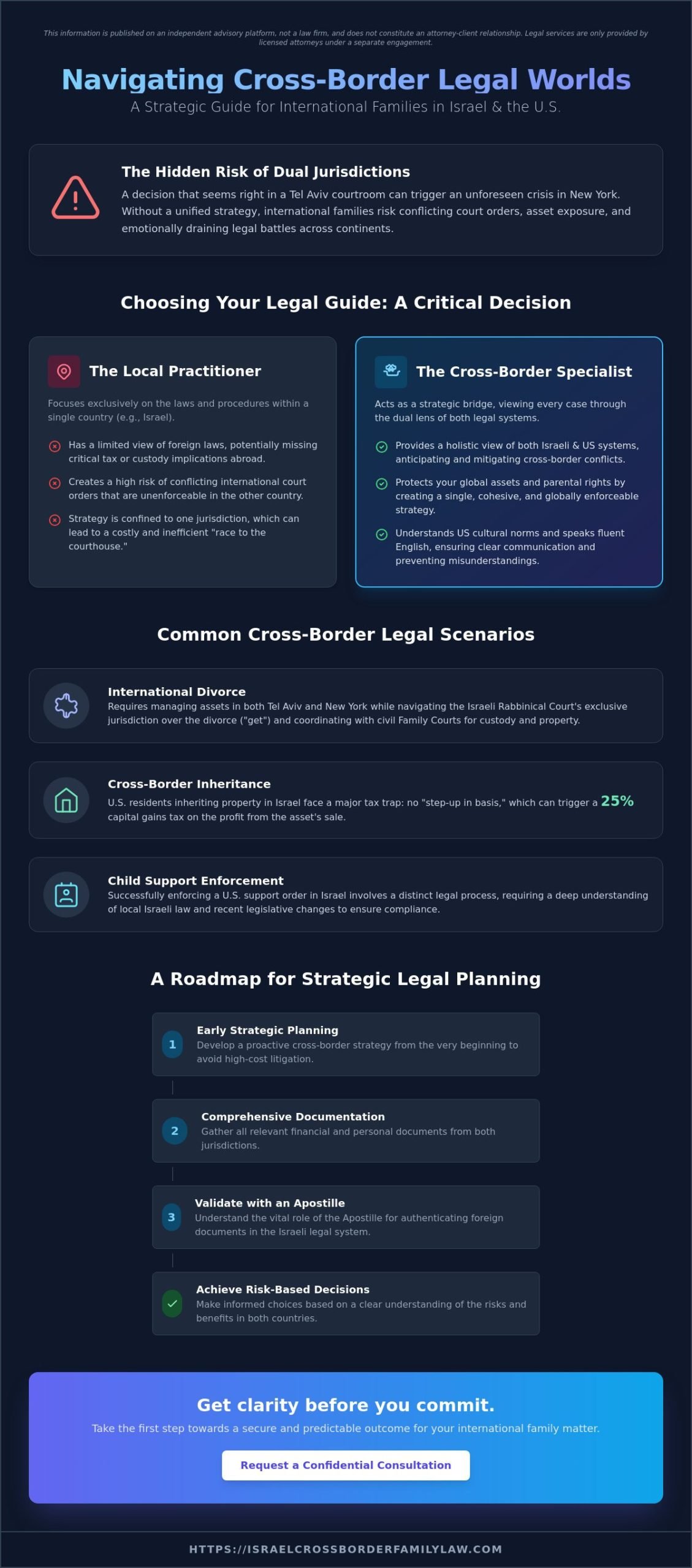
An israel international lawyer is a specialist who manages the legal friction that occurs when the rules of two different countries collide. While a local practitioner focuses exclusively on the statutes within Israel, an international specialist views every case through a dual lens. They understand how Israeli family or estate laws interact with foreign legal systems, particularly the US common law system. This expertise is vital because a decision that seems beneficial in a Tel Aviv courtroom could inadvertently trigger a tax crisis or a jurisdictional conflict in New York.
To better understand the broader context of international legal relations and the complexities involved in cross-border matters, watch this helpful video:
The role of an international specialist is to act as a legal bridge. They work to prevent a “race to the court,” which happens when parties rush to file in the country they believe offers a tactical advantage. Without this strategic oversight, families often find themselves Navigating the Complexity of Dual Jurisdictions without a map. This often leads to contradictory court orders that are impossible to enforce in both locations simultaneously. By coordinating the strategy from the start, an israel international lawyer ensures that your legal standing remains secure across both borders.
The Distinction Between Public and Private International Law
Most search results for international law focus on treaties, diplomacy, and government relations. This is known as public international law. However, for expats and families, the focus is on private international law. This area of practice deals with the specific needs of individuals, such as divorce and separation, inheritance, and business interests. Today, individuals are the primary subjects of cross-border legal conflicts, making this specialized knowledge more relevant than ever for those living between two cultures.
Key Scenarios Requiring International Expertise
- International Divorce: Managing assets in both Tel Aviv and New York requires a strategy that accounts for different property division rules and potential tax implications.
- Inheritance: US residents inheriting property in Israel must navigate the lack of a “step-up in basis,” which leads to a 25% capital gains tax on the profit from the sale of inherited assets.
- Child Support Enforcement: Enforcing a US support order in Israel involves understanding recent 2025 legislative efforts to standardize and reform child support payments.
Get clarity before you commit. Request a confidential consultation.
This article is published on an independent advisory platform, not a law firm, and does not constitute an attorney-client relationship. Legal services are only provided by licensed attorneys under a separate engagement.
Navigating the Complexity of Dual Jurisdictions: Family and Estates
When a family lives across two countries, they essentially live under two different sets of rules. This dual reality often leads to contradictory court orders, where a judge in Israel may grant a ruling that is entirely unenforceable in the US. For Jewish couples, the complexity increases because the Rabbinical Courts have exclusive jurisdiction over the divorce itself, known as the “get.” While ancillary matters like property division or child custody can be decided in civil Family Courts, a law passed in late 2025 clarified that Rabbinical Courts can also adjudicate child support within a divorce lawsuit. An israel international lawyer helps you identify which court system will handle which aspect of your life before a conflict arises.
International Divorce and the “Race to the Court”
The timing of where you file for divorce can change the entire trajectory of your case. In Israel, the concept of a “race to the court” is very real; the party that files first often secures the jurisdiction they prefer. This decision has significant consequences for property division and support payments. In 2025, 11,093 couples divorced in Israel, and many involved international components where filing in the US might have yielded a different financial outcome. Choosing the most favorable jurisdiction requires a deep understanding of both systems. You can learn more about these dynamics by reviewing the strategy for divorce and separation for international families.
Beyond financial disputes, international families must consider the implications of the Hague Convention. This international treaty governs cases of cross-border child abduction or unauthorized relocation. If a parent moves a child to or from Israel without consent, the legal response must be immediate and strategically sound to ensure the child’s return. Understanding these risks is a vital part of international custody and relocation planning.
Cross-Border Inheritance and Probate
Estate planning for US-Israel families requires more than a standard will. While Israel does not have an inheritance tax, it does levy a 25% capital gains tax on the profit from the sale of inherited assets. Because Israel does not offer a “step-up in basis,” the tax is calculated from the original purchase price paid by the deceased. Probating a US will in an Israeli court can be a lengthy process if the document was not drafted with Israeli requirements in mind. Dual-jurisdiction estate planning ensures that your beneficiaries don’t face legal gridlock or unexpected tax burdens. If you are managing assets in multiple countries, it is helpful to request a review of your current standing to ensure your strategy is robust. Get clarity before you commit. Request a confidential consultation.
This article is published on an independent advisory platform, not a law firm, and does not constitute an attorney-client relationship. Legal services are only provided by licensed attorneys under a separate engagement.
Local Counsel vs. Cross-Border Specialist: A Strategic Comparison
Choosing a lawyer is often the most critical decision an expat makes. A local generalist understands the mechanics of the Israeli court system but may not grasp the ripple effects their decisions have on your foreign interests. An israel international lawyer provides a different level of oversight. They ensure that an action taken in a Haifa or Tel Aviv court doesn’t jeopardize your legal standing in the US. This is particularly important for expats and foreign nationals who maintain assets or family ties in both countries.
One of the greatest risks in cross-border litigation is “siloed” advice. This happens when your Israeli legal representative operates without communicating with your US-based accountant or estate planner. Without a unified strategy, you may find that a settlement reached in Israel triggers an unexpected tax event or a violation of a US court order. A strategist looks at the global impact of every move, ensuring your entire professional team works in harmony rather than at cross-purposes. This collaborative approach is essential for protecting your long-term financial health.
Understanding the Cultural and Language Gap
Legal Hebrew is notoriously dense. Even fluent Hebrew speakers often struggle with the technical nuances of Israeli court documents. A bridge lawyer ensures nothing is lost in translation by explaining complex concepts in plain English. Beyond language, there is a significant difference in legal culture. The Israeli system is often characterized by its directness and speed, while the US system is deeply rooted in rigid procedural norms. An israel international lawyer manages these expectations, helping Anglos feel more comfortable in an environment that can otherwise feel chaotic or unfamiliar.
Managing Risk and Strategy Across Borders
A local lawyer focuses on solving the immediate problem in front of them. However, a cross-border specialist asks how that solution affects your long-term goals. For example, a property settlement in Tel Aviv might seem like a win until you realize it creates a massive capital gains tax liability in New York. This is why seeking clarity before you commit is a foundational principle of international family law. By analyzing the global footprint of your assets and family structure, you can make informed choices based on strategy rather than reaction. Get clarity before you commit. Request a confidential consultation.
This article is published on an independent advisory platform, not a law firm, and does not constitute an attorney-client relationship. Legal services are only provided by licensed attorneys under a separate engagement.
How to Prepare for an International Legal Case in Israel
Preparing for a legal case in Israel while managing assets or family ties in multiple countries requires meticulous organization. It isn’t just about the law; it’s about the logistics of proving your case in a system that may be foreign to you. An israel international lawyer will guide you through the specific paperwork needed to satisfy both Israeli and foreign court standards. Proper preparation helps reduce anxiety and ensures that your strategy remains focused on your desired outcomes.
Documentation is the foundation of any cross-border case. You’ll likely need to gather several key items from both jurisdictions:
- Original birth and marriage certificates.
- Property deeds, mortgage statements, or lease agreements.
- Recent tax returns, bank statements, and proof of income.
- Existing court orders or prenuptial agreements.
In many cases, these documents must be authenticated with an “Apostille.” This is a specialized certificate issued by a government authority that verifies a document is legitimate for use in another country. Because Israeli courts operate in Hebrew, you’ll also need notarized translations. Ensuring these are accurate is vital, as a poor translation can lead to significant misunderstandings during a hearing. Setting a realistic budget is also part of the preparation. Beyond legal representation, you should account for court filing fees, translation costs, and potential expert witness fees if your case involves complex asset valuation.
The Importance of Early Strategy
The first 30 days of a cross-border dispute often determine the final outcome. This is the critical window where jurisdictional hooks are established. To assist your representative, you should draft a “Statement of Facts.” This is a clear, chronological timeline of your marriage, the birth of children, and the acquisition of assets. It helps identify which country has the strongest legal claim to the case. For more insights, you can watch our video on cross-border legal strategy to see how these elements come together.
Working with an Advisory Platform
Navigating these choices alone is difficult and often overwhelming. An independent advisory platform offers a neutral risk assessment before you commit to a specific path. This is different from a formal legal engagement; it’s a strategic first step to understand your options without the pressure of immediate litigation. You can learn more about how it works and how it helps you avoid common pitfalls. If you’re ready to begin organizing your case, you should contact us to discuss your situation. Get clarity before you commit. Request a confidential consultation.
This article is published on an independent advisory platform, not a law firm, and does not constitute an attorney-client relationship. Legal services are only provided by licensed attorneys under a separate engagement.
Strategic Legal Planning: Finding Clarity Before You Commit
The “international” designation of your legal representative is more than a professional title; it’s your most significant strategic asset. As we’ve explored, a local generalist may resolve a specific Israeli matter while unknowingly creating a secondary crisis in your home country. An israel international lawyer functions as a steady guide, ensuring that your global footprint is protected. Whether you’re managing a divorce, an inheritance, or a complex estate, the goal is to move forward with a unified strategy that accounts for both Israeli statutes and foreign procedural norms.
The Advisory Approach to International Law
Objective guidance is the cornerstone of successful cross-border management. This article is published on an independent advisory platform to ensure that the focus remains on risk-based decision-making rather than aggressive or unnecessary litigation. This approach prioritizes long-term stability and asset protection over short-term legal wins. You can learn more about our commitment to neutral, high-level strategy by visiting our page about the advisory. Our role is to bridge the gap between innovation hubs and established global markets, providing you with a clear roadmap for your international life.
Next Steps for International Families
To begin finding clarity, you must first identify your core objectives. Are you focused on asset protection during a divorce, securing child custody across borders, or managing a simple probate for an Israeli estate? Once your goals are clear, the next step is an initial review of your dual-country status. This review helps you understand the specific risks associated with your unique situation, allowing you to plan effectively.
- Identify all assets held in both Israel and the US.
- Review existing prenuptial or estate documents for cross-border compatibility.
- Assess the potential impact of the latest 2025 legislative updates on your family matters.
Get clarity before you commit. Request a confidential consultation to discuss your strategy. Please be advised that this article is for informational and educational purposes only. It does not constitute legal representation or legal advice. Every international situation is unique, and you should seek professional counsel regarding your specific circumstances.
This article is published on an independent advisory platform, not a law firm, and does not constitute an attorney-client relationship. Legal services are only provided by licensed attorneys under a separate engagement.
Secure Your Global Future Through Informed Strategy
Managing a life across borders requires more than just local legal knowledge; it demands a strategy that accounts for the inherent complexity of dual jurisdictions. You now understand how early decisions, particularly in the first 30 days of a dispute, can dictate the long-term protection of your assets and parental rights. By coordinating Israeli statutes with US legal expectations, you avoid the common pitfalls of contradictory court orders and unexpected tax liabilities. This proactive planning is the most effective way to ensure your family’s stability.
Securing the right israel international lawyer means choosing a partner who provides authoritative guidance specifically tailored for the Anglo and expat community. With a specialized focus on complex family and estate matters and decades of experience in cross-border law, our advisory platform helps you navigate these challenges with confidence. You don’t have to face the Israeli legal system without a clear roadmap. Get clarity before you commit. Request a confidential consultation. Your path to legal clarity begins with a single strategic step.
This article is published on an independent advisory platform, not a law firm, and does not constitute an attorney-client relationship. Legal services are only provided by licensed attorneys under a separate engagement.
Frequently Asked Questions
What exactly does an Israel international lawyer do for families?
An israel international lawyer acts as a strategic bridge between two different legal systems to ensure your family interests are protected in both countries. They manage jurisdictional overlaps in divorce, custody, and inheritance matters. By coordinating with professionals in both regions, they prevent conflicting court orders and ensure that a decision made in one country doesn’t create a legal or financial crisis in the other.
Can an Israeli lawyer represent me in a US court?
Why is the US-Israel tax treaty important for my inheritance case?
The US-Israel tax treaty is essential for preventing double taxation on assets and income held across both borders. While Israel abolished its inheritance tax in 1981, beneficiaries still face a 25% capital gains tax on the sale of inherited assets. The treaty helps your legal and tax team determine how to credit taxes paid in one country against the liabilities in the other.
Do I need a lawyer in both the US and Israel for my divorce?
You typically need legal representation in both countries if you have significant assets, property, or children in both jurisdictions. A divorce in Israel involves unique Rabbinical Court procedures for the “get” that a US lawyer cannot handle. Conversely, an Israeli lawyer cannot manage US property division. A specialist ensures these two separate legal processes don’t work against each other.
How are US child support orders enforced in Israel?
US child support orders are enforced in Israel through reciprocal legal agreements and the Israeli Family Court system. The process involves filing a request to recognize and enforce the foreign judgment. Once validated, the order has the same legal standing as one issued by an Israeli judge. Recent 2025 legislative efforts also aim to standardize these calculations to ensure fairness for both parents.
Are prenuptial agreements from the US valid in Israeli courts?
US prenuptial agreements are generally recognized in Israel, but they must be approved by an Israeli court to be fully enforceable. This process ensures the agreement doesn’t conflict with local public policy. It’s vital to have an israel international lawyer review the document early to determine if any amendments are needed to satisfy Israeli legal requirements while maintaining its validity in the US.
What is the Hague Convention and how does it affect my custody case?
The Hague Convention is an international treaty designed to protect children from the harmful effects of cross-border abduction or unauthorized relocation. If a child is moved between the US and Israel without the other parent’s consent, the treaty provides a legal framework for their swift return to their habitual residence. It focuses on where the custody case should be heard rather than deciding the custody itself.
How much does it cost to hire a cross-border legal specialist in Israel?
The cost of hiring a specialist depends on the complexity of your multi-jurisdictional case and the specific services required. While the Israeli Judicial Authority publishes a minimum fee schedule for family court filings, international matters often involve additional costs for translations and expert coordination. You should request a detailed breakdown of potential costs during your initial strategy session to ensure your budget is realistic.

Article by
Gabriel Lior
A Personal Journey That Became a Mission
The advisory was founded by an American father Gabriel Lior, LLB, MBA , global entrepreneur, and cross-border advisor who spent more than a decade navigating the Israeli family court system firsthand and now lives in Singapore with his son.
As a divorced parent in a cross-border family, Gabriel faced nearly every legal challenge a foreign parent can encounter in Israel — including child custody disputes, child support proceedings, property matters in Israel and abroad, false accusations, and complex immigration and relocation proceedings.
Over the years, he learned the hard way how difficult it is for non-Israeli parents to understand the system, identify the right legal strategy, and choose the right legal representation — especially when language, culture, and jurisdictional differences are involved. He also witnessed how foreign parents and new immigrants are often disadvantaged or taken advantage of by service providers and institutions simply because they lack local knowledge or fluency.
From Client to Advisor
To truly understand — and survive — the system, Gabriel pursued formal legal education in Israel, completing two Israeli law degrees, alongside a BA and MBA earned in the United States. This was never about becoming a practicing attorney, but about gaining a deep, structural understanding of how the system works — and where it breaks down for foreign parents.
This rare combination of:
Firsthand client experience
Israeli legal and US business education
International business and negotiation training
Decades of commercial execution
created a unique perspective – one that understands both sides of the table.
After years of litigation, persistence, and at times self-representation, he ultimately succeeded in securing custody of his son and relocating abroad through a rare legal victory in the Israeli Supreme Court — becoming one of the first fathers in Israel to do so under these circumstances.
Disclaimer
Important Disclaimer:
The information provided on this website and in its content is for general informational and educational purposes only and does not constitute legal advice, legal opinion, or legal representation.
Gabriel Lior is not licensed to practice law in Israel (nor is he interested in doing so) and does not provide legal services, despite having completed 2 Law Degrees. The services offered are advisory in nature and are intended to provide general guidance, strategic insight, and information regarding cross-border family law considerations.
No attorney-client relationship is formed by accessing this website, reading its content, or communicating with us.
Any decisions made based on this information are at your own discretion and risk. For legal advice specific to your situation, you should consult a licensed attorney in the relevant jurisdiction.
Where appropriate, we may refer clients to independent, licensed attorneys or professionals. Such referrals do not constitute legal representation and no liability is assumed for services provided by third parties.