This article is published on an independent advisory platform and does not imply an attorney-client relationship. Legal services are only provided by licensed attorneys under a separate engagement.
In the high-stakes environment of cross-border family law, your status as a legal guardian is permanent, but your right to physical custody depends entirely on early jurisdictional decisions and strategic risk management. It’s understandable to feel a sense of unease when facing an unfamiliar legal system, especially when language barriers and the potential for “no-exit” orders complicate your family’s future. Understanding child custody laws israel for foreigners is the essential first step toward replacing that uncertainty with a clear, actionable strategy.
You’ll gain the clarity needed to protect your parental rights and manage the complexities of international child abduction risks under the Hague Convention. This guide provides an authoritative look at the crucial differences between guardianship and physical custody while explaining how Israeli courts determine the best interests of the child. We’ll also outline a framework for building a sustainable parenting plan that addresses the unique challenges of international living in 2026. Get clarity before you commit. Request a confidential consultation.
Key Takeaways
- Understand the Legal Capacity and Guardianship Law (1962) to identify your permanent rights as a natural guardian in the Israeli legal system.
- Navigate the “Best Interests of the Child” standard and see how child custody laws israel for foreigners impact the court’s evaluation of your family’s stability.
- Learn about the transition toward shared parental responsibility and how joint custody arrangements are structured to support international families.
- Identify the legal risks associated with cross-border relocation, including the use of “No-Exit” orders to prevent the wrongful removal of children.
- Establish a strategic approach to jurisdictional decisions to ensure long-term stability and avoid common pitfalls in the Israeli Family Court system.
The Framework of Child Custody Laws in Israel for Foreigners
This article is published on an independent advisory platform and does not constitute an attorney-client relationship. Understanding the child custody laws israel for foreigners begins with the Legal Capacity and Guardianship Law of 1962. This legislation serves as the bedrock for all parental rights in IL. It establishes that both parents are the natural guardians of their children. This status carries equal rights and duties, regardless of your marital status or whether you hold Israeli citizenship. It’s a common misconception that being a foreigner puts you at a disadvantage. In reality, the Israeli judicial system is designed to apply the same legal standards to everyone within its borders.
The system focuses heavily on the “best interests of the child” rather than the parents’ nationality. However, the complexity increases significantly in cross-border situations. When one parent resides outside the country or intends to relocate, the court must balance local statutes with international treaties. This includes the Hague Convention on International Child Abduction, which provides a framework for returning children who have been wrongfully removed from their home country. Understanding how these layers of law interact is vital for any international family living in Israel.
To better understand how these laws apply when a parent considers leaving the country, watch this helpful video:
Legal Guardianship vs. Physical Custody
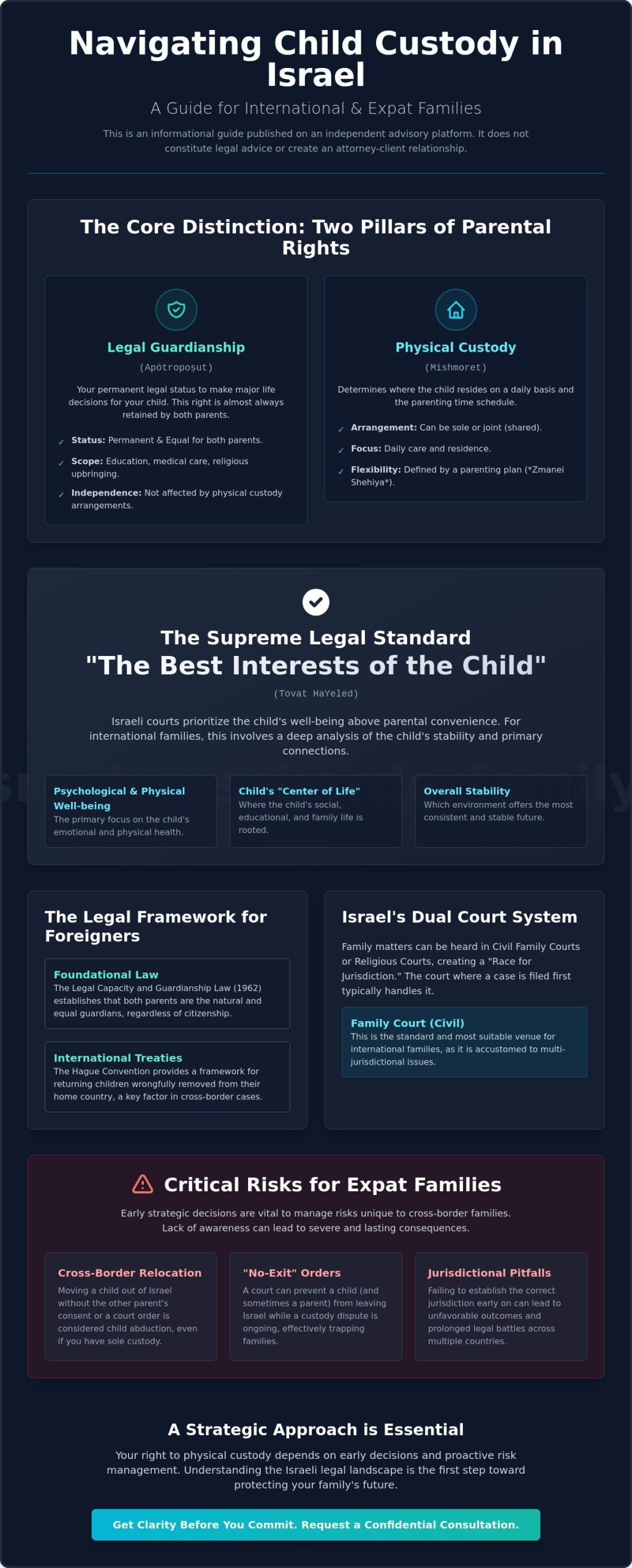
In IL, the law makes a sharp distinction between guardianship (Apótropoṣut) and physical custody (Mishmoret). Guardianship is a permanent legal status that grants you the right to make major life decisions. This includes choices regarding your child’s education, medical treatments, and religious upbringing. Even if one parent is granted sole physical custody, the other parent almost always retains full guardianship. Physical custody refers specifically to where the child resides on a daily basis. This differs from many US or UK jurisdictions where these terms are often used interchangeably or bundled together, creating confusion for many expats.
The Dual Court System: Family vs. Rabbinical Courts
Israel operates a unique dual legal system where family matters can be heard in either civil Family Courts or religious courts. This creates what is known as the “Race for Jurisdiction.” The court where a case is first filed typically gains the authority to decide the outcome. While a law passed in March 2026 expanded the arbitration powers of religious courts, it specifically protected child custody issues for married couples from being decided in these venues without mutual consent. For most international families, navigating divorce and separation involves the civil Family Court, which is more accustomed to the multi-jurisdictional needs of foreigners. Get clarity before you commit. Request a confidential consultation.
This article is published on an independent advisory platform and does not constitute an attorney-client relationship. Legal services are only provided by licensed attorneys under a separate engagement.
Core Principles: The Best Interests and Tender Years Doctrines
The supreme legal standard governing child custody laws israel for foreigners is the principle of “The Best Interests of the Child” (Tovat HaYeled). Within Israel’s Official Family Court System, judges prioritize the psychological and physical well-being of the minor above the specific desires or convenience of the parents. For international families, this evaluation often includes an analysis of the child’s “center of life.” The court examines which environment provides the most stability, especially when one parent is an expat who may eventually wish to return to their home country.
Cultural differences can significantly impact how a judge perceives “best interests.” Israeli courts value family continuity and the child’s connection to their local community and extended family. If you’re an international parent, you’ll need to demonstrate how your parenting plan supports these connections. The court frequently appoints professionals, such as social workers or psychologists, to conduct “Parental Capability” evaluations. These experts charge fees that often start around ₪5,000, and their recommendations carry substantial weight in the final ruling. It’s vital to prepare for these evaluations with a clear understanding of local expectations.
How the Best Interests Standard is Applied
Judges look for concrete evidence of parental capability and emotional stability. They consider several key factors:
- Continuity of Care: Who has been the child’s primary caregiver up to this point?
- Sibling Bonds: Courts rarely separate siblings unless there’s a compelling reason.
- The Child’s Wishes: Depending on the child’s age and maturity, typically starting around age 10 to 12, the court may hear their preferences directly or through a professional.
- Parental Cooperation: The ability of parents to communicate and co-parent effectively is a major factor in awarding joint custody.
The Tender Years Doctrine: Presumptions for Children Under Six
The “Tender Years Doctrine” (Hazzakat Hagil Harach) is a legal presumption in Israel that children under the age of six should remain in the physical custody of their mother. While this remains part of the statutory framework, its influence is declining. In 2026, the trend in Israeli Family Courts is moving aggressively toward shared parental responsibility. Fathers can successfully challenge this presumption by demonstrating they have been the primary caregiver or by showing that joint custody is in the child’s best interest. The court’s focus has shifted from gender-based roles to identifying which parent can best provide for the child’s immediate and long-term needs. If you’re facing a complex situation involving young children, you might find it helpful to discuss your specific circumstances to understand how these modern shifts apply to your case.
Get clarity before you commit. Request a confidential consultation.
This article is published on an independent advisory platform and does not constitute an attorney-client relationship. Legal services are only provided by licensed attorneys under a separate engagement.
Navigating Joint and Sole Custody Arrangements (Zmanei Shehiya)
In the Israeli legal system, the focus has shifted from the rigid concept of “custody” to the more collaborative framework of “parental responsibility.” This is reflected in the term Zmanei Shehiya, which translates to “staying times” or time-sharing. For those exploring child custody laws israel for foreigners, understanding how these arrangements are structured is vital for long-term stability. The court no longer views one parent as a primary custodian and the other as a mere visitor. Instead, the goal is to maintain the child’s relationship with both parents through a clearly defined and predictable schedule.
The type of arrangement chosen directly impacts financial obligations. Under current 2026 standards, a move toward joint custody often results in a significant reduction in child support payments, provided the parents’ incomes are relatively similar. This financial shift reflects the reality that both parents are incurring direct costs for the child’s care during their respective times. However, for international families, these arrangements carry unique logistical hurdles that require careful strategic planning before any court filings occur.
The Shift Toward Joint Custody
Joint custody, or Mishmoret Meshutefet, has become the preferred starting point for Israeli Family Courts. To qualify for a 50/50 time-sharing split, parents typically must demonstrate geographical proximity and a high level of cooperation. For expats living in IL, this means residing in the same city or within a very short commuting distance. If you are navigating a divorce for international families, you must consider whether your professional life and residency status allow for this level of local commitment. The courts are increasingly wary of awarding joint custody if one parent’s living situation is unstable or if there is a clear intent to relocate in the near future.
Sole Custody and Visitation for International Parents
Sole custody remains a necessity in cases of high conflict or when parents live in different countries. When one parent resides abroad, the Zmanei Shehiya must be meticulously detailed to account for the complexities of international travel. A sustainable plan usually includes extended stays during summer months and winter holidays, supplemented by consistent digital contact. Ensuring these rights are enforceable across borders is a primary concern for the court. To manage the risk of international child abduction, Israeli courts may require a bank guarantee, often starting at ₪50,000, before allowing a child to travel overseas. This protective measure ensures that the child returns to IL as agreed in the parenting plan. Get clarity before you commit. Request a confidential consultation.
This article is published on an independent advisory platform and does not constitute an attorney-client relationship. Legal services are only provided by licensed attorneys under a separate engagement.
Critical Risks for Expat Families: Relocation and the Hague Convention
For many international parents, the most significant anxiety involves the risk of being trapped in IL or having a child removed without consent. Understanding the intersection of the Hague Convention and child custody laws israel for foreigners is critical for managing these risks. Israel has been a signatory to the Hague Convention on the Civil Aspects of International Child Abduction since 1991. This treaty defines “wrongful removal” as taking a child across international borders in violation of the other parent’s custody rights. To prevent such scenarios, Israeli courts frequently issue a “Stay of Exit” order, known as Tzav Ikur Yetzia Min Haaretz. This order is a common protective measure that prevents a child from leaving the country until the court is satisfied that the travel is authorized and the child will return.
The “Stay of Exit” order can be applied even if there’s no immediate threat of abduction. It’s often used as a standard safeguard in cases involving foreign nationals. If you’re an expat, this means you cannot take your child on a vacation or a visit home without the other parent’s written consent or a specific court order. Lifting these orders temporarily often requires a bank guarantee, which can start at ₪50,000, to ensure compliance with the return date. Managing these restrictions requires a proactive legal strategy to ensure your freedom of movement remains intact while protecting your parental rights.
International Relocation: Moving Children Out of Israel
Permanent relocation carries a heavy burden of proof. The court prioritizes the child’s stability and their relationship with the left-behind parent over your desire to move. You must present a comprehensive plan covering education, housing, and a detailed schedule for maintaining the child’s connection to IL. The judge will scrutinize your motives to ensure the move isn’t an attempt to alienate the other parent. Check our guide on International Custody and Relocation for a deeper analysis of these requirements. Early strategy is vital; announcing a move before securing legal footing can trigger immediate “No-Exit” orders that are difficult to reverse.
The Role of Social Workers and Expert Reports
The Teskir, or social worker report, is often the most influential document in an Israeli custody case. Court-appointed social workers act as the “eyes and ears” of the judge. They’ll conduct home visits and interviews to evaluate the child’s environment and parental capability. As a foreigner, you should be prepared for questions about your long-term intentions in IL and the strength of your local support network. These professionals evaluate your case based on local norms, which may differ from your home country’s standards. Presenting your situation effectively requires a balance of transparency and a clear focus on the child’s best interests. If you’re concerned about how your international lifestyle might be perceived, it is wise to seek a strategic case review before these interviews begin.
Get clarity before you commit. Request a confidential consultation.
This article is published on an independent advisory platform and does not imply an attorney-client relationship. Legal services are only provided by licensed attorneys under a separate engagement.
Strategic Planning for Cross-Border Custody Disputes
Success in navigating child custody laws israel for foreigners isn’t measured by a single court order. It’s defined by the long-term stability of the family unit across multiple borders. In cross-border situations, the legal landscape is exceptionally fluid. A decision made in a Haifa courtroom can have immediate repercussions for a parent’s status in New York or London. Because of this multi-jurisdictional complexity, your strategy must account for the “Race for Jurisdiction.” This occurs when one party attempts to file in the Rabbinical Court to gain a perceived tactical advantage. While 2026 legal updates have limited the power of religious courts in custody matters without mutual consent, the initial filing location still dictates the procedural rhythm of the entire case. Understanding these nuances is the difference between a proactive strategy and a reactive struggle.
Choosing between mediation and litigation is a pivotal strategic crossroad. In IL, the “Settlement of Dispute” process is a mandatory first step for most families. It requires a ₪100 filing fee and involves meetings with court-appointed professionals to explore settlement options. For international families, mediation often provides a more flexible framework to address unique needs, such as international school schedules or dual-citizenship requirements. However, if there’s a risk of a “Stay of Exit” order being misused, litigation may be necessary to protect your fundamental right to travel. Integrating your legal approach in IL with your home country’s legal standards ensures that any agreement reached is enforceable and recognized globally.
Early Decisions and Their Long-Term Impact
It’s a common trap to view temporary custody orders as “just for now.” In the Israeli system, these interim arrangements often create a status quo that judges are reluctant to change later. Signing informal or “handshake” agreements without a formal legal advisory can lead to unintended jurisdictional commitments. These early choices set the foundation for your child’s “center of life” evaluation. To understand the mechanics of how these strategies are built, you can learn more about how it works on our platform. Clarity at the beginning of the process prevents costly corrections years down the line.
Requesting a Confidential Review
A strategy-first approach is the most effective way to manage the inherent risks of international family law. Before taking formal action, you should organize your essential documentation. This includes marriage certificates, birth records, and comprehensive financial data. Having these records ready allows for a more nuanced analysis of your cross-border standing. Every family’s situation is unique, especially when dealing with the intersection of different legal cultures and languages. Get clarity before you commit. Request a confidential consultation to begin building a framework for your family’s future.
This article is published on an independent advisory platform and does not imply an attorney-client relationship. Legal services are only provided by licensed attorneys under a separate engagement.
Securing Your Family’s Future Through Strategic Clarity
Managing an international household requires a specialized understanding of how Israeli statutes interface with global legal standards. You now have a framework for distinguishing between permanent legal guardianship and the daily realities of physical custody. Navigating child custody laws israel for foreigners successfully depends on recognizing these nuances before any formal legal process begins. Early decisions regarding the jurisdictional race and the strategic presentation of your case to social workers will shape your family’s reality for years to come.
Our advisory provides a steady hand for international families facing these multi-jurisdictional complexities. We offer calm, strategy-based guidance rooted in specialized knowledge of the Hague Convention and the specific interplay between US and Israeli legal systems. By prioritizing risk management and informed decision-making, you can avoid common pitfalls and ensure your parental rights are respected across borders. The complexity of cross-border family law demands a proactive approach rather than a reactive struggle.
Get clarity before you commit. Request a confidential consultation to build a sustainable parenting plan for your family. You don’t have to navigate these challenges alone; the right strategy provides the long-term security your children deserve.
This article is published on an independent advisory platform and does not imply an attorney-client relationship. Legal services are only provided by licensed attorneys under a separate engagement.
Frequently Asked Questions
Can a foreigner get full custody of a child in Israel?
Yes, foreign nationals can obtain sole physical custody if the court determines it serves the best interests of the child. Israeli courts treat foreigners and citizens equally under the law, applying the same standards for parental capability. It’s important to remember that even with sole physical custody, both parents typically retain equal legal guardianship, meaning major decisions about education and health still require mutual agreement.
What happens if one parent wants to move the child back to the US?
Relocating a child to the US requires either the written consent of the other parent or a specific relocation order from the Israeli Family Court. Without these, moving the child out of Israel is considered wrongful removal under the Hague Convention. The parent wishing to move must prove that the relocation is beneficial for the child and provide a detailed plan for maintaining the left-behind parent’s relationship.
Does the Rabbinical court have jurisdiction over my custody case?
The Rabbinical court can gain jurisdiction if a divorce claim is filed there first and explicitly includes the custody matter. This situation is often referred to as the “race for jurisdiction.” However, under legal standards effective in 2026, religious courts generally cannot decide child custody issues for married couples unless both parties provide their explicit consent to the venue.
How long does a custody battle typically last in the Israeli Family Court?
A custody case in the Israeli Family Court often takes between six months and two years to reach a final ruling. The duration depends largely on the complexity of the family dynamic and the time required for court-appointed social workers to submit their evaluation reports. Cases involving child custody laws israel for foreigners may take longer if international experts or cross-border evidence are required.
What is a “no-exit” order and how can I prevent one?
A “no-exit” order is a protective legal measure that prevents a child from leaving Israel without a court’s permission. To prevent or lift such an order, you can propose a clear, court-approved travel schedule and offer financial security, such as a bank guarantee starting at ₪50,000. These measures reassure the court that the child will return to the country after any authorized international travel.
How is child support calculated in a joint custody arrangement in Israel?
Child support is calculated based on a combination of each parent’s income and the actual time the child spends in each household. In 2026, courts frequently reduce the base support amount by 25% to 50% when parents share equal time and have similar financial standing. This approach recognizes that both parents incur direct costs for the child’s care during their respective time-sharing periods.
Will the court provide an English translator for my custody hearings?
The court does not provide a translator for parties, so you’re responsible for hiring a certified interpreter if you don’t speak Hebrew. While many judges and attorneys are familiar with child custody laws israel for foreigners and speak English, the official proceedings and protocols are conducted in Hebrew. Having a professional translator ensures you understand every nuance of the testimony and the judge’s instructions.

Article by
Gabriel Lior
A Personal Journey That Became a Mission
The advisory was founded by an American father Gabriel Lior, LLB, MBA , global entrepreneur, and cross-border advisor who spent more than a decade navigating the Israeli family court system firsthand and now lives in Singapore with his son.
As a divorced parent in a cross-border family, Gabriel faced nearly every legal challenge a foreign parent can encounter in Israel — including child custody disputes, child support proceedings, property matters in Israel and abroad, false accusations, and complex immigration and relocation proceedings.
Over the years, he learned the hard way how difficult it is for non-Israeli parents to understand the system, identify the right legal strategy, and choose the right legal representation — especially when language, culture, and jurisdictional differences are involved. He also witnessed how foreign parents and new immigrants are often disadvantaged or taken advantage of by service providers and institutions simply because they lack local knowledge or fluency.
From Client to Advisor
To truly understand — and survive — the system, Gabriel pursued formal legal education in Israel, completing two Israeli law degrees, alongside a BA and MBA earned in the United States. This was never about becoming a practicing attorney, but about gaining a deep, structural understanding of how the system works — and where it breaks down for foreign parents.
This rare combination of:
Firsthand client experience
Israeli legal and US business education
International business and negotiation training
Decades of commercial execution
created a unique perspective – one that understands both sides of the table.
After years of litigation, persistence, and at times self-representation, he ultimately succeeded in securing custody of his son and relocating abroad through a rare legal victory in the Israeli Supreme Court — becoming one of the first fathers in Israel to do so under these circumstances.
Disclaimer
Important Disclaimer:
The information provided on this website and in its content is for general informational and educational purposes only and does not constitute legal advice, legal opinion, or legal representation.
Gabriel Lior is not licensed to practice law in Israel (nor is he interested in doing so) and does not provide legal services, despite having completed 2 Law Degrees. The services offered are advisory in nature and are intended to provide general guidance, strategic insight, and information regarding cross-border family law considerations.
No attorney-client relationship is formed by accessing this website, reading its content, or communicating with us.
Any decisions made based on this information are at your own discretion and risk. For legal advice specific to your situation, you should consult a licensed attorney in the relevant jurisdiction.
Where appropriate, we may refer clients to independent, licensed attorneys or professionals. Such referrals do not constitute legal representation and no liability is assumed for services provided by third parties.