
This article is published on an independent advisory platform and does not constitute legal representation or legal advice. Legal services are only provided by licensed attorneys under a separate engagement.
A prenuptial agreement signed in a US law office might be little more than a piece of paper once you land at Ben Gurion Airport. Many international couples assume that a valid contract in one country automatically holds weight in another, but the reality is far more complex. Understanding what makes a prenup valid across borders is the first step in ensuring your assets remain protected as you move between the US and Israel. You likely feel that your existing agreement is a settled matter, yet the transition between these two legal systems often reveals vulnerabilities that local counsel might overlook.
This 2026 guide provides the clarity you need to ensure your financial arrangements remain enforceable in both jurisdictions. We will examine the specific requirements of the Israeli Spouses’ Property Relations Law of 1973 and explain why a US agreement must undergo a formal validation process through an Israeli court or notary to be recognized as a Heskem Mamon. You will learn how to create a portable strategy that offers peace of mind for both partners, regardless of where you choose to live. For more insights, view our educational resources at https://www.youtube.com/@IsraelFamilyLaw.
Get clarity before you commit. Request a confidential consultation.
This article is published on an independent advisory platform and does not constitute legal representation or legal advice.
- Learn why standard domestic agreements often fail during international relocation and how to bridge the gap between US and Israeli legal systems.
- Discover what makes a prenup valid across borders by focusing on essential criteria like full financial disclosure and independent legal representation for both partners.
- Understand the “Mirror Agreement” strategy, which ensures your contract meets both US contractual standards and Israeli “Heskem Mamon” requirements.
- Identify the critical role of “Choice of Law” and “Habitual Residence” clauses in protecting your assets regardless of where you decide to live.
- Gain insights into why a bespoke advisory approach is necessary to maintain enforceability when facing complex cross-border family law scenarios.
Get clarity before you commit. Request a confidential consultation.
This article is published on an independent advisory platform and does not constitute legal representation or legal advice. It does not imply an attorney-client relationship. Legal services are only provided by licensed attorneys under a separate engagement.
The Challenge of the ‘Portable’ Prenuptial Agreement
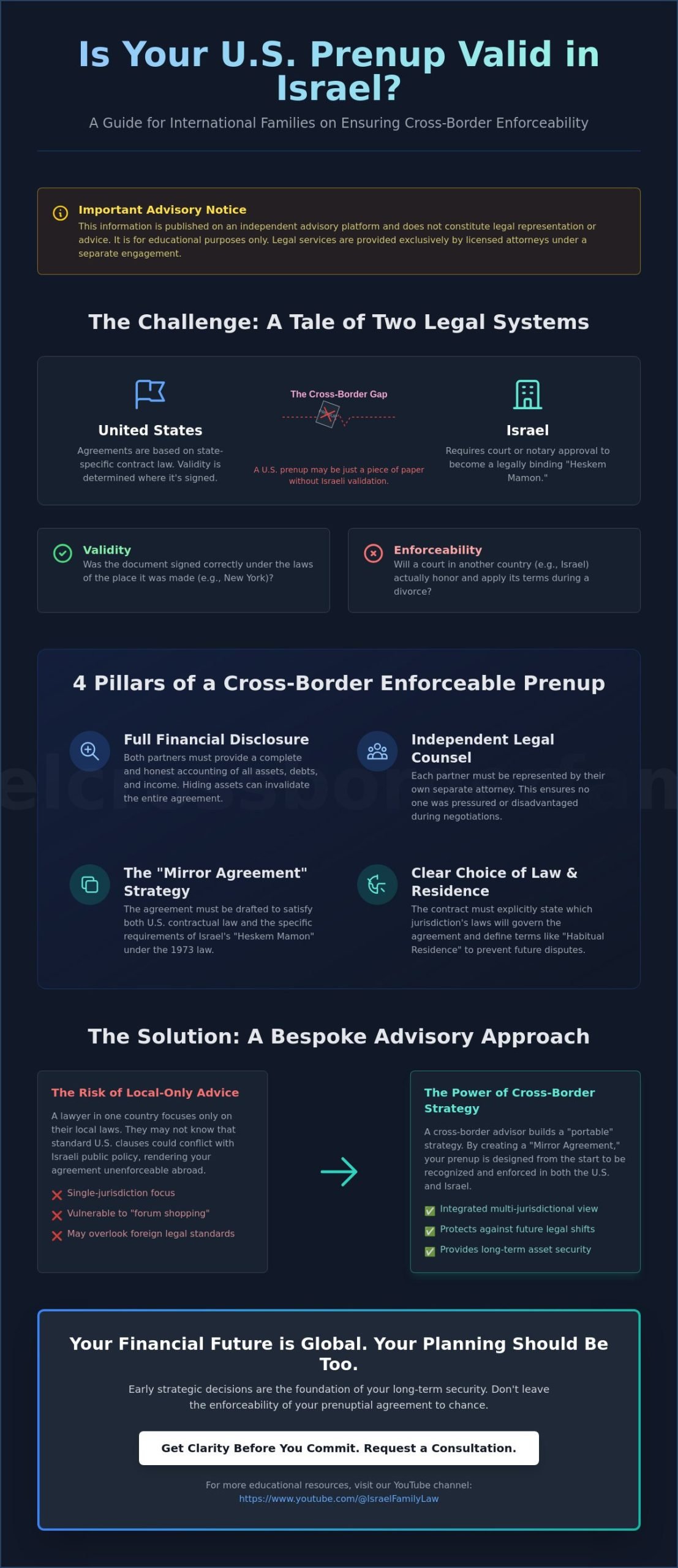
A Prenuptial agreement is often drafted with a single jurisdiction in mind. In the US, matrimonial law varies significantly between states, but these rules usually stop at the border. Many families assume that if a document is valid where they signed it, it’ll be enforceable wherever they move. This is a dangerous assumption. Understanding what makes a prenup valid across borders requires looking past the signature and toward the destination. Validity refers to whether the document was signed correctly under the law of the place of execution. Enforceability is a different matter. It refers to whether a court in a different country, like Israel, will actually honor those terms during a divorce.
Family law is one of the most localized legal sectors. Even as families become global, the courts deciding their fate stay rooted in national tradition and specific statutes. A document that works in Manhattan might be ignored in Tel Aviv if it doesn’t meet specific local standards. To better understand how these documents are viewed by the law, watch this helpful video:
Why ‘Local’ Advice Isn’t Enough
A lawyer in New York or California focuses on their specific state’s domestic relations codes. They might not realize that certain clauses, while standard in the US, could conflict with Israeli public policy. For example, Israel’s Spouses’ Property Relations Law (1973) has strict requirements for what it calls a “Heskem Mamon.” If your US agreement doesn’t mirror these standards, it might be set aside. Without a cross-border strategy, you risk “forum shopping.” This happens when one spouse tries to file for divorce in the country where the laws are most favorable to them. Early strategic decisions aren’t just paperwork; they are the foundation of your long-term asset security. What makes a prenup valid across borders is the foresight to address these conflicting systems before a crisis occurs.
The US-Israel Context
Families with assets in both the US and Israel face unique hurdles. If you own property in Tel Aviv but live in the US, or vice versa, the “governing law” of your marriage can shift when you relocate. This change in habitual residence can trigger new legal obligations you didn’t anticipate. It’s essential to seek clarity for international families before these shifts occur. Moving between jurisdictions changes how a court views your marital property. In Israel, the default is an equal “balancing of resources” for assets acquired during the marriage. If your US prenup wasn’t properly validated in Israel, you might find your pre-marital planning is suddenly irrelevant under Israeli law.
Get clarity before you commit. Request a confidential consultation.
This article is published on an independent advisory platform and does not constitute legal representation or legal advice. It does not imply an attorney-client relationship. Legal services are only provided by licensed attorneys under a separate engagement.
4 Essential Criteria for Cross-Border Validity
Establishing what makes a prenup valid across borders requires a rigorous focus on four specific pillars. While you might feel your agreement is secure because it was signed in a professional setting, international courts look for specific procedural safeguards to ensure the contract is fair. Without these, a judge in Israel may decide the agreement is unenforceable, regardless of its status in the US. These criteria act as your primary defense against future legal challenges.
The Role of Financial Disclosure
Full and fair financial disclosure is the absolute requirement in both the US and IL. In a cross-border setting, this means disclosing every asset, including foreign bank accounts, real estate in Tel Aviv, or stock options in a US startup. If you hide a “minor” asset in one country, it can void the entire agreement years later. You should document asset values across different currencies and markets clearly. This transparency builds the “procedural fairness” that courts require. International firms often highlight that Cross Border Prenuptial Agreements lack a single global standard, which makes this detailed disclosure even more vital for long-term security.
Independent Advice and Translation
Each party must have their own unconflicted advisor. You can’t use the same lawyer or even lawyers from the same firm. Ideally, both partners should consult with practitioners who understand the relevant jurisdictions. If one partner is not fluent in the language of the contract, you need a certified translation. A spouse who signs a document they don’t fully understand can later claim they were misled. Ensuring both partners have clear, independent guidance is a key part of how the process works to protect both parties.
The absence of duress is equally important. Timing is a major risk factor. If you present a prenup to your partner the day before the wedding, a court might view this as “pressure,” making the agreement vulnerable. Most experts suggest finalizing the document at least thirty days before the ceremony. This ensures both partners had sufficient time to review the terms and seek advice without the stress of an impending event.
Finally, you must respect the formalities of execution. This is where many families encounter the gap between “Habitual Residence” and “Domicile.” Domicile is the place you consider your permanent home, while habitual residence is where you actually live day-to-day. Israeli courts often prioritize your habitual residence when determining which law applies to your marriage. To ensure your agreement stands up, it must meet the specific signing requirements of both your current home and your intended future home. You may want to discuss your specific relocation plans to see how these definitions might impact your agreement’s validity.
Get clarity before you commit. Request a confidential consultation.
This article is published on an independent advisory platform and does not constitute legal representation or legal advice. It does not imply an attorney-client relationship. Legal services are only provided by licensed attorneys under a separate engagement.
Navigating the US-Israel Legal Divide
Moving from the US to Israel introduces a fundamental shift in how the law views your marital assets. In the United States, a prenuptial agreement is primarily treated as a private contract between two individuals. However, in Israel, the legal framework is more rigid and statutory. The Spouses’ Property Relations Law of 1973 dictates that any deviation from the default principle of equal “balancing of resources” must be documented in a specific type of contract known as a “Heskem Mamon.” Without this specific classification, your US agreement may face significant hurdles during an Israeli divorce.
To bridge this gap, many families employ a “Mirror Agreement” strategy. This involves drafting documents that satisfy both the contractual standards of a US state and the statutory requirements of Israeli law simultaneously. This prevents the risk of re-litigation. If an Israeli court finds that a US agreement hasn’t followed local procedural rules, it might ignore the document entirely. It’s a common pitfall for those who assume a “valid” US document is automatically an “enforceable” Israeli one. High-level firms often emphasize that Cross-Border Prenuptial Agreements require a deep understanding of these local statutory requirements to avoid being disregarded by foreign judges.
For Jewish couples, the “Get” or religious divorce adds a layer of complexity that doesn’t exist in US civil law. While civil courts handle property division, the Rabbinical Court oversees the actual dissolution of the marriage. A well-drafted agreement should include clauses that encourage cooperation in the religious process. This ensures neither party is left in a state of legal limbo. What makes a prenup valid across borders in this context is its ability to address both the civil and religious aspects of the separation.
The Israeli Court Approval Requirement
In Israel, a prenuptial agreement isn’t legally binding just because it’s signed. It must be approved by a judge in the Family Court, a Rabbinical Court, or a licensed notary. This process ensures both partners understand the consequences of the agreement. A US prenup that was never validated according to these specific standards may be ruled invalid in Israel. Aligning your divorce and separation strategies across both systems is the only way to ensure your intent is honored if you relocate.
Religious vs. Civil Jurisdiction
Israel maintains a dual-court system where both the Family Court and the Rabbinical Court can have authority over financial matters depending on who files first. This often leads to a “race to the court” that can complicate even the simplest divorce. A robust prenup can pre-determine which court will handle specific issues, providing much-needed predictability. By including clear jurisdiction clauses, you can avoid the uncertainty of the religious court’s intervention in your financial affairs. This strategic planning is a cornerstone of protecting your assets in a cross-border environment.
Get clarity before you commit. Request a confidential consultation.
This article is published on an independent advisory platform and does not constitute legal representation or legal advice. It does not imply an attorney-client relationship. Legal services are only provided by licensed attorneys under a separate engagement.
Strategic Drafting for Future Relocation
Drafting for a potential relocation is often what makes a prenup valid across borders in the long term. Many couples sign an agreement while living in New York or California without considering that their “center of life” might shift to Tel Aviv a decade later. A static document that only addresses your current home is a significant risk. You need a strategy that anticipates change. This requires including both a “Choice of Law” clause and a “Choice of Forum” clause. While they sound similar, they serve different purposes. One determines which country’s rules apply to your assets, while the other decides which country’s court system has the authority to hear your case.
Strategic drafting also involves planning for the unique flow of assets between the US and Israel. This is especially true for families involved in the technology sector. An Israeli “Exit” or the vesting of US-based equity can create complex valuation issues during a divorce. Your agreement should clearly define how these interests are treated, whether they are considered separate or marital property. Additionally, you must consider the welfare of your family. Including provisions for international custody and relocation can help provide a framework for future decisions, reducing conflict during a stressful transition.
Anticipating the ‘Habitual Residence’
Courts in both jurisdictions will look at your “habitual residence” to determine which laws should govern your separation. This is often described as your “center of life.” Judges look at where you pay taxes, where your children go to school, and where you maintain your primary social ties. If your prenup doesn’t account for a shift in this residence, a judge might decide that local laws override your original contract. Drafting for flexibility is essential. You should also consider the importance of periodic reviews. A postnuptial update can ensure your agreement remains relevant if you move to a third country or if your financial situation changes significantly.
Protecting Cross-Border Assets
Managing real estate in Israel while living in the US requires specific clauses to ensure the property is handled according to your wishes. The same applies to financial vehicles that are unique to each country. While a US lawyer is familiar with 401ks and IRAs, they may not understand the tax or legal implications of an Israeli “Keren Hishtalmut” (a tax-advantaged study fund). These funds have specific rules regarding withdrawal and ownership that must be addressed. It’s vital to understand the advisory process before you commit to a final draft. This ensures every cross-border asset is identified and protected. If you are planning a move or hold assets in both countries, discuss your drafting strategy with a professional who understands both systems.
Get clarity before you commit. Request a confidential consultation.
This article is published on an independent advisory platform and does not constitute legal representation or legal advice. It does not imply an attorney-client relationship. Legal services are only provided by licensed attorneys under a separate engagement.
Ensuring Enforceability: The Advisory Approach
Understanding what makes a prenup valid across borders requires moving beyond generic templates found online. A standard document might satisfy basic domestic requirements, but it often fails to account for the multi-jurisdictional complexity of a life split between the US and Israel. A bespoke strategy is designed to withstand the scrutiny of different legal cultures. While a template provides a starting point, an advisory approach focuses on the specific “weak points” that could lead a judge to set the agreement aside years later.
Fairness is not a static concept. A provision that appears equitable during the initial drafting phase may be viewed as unconscionable by a judge decades later if circumstances have shifted significantly. This is particularly relevant in Israel, where courts maintain a high standard for procedural fairness. A cross-border practitioner acts as a bridge. They ensure that the language used in a US contract translates effectively into the Israeli “Heskem Mamon” framework. Before you consider your agreement finalized, use this checklist to ensure it is ready for international travel:
- Does the document include full disclosure of all global assets, including those in both the US and IL?
- Were both parties represented by independent counsel licensed in the relevant jurisdictions?
- Has the agreement been formally validated by an Israeli court or notary if you intend to live in Israel?
- Are the Choice of Law and Choice of Forum clauses clearly defined to avoid jurisdictional disputes?
Risk-Based Decision Making
The goal of a cross-border agreement is to move from emotional reactions to strategic financial planning. This starts with identifying the specific risks associated with your relocation or asset structure. A confidential case review can help you assess these multi-jurisdictional risks before you sign. By identifying potential conflicts early, you can draft provisions that mitigate those risks. This proactive stance is the most effective way to ensure your assets remain protected regardless of where your life takes you.
Next Steps for International Couples
If you are part of a US-Israel family, your next step should be consulting with practitioners who understand both systems. Relying on a lawyer who only knows one side of the border is a common mistake that can lead to unenforceable terms. You can find more educational resources and deep dives into specific topics on the Israel Family Law YouTube channel. Taking the time to understand these nuances now will provide peace of mind for the future.
Get clarity before you commit. Request a confidential consultation.
This article is published on an independent advisory platform and does not constitute legal representation or legal advice. It does not imply an attorney-client relationship. Legal services are only provided by licensed attorneys under a separate engagement.
Securing Your Global Future
Navigating the intersection of US and Israeli law requires more than a standard contract; it demands a strategic, risk-based approach. We have explored how the “Mirror Agreement” strategy and a deep understanding of habitual residence can prevent the risk of re-litigation. By focusing on what makes a prenup valid across borders, families can ensure that their assets, from US equity to Israeli property, remain protected under both legal systems. This proactive planning is the most effective way to manage the inherent complexity of a transnational life.
Key takeaways include the necessity of formal court or notarial approval in Israel to establish a Heskem Mamon and the importance of addressing religious jurisdiction early to avoid a “race to the court.” Our expertise in US-Israel cross-border family law provides a framework for international families and expats to make informed choices. Moving between jurisdictions doesn’t have to mean leaving your financial security to chance.
Get clarity before you commit. Request a confidential consultation.
Taking these steps today ensures that your transition between countries remains a source of opportunity rather than a legal burden. With the right strategy, you can build a future that is secure in every jurisdiction.
This article is published on an independent advisory platform and does not constitute legal representation or legal advice. It does not imply an attorney-client relationship. Legal services are only provided by licensed attorneys under a separate engagement.
Frequently Asked Questions
Is a US prenuptial agreement automatically valid in Israel?
No, a US prenuptial agreement is not automatically valid or enforceable in Israel. To ensure it holds weight, the document must be approved by an Israeli Family Court, Rabbinical Court, or a licensed notary. This process confirms that both parties entered the agreement voluntarily and fully understand its consequences. Without this formal validation, an Israeli judge may apply default property laws instead of your private contract.
What is a ‘Heskem Mamon’ and do I need one if I already have a prenup?
A Heskem Mamon is the specific legal term for a financial agreement under the Israeli Spouses’ Property Relations Law of 1973. If you already have a US prenup, it must be adapted or validated to meet these local statutory requirements. Simply possessing a foreign document is often insufficient to override the default principle of equal balancing of resources during a divorce in Israel.
Can an Israeli court change the terms of my US prenuptial agreement?
Israeli courts can intervene if an agreement is found to be procedurally flawed or unconscionable. Understanding what makes a prenup valid across borders involves ensuring the document meets the “procedural fairness” standards of both jurisdictions. If a judge determines that there was insufficient financial disclosure or that the terms violate Israeli public policy, they may choose to re-litigate specific clauses to achieve a fair outcome.
What happens to my assets in Israel if my prenup was only signed in New York?
Assets located in Israel may be subject to the Israeli default “balancing of resources” if your New York agreement is not properly validated locally. While your US document might govern assets in America, Israeli courts maintain jurisdiction over local real estate and financial funds. Validating your agreement in Israel ensures that your intent for these specific assets is respected by local authorities and religious courts.
Do we need two separate lawyers to make a prenup valid across borders?
Yes, independent legal counsel for each party is a fundamental requirement for validity in both the US and Israel. Using a single lawyer, or even lawyers from the same firm, creates a conflict of interest that can void the entire agreement. This requirement is a core component of what makes a prenup valid across borders, as it demonstrates that neither spouse was pressured or misled during negotiations.
How does ‘habitual residence’ affect the enforceability of my prenup?
Habitual residence, or your “center of life,” often determines which country’s law a court will apply during a divorce. If you live in Israel for a significant period, a judge may apply Israeli law regardless of where you signed your prenup. Drafting your agreement to include specific Choice of Law clauses helps provide predictability and asset security when your habitual residence changes from one country to another.
Can I include child support terms in an international prenup?
No, you generally cannot include binding child support terms in a prenuptial agreement. In Israel, as in most US states, the court maintains the authority to determine support based on the child’s best interests at the time of the separation. While you can outline your intentions, these clauses are typically advisory and don’t override the court’s statutory duty to protect the children’s financial welfare.
What makes a prenup ‘unfair’ in the eyes of an Israeli judge?
An Israeli judge may view a prenup as unfair if there was a significant lack of financial disclosure or evidence of duress at the time of signing. If the enforcement of the agreement would leave one spouse in extreme financial distress, the court might set aside certain provisions. Ensuring that the agreement remains equitable even as circumstances change is a primary goal of a strategic, risk-based advisory process.

Article by
Gabriel Lior
A Personal Journey That Became a Mission
The advisory was founded by an American father Gabriel Lior, LLB, MBA , global entrepreneur, and cross-border advisor who spent more than a decade navigating the Israeli family court system firsthand and now lives in Singapore with his son.
As a divorced parent in a cross-border family, Gabriel faced nearly every legal challenge a foreign parent can encounter in Israel — including child custody disputes, child support proceedings, property matters in Israel and abroad, false accusations, and complex immigration and relocation proceedings.
Over the years, he learned the hard way how difficult it is for non-Israeli parents to understand the system, identify the right legal strategy, and choose the right legal representation — especially when language, culture, and jurisdictional differences are involved. He also witnessed how foreign parents and new immigrants are often disadvantaged or taken advantage of by service providers and institutions simply because they lack local knowledge or fluency.
From Client to Advisor
To truly understand — and survive — the system, Gabriel pursued formal legal education in Israel, completing two Israeli law degrees, alongside a BA and MBA earned in the United States. This was never about becoming a practicing attorney, but about gaining a deep, structural understanding of how the system works — and where it breaks down for foreign parents.
This rare combination of:
Firsthand client experience
Israeli legal and US business education
International business and negotiation training
Decades of commercial execution
created a unique perspective – one that understands both sides of the table.
After years of litigation, persistence, and at times self-representation, he ultimately succeeded in securing custody of his son and relocating abroad through a rare legal victory in the Israeli Supreme Court — becoming one of the first fathers in Israel to do so under these circumstances.
Disclaimer
Important Disclaimer:
The information provided on this website and in its content is for general informational and educational purposes only and does not constitute legal advice, legal opinion, or legal representation.
Gabriel Lior is not licensed to practice law in Israel (nor is he interested in doing so) and does not provide legal services, despite having completed 2 Law Degrees. The services offered are advisory in nature and are intended to provide general guidance, strategic insight, and information regarding cross-border family law considerations.
No attorney-client relationship is formed by accessing this website, reading its content, or communicating with us.
Any decisions made based on this information are at your own discretion and risk. For legal advice specific to your situation, you should consult a licensed attorney in the relevant jurisdiction.
Where appropriate, we may refer clients to independent, licensed attorneys or professionals. Such referrals do not constitute legal representation and no liability is assumed for services provided by third parties.
Related Insights & Resources

Avocat spécialisé en aliénation parentale internationale : Naviguer les litiges de garde entre les États-Unis et Israël
Et si les 6 000 miles entre les États-Unis et Israël n'étaient pas seulement un...Read More →
Reconnaissance du mariage entre Israël et les États-Unis : Un guide juridique transfrontalier
Et si la décision la plus importante pour l'avenir de votre famille en Israël n'était...Read More →
Finding a Family Law Lawyer in Israel: A Comprehensive Guide
Navigating a family law matter in Israel presents a unique set of complexities, particularly for...Read More →