This article is published on an independent advisory platform, not a law firm. The content provided is for informational and advisory purposes only and does not constitute legal representation or legal advice. Legal services are only provided by licensed attorneys under a separate engagement.
What if the most effective way to protect your family’s future isn’t a document you signed before your wedding, but one you create today? Many international families feel a sense of anxiety when they realize that living as an expat has fundamentally changed how the law views their property. You likely understand the challenge of managing assets across two different legal systems; it’s a complex reality where U.S. based accounts and Israeli property often collide. This guide explains how postnuptial agreements for expat couples can secure your financial future and manage cross-border risks through a strategic, neutral framework.
You’ll learn how to navigate the 2026 legal landscape, including the $15 million U.S. federal estate tax exemption and the specific requirements for Israeli court approval. We’ll also preview how these agreements protect business growth and inheritances within the Israeli legal context. For more insights on protecting your family’s interests, you can view our detailed guides at https://www.youtube.com/@IsraelFamilyLaw. Get clarity before you commit. Request a confidential consultation.
Key Takeaways
- Navigate the friction between U.S. property rules and the Israeli default matrimonial regime to ensure your global assets are categorized correctly.
- Learn why postnuptial agreements for expat couples are a vital tool for families who didn’t sign a prenuptial agreement but now face cross-border financial changes.
- Understand the mandatory judicial review process in Israel that ensures your agreement is entered into voluntarily and remains enforceable in 2026.
- Discover strategic methods to protect future inheritances and business equity from being automatically split under the default laws of either nation.
- Shift from reactive planning to a strategy-based approach that addresses the unique risks of living between two different legal cultures.
Understanding Postnuptial Agreements for Expat Couples
This article is published on an independent advisory platform (not a law firm) and is intended for informational purposes only. It does not imply or create an attorney-client relationship. Legal services are only provided by licensed attorneys under a separate engagement.
A postnuptial agreement serves as a strategic tool for managing multi-jurisdictional financial risk. For many international families, the realization that their financial landscape has shifted often comes after the move is complete. Postnuptial agreements for expat couples provide a necessary framework to address assets that span both the U.S. and Israel, ensuring that neither spouse is left vulnerable to the default rules of a system they don’t fully understand. These agreements are not about anticipating failure; they’re about recognizing that a marriage established in New York or California operates differently under the laws of Jerusalem or Tel Aviv.
To better understand why timing and jurisdiction matter so much, watch this helpful video regarding the considerations for these agreements:
The Role of the Heskem Mamon in Israeli Law
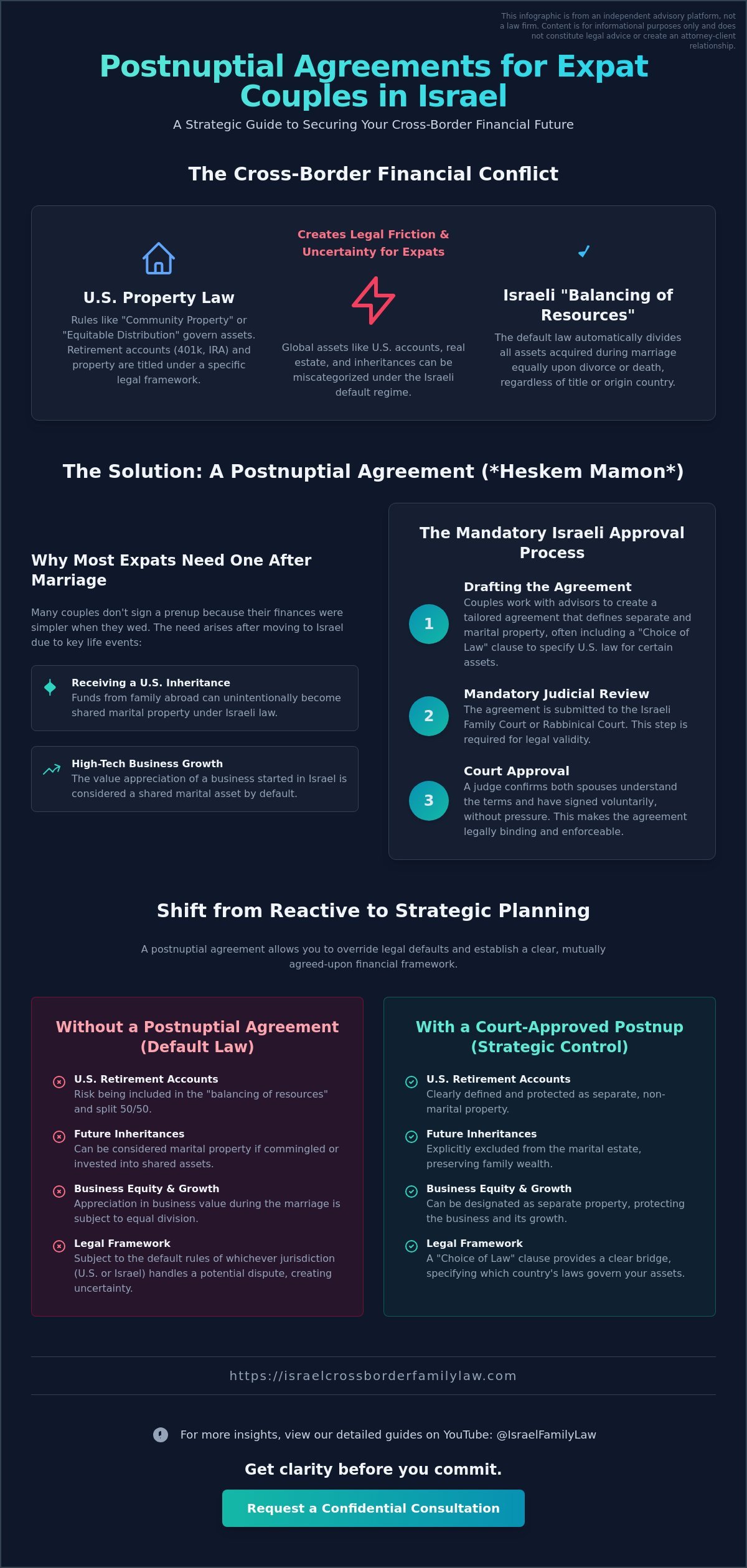
In Israel, the Spouses’ Property Relations Law of 1973 dictates that assets acquired during a marriage are divided equally upon divorce or death. This default regime, known as the “balancing of resources,” can create significant friction for expats and foreign nationals who hold U.S. retirement accounts or real estate. To override this default, couples must enter into a Heskem Mamon (Financial Agreement). Unlike many U.S. jurisdictions where a signed contract might suffice, an Israeli postnuptial agreement must be approved by the Family Court or the Rabbinical Court to be legally binding. This judicial review ensures both parties understand the terms and are entering the agreement voluntarily. Including a “Choice of Law” clause is often essential for expats, as it allows them to specify which country’s laws should govern their assets, providing a bridge between the two legal cultures.
Why Expats Miss the Prenuptial Window
Many couples arrive in Israel without a prenuptial agreement because their financial lives were simpler when they wed. The need for postnuptial agreements for expat couples often arises from specific life milestones, such as receiving a significant inheritance from U.S. based family or the rapid growth of a high-tech business venture in Israel. There is a common misconception that once you’re married, it’s “too late” to organize your finances. In reality, the shift from a U.S. common law perspective to the Israeli system makes mid-marriage planning even more critical. Addressing these complexities now prevents the anxiety of leaving global assets unprotected. Moving forward with a clear strategy allows you to protect family wealth while maintaining a neutral, non-confrontational dialogue with your spouse. Get clarity before you commit. Request a confidential consultation.
This article is published on an independent advisory platform, not a law firm. The content provided is for informational and advisory purposes only and does not constitute legal representation or legal advice. Legal services are only provided by licensed attorneys under a separate engagement.
Cross-Border Complexity: The Interplay Between US and Israeli Law
Managing assets across borders requires an understanding of how two distinct legal systems interact. This creates a jurisdictional gap. While many U.S. states operate under community property or equitable distribution rules, Israel follows the Spouses’ Property Relations Law of 1973. The discrepancy means an asset’s status depends entirely on which court is looking at it. For example, a U.S. retirement account might be viewed as separate property in some states but could be subject to equal division in an Israeli court if no agreement exists. Israeli courts often claim jurisdiction over global assets if the couple resides in IL, including property located in New York or Florida.
Using postnuptial agreements for international couples helps bridge this gap. A generic template found online cannot account for the way Israeli judges view U.S. based real estate or the risk of conflicting court orders. Without a tailored strategy, families risk “limping” agreements that are valid in one country but unenforceable in another. These conflicting orders can lead to years of litigation in two different countries simultaneously, which is why a “one-size-fits-all” approach fails international families.
Enforceability Challenges Across Jurisdictions
Will a U.S. court recognize an agreement signed in Tel Aviv? Generally, the principle of comity allows for this, but enforcement isn’t automatic. If the agreement doesn’t meet the standards of both jurisdictions, such as the requirement for independent counsel for both spouses, one party might attempt “forum shopping” to find a more favorable court. This highlights why postnuptial agreements for expat couples must be drafted with a multi-jurisdictional lens. Each spouse needs their own legal representative to prevent future claims of duress or unfairness that could void the contract in a U.S. court.
Managing Global Assets and Business Interests
Expats often face the challenge of commingling assets. A pre-marital U.S. brokerage account might become “joint” in the eyes of Israeli law if marital funds were used to manage it or if the couple relied on it for daily expenses after the move. This is particularly relevant for founders in Israel’s high-tech sector. Protecting “exit” proceeds requires a clear framework before the liquidity event occurs. Understanding the nuances of divorce and separation for international families is the first step toward preventing these complications. Get clarity before you commit; request a confidential consultation to discuss how to safeguard your specific global interests.
This article is published on an independent advisory platform (not a law firm) and is intended for informational purposes only. It does not imply or create an attorney-client relationship.
Strategic Benefits of a Postnuptial Agreement for Expats
Living between two legal cultures creates a unique set of financial vulnerabilities. For many, postnuptial agreements for expat couples act as a stabilizing force, providing essential certainty where international law is often vague. When you reside in Israel while maintaining financial ties to the U.S., you’re essentially operating under two different rulebooks. A strategic agreement allows you to merge these rules into a single, predictable framework. This proactive approach reduces the likelihood of future disputes and significantly lowers potential litigation costs by establishing a clear roadmap before a crisis occurs.
Inheritance and Future Windfalls
One of the most critical functions of a postnup is “ring-fencing” future inheritances. Under Israeli law, the default is that assets acquired during marriage are shared; however, specific inheritances can be kept separate if handled correctly. The lines often blur when those funds are used to pay off an Israeli mortgage or are invested in joint ventures. With the U.S. federal estate tax exemption set at $15 million per individual in 2026, the stakes for international families are high. A valid agreement ensures that family wealth remains with the intended recipient. Full and frank disclosure is the cornerstone of this process. Without it, even a well-drafted document may fail under judicial scrutiny in either jurisdiction. Integrating these agreements with your broader international estate planning ensures your global footprint remains protected.
Addressing the Alimony Gap
The concept of spousal support, or alimony, varies significantly between the U.S. and IL. In many U.S. states, alimony is calculated based on the length of the marriage and the previous standard of living. In Israel, the system of “Mezonot” is influenced by personal status law and can be adjudicated in either the Family Court or the Rabbinical Court. These systems often produce different outcomes. A postnup allows a couple to define “maintenance” on their own terms, avoiding the “race to the court” that often happens when one spouse seeks a more favorable jurisdiction. For a deeper visual explanation of how spousal support is handled in cross-border cases, you can find helpful resources on the YouTube channel “IsraelFamilyLaw.” By clarifying these expectations now, you remove the element of surprise and ensure that any future financial arrangements are based on mutual agreement rather than court-imposed mandates. Get clarity before you commit. Request a confidential consultation.
This article is published on an independent advisory platform (not a law firm) and is intended for informational purposes only. It does not imply or create an attorney-client relationship. Legal services are only provided by licensed attorneys under a separate engagement.
Drafting a Valid Agreement: Essential Considerations
Creating a legally sound document requires more than just listing assets on a page. It is a precise technical exercise in risk management. For postnuptial agreements for expat couples, the foundation of validity rests on full and frank financial disclosure. This means every asset, regardless of where it is located globally, must be identified and valued. If a court later determines that one spouse withheld information about a U.S. retirement account or an Israeli business interest, the entire agreement may be set aside as fraudulent. Transparency is not just a moral choice; it is your primary defense against future legal challenges.
The Disclosure Process for International Assets
Full disclosure in a cross-border context is often more complex than in domestic cases. You must account for assets spread across different continents and tax systems. Common mistakes include overlooking “situs” assets, such as U.S. brokerage accounts, or failing to disclose the true value of overseas business ventures. In 2026, with increased global financial reporting, courts have greater access to transnational data. Providing a comprehensive schedule of assets, including debts and potential future interests, ensures the agreement holds up under the scrutiny of both U.S. and Israeli judicial standards.
Independent Counsel and Cultural Nuance
One of the most dangerous risks in drafting is attempting to use a single lawyer for both spouses. To prevent future “duress” claims, each party must receive independent legal advice. This ensures that both spouses fully understand the legal consequences of the document and are signing it voluntarily. Cultural differences in the definition of “fairness” can also lead to disputes. What seems fair in a U.S. common law context might be viewed differently under the Israeli Spouses’ Property Relations Law. This is why a tailored approach for expats and foreign nationals is essential for long-term security.
The procedural steps in Israel are distinct and mandatory. Unlike many U.S. jurisdictions where a notarized signature might suffice, an Israeli postnuptial agreement must be approved by a judge in the Family Court or the Rabbinical Court. During this session, the judge will speak with both spouses to verify they understand the terms and are entering the agreement of their own free will. This judicial “stamp of approval” is what transforms a private contract into a binding legal judgment in IL. To ensure your strategy meets these rigorous standards, request a confidential consultation before you finalize any documents.
This article is published on an independent advisory platform, not a law firm. The content provided is for informational and advisory purposes only and does not constitute legal representation or legal advice. Legal services are only provided by licensed attorneys under a separate engagement.
The Advisory Approach: Strategy Before Commitment
Adopting a strategy-first approach is essential when dealing with the transnational complexity of family law. For international families, the decision to enter into postnuptial agreements for expat couples shouldn’t be a reactive response to conflict. Instead, it’s a calculated move to manage multi-jurisdictional risk. You must evaluate the risks of doing nothing against the potential liabilities of an improperly drafted agreement. Doing nothing is a choice to accept the default Israeli “balancing of resources” or the unpredictable application of U.S. state laws to your global estate. Conversely, a poorly constructed document can lead to “limping” legal status, where you’re protected in one country but exposed in another.
An international family law advisor serves as a bridge between the U.S. and Israeli systems, ensuring that your financial framework remains robust across borders. The goal is to provide a sense of security and comprehensive support for the entire family unit. By addressing these issues through a lens of corporate formality and strategic established practices, you replace anxiety with a structured plan. This clarity allows you to focus on your commercial goals and family life without the undercurrent of legal uncertainty.
Risk-Based Decision Making for International Couples
Identifying the specific “trigger points” in your expat journey is the first step toward effective planning. These triggers often include the purchase of real estate in Israel, the expansion of a U.S. based business, or the receipt of a family inheritance. Early decisions have a profound impact on your long-term financial health; waiting until a crisis occurs often limits your strategic options. It’s vital to remember that this guide serves as an informational resource to help you understand the landscape. It is not a substitute for licensed legal representation, which is required to finalize any binding agreement.
Next Steps for Expat Families
Starting a conversation about finances with a spouse can be sensitive. We recommend approaching the topic in a neutral, calm manner, framing it as a mutual exercise in family protection rather than a confrontational demand. Begin by gathering documentation for your global assets, including U.S. retirement accounts, Israeli property deeds, and any business equity. To understand how the process unfolds, you can review our how it works page or check our pricing for strategy sessions. For more detailed visual guides on managing these cross-border challenges, visit the YouTube channel “IsraelFamilyLaw.” Get clarity before you commit. Request a confidential consultation.
This article is published on an independent advisory platform, not a law firm. The content provided is for informational and advisory purposes only and does not constitute legal representation or legal advice. Legal services are only provided by licensed attorneys under a separate engagement.
Securing Your Global Legacy Through Strategic Planning
The complexity of managing wealth across borders in 2026 requires a shift from reactive worry to proactive strategy. As we’ve explored, the default property regimes in IL can create significant friction with U.S. based assets if left unaddressed. By establishing a clear framework for inheritances, business growth, and spousal support, you can ensure your family’s financial health remains intact regardless of jurisdictional shifts. The most successful outcomes for international families involve early decision making and a commitment to transparency.
Our advisory approach is specifically tailored for the Anglo and expat community. We offer specialized expertise in cross-border US-Israel family law and multi-jurisdictional asset protection. Utilizing postnuptial agreements for expat couples is about more than just legal protection; it’s about providing your family with the certainty they deserve. You don’t have to navigate these divergent systems alone. Get clarity before you commit. Request a confidential consultation.
This article is published on an independent advisory platform (not a law firm) and is intended for informational purposes only. It does not imply or create an attorney-client relationship. Legal services are only provided by licensed attorneys under a separate engagement.
Frequently Asked Questions
Can a postnuptial agreement signed in Israel be enforced in the United States?
US courts generally recognize postnuptial agreements for expat couples signed abroad through the principle of comity. However, the agreement must satisfy local standards of fairness and transparency to be upheld. If a US judge finds that the agreement violates public policy or was signed without full disclosure, they may refuse to enforce it within their jurisdiction. Ensuring the document meets the requirements of both legal systems is essential for cross-border protection.
Is a postnuptial agreement valid if we did not have a prenuptial agreement?
It is never too late to organize your finances and protect your global assets. Postnuptial agreements for expat couples are specifically designed for those who are already married but wish to clarify their property rights. They allow families to address new financial realities, such as a relocation to Israel or the acquisition of international business interests, providing a strategic framework for future security regardless of when the marriage began.
Do I need a separate lawyer from my spouse to sign a postnup in Israel?
Independent counsel is essential for both spouses to ensure the agreement is resilient against future legal challenges. This prevents one party from claiming they didn’t understand the terms or were pressured into signing the document. Having two separate lawyers confirms that the agreement meets the rigorous standards of fairness required by both US and Israeli courts. This procedural step is vital for making the document enforceable in multi-jurisdictional litigation.
What happens to my US-based 401k if we live in Israel and don’t have a postnup?
Without an agreement, your US based retirement accounts are subject to the Israeli Spouses’ Property Relations Law. This law mandates an equal balancing of resources for assets accumulated during the marriage. Israeli courts may include the value of your 401k in the total marital pot even if the funds are located outside of IL. This often surprises expats who assume their US accounts are protected exclusively by US state laws.
How much does it cost to draft a cross-border postnuptial agreement?
The investment for drafting a cross-border agreement depends on the complexity of your international holdings and the legal requirements of each jurisdiction. Professionals typically assess the scope of work based on the number of assets involved and the strategic depth needed for multi-jurisdictional enforcement. You should inquire about specific engagement terms directly with a qualified practitioner to understand the resources required for your unique family situation.
Can we include child custody arrangements in our postnuptial agreement?
Child custody provisions in a postnup are generally not legally binding in Israel. While you can express your intentions within the document, the Israeli court system retains the final authority to decide custody based on the child’s best interests at the time of a dispute. These agreements should remain focused on financial assets and property division to ensure they remain enforceable and provide the intended clarity for the couple’s global estate.
What is the difference between a postnup and a Heskem Mamon?
A Heskem Mamon is the formal Israeli legal term for a financial agreement that overrides the default property regime. While a US postnup is often viewed as a private contract, a Heskem Mamon is a specific statutory tool governed by the 1973 Financial Relations Law. Both serve to protect assets, but the Heskem Mamon has strict procedural requirements in IL that must be met for the document to be legally recognized.
Is court approval mandatory for a postnuptial agreement to be valid in Israel?
Court approval is a non-negotiable requirement for a postnup to be valid under Israeli law. A judge must personally review the document and speak with both spouses to confirm their voluntary consent and understanding of the terms. Without this judicial confirmation, the agreement will not be recognized by Israeli authorities, leaving your global assets exposed to the default balancing rules. This process is designed to ensure that both parties are fully aware of their legal rights.

Article by
Gabriel Lior
A Personal Journey That Became a Mission
The advisory was founded by an American father Gabriel Lior, LLB, MBA , global entrepreneur, and cross-border advisor who spent more than a decade navigating the Israeli family court system firsthand and now lives in Singapore with his son.
As a divorced parent in a cross-border family, Gabriel faced nearly every legal challenge a foreign parent can encounter in Israel — including child custody disputes, child support proceedings, property matters in Israel and abroad, false accusations, and complex immigration and relocation proceedings.
Over the years, he learned the hard way how difficult it is for non-Israeli parents to understand the system, identify the right legal strategy, and choose the right legal representation — especially when language, culture, and jurisdictional differences are involved. He also witnessed how foreign parents and new immigrants are often disadvantaged or taken advantage of by service providers and institutions simply because they lack local knowledge or fluency.
From Client to Advisor
To truly understand — and survive — the system, Gabriel pursued formal legal education in Israel, completing two Israeli law degrees, alongside a BA and MBA earned in the United States. This was never about becoming a practicing attorney, but about gaining a deep, structural understanding of how the system works — and where it breaks down for foreign parents.
This rare combination of:
Firsthand client experience
Israeli legal and US business education
International business and negotiation training
Decades of commercial execution
created a unique perspective – one that understands both sides of the table.
After years of litigation, persistence, and at times self-representation, he ultimately succeeded in securing custody of his son and relocating abroad through a rare legal victory in the Israeli Supreme Court — becoming one of the first fathers in Israel to do so under these circumstances.
Disclaimer
Important Disclaimer:
The information provided on this website and in its content is for general informational and educational purposes only and does not constitute legal advice, legal opinion, or legal representation.
Gabriel Lior is not licensed to practice law in Israel (nor is he interested in doing so) and does not provide legal services, despite having completed 2 Law Degrees. The services offered are advisory in nature and are intended to provide general guidance, strategic insight, and information regarding cross-border family law considerations.
No attorney-client relationship is formed by accessing this website, reading its content, or communicating with us.
Any decisions made based on this information are at your own discretion and risk. For legal advice specific to your situation, you should consult a licensed attorney in the relevant jurisdiction.
Where appropriate, we may refer clients to independent, licensed attorneys or professionals. Such referrals do not constitute legal representation and no liability is assumed for services provided by third parties.