This article is published on an independent advisory platform and does not constitute legal representation or an attorney-client relationship. Legal services are provided only by licensed attorneys under a separate engagement.
In the Israeli legal system, the person who files first often dictates the entire trajectory of the case. The “race for jurisdiction” is a critical strategic reality that can determine which laws apply to your property and your children. If you’re an expat or part of an international family, starting a divorce in israel often feels like navigating a maze where the rules change depending on which door you enter first. You might worry about how a Rabbinical court handles US-based assets or whether your rights as an English speaker will be fully protected.
We understand these concerns and want to provide the clarity you need to move forward with confidence. This guide offers a clear roadmap of the process, explaining the dual-jurisdiction system and the latest 2026 updates to child support and arbitration laws. You’ll learn how to identify jurisdictional risks and protect your cross-border interests before making any permanent commitments. For more visual guidance, you can explore detailed explanations on our YouTube channel. Get clarity before you commit. Request a confidential consultation.
Key Takeaways
- Understand the fundamental differences between Family and Rabbinical courts to manage the dual-jurisdiction reality of divorce in israel.
- Learn why the “race for jurisdiction” makes the timing and location of your first filing a critical strategic decision for your case.
- Discover how Israeli courts treat international assets, such as US-based retirement accounts and real estate, to protect your cross-border interests.
- Gain a clear roadmap for the mandatory dispute settlement process and learn how to handle mediation sessions with a strategic mindset.
- Identify why gathering financial records early and avoiding unvetted “temporary” agreements are essential steps for securing your future.
This article is published on an independent advisory platform and does not constitute legal representation or an attorney-client relationship. Legal services are provided only by licensed attorneys under a separate engagement.
Understanding the Israeli Divorce System: A Dual-Jurisdiction Reality
The legal framework for divorce in israel is built on a unique dual-system that often surprises those from Western backgrounds. It requires Understanding the Israeli Divorce System as a hybrid of secular and religious authority. While civil courts handle many family matters, the religious courts maintain exclusive power over the actual status of marriage for their respective communities. This means your faith, or the lack of it, dictates which rules apply to your personal status.
To better understand this concept, watch this helpful video:
For Jewish couples, the Rabbinical court is the only body that can grant a “Get,” the religious writ of divorce. Without this document, you remain legally married in the eyes of the state, even if you have a civil decree from abroad. Non-Jewish expats or those in civil marriages also face specific hurdles. While they may not need a religious “Get,” they must still navigate the Family Court to dissolve their union, a process often involving complex private international law and the coordination of foreign legal documents.
The Family Court vs. The Rabbinical Court
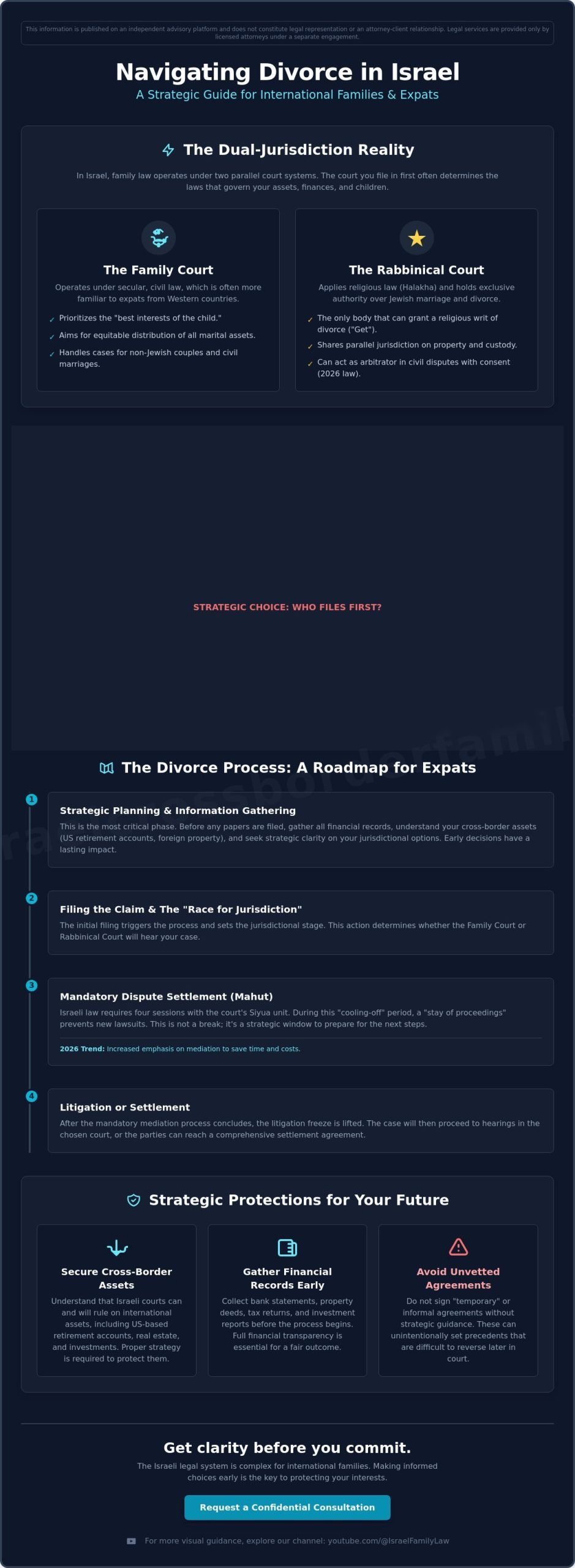
The Family Court operates under civil law principles, making it feel more familiar to those used to US systems. It prioritizes the “best interests of the child” and equitable distribution of assets. Conversely, the Rabbinical Court applies religious law. In 2025, Rabbinical courts imposed 156 sanctions on 36 men who refused to provide a “Get.” Because both courts share “parallel jurisdiction” over issues like property and custody, the court that receives the claim first usually keeps the case. This creates a strategic environment where early decisions carry heavy weight. You can find more about these dynamics on our page regarding divorce and separation for international families.
The Mandatory Mediation (Mahut) Process
Before you can litigate, IL law requires a “Settlement of Dispute” period. This involves four mandatory sessions with the court’s social workers, known as the Siyua unit. During this time, a “stay of proceedings” is in effect. Neither spouse can file new lawsuits while these meetings happen. It’s designed as a cooling-off period, but it’s also a time for high-level strategy. Recent 2026 trends show an increased shift toward mediation to save time and costs. Navigating a divorce in israel requires patience during this phase. Additionally, a March 2026 law now allows Rabbinical courts to act as arbitrators in civil disputes if both parties consent. Use this window to gather documentation and understand your risks before the litigation freeze ends. Get clarity before you commit. Request a confidential consultation.
This article is published on an independent advisory platform and does not constitute legal representation or an attorney-client relationship. Legal services are provided only by licensed attorneys under a separate engagement.
The “Race for Jurisdiction”: Why Filing First Matters
In the context of divorce in israel, the court that first receives a valid claim generally secures the authority to rule on all related matters. This procedural reality is widely known as The ‘Race for Jurisdiction’. It means that the spouse who initiates the process often chooses the legal environment that will govern their property, child custody, and financial future. Because the Family Court and the Rabbinical Court apply different legal principles, this first step is rarely just a matter of paperwork; it’s a foundational strategic move.
The system allows a party to “bind” ancillary issues to their divorce claim. By specifically including matters like the division of assets or child support in the initial filing, you ensure that one specific court handles the entire package. This prevents a situation where different issues are scattered across multiple legal venues. Recent legal shifts have made this race even more consequential. For example, as of November 2025, a two-year interim measure now allows Rabbinical courts to rule on child support payments, a power they previously lacked according to prior High Court rulings. This change significantly alters how one might approach the jurisdictional race.
How the Race to Court Functions
Navigating this race requires a methodical three-step approach. First, you must assess which court is likely to be more favorable for your specific circumstances. A spouse with significant foreign-earned assets might find the civil principles of the Family Court more predictable. Second, you must prepare a “bound” divorce claim. This document must be technically precise to ensure the court accepts jurisdiction over the attached property and custody issues. Third, you must understand the impact of the “Settlement of Dispute” filing. This initial application triggers a mandatory stay of proceedings, effectively “locking in” your chosen court while the mandatory mediation sessions take place.
Strategic Risks of Delay
For US expats and international families, waiting for a “better time” to address a failing marriage can lead to a permanent loss of jurisdictional advantage. If your spouse files first in a court system that doesn’t align with your interests, you may find yourself litigating complex cross-border issues in an unfamiliar legal setting. This is particularly risky when US-based assets like 401(k)s or real estate are involved, as the two court systems may view the division of these assets differently. Consulting a cross-border family lawyer early helps ensure you don’t lose the opportunity to set the stage for your case. It’s often helpful to review your specific situation before any formal papers are served. Get clarity before you commit. Request a confidential consultation.
This article is published on an independent advisory platform and does not constitute legal representation or an attorney-client relationship. Legal services are provided only by licensed attorneys under a separate engagement.
Cross-Border Complications: US Assets and Dual Citizenship
For expats and dual citizens, a divorce in israel isn’t just a local matter. It’s a complex intersection of two different legal and financial systems. Israeli courts generally operate under the “Balancing of Resources” principle. This rule dictates that assets accumulated during the marriage should be divided equally. However, when those assets include US-based real estate, 401(k) retirement accounts, or private business interests, the process becomes significantly more difficult. You must consider how a judge in Jerusalem or Tel Aviv will view property located thousands of miles away.
A major challenge involves the enforcement of court orders. While an Israeli court can rule on the division of a New York apartment, it doesn’t have the direct authority to force a sale or transfer title in the United States. Instead, Israeli judges often use a method called “offsetting.” They may grant one spouse a larger share of Israeli-based assets, like a family home or local bank accounts, to compensate for the value of property held abroad. This strategy requires precise, expert valuation of international holdings to ensure the final balance is truly equitable.
Tax implications also play a critical role in cross-border cases. A settlement that looks fair in an Israeli court might trigger unexpected IRS penalties for a US citizen. For instance, US retirement funds typically require a Qualified Domestic Relations Order (QDRO) for a tax-free transfer between spouses. An Israeli divorce decree isn’t automatically recognized as a QDRO. Without specific structural planning, a transfer of these funds could be treated as a taxable distribution, significantly reducing the actual value received by the beneficiary.
Asset Division and the US-Israel Intersection
Israeli law focuses on a mathematical split of marital growth, which differs from the “Equitable Distribution” model used in many US states. This rigid 50/50 approach makes expert valuation for international business holdings essential. Israeli courts generally respect foreign assets but may offset their value using local property. This simplifies the process by avoiding the need to litigate in multiple countries simultaneously, provided there are enough local assets to balance the ledger.
International Custody and Relocation
Custody matters involving dual-national children are governed by strict international treaties. Israel is an active member of the Hague Convention on Child Abduction, which aims to return children to their country of “habitual residence” if they’re moved without both parents’ consent. If one parent wishes to return to the US with the children, they face a very high legal bar. The court’s primary focus is maintaining the child’s existing stability in IL. It’s vital to seek professional strategy regarding international custody and relocation before any unilateral moves are made. Get clarity before you commit. Request a confidential consultation.
This article is published on an independent advisory platform and does not constitute legal representation or an attorney-client relationship. Legal services are provided only by licensed attorneys under a separate engagement.
The Divorce Process: A Roadmap for Expats
The journey through a divorce in israel begins formally with the “Request for Settlement of Dispute.” This filing initiates a mandatory stay of proceedings, which creates a required waiting period. It gives both parties a chance to resolve issues outside of a courtroom through the Siyua unit. You will attend up to four sessions with social workers and legal advisors who try to facilitate a mutual agreement. If these sessions don’t result in a signed settlement, the stay of proceedings eventually expires. At that point, the party who filed first has a 15-day exclusive window to submit their actual lawsuits to their chosen court.
Transitioning from mediation to litigation is a significant shift. If you move into the courtroom, the process follows the jurisdictional rules established in the initial “race.” For Jewish couples, even if property and custody are decided in the civil Family Court, the marriage is only legally dissolved through a specific ceremony at the Rabbinical Court. This ceremony culminates in the delivery of the “Get,” the religious divorce document.
Grounds for Divorce in the Rabbinical Court
Under Jewish law, a divorce usually requires a specific reason or “ground” unless both spouses agree to separate. Common grounds include domestic violence, desertion, or infidelity. When one party refuses to cooperate, they create a status known as “Get-refusal.” In 2025, the Rabbinical courts imposed 156 sanctions on 36 men and 41 sanctions on 12 women to address this issue. For women whose husbands have disappeared, a special unit successfully obtained a “Get” for 198 individuals in 2025. Pressure from the civil Family Court regarding property division can often help resolve these religious deadlocks.
Child Support and Spousal Maintenance
Understanding the financial obligations of a divorce in israel is essential, as the calculation methods differ from most US states. As of January 2026, the generally accepted minimum for a child’s essential needs ranges between ₪1,400 and ₪1,600 per month. This baseline does not include “extras” like extracurricular activities or private schooling. There is also a distinction between “Wife Maintenance” and typical spousal support. Wife maintenance is a payment intended to help a woman keep her standard of living until the divorce is final, but it usually ends once the “Get” is delivered. Navigating these payments across borders requires an understanding of child support cross-border enforcement to ensure obligations are met regardless of where a parent resides.
If you are unsure how these rules apply to your international situation, it is wise to discuss your case with an advisor. Get clarity before you commit. Request a confidential consultation.
This article is published on an independent advisory platform and does not constitute legal representation or an attorney-client relationship. Legal services are provided only by licensed attorneys under a separate engagement.
Strategic Planning: Protecting Your Future Before You File
Success in a divorce in israel depends heavily on the actions you take before the formal process begins. Because the system moves quickly once a “Request for Settlement of Dispute” is filed, you must have your documentation ready. This includes gathering comprehensive financial records for both IL and US assets. You need bank statements, property valuations, and retirement account summaries from the start. Without these, you may struggle to provide the expert valuations required for a fair balancing of resources. Israeli courts are increasingly using digital tools for case management in 2026, which allows for greater transparency but also requires parties to be more organized with their disclosures.
One common pitfall for expats is signing “temporary” agreements during the mandatory mediation phase. These documents are often presented as short-term fixes for parenting time or immediate financial needs. However, in the Israeli legal system, these interim arrangements frequently set a precedent that courts are reluctant to change later. You should never sign any document, no matter how minor it seems, without an international legal review. This ensures the agreement doesn’t compromise your long-term rights or trigger unintended tax consequences in the US.
Choosing the right support team is the next critical step. While a local Israeli lawyer is necessary for court filings, a cross-border advisory provides the strategic oversight needed for international lives. This broader perspective helps you weigh the pros and cons of different jurisdictions. It ensures that your strategy in IL doesn’t negatively impact your legal standing or asset protection in your home country.
The Role of an International Advisory
Navigating these complexities requires a specific type of support. It is important to understand that this article is published on an independent advisory platform, not a law firm. We provide strategic guidance and risk-based analysis specifically for international families. Actual legal representation and services in court require a separate engagement with licensed attorneys. You can learn more about how we bridge the gap between different legal cultures and systems by visiting our page on how it works.
Next Steps for Expats and Anglos
Early strategy is the most cost-effective way to manage your future. It allows you to anticipate jurisdictional risks rather than reacting to them after a spouse has already filed. For deeper insight into specific scenarios, we suggest watching the educational videos available at Israel Family Law. These resources help demystify the process for English speakers who are unfamiliar with local norms and the “race for jurisdiction.” Making informed choices now prevents expensive mistakes later. Get clarity before you commit. Request a confidential consultation.
This article is published on an independent advisory platform and does not constitute legal representation or an attorney-client relationship. Legal services are provided only by licensed attorneys under a separate engagement.
Securing Your Strategy for the Road Ahead
Navigating a divorce in israel requires more than just local legal knowledge; it demands a strategic understanding of how dual court systems interact with your international life. By recognizing the importance of the jurisdictional race and gathering comprehensive documentation for your US and Israeli assets early, you can significantly reduce the risks of unexpected legal or financial outcomes. Success in these matters often depends on the clarity you establish before the first document is filed.
Our platform provides a strategic focus specifically designed for international families. We offer specialized US-Israel cross-border expertise through a network of practitioners licensed in multiple jurisdictions. This multi-qualified approach ensures that your interests are protected across both legal systems. You don’t have to face these complexities alone. Get clarity before you commit. Request a confidential consultation. We look forward to helping you move forward with confidence.
This article is published on an independent advisory platform and does not constitute legal representation or an attorney-client relationship. Legal services are provided only by licensed attorneys under a separate engagement.
Frequently Asked Questions
Can a US citizen get divorced in Israel if they were married in the US?
Yes, US citizens can dissolve their marriage in IL regardless of where the original ceremony took place. The Israeli legal system accepts jurisdiction over the case if at least one spouse is a resident of the country. If the couple is Jewish, the Rabbinical court will manage the religious dissolution, while the civil Family Court can address the division of property and custody matters.
How long does the divorce process typically take in Israel?
The timeline for a divorce in israel varies based on the level of cooperation between spouses. Every case must begin with a mandatory mediation period that typically lasts between 45 and 60 days. If the parties reach a settlement during this phase, the process can conclude quickly. However, if the case moves into litigation, property and custody disputes can take several months or even years to resolve.
What is the “Race for Jurisdiction” and why is it so important?
This principle dictates that the court where a claim is first filed gains the authority to rule on related issues like assets and custody. Because the Family Court and Rabbinical Court apply different legal frameworks, the choice of venue can significantly impact the final outcome. Filing first allows a spouse to select the court system that best aligns with their strategic goals and protects their interests.
Will my US prenuptial agreement be honored by an Israeli court?
An Israeli court may honor a US prenuptial agreement, but it’s not an automatic process. The agreement must generally meet local standards of fairness and full disclosure. To be fully enforceable, the document often needs to be validated by an Israeli court. This ensures the agreement complies with local public policy while respecting the original intent of the parties.
How is child custody determined for international families in Israel?
Courts determine custody based on the “best interests of the child” standard. Current 2026 trends show a clear shift toward joint custody and shared parenting arrangements for families living in IL. For international families, the court also looks closely at the child’s habitual residence and the potential impact of relocation on the child’s stability and relationship with both parents.
What happens if my spouse refuses to grant a religious divorce (Get)?
The Rabbinical court has the authority to impose various sanctions on a spouse who refuses to provide or accept a “Get.” These measures can include financial penalties, the revocation of a driver’s license, or prevents them from leaving the country. In some cases, the civil court may also apply pressure through property rulings to resolve the deadlock and allow the religious divorce to proceed.
Are US-based retirement accounts subject to division in an Israeli divorce?
Yes, accounts such as 401(k)s and IRAs are considered marital assets subject to the balancing of resources. Since an Israeli court cannot directly order a US bank to divide these funds, they typically use an “offsetting” method. The spouse without the retirement account may receive a larger portion of local assets, such as the family home, to compensate for their share of the US savings.
Do I need an Israeli lawyer if I already have a lawyer in the US?
You must have a lawyer licensed in IL to handle the local aspects of a divorce in israel. While your US attorney manages your domestic interests, they cannot represent you in Israeli courts or file local legal documents. A cross-border advisory can help coordinate between your legal teams in both countries to ensure your global strategy remains consistent and effective.

Article by
Gabriel Lior
A Personal Journey That Became a Mission
The advisory was founded by an American father Gabriel Lior, LLB, MBA , global entrepreneur, and cross-border advisor who spent more than a decade navigating the Israeli family court system firsthand and now lives in Singapore with his son.
As a divorced parent in a cross-border family, Gabriel faced nearly every legal challenge a foreign parent can encounter in Israel — including child custody disputes, child support proceedings, property matters in Israel and abroad, false accusations, and complex immigration and relocation proceedings.
Over the years, he learned the hard way how difficult it is for non-Israeli parents to understand the system, identify the right legal strategy, and choose the right legal representation — especially when language, culture, and jurisdictional differences are involved. He also witnessed how foreign parents and new immigrants are often disadvantaged or taken advantage of by service providers and institutions simply because they lack local knowledge or fluency.
From Client to Advisor
To truly understand — and survive — the system, Gabriel pursued formal legal education in Israel, completing two Israeli law degrees, alongside a BA and MBA earned in the United States. This was never about becoming a practicing attorney, but about gaining a deep, structural understanding of how the system works — and where it breaks down for foreign parents.
This rare combination of:
Firsthand client experience
Israeli legal and US business education
International business and negotiation training
Decades of commercial execution
created a unique perspective – one that understands both sides of the table.
After years of litigation, persistence, and at times self-representation, he ultimately succeeded in securing custody of his son and relocating abroad through a rare legal victory in the Israeli Supreme Court — becoming one of the first fathers in Israel to do so under these circumstances.
Disclaimer
Important Disclaimer:
The information provided on this website and in its content is for general informational and educational purposes only and does not constitute legal advice, legal opinion, or legal representation.
Gabriel Lior is not licensed to practice law in Israel (nor is he interested in doing so) and does not provide legal services, despite having completed 2 Law Degrees. The services offered are advisory in nature and are intended to provide general guidance, strategic insight, and information regarding cross-border family law considerations.
No attorney-client relationship is formed by accessing this website, reading its content, or communicating with us.
Any decisions made based on this information are at your own discretion and risk. For legal advice specific to your situation, you should consult a licensed attorney in the relevant jurisdiction.
Where appropriate, we may refer clients to independent, licensed attorneys or professionals. Such referrals do not constitute legal representation and no liability is assumed for services provided by third parties.