This article is published on an independent advisory platform and is for informational purposes only. It does not constitute legal representation or legal advice. Legal services are only provided by licensed attorneys under a separate engagement. This platform is not a law firm and the content herein does not imply an attorney-client relationship.
What if the US trust you established to protect your family’s future is effectively invisible to an Israeli bank when your heirs need it most? Many international families assume that a legal structure valid in one jurisdiction automatically carries weight in another, but the reality is often far more complex. You’ve likely felt the weight of uncertainty regarding using trusts for international estate planning, especially with Israel’s 2026 reporting requirements now in effect for new immigrants and returning residents. It’s natural to feel concerned about how your cross-border assets will be handled by two different legal systems that don’t always communicate well.
We’re here to provide clarity on how you can use these tools to protect your legacy and ensure a seamless inheritance process between the US and Israel. This guide explains the impact of the $15 million US federal estate tax exemption and how to navigate the new Israeli transparency rules. You’ll learn how a well-structured trust can help your family avoid the delays of probate in two countries while maintaining the privacy your beneficiaries deserve. For more insights, you can also explore our guidance on the Israel Family Law YouTube channel. Get clarity before you commit. Request a confidential consultation.
Key Takeaways
- Understand how to bridge the gap between US and Israeli legal systems to ensure your trust is recognized by local financial institutions and banks.
- Explore the strategic advantages and potential hurdles of using trusts for international estate planning, specifically regarding the differences between revocable and irrevocable structures.
- Identify common pitfalls where cross-border trusts fail, including double taxation risks and the updated 2026 reporting requirements for new immigrants in Israel.
- Learn a practical framework for harmonizing global assets by accurately defining residency and domicile for family members in both jurisdictions.
- Discover how proactive planning can help your family avoid complex probate processes in two countries while maintaining privacy for your beneficiaries.
What is an International Trust in the US-Israel Context?
This article is published on an independent advisory platform and does not imply an attorney-client relationship. Legal services are only provided by licensed attorneys under a separate engagement.
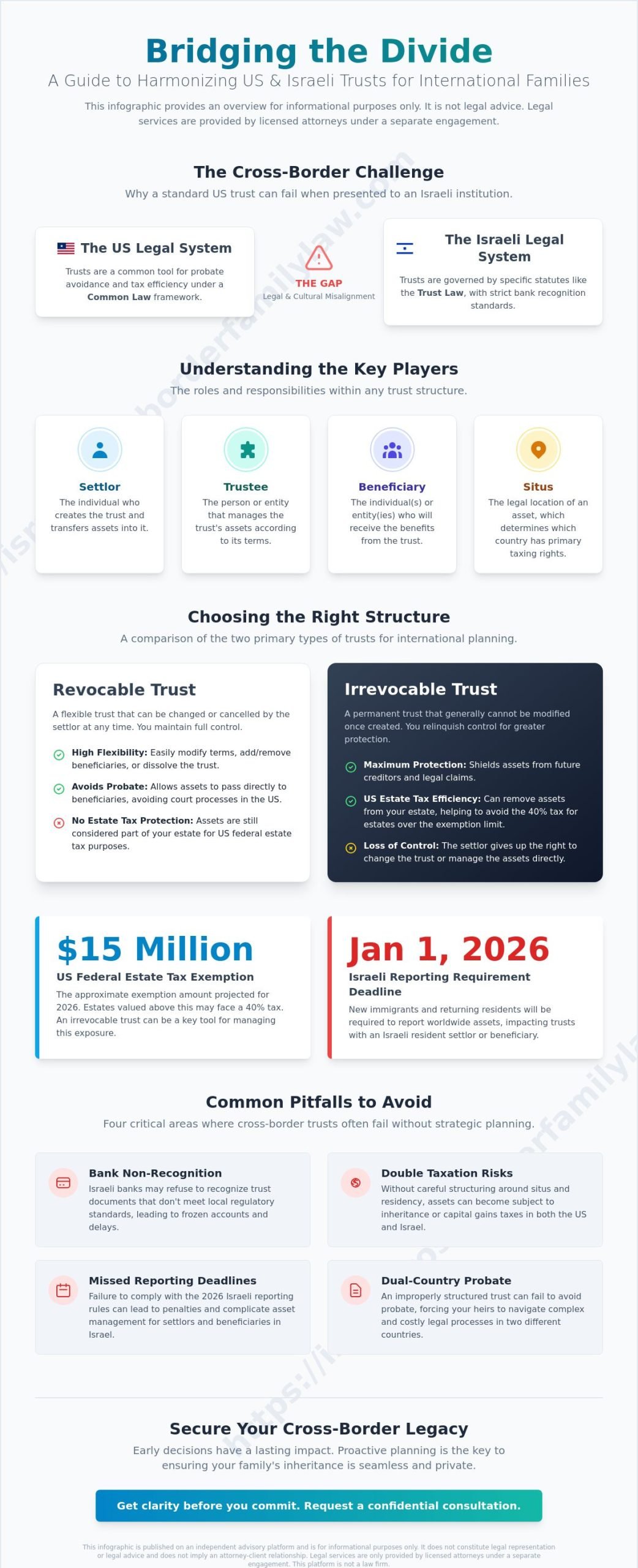
A trust is a legal arrangement where one person, known as the settlor, transfers assets to another party, the trustee, to manage for the benefit of specific individuals or entities, called beneficiaries. While this concept is a cornerstone of American wealth management, using trusts for international estate planning involves navigating the friction between two distinct legal systems. In the US, trusts are frequently used for probate avoidance and tax efficiency. However, in Israel, the legal framework is governed by the Trust Law, which categorizes trusts based on the residency of the parties involved. When assets are held outside of your primary country of residence, you are effectively dealing with what some call Offshore Trusts Explained; this simply refers to a trust governed by the laws of a jurisdiction other than where the settlor or beneficiaries reside.
To better understand the fundamentals of trust structures, watch this helpful video:
The “cross-border factor” is the primary reason why a standard US domestic trust might fail in Israel. Israeli banks are often hesitant to recognize foreign trust documents that do not align with local regulatory standards. This can lead to frozen accounts or significant delays during the inheritance process. Beyond simple asset transfer, a well-structured international trust provides strategic benefits such as avoiding probate in two different countries, maintaining family privacy, and managing tax deferral. It is vital to understand how the Israeli Tax Authority views your trust. As of January 1, 2026, new immigrants and returning residents are required to report worldwide assets. If a trust has an Israeli resident settlor, it may be classified as a “Settlor-Resident Trust,” which carries specific reporting obligations that differ from a “Foreign-Resident Trust.”
The Role of Trusts in Cross-Border Strategy
Trusts act as a vital bridge between divergent legal systems, allowing families to maintain a unified strategy despite living across borders. There is a significant difference between simple inheritance, where assets are handed over directly, and asset protection, which uses a trust to shield wealth from future risks. Seeking clarity before making financial commitments is essential for expats and foreign nationals who want to ensure their long term goals are not undermined by unexpected local regulations.
Key Terminology for US Expats in Israel
Understanding the basic vocabulary of using trusts for international estate planning helps you make informed decisions. The “Settlor” is the person creating the trust, the “Trustee” is the manager, and the “Beneficiary” is the recipient. “Situs” refers to the legal location of an asset, which determines which country has the primary right to tax it. Finally, you must choose between a “Revocable” trust, which you can change at any time, and an “Irrevocable” trust, which generally cannot be modified but offers greater protection against the 40% US federal estate tax for estates exceeding $15 million in 2026.
Get clarity before you commit. Request a confidential consultation.
Common Types of Trusts for International Estate Planning
Choosing the right structure is the first step in protecting a cross-border legacy. While many US citizens are familiar with Revocable Living Trusts, using trusts for international estate planning requires looking beyond domestic benefits. These trusts offer excellent flexibility in the US; however, they often encounter friction within the Israeli banking system. Israeli institutions frequently demand specific documentation to prove that a foreign trust complies with local anti-money laundering regulations. Without careful coordination, an Israeli bank may freeze accounts held by a US trust because they do not recognize the settlor’s authority under local law.
For estates exceeding the 2026 US federal exemption of $15 million, Irrevocable Life Insurance Trusts (ILITs) become a strategic necessity. They provide the liquidity needed to cover the 40% federal estate tax rate without forcing the sale of family assets. Similarly, Dynasty Trusts allow families to shield wealth across multiple generations. These structures must be carefully aligned with the Israeli Trust Law to ensure they aren’t inadvertently taxed as Israeli-resident trusts. This alignment is crucial for maintaining the long-term integrity of the family’s financial goals.
The landscape for Foreign Grantor Trusts changed significantly on January 1, 2026. New immigrants and veteran returning residents must now report their worldwide assets and income to the Israel Tax Authority. While the ten-year tax exemption on foreign income remains, the previous reporting exemption has been abolished. This shift toward transparency means that using trusts for international estate planning now requires a higher level of disclosure than in previous years. You must disclose these foreign structures to remain compliant with Israeli law and avoid potential penalties.
Revocable vs. Irrevocable: The Cross-Border Trade-off
The decision between a revocable or irrevocable structure often comes down to a choice between personal control and asset protection. In a revocable trust, the settlor retains the power to amend the document at any time. Israeli law, however, may view this retained control as a reason to treat the trust assets as the settlor’s personal property for tax or legal purposes. For many expats and foreign nationals, an irrevocable trust may offer superior protection against creditors or future tax changes, even though it requires relinquishing direct ownership. This balance is a central theme in any introduction to international estate planning.
Trusts and Israeli Family Law
In Israel, trust assets are not automatically shielded from divorce proceedings. If a couple uses trust distributions to fund their daily communal lifestyle, an Israeli family court might classify those assets as communal property. To prevent an inheritance from being split during a separation, the trust should be supported by a formal Financial Agreement. This legal document clarifies that the trust remains separate property. You can learn more about protecting your interests by requesting a case review to discuss your specific family dynamic. Get clarity before you commit. Request a confidential consultation.
The Pitfalls: Why International Trusts Often ‘Break’
Even the most sophisticated legal documents can fail if they aren’t adapted for the practical realities of a second jurisdiction. When using trusts for international estate planning, many families encounter what we call the ‘Recognition Gap.’ This occurs because the Israeli legal system, while recognizing trusts under the 1979 Trust Law, does not view them with the same cultural or administrative familiarity as the US system. An Israeli bank may see a US-based Revocable Living Trust not as a seamless extension of the settlor, but as a complex foreign entity that requires exhaustive documentation before any funds can be moved or accounts opened.
Inconsistent drafting is another common point of failure. A trust document written by a US attorney might use language or grant powers to a trustee that are unenforceable or even contradictory to Israeli regulations. If the document doesn’t explicitly address the 2026 Israeli reporting requirements, it can lead to administrative gridlock. Beyond the paperwork, there’s the looming risk of double taxation. While the US-Israel Tax Treaty exists to prevent this, it doesn’t always cover the specific timing of trust distributions. This can result in both countries claiming taxing rights on the same income, significantly eroding the wealth you intended to protect.
Navigating Israeli Bank Bureaucracy
Israeli financial institutions operate under strict ‘Know Your Customer’ (KYC) protocols. For a foreign trust, this means the bank will likely require a specialized legal opinion from a locally licensed practitioner to verify the trust’s validity. They’ll want to see the entire chain of control, from the settlor to the ultimate beneficiaries. A proactive strategy involves pre-approving your trust documents with your Israeli bank before you actually need to transfer assets. This step ensures that the bank’s compliance department is comfortable with the structure, preventing a frozen account during a sensitive time of transition.
Tax Reporting and Compliance Risks
The cost of reporting failures is high. For US citizens living in Israel, the burden of dual-country reporting is constant. You must navigate IRS Form 3520 for foreign trust transactions while simultaneously managing Israeli Form 147. Under the new rules effective January 1, 2026, new immigrants must report worldwide assets, removing the previous reporting ‘holiday.’ Failure to disclose these structures can lead to aggressive penalties from both the IRS and the Israel Tax Authority. There’s also the risk of the US ‘Throwback Tax,’ which applies to accumulated income in foreign trusts and can result in an effective tax rate that consumes most of the trust’s growth. What begins as a ‘simple’ trust in one country can quickly become a ‘complex’ tax nightmare in another without a unified strategy. Get clarity before you commit. Request a confidential consultation.
Strategy: Harmonizing Your Trust for US and Israel
This article is published on an independent advisory platform and is for informational purposes only. It does not constitute legal representation or legal advice. Legal services are only provided by licensed attorneys under a separate engagement.
Success in using trusts for international estate planning depends on more than just high-quality drafting; it requires active harmonization between US common law and the Israeli civil law system. To prevent your estate from becoming a series of disconnected legal battles, you must treat your US and Israeli assets as a single, integrated portfolio. This process begins with a structured approach to bridge the gap between how each country views ownership, control, and taxation.
A robust harmonization strategy involves five critical steps:
- Step 1: Conduct a global asset inventory. Separate your assets by ‘situs,’ or legal location. For example, US stocks and Israeli real estate are governed by different rules, and your trust must explicitly account for these differences.
- Step 2: Define primary residency and domicile. Because the Israel Tax Authority (ITA) implemented new reporting rules on January 1, 2026, the residency status of every family member must be clearly established to determine tax obligations.
- Step 3: Draft ‘Harmonized’ documents. Your trust should reference both US and Israeli legal frameworks. This ensures that the powers granted to your trustee are recognized in both jurisdictions.
- Step 4: Establish a local ‘Letter of Wishes.’ This document provides non-binding but essential guidance to Israeli trustees, helping them understand your intent in a way that aligns with local cultural and legal expectations.
- Step 5: Review the plan annually. The regulatory shifts of 2026 mean that a strategy that worked last year may now require updates to remain compliant with worldwide reporting standards.
Coordination Between Wills and Trusts
In many US estate plans, a ‘Pour-Over’ Will is used to catch any assets not formally titled in the name of the trust and move them into the trust upon death. In a cross-border context, your Israeli Will must be carefully coordinated to identify the trust without creating a conflict. If your Israeli Will contains instructions that contradict your US trust, it can lead to litigation. This is particularly relevant for families managing divorce and separation for international families, where the division of assets must be crystal clear to avoid communal property claims.
Choosing the Right Fiduciaries
Selecting a trustee is a pivotal decision. While a US-based trustee understands IRS requirements, they may struggle to manage Israeli property or navigate local banks. Conversely, having a sole Israeli trustee for a US-compliant trust can sometimes trigger unintended tax consequences in the US. A common solution is the appointment of a ‘Trust Protector.’ This individual holds the power to oversee fiduciaries and make adjustments if legal or tax environments change in either country. Before finalizing these roles, you should speak with a professional advisor to evaluate the best structure for your family’s specific needs. Get clarity before you commit. Request a confidential consultation.
Seeking Clarity: The Importance of Strategic Advisory
This article is published on an independent advisory platform and is for informational purposes only. It does not constitute legal representation or legal advice. Legal services are only provided by licensed attorneys under a separate engagement. This platform is not a law firm and the content herein does not imply an attorney-client relationship.
The transition of wealth across borders is rarely a matter of simple documentation. Effective estate management requires a multi-qualified perspective that acknowledges the friction between US common law and the Israeli civil law system. When using trusts for international estate planning, the most significant risks often lie in the details that a standard template cannot address. Early decisions regarding the structure of a trust or the selection of fiduciaries will dictate how your heirs interact with the Israeli Tax Authority and financial institutions for years to come. Without a unified strategy, even a well-funded trust can become a source of administrative gridlock and family conflict.
A strategic advisory approach moves beyond the delivery of a one-off document. It focuses on identifying hidden risks, such as how the 2026 reporting requirements for new immigrants in Israel might impact a trust established decades ago in the US. The goal is to build a plan that is resilient enough to withstand regulatory shifts while remaining flexible enough to meet the changing needs of an international family. By seeking clarity before you commit to a specific legal path, you ensure that your legacy is protected by strategy rather than left to chance.
Beyond Legal Documents: The Advisory Approach
Many families mistakenly believe that a trust is a “set and forget” tool. In reality, successful cross-border planning relies on risk-based decision-making. This involves understanding both the “Anglo” culture of the settlor and the specific regulatory environment of Israel. A firm that operates at this intersection can help you avoid the pitfalls of inconsistent drafting. For those managing broader financial interests, such as business owners or investors, these principles often overlap with other complex areas, as seen in our guide to Navigating US-Israel M&A: Your Comprehensive Guide. Every element of your financial life should work in harmony to prevent unintended tax or legal consequences.
Next Steps for Your International Estate
Taking the next step requires an honest assessment of your current arrangements. You should begin by reviewing your existing documents against the current 2026 standards, including the $15 million US federal estate tax exemption and the new Israeli transparency rules. For additional educational resources on how these laws affect families, you can view the latest updates on the Israel Family Law YouTube channel. Once you have a baseline understanding, the most effective way to identify specific vulnerabilities is through a professional review. Get clarity before you commit. Request a confidential consultation to discuss your family’s unique situation.
This article is published on an independent advisory platform and is for informational purposes only. It does not constitute legal representation or legal advice. Legal services are only provided by licensed attorneys under a separate engagement. This platform is not a law firm and the content herein does not imply an attorney-client relationship.
Securing Your Cross-Border Legacy
The regulatory shifts of 2026 have introduced significant changes in how international assets are reported and taxed in Israel. Successfully using trusts for international estate planning requires a shift from passive document creation to active, strategic management. As we’ve explored, bridging the gap between US common law and the Israeli legal system is the only way to prevent administrative gridlock at local banks or unintended tax liabilities for your beneficiaries.
Our strategic advisory focuses on long-term risk mitigation through a deep understanding of both jurisdictions. We offer a unique perspective provided by multi-qualified practitioners who are licensed to practice in both the US and Israel. This specific expertise in US-Israel cross-border family and estate law ensures that your plan remains robust and compliant with current worldwide reporting standards. Early decisions define the ease with which your heirs will eventually navigate their inheritance.
Get clarity before you commit. Request a confidential consultation. Protecting your family’s future across borders is a complex journey, but with a harmonized strategy, it’s one you can navigate with complete confidence.
This article is published on an independent advisory platform and is for informational purposes only. It does not constitute legal representation or legal advice. Legal services are only provided by licensed attorneys under a separate engagement. This platform is not a law firm and the content herein does not imply an attorney-client relationship.
Frequently Asked Questions
Is a US revocable living trust recognized in Israel?
US revocable living trusts are recognized in Israel, though they often face administrative hurdles at local financial institutions. While the 1979 Trust Law provides a framework for recognition, Israeli banks frequently require a formal legal opinion from a local practitioner to confirm the trust’s validity. Without proactive coordination, you may find that an Israeli bank refuses to transfer funds or recognize the trustee’s authority during a critical time of transition.
Can an Israeli resident be a beneficiary of a US trust?
An Israeli resident can certainly be a beneficiary of a US trust. However, the residency of the beneficiary triggers specific disclosure obligations with the Israel Tax Authority. Under the reporting rules effective January 1, 2026, even new immigrants who are within their ten year tax holiday must report trust distributions as part of their worldwide asset disclosure. This transparency is now a mandatory standard for all Israeli residents.
Do I need a separate trust for my assets in Israel?
Whether you need a separate trust for Israeli assets depends on the complexity of your holdings and your long term goals. While a single US trust can technically hold global assets, using trusts for international estate planning often involves creating “harmonized” structures or separate local entities to simplify the management of Israeli real estate. This approach reduces the friction caused by different legal cultures and ensures that local assets are handled efficiently under Israeli law.
How does the US-Israel tax treaty affect my trust?
The US-Israel tax treaty primarily serves to prevent the same income from being taxed twice by both nations. It allows for tax credits to be applied in one country for taxes already paid in the other. While the treaty provides significant relief, it does not exempt you from the rigorous reporting requirements of either the IRS or the Israel Tax Authority. You must still maintain meticulous records to prove your eligibility for these credits.
What are the reporting requirements for an Israeli trust with US assets?
Reporting requirements for trusts with cross-border assets are extensive and mandatory. On the US side, you will likely need to file IRS Form 3520 or 3520-A to disclose foreign trust activity. In Israel, you must comply with Form 147 or Form 150 requirements. The 2026 regulatory shift means that the Israel Tax Authority now requires full transparency regarding worldwide assets for nearly all residents, including those who previously enjoyed reporting exemptions.
Can a trust protect my assets from Israeli forced heirship rules?
A trust can be an effective tool for ensuring your assets are distributed according to your specific wishes rather than default legal rules. Israel generally recognizes freedom of testation, which allows you to choose your heirs. By moving assets into a trust, you remove them from your personal estate, providing a layer of protection that ensures your legacy is handled through strategy rather than being subject to future changes in inheritance laws.
How often should I update my international trust?
International estate plans should be reviewed at least every two to three years to remain effective. Major legislative changes, such as the permanent $15 million US federal estate tax exemption or the 2026 Israeli reporting updates, can make older plans obsolete overnight. Regular reviews allow you to adjust your strategy for using trusts for international estate planning to account for new tax rates, reporting thresholds, and family residency changes.
What happens if my trustee lives in a different country than the assets?
A trustee living in a different country than the trust assets often faces logistical and regulatory challenges. If a US trustee manages Israeli assets, they may struggle to interact with local banks that demand a physical presence or local identification. Conversely, an Israeli trustee managing US assets might inadvertently trigger “foreign trust” status for US tax purposes. Using a Trust Protector or co-trustees in both jurisdictions can help bridge these operational gaps.
For more educational insights on managing family assets across borders, you can explore the Israel Family Law YouTube channel. Get clarity before you commit. Request a confidential consultation.

Article by
Gabriel Lior
A Personal Journey That Became a Mission
The advisory was founded by an American father Gabriel Lior, LLB, MBA , global entrepreneur, and cross-border advisor who spent more than a decade navigating the Israeli family court system firsthand and now lives in Singapore with his son.
As a divorced parent in a cross-border family, Gabriel faced nearly every legal challenge a foreign parent can encounter in Israel — including child custody disputes, child support proceedings, property matters in Israel and abroad, false accusations, and complex immigration and relocation proceedings.
Over the years, he learned the hard way how difficult it is for non-Israeli parents to understand the system, identify the right legal strategy, and choose the right legal representation — especially when language, culture, and jurisdictional differences are involved. He also witnessed how foreign parents and new immigrants are often disadvantaged or taken advantage of by service providers and institutions simply because they lack local knowledge or fluency.
From Client to Advisor
To truly understand — and survive — the system, Gabriel pursued formal legal education in Israel, completing two Israeli law degrees, alongside a BA and MBA earned in the United States. This was never about becoming a practicing attorney, but about gaining a deep, structural understanding of how the system works — and where it breaks down for foreign parents.
This rare combination of:
Firsthand client experience
Israeli legal and US business education
International business and negotiation training
Decades of commercial execution
created a unique perspective – one that understands both sides of the table.
After years of litigation, persistence, and at times self-representation, he ultimately succeeded in securing custody of his son and relocating abroad through a rare legal victory in the Israeli Supreme Court — becoming one of the first fathers in Israel to do so under these circumstances.
Disclaimer
Important Disclaimer:
The information provided on this website and in its content is for general informational and educational purposes only and does not constitute legal advice, legal opinion, or legal representation.
Gabriel Lior is not licensed to practice law in Israel (nor is he interested in doing so) and does not provide legal services, despite having completed 2 Law Degrees. The services offered are advisory in nature and are intended to provide general guidance, strategic insight, and information regarding cross-border family law considerations.
No attorney-client relationship is formed by accessing this website, reading its content, or communicating with us.
Any decisions made based on this information are at your own discretion and risk. For legal advice specific to your situation, you should consult a licensed attorney in the relevant jurisdiction.
Where appropriate, we may refer clients to independent, licensed attorneys or professionals. Such referrals do not constitute legal representation and no liability is assumed for services provided by third parties.