This article is published on an independent advisory platform (not a law firm) and must not imply an attorney-client relationship. Legal services are only provided by licensed attorneys under a separate engagement.
The person you trust most in your personal life might actually be the most risky choice for managing your international legacy. When you are choosing an executor for a cross-border estate, you aren’t just picking a friend; you’re appointing a project manager for two distinct legal systems. It’s natural to worry about assets being frozen in probate or how your heirs will handle US tax reporting for Israeli property. Many families find the transition between the US and Israel confusing because the rules change the moment you cross the border.
You will learn the critical factors and strategic considerations for selecting an executor capable of managing assets across both jurisdictions. We provide a clear framework to help you understand the risks of non-resident executors and the impact of the 40% US estate tax on worldwide assets. For more visual guidance on these complex family matters, you can explore the resources at https://www.youtube.com/@IsraelFamilyLaw. This overview will give you the peace of mind that your asset transition is handled with professional care. Get clarity before you commit. Request a confidential consultation.
Key Takeaways
- Understand why managing assets across two legal systems requires more than just trust; local regulations in Israel differ significantly from US probate norms.
- Identify the logistical hurdles of choosing an executor for a cross-border estate, including the difficulty of opening Israeli estate accounts for non-residents.
- Evaluate whether a family member or a professional fiduciary is best suited to handle the technical and emotional demands of international succession.
- Learn the five-step process for vetting a candidate’s jurisdictional literacy and their ability to manage long-distance logistics between the US and Israel.
- Discover how to coordinate your estate plan so that your choice of executor aligns with wills recognized in both jurisdictions.
This article is published on an independent advisory platform (not a law firm) and does not imply an attorney-client relationship. Legal services are only provided by licensed attorneys under a separate engagement.
Understanding the Executor’s Role in a Cross-Border Estate
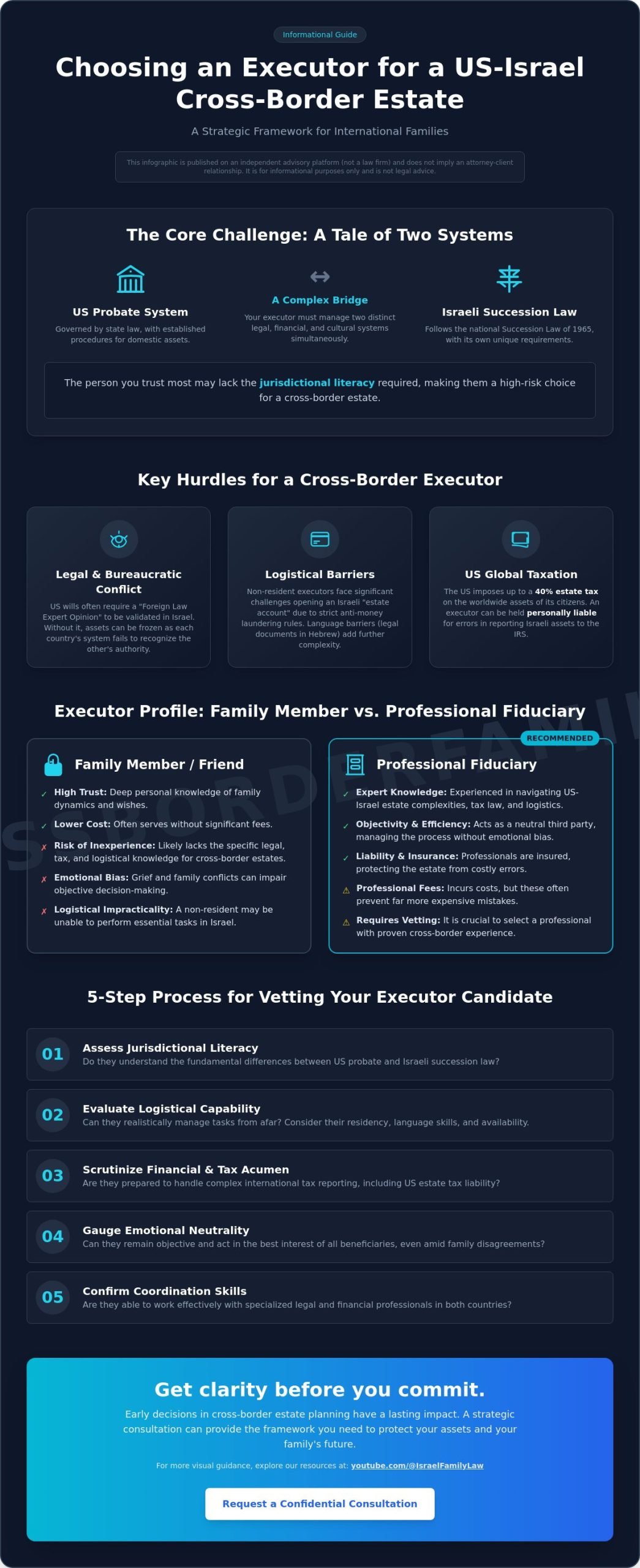
An executor is the legal representative appointed to manage and settle a person’s estate after they pass away. While the core definition remains the same globally, Understanding the Executor’s Role in an international context reveals a much higher level of responsibility. When you are choosing an executor for a cross-border estate, you are selecting a person who will serve as the primary bridge between your heirs and two separate government systems. They must navigate two distinct probate processes simultaneously, ensuring that actions taken in the US align with requirements in Israel.
To better understand how this role functions on an international level, watch this helpful video:
The Unique Complexity of US-Israel Probate
US probate is typically governed by state law, while Israel follows the national Succession Law of 1965. These systems do not always communicate well. For instance, assets like a family home in Tel Aviv are handled under Israeli jurisdiction, while a 401k or brokerage account in New York follows US rules. An executor must often secure a “Foreign Law Expert Opinion” to validate a US will before the Israeli Inheritance Registrar. Without careful coordination, the estate can fall into a legal limbo where neither country recognizes the other’s authority. This leads to frozen accounts and significant delays for beneficiaries who may be waiting for vital funds.
Fiduciary Duties Across Borders
Every executor has a fiduciary duty to act in the best interest of the beneficiaries, but cross-border estates make this duty harder to fulfill. The executor is responsible for inventorying global assets, which includes everything from Israeli bank accounts to US real estate. They must also identify and settle international debts. One of the most significant risks involves tax compliance. Because the US taxes the worldwide assets of its citizens, an executor could be held personally liable for errors in reporting Israeli property to the IRS. This technical burden is why choosing an executor for a cross-border estate requires looking for someone with high organizational skills and a willingness to work with specialized professionals.
Get clarity before you commit. Request a confidential consultation.
This article is published on an independent advisory platform (not a law firm) and does not imply an attorney-client relationship. Legal services are only provided by licensed attorneys under a separate engagement.
Key Challenges for Executors Managing Assets in Israel and the US
The logistical reality of managing an estate often clashes with the geographical distance between the US and Israel. When choosing an executor for a cross-border estate, you must consider whether a US resident can effectively handle the day-to-day requirements of an Israeli probate. Israeli banks often present the most significant hurdle. Opening an “estate account” in Israel as a non-resident is notoriously difficult due to strict anti-money laundering regulations and FATCA compliance. This can lead to a situation where funds remain stuck in a deceased person’s account because the executor cannot satisfy the bank’s residency or identification requirements.
Language barriers add another layer of friction. While many Israelis speak English, the legal system operates in Hebrew. Court filings, bank forms, and correspondence with the Israel Tax Authority will be in Hebrew. An executor without specific experience in this corridor may struggle to verify the accuracy of these documents. Additionally, US tax reporting is a constant shadow over the process. An executor must manage IRS requirements such as the Foreign Bank Account Report (FBAR) and potentially Form 3520 if the estate involves foreign trusts. Getting clarity on these points early is essential for expats and foreign nationals who want to avoid administrative gridlock.
The Problem of Non-Resident Executors
Israeli courts frequently demand that a foreign executor provide a financial bond or appoint a local representative to ensure the estate’s obligations are met. The process of signing documents becomes a technical exercise in obtaining Apostilles. This international notarization is required for documents to be recognized across borders. Time zone differences also complicate urgent financial decisions, as the limited window for communication between the US and Israel is often insufficient for complex banking tasks. These factors make choosing an executor for a cross-border estate a decision that requires assessing a candidate’s availability as much as their integrity.
Tax Compliance and Reporting Risks
A US-based executor must have a working knowledge of the US-Israel tax treaty to avoid double taxation. For instance, while Israel abolished estate taxes in 1981, the US still taxes the worldwide assets of its citizens at a top marginal rate of 40% for estates exceeding the exemption. Failing to file an FBAR for Israeli accounts can result in significant penalties, even for non-willful errors. Distributing “clean” money from Israel to US beneficiaries requires meticulous record-keeping to prove the source of funds to US financial institutions. You can learn more about these strategies through a confidential case review before making final decisions.
Get clarity before you commit. Request a confidential consultation.
This article is published on an independent advisory platform (not a law firm) and does not imply an attorney-client relationship. Legal services are only provided by licensed attorneys under a separate engagement.
Family vs. Professional Executors: Which is Right for Your International Estate?
Deciding who will manage your legacy involves a difficult balance between emotional trust and technical proficiency. Most people naturally look to a spouse or an adult child first. However, choosing an executor for a cross-border estate requires you to look beyond personal bonds. You must evaluate if the person has the capacity to handle the specialized demands of two legal systems. A family member understands your values, but they may lack the professional distance needed to navigate the 40% US estate tax threshold or the nuances of the US-Israel tax treaty. Professional fiduciaries, while charging a fee, bring a level of systemic knowledge that can prevent costly delays.
One effective strategy is appointing co-executors. This allows a family member to oversee personal decisions while a professional handles the complex filings in Israel and the US. This hybrid approach ensures your family’s wishes are respected without placing the entire technical burden on a grieving relative. It also provides a layer of protection against family conflict. When assets are split between different countries, heirs often feel a sense of unfairness if they don’t understand the local tax impacts, such as Israel’s lack of a “step-up in basis” on inherited property. A neutral third party can provide the objective clarity needed to maintain family harmony. You can learn more about how these roles are structured by reviewing how the advisory process works.
Pros and Cons of Appointing a Family Member
The primary benefit of a family executor is their deep knowledge of your family dynamics. They know who should receive specific sentimental items and can interpret your wishes with nuance. The downside is that they are often overwhelmed by the technicality of international probate. The risk of unintentional non-compliance is high. For example, a family member might not realize that Israeli capital gains tax (Mas Shevach) applies differently than US taxes. This can lead to personal liability for the executor if the estate’s tax obligations aren’t met in both jurisdictions.
When to Consider a Professional Executor
You should consider a professional if your estate includes complex business interests in IL or multiple pieces of real estate. These situations require active management that a non-resident family member simply cannot provide from abroad. A professional executor or a cross-border legal advisor acts as a steady guide, ensuring that all reporting requirements, such as the FBAR, are filed accurately and on time. Their neutrality is also vital if there is any history of sibling rivalry or disagreement among beneficiaries. Having a professional in place ensures that the distribution of global assets follows a strict, legally sound strategy rather than an emotional one.
Get clarity before you commit. Request a confidential consultation.
This article is published on an independent advisory platform (not a law firm) and does not imply an attorney-client relationship. Legal services are only provided by licensed attorneys under a separate engagement.
5 Steps for Selecting the Right Executor for Your Global Assets
The process of choosing an executor for a cross-border estate requires a structured approach to risk management. You aren’t simply picking a trusted individual; you’re vetting a candidate for a role that spans two legal cultures. Because the administrative burden is high, following a clear selection framework helps prevent future gridlock for your heirs. Most international probate cases fail not due to a lack of trust, but due to a lack of specific jurisdictional knowledge or logistical capacity.
- Step 1: Assess Jurisdictional Literacy. Confirm the candidate understands that Israeli law may apply to real estate in Tel Aviv or Jerusalem regardless of what a US will states.
- Step 2: Verify Availability. Ensure the person is willing to manage long-distance logistics, including the physical document signing and Apostille requirements mentioned in previous sections.
- Step 3: Evaluate Financial Acumen. The executor must be comfortable with complex international reporting, such as FBAR filings and understanding the 30% tax on distributions to Israeli beneficiaries in certain trust scenarios.
- Step 4: Align Residency. Consider where your beneficiaries live. If they are in Israel, having a US-based executor can make simple banking tasks nearly impossible due to FATCA and local banking hurdles.
- Step 5: Consult a Cross-Border Advisor. Before finalizing your will, review the appointment with a professional who understands the US-Israel corridor to ensure the choice is strategically sound.
Evaluating Jurisdictional Literacy
Jurisdictional literacy is the ability to recognize when foreign law overrides domestic intent. A candidate must be comfortable working with Hebrew-speaking professionals and understand the procedural differences between US state courts and the Israeli Inheritance Registrar. For example, they should know that Israel does not provide a “step-up in basis,” which significantly changes how assets are valued for capital gains tax purposes. If an executor assumes US rules apply everywhere, they may inadvertently create a massive tax liability for your heirs. You can gain more clarity on these requirements by reviewing strategies for expats and foreign nationals.
Logistical and Financial Readiness
Managing an international estate is a marathon, often taking 12 to 24 months to resolve fully. You must verify that your chosen executor has the time to handle dual-country tax deadlines and the patience to deal with Israeli bureaucracy. Organizational skills are vital. They will need to coordinate with US tax preparers and Israeli legal experts simultaneously. You should also check for potential conflicts of interest. If the executor is also a primary beneficiary, their decisions regarding the timing of asset sales in Israel versus the US could be scrutinized by other heirs. To ensure your selection stands up to these challenges, request a confidential case review to discuss your specific family structure.
Get clarity before you commit. Request a confidential consultation.
This article is published on an independent advisory platform (not a law firm) and must not imply an attorney-client relationship. Legal services are only provided by licensed attorneys under a separate engagement.
Strategic Planning for Cross-Border Succession
The choice of an executor shouldn’t be made in a vacuum. It is the final piece of a broader strategic puzzle that determines how effectively your legacy will be managed across two continents. If your estate plan is fragmented, even the most capable person will struggle to manage assets across the US and Israel. Strategic planning for cross-border succession ensures that your legal documents actually empower the person you’ve chosen, rather than creating administrative roadblocks. When you are choosing an executor for a cross-border estate, you are essentially selecting the person who will execute a strategy you have already put into motion.
Integrating Your US and Israeli Wills
One common strategy involves the use of Situs Wills. A US-based Master Will might outline your global intentions, but a specific Israeli Situs Will focuses exclusively on assets within Israel, such as property in Tel Aviv or local bank accounts. This approach allows your executor to present a Hebrew-language document directly to the Israeli Inheritance Registrar. It bypasses many of the delays associated with translating and validating a foreign US will, which often requires a Foreign Law Expert Opinion costing between 3,000 and 7,000 ILS. For more context on how these documents work together, you can explore resources from the Israel Cross Border Law Firm. This coordination ensures your executor has the specific legal powers required by the Israeli court system from day one, reducing the risk of administrative gridlock.
The Value of Early Strategy
Early strategy is the best defense against the emergency probate scenarios that often plague international families. When assets are frozen because of a poorly drafted will or a non-resident executor who cannot access accounts, the emotional and financial cost to heirs is significant. A well-structured plan reduces the technical burden on your executor by clearly defining how US tax reporting and Israeli capital gains will be handled. For example, knowing that Israel does not provide a step-up in basis allows the executor to plan for the 25% capital gains tax before selling property. You can view relevant guidance on these topics through the Israel Family Law YouTube channel. By making these decisions now, you prevent the risk of double taxation where an estate faces the 40% US tax and the 25% Israeli capital gains tax on the same asset. This proactive approach is the only way to ensure a seamless transition for your family. Get clarity before you commit. Request a confidential case review to ensure your legacy is protected.
This article is published on an independent advisory platform (not a law firm) and must not imply an attorney-client relationship. Legal services are only provided by licensed attorneys under a separate engagement.
Securing Your International Legacy
Managing a legacy across two nations is a sophisticated task that requires proactive risk management. Success depends on recognizing that an executor is a bridge between the US and Israeli legal systems. You now understand how residency requirements and banking hurdles can freeze progress, making the selection process vital. Whether you choose a family member, a professional, or a combination of both, your decision should prioritize jurisdictional literacy over personal convenience. Early coordination of your US and Israeli wills ensures your representative has the specific powers needed to act in both jurisdictions without delay.
The process of choosing an executor for a cross-border estate is a critical component of a coordinated plan. This platform provides authoritative expertise in US-Israel legal corridors with a specialized focus on international families and expats. With a physical presence and strategic connections in both Tel Aviv and New York, we offer the nuanced understanding required for multi-jurisdictional complexity. Get clarity before you commit. Request a confidential consultation. Taking these steps today provides the security and comprehensive support your family deserves.
This article is published on an independent advisory platform (not a law firm) and does not imply an attorney-client relationship. Legal services are only provided by licensed attorneys under a separate engagement.
Frequently Asked Questions
Can a US citizen serve as an executor for an estate in Israel?
Yes, a US citizen can serve as an executor in Israel, but the process involves specific logistical hurdles. The Israeli Inheritance Registrar may require the foreign executor to appoint a local representative or agent for service of process within Israel. This ensures the court has a reliable point of contact for legal notices. Additionally, the court might require a financial bond to protect the estate’s assets while they’re under the management of a non-resident.
Does an executor of a cross-border estate need to be a lawyer?
No, an executor does not need to be a lawyer to manage an international estate. Any adult who is legally competent can be appointed to the role. However, the technical complexity of US-Israel probate often leads families to choose a professional fiduciary or a co-executor with legal experience. While a family member can serve, they’ll likely need to work closely with cross-border advisors to handle the dual tax and court filings correctly.
What are the tax reporting responsibilities for a US executor of an Israeli estate?
A US executor must report the deceased’s worldwide assets to the IRS, regardless of where those assets are located. This includes filing the Foreign Bank Account Report (FBAR) for any Israeli accounts and potentially Form 3520 for foreign trusts. When you are choosing an executor for a cross-border estate, you must ensure they understand the 40% top marginal US estate tax rate. They’re responsible for ensuring all international assets are accounted for before distributions are made to heirs.
Can I have two different executors—one for my US assets and one for my Israeli assets?
Yes, appointing separate executors for different jurisdictions is a common and often recommended strategy. By using a “Situs Will” specifically for assets in Israel, you can appoint a local resident to handle the Hebrew-language filings and banking hurdles. This allows your US executor to focus on American probate while the Israeli executor manages property in Tel Aviv or Jerusalem. It’s an effective way to prevent one person from becoming overwhelmed by two different legal systems.
What happens if the executor I chose cannot travel to Israel?
If an executor cannot travel, they can manage the estate remotely by using a Power of Attorney and Apostilled documents. This process is legally valid but often significantly slower than having a person physically present in Israel. Many foreign executors choose to appoint a local Israeli attorney to handle the physical tasks, such as appearing before the Inheritance Registrar or visiting bank branches. This hybrid approach helps keep the process moving when travel isn’t possible.
Is an executor responsible for paying Israeli inheritance tax?
No, the executor doesn’t need to pay inheritance tax because Israel abolished these taxes in 1981. However, the executor is responsible for managing the Israeli capital gains tax, known as Mas Shevach, which typically applies at a 25% rate when an inherited asset is sold. Because Israel doesn’t provide a “step-up in basis” to the value at the time of death, the executor must calculate the gain based on the deceased’s original purchase price.
How much does a professional executor typically charge for cross-border estates?
Professional executor fees are generally based on a percentage of the estate’s total value or an hourly rate for their services. These fees can vary depending on the complexity of the international assets and the number of jurisdictions involved. In many cases, the fees are subject to the approval of the probate court or the Israeli Inheritance Registrar. It’s best to discuss fee structures with a potential professional fiduciary during the planning stage to ensure the costs are transparent.
Can an Israeli court reject my choice of executor?
Yes, an Israeli court or the Inheritance Registrar has the authority to reject an executor if they’re deemed unfit or legally incompetent. Reasons for rejection include the candidate being a minor, having a significant conflict of interest, or having a criminal record that impacts their financial integrity. Choosing an executor for a cross-border estate requires careful vetting to ensure your candidate meets the legal standards of both the US and Israel. If a rejection occurs, the court will typically appoint an administrator to manage the estate.

Article by
Gabriel Lior
A Personal Journey That Became a Mission
The advisory was founded by an American father Gabriel Lior, LLB, MBA , global entrepreneur, and cross-border advisor who spent more than a decade navigating the Israeli family court system firsthand and now lives in Singapore with his son.
As a divorced parent in a cross-border family, Gabriel faced nearly every legal challenge a foreign parent can encounter in Israel — including child custody disputes, child support proceedings, property matters in Israel and abroad, false accusations, and complex immigration and relocation proceedings.
Over the years, he learned the hard way how difficult it is for non-Israeli parents to understand the system, identify the right legal strategy, and choose the right legal representation — especially when language, culture, and jurisdictional differences are involved. He also witnessed how foreign parents and new immigrants are often disadvantaged or taken advantage of by service providers and institutions simply because they lack local knowledge or fluency.
From Client to Advisor
To truly understand — and survive — the system, Gabriel pursued formal legal education in Israel, completing two Israeli law degrees, alongside a BA and MBA earned in the United States. This was never about becoming a practicing attorney, but about gaining a deep, structural understanding of how the system works — and where it breaks down for foreign parents.
This rare combination of:
Firsthand client experience
Israeli legal and US business education
International business and negotiation training
Decades of commercial execution
created a unique perspective – one that understands both sides of the table.
After years of litigation, persistence, and at times self-representation, he ultimately succeeded in securing custody of his son and relocating abroad through a rare legal victory in the Israeli Supreme Court — becoming one of the first fathers in Israel to do so under these circumstances.
Disclaimer
Important Disclaimer:
The information provided on this website and in its content is for general informational and educational purposes only and does not constitute legal advice, legal opinion, or legal representation.
Gabriel Lior is not licensed to practice law in Israel (nor is he interested in doing so) and does not provide legal services, despite having completed 2 Law Degrees. The services offered are advisory in nature and are intended to provide general guidance, strategic insight, and information regarding cross-border family law considerations.
No attorney-client relationship is formed by accessing this website, reading its content, or communicating with us.
Any decisions made based on this information are at your own discretion and risk. For legal advice specific to your situation, you should consult a licensed attorney in the relevant jurisdiction.
Where appropriate, we may refer clients to independent, licensed attorneys or professionals. Such referrals do not constitute legal representation and no liability is assumed for services provided by third parties.