This article is published on an independent advisory platform and does not imply an attorney-client relationship.
You might assume that a lawyer who speaks perfect English and understands your home country’s laws is automatically licensed to represent you in an Israeli courtroom. In reality, the distinction between a foreign legal consultant and a fully admitted Israeli attorney is a critical one that often gets lost in translation. It’s natural to feel uncertain when faced with Hebrew-only databases and a legal system that operates differently than what you’re used to back home. This guide explains exactly how to verify a lawyer’s credentials in israel so you can move forward with confidence.
You’ll learn how to check an attorney’s listing with the Israel Bar Association, distinguish Israeli admission from foreign-lawyer registration, and assess experience relevant to cross-border family and estate matters. Use the official sources linked below to verify the practitioner’s current status and the jurisdictions in which they can act. For further educational resources, visit the Israel Family Law YouTube channel.
Key Takeaways
- Understand why cross-border cases require rigorous verification of legal credentials before you commit to representation.
- Learn how to verify a lawyer’s credentials in israel using the official Israel Bar Association databases to confirm active licensing.
- Distinguish between an Israeli Advocate and a registered Foreign Lawyer to ensure your counsel has the correct jurisdictional authority.
- Identify how to access disciplinary records through the Ethics Committee to protect your family’s long-term interests.
- Evaluate a practitioner’s strategic fit for complex international family law and estate matters once licensing is confirmed.
Why Verifying Credentials is the First Step in Cross-Border Strategy
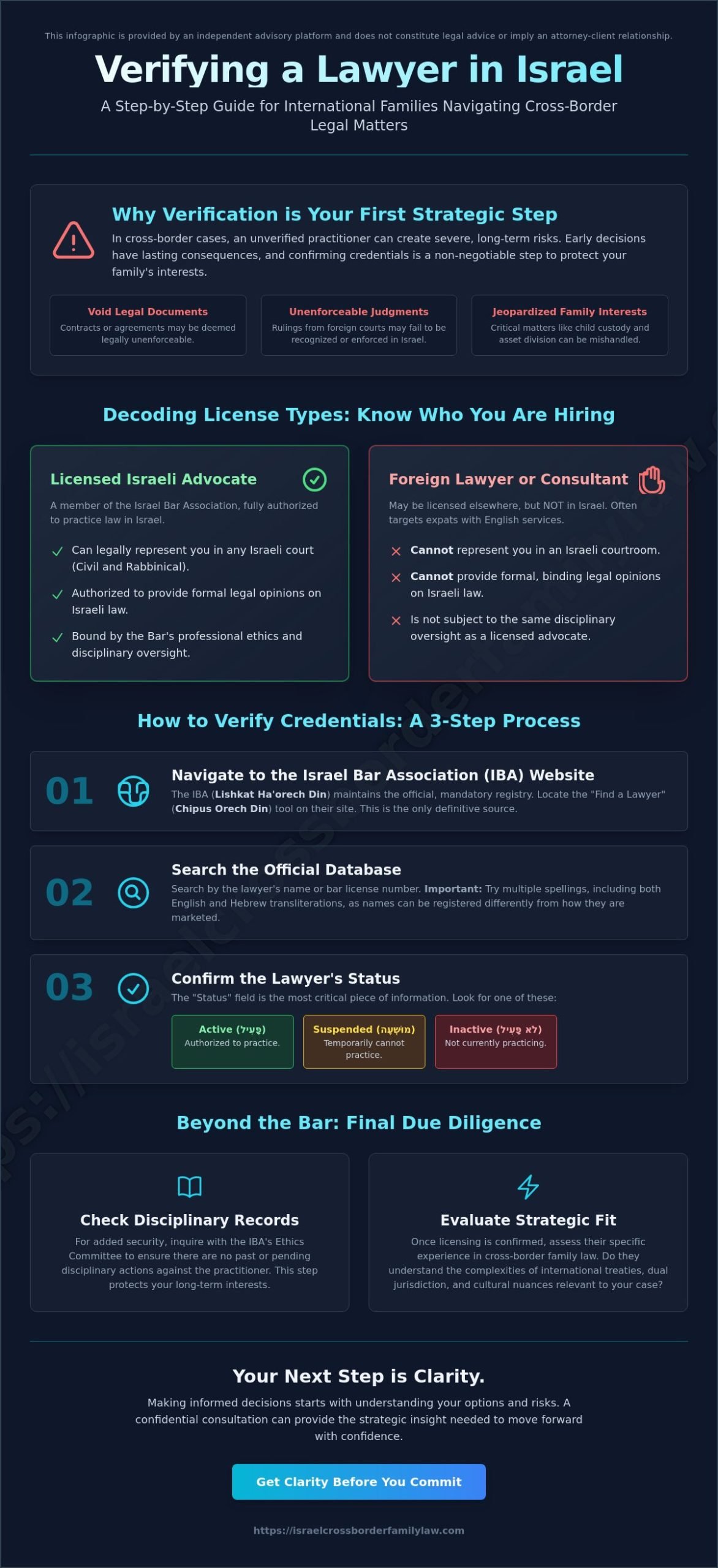
In Israel, the legal profession is strictly regulated to ensure practitioners meet specific educational and ethical standards. A licensed practitioner must be a member of the Israel Bar Association, which serves as the statutory body overseeing the licensing and conduct of all attorneys. Understanding how to verify a lawyer’s credentials in israel isn’t just a formality; it’s a strategic necessity for anyone managing assets or family matters across borders. Without this membership, an individual cannot legally represent you in court or provide formal legal opinions on Israeli law.
Cross-border cases, particularly those involving US and Israeli interests, demand a level of scrutiny beyond local domestic matters. These situations involve the intersection of two distinct legal systems, meaning a mistake in jurisdictional filing can lead to years of unnecessary litigation. Hiring an individual who isn’t properly registered can result in documents that are legally void or unenforceable in Israeli courts. It’s common to encounter “legal consultants” who lack formal Bar membership, and while they may offer advice, they aren’t bound by the same professional ethics or disciplinary oversight as a licensed advocate.
To better understand this concept, watch this helpful video:
The Complexity of the Israeli Legal Landscape for Expats
Expats often find the Israeli system confusing because it blends civil law, common law, and religious law for family matters. Unlicensed practitioners frequently target Anglo clients by offering English-language services that seem accessible but lack the formal backing of the Bar. It’s essential to seek clarity on a practitioner’s standing before signing a retainer. This early diligence prevents you from relying on advice that may not hold up under the scrutiny of an Israeli judge or a religious tribunal.
Identifying the Stakes in International Matters
The stakes are high when a case involves a divorce or separation between two countries. An attorney without the proper credentials might fail to secure the enforceability of foreign judgments or misapply specific religious law requirements. This can jeopardize child custody or the division of international assets. Relying on personal trust is a high-risk approach. Instead, use a risk-based decision-making process to confirm that your lawyer has the professional standing to handle multi-jurisdictional complexities.
The Israel Bar Association (IBA): Navigating the Official Database
The Israel Bar Association, known in Hebrew as Lishkat Orchei HaDin, maintains the official lawyer directory. To understand how to verify a lawyer’s credentials in israel, start with this source. Its search tools include name, practice area, city and language. The Bar says the directory is updated periodically and may contain errors, so ask the Bar to clarify any uncertainty before relying on a result.
Ask the practitioner for their full registered Hebrew name and license number. Use the directory’s name suggestions to avoid spelling or transliteration mismatches. According to the Bar’s published instructions, this directory includes active lawyers with valid licenses; it does not display lawyers who have been suspended, removed, retired or whose membership has otherwise ended or been restricted. A missing result does not by itself establish why a person is absent. Contact the Bar to confirm their current status.
Translation Guide for the IBA Search Tool
Useful Hebrew labels include Shem Prati (first name), Shem Mishpacha (surname), Tchumei Isuk (practice areas) and Mispar Rishayon (license number). Match the result to the practitioner’s identity rather than relying on an English spelling alone. The Bar notes that some active lawyers may appear by name only because they have asked not to publish their address. Directory inclusion is a licensing check, not a guarantee of experience, suitability or a clean disciplinary history.
What to Do If You Can’t Find a Name
If a search yields no results, don’t panic immediately. Transliteration issues are the most frequent cause of missing names. For example, a name like “Jonathan” could be registered as “Yonatan.” If you remain unsure, you can contact the IBA directly for a manual verification. This is particularly relevant when dealing with the licensing process for foreign lawyers, as practitioners transitioning from other jurisdictions may have different registration timelines.
Understanding these nuances is vital for expats and foreign nationals who need to ensure their legal support is fully compliant with local regulations. If you find the database confusing, you can always seek a professional review of your situation to ensure your strategy is sound.
Decoding License Types: Israeli Lawyers vs. Foreign Lawyers
When researching how to verify a lawyer’s credentials in israel, you will encounter two distinct categories of practitioners: the Israeli Advocate and the registered Foreign Lawyer. An Israeli Advocate is a full member of the Bar who has completed local examinations and internships, granting them the right to represent clients in all Israeli courts and tribunals. In contrast, a Foreign Lawyer is a practitioner licensed in another jurisdiction who has registered with the Israel Bar Association to provide advice specifically on the laws of their home country while residing in Israel.
This distinction is vital for international families managing divorce or separation or estate planning. A Foreign Lawyer may have deep expertise in New York or California law, but they cannot file motions in an Israeli Family Court or sign off on Israeli legal documents. If your case involves multi-jurisdictional complexity, you must confirm which license your practitioner holds to ensure they have the legal authority to execute your strategy.
The Scope of Practice for Foreign Attorneys
Foreign-lawyer registration and admission as an Israeli Advocate are different routes. Check the practitioner’s name and jurisdiction in the Bar’s official foreign-lawyer register, and ask the Bar to clarify any uncertainty about their registration. A foreign-lawyer listing does not by itself authorize representation in an Israeli court or practice of Israeli law. If those services are needed, verify a separate active Israeli licence. Registration requirements depend on the applicable route; do not assume that a stated number of years abroad establishes eligibility or removes examination requirements. Confirm the current requirements with the Bar. For foreign-law advice, also verify the practitioner’s authorization and relevant experience in the jurisdiction involved.
Why Dual-Qualified Practitioners are a Rarity
Dual-qualified practitioners represent a strategic bridge between two legal cultures. These individuals have navigated the rigorous process of qualifying in both the US and Israel, which often involves additional examinations and internships. This dual status is a significant differentiator because it reduces the risk of vital details being lost in translation between divergent legal frameworks. When a practitioner understands both the Israeli system and the state bar requirements of places like New York or California, they can anticipate how a decision in one country will impact your standing in the other. You can verify the US side of their credentials through the relevant state bar website to ensure their international standing is as robust as their local registration.
Beyond the Bar: Checking Disciplinary Records and Standing
Confirming that an attorney is licensed is only the baseline of your due diligence. To fully protect your interests, you must also investigate their standing with the Ethics Committee, known in Israel as the Va’adat Etika. This body handles complaints regarding professional conduct and maintains records of disciplinary hearings. Learning how to verify a lawyer’s credentials in israel effectively means looking for any history of warnings, fines, or temporary suspensions that might not be immediately obvious on a standard search result.
Another marker of professional standing is professional indemnity insurance. While the Bar Association requires certain standards, verifying that a firm carries comprehensive coverage provides an additional layer of reassurance for clients managing high value international assets. This insurance is a sign of a stable, responsible practice that takes the protection of client interests seriously. If a practitioner cannot or will not confirm their insurance status, it may indicate a lack of professional depth.
Investigating Ethical Violations
Disciplinary tribunal decisions are published by the IBA, though they are often archived in Hebrew. These records distinguish between minor administrative oversights and serious professional malpractice. For sensitive international custody and relocation cases, a clean ethical record is not negotiable. A lawyer’s history in handling delicate family dynamics can be the difference between a smooth transition and a jurisdictional crisis. You don’t want your case handled by someone with a history of ethical lapses in high stakes litigation.
Assessing Professional Reputation and Specialty
Reputation is often built in the courtroom. The Israeli court database, Net HaMishpat, allows you to view a practitioner’s litigation history. This tool helps you determine if a lawyer is a generalist or a dedicated specialist in family law or estates. It’s also wise to evaluate the firm’s physical presence and local engagement within the Israeli legal community. A practitioner who is active in local legal circles and has a tangible office presence is often better positioned to navigate the nuances of the local system than a remote consultant.
To ensure your chosen representative meets the highest standards of professional standing, you can request a review of your specific case requirements today.
Strategic Selection: Moving from Verification to Consultation
Once you’ve mastered how to verify a lawyer’s credentials in israel, the focus shifts from administrative legitimacy to strategic alignment. A valid license is the entry requirement, but it doesn’t guarantee that a practitioner possesses the specific experience required for high-stakes transnational family law or estate matters. You need to assess whether the attorney’s approach matches the complexity of your multi-jurisdictional life. This transition requires moving beyond the database and engaging in a direct dialogue about your specific needs.
During an initial case review, ask targeted questions about their experience with cases involving both Israeli and foreign jurisdictions. Transparency regarding fee structures is essential. Israeli legal fees can be calculated in various ways, including hourly rates, flat fees, or percentage-based models for certain estate matters. Ensuring you receive a clear, written explanation of these costs is a critical step in risk management. Always insist on a written engagement letter in English. This document should clearly outline the scope of representation, the expected timeline, and the financial commitments to avoid any linguistic ambiguity later.
Evaluating the ‘Bridge’ Capability
A practitioner’s value in cross-border matters often lies in their ability to act as a bridge between legal systems. You should determine if the lawyer understands the US context of your case, particularly if you have assets or family members in states like New York or California. A practitioner who can work seamlessly with your existing US-based legal team ensures that decisions made in Israel don’t have unintended consequences abroad. To supplement your research, you can find educational resources and deep dives into these topics on the Israel Family Law YouTube channel.
Taking the Next Step with Confidence
Moving forward requires a clear path and a structured approach to decision-making. An independent advisory platform serves as a vital resource in this process, helping you filter through options based on verified data and strategic fit. When you are ready to proceed, preparing for a confidential case review is the most effective way to test the practitioner’s insights. Gather all relevant foreign and Israeli documents, such as previous court orders or estate plans, to maximize the value of the session. As you finalize your choice, use your research to ensure you’ve confirmed how to verify a lawyer’s credentials in israel and their ability to protect your family’s future through expert strategy.
Securing Your Legal Strategy with Verified Professional Support
Verification is the foundation of any successful cross-border legal strategy. You’ve learned that checking the Israel Bar Association database for an active status is just the beginning. It’s equally important to understand the specific license type your practitioner holds, especially when dealing with the intersections of Israeli and US law in family or estate matters. Confirming disciplinary standing and professional insurance provides the final layer of security needed to protect your interests.
By taking these steps, you move from uncertainty to a risk-based decision-making process. This independent advisory platform leverages decades of cross-border experience to help you navigate these complexities without the confusion of language barriers. Now that you know how to verify a lawyer’s credentials in israel, you can approach your initial consultation with a clear understanding of what to expect. Strategic choices made today will define the long-term stability of your assets and family relationships.
Get clarity before you commit. Request a confidential case review to discuss your specific family law or estate needs. Building a bridge between legal systems starts with choosing a representative you can fully verify.
Frequently Asked Questions
Can a US lawyer represent me in an Israeli court?
A US lawyer cannot represent you in an Israeli court unless they have also qualified as an Israeli Advocate. While they may advise on US law, the right to appear before an Israeli judge is strictly reserved for those who have passed the Israeli bar exams and completed an internship. If your case is multi-jurisdictional, your US counsel must collaborate with a local practitioner who holds a valid Israeli license.
How do I check if an Israeli lawyer has been disbarred?
The official lawyer directory lists active lawyers only and does not show suspended or removed members. For those records, consult the Bar’s separate suspended and removed lawyers section. If a name is missing or the records are unclear, ask the Bar to confirm the practitioner’s current status. An active listing does not establish that no past disciplinary action exists.
Is there an English version of the Israel Bar Association website?
The official Israel Bar Association website does not currently offer a full English version for its lawyer search database. This often creates a barrier for expats trying to understand how to verify a lawyer’s credentials in israel. You may need to use browser translation tools or work with an advisor who can navigate the Hebrew interface to confirm a practitioner’s active status and license number accurately.
What is the difference between an ‘Advocate’ and a ‘Lawyer’ in Israel?
In the Israeli legal system, an “Advocate” (Orech Din) is the specific title for a professional who is a member of the Bar Association. While the term “lawyer” is used colloquially in English, only an Advocate is legally authorized to perform legal acts on behalf of others in Israel. Verifying this title is a key step in confirming that your representative has the necessary statutory authority to handle your case.
How can I verify a lawyer’s specialty in family law?
You can verify a lawyer’s specialty in family law by researching their litigation record in the Net HaMishpat court database. Unlike some jurisdictions, Israel does not have a formal board certification for specialties. Instead, look for practitioners who consistently handle divorce, wills, and estates. Their frequency in these specific courts demonstrates their practical expertise and focus on the complexities of the Israeli family law system.
Do I need a lawyer licensed in both the US and Israel for my divorce?
You aren’t legally required to have a dual-licensed attorney, but it is a significant strategic advantage for a cross-border divorce. A lawyer who understands both legal systems can draft agreements that are enforceable in both Israel and the US. This prevents future conflicts regarding child support or asset division that might arise from conflicting legal interpretations between the two countries’ distinct legal frameworks.
What should I do if I suspect my Israeli lawyer is unlicensed?
If you suspect a practitioner is unlicensed, you should immediately verify their name through the Israel Bar Association’s registry. Practicing law without a license is a serious violation of Israeli law. You can file a formal inquiry with the IBA Ethics Committee to confirm their standing and report any fraudulent claims of licensing to protect your family and the integrity of your legal proceedings.
Where can I find a directory of English-speaking lawyers in Israel?
You can find English-speaking practitioners through the Israel Bar Association’s search filter or by using specialized advisory platforms. Many lawyers who serve the international community also list their qualifications on independent directories. It’s helpful to confirm their language proficiency during an initial case review to ensure clear communication throughout your family law or estate matter.

Article by
Gabriel Lior
A Personal Journey That Became a Mission
The advisory was founded by an American father Gabriel Lior, LLB, MBA , global entrepreneur, and cross-border advisor who spent more than a decade navigating the Israeli family court system firsthand and now lives in Singapore with his son.
As a divorced parent in a cross-border family, Gabriel faced nearly every legal challenge a foreign parent can encounter in Israel — including child custody disputes, child support proceedings, property matters in Israel and abroad, false accusations, and complex immigration and relocation proceedings.
Over the years, he learned the hard way how difficult it is for non-Israeli parents to understand the system, identify the right legal strategy, and choose the right legal representation — especially when language, culture, and jurisdictional differences are involved. He also witnessed how foreign parents and new immigrants are often disadvantaged or taken advantage of by service providers and institutions simply because they lack local knowledge or fluency.
From Client to Advisor
To truly understand — and survive — the system, Gabriel pursued formal legal education in Israel, completing two Israeli law degrees, alongside a BA and MBA earned in the United States. This was never about becoming a practicing attorney, but about gaining a deep, structural understanding of how the system works — and where it breaks down for foreign parents.
This rare combination of:
Firsthand client experience
Israeli legal and US business education
International business and negotiation training
Decades of commercial execution
created a unique perspective – one that understands both sides of the table.
After years of litigation, persistence, and at times self-representation, he ultimately succeeded in securing custody of his son and relocating abroad through a rare legal victory in the Israeli Supreme Court — becoming one of the first fathers in Israel to do so under these circumstances.
Disclaimer
Important Disclaimer:
The information provided on this website and in its content is for general informational and educational purposes only and does not constitute legal advice, legal opinion, or legal representation.
Gabriel Lior is not licensed to practice law in Israel (nor is he interested in doing so) and does not provide legal services, despite having completed 2 Law Degrees. The services offered are advisory in nature and are intended to provide general guidance, strategic insight, and information regarding cross-border family law considerations.
No attorney-client relationship is formed by accessing this website, reading its content, or communicating with us.
Any decisions made based on this information are at your own discretion and risk. For legal advice specific to your situation, you should consult a licensed attorney in the relevant jurisdiction.
Where appropriate, we may refer clients to independent, licensed attorneys or professionals. Such referrals do not constitute legal representation and no liability is assumed for services provided by third parties.