This article is published on an independent advisory platform (not a law firm) and does not constitute an attorney-client relationship. Legal services are only provided by licensed attorneys under a separate engagement.
Imagine it is 3:00 AM in Israel when your phone vibrates with a confrontational message from your ex-spouse across the ocean, instantly pulling you back into a conflict you thought you left behind. You likely feel that the physical distance hasn’t translated into the emotional or legal space you need to start over. Setting boundaries with an ex-spouse in another country is not just about your personal well-being; it is a vital form of legal risk management. Without a structured plan, the complexities of different time zones and legal systems can leave you feeling vulnerable and exhausted.
We understand the fear that international legal gaps could affect your children’s safety or your financial stability. This guide will show you how to establish structured communication and navigate the intricacies of international custody laws to regain your peace of mind. You will learn how to use strategic tools to create a predictable environment for your family, and you can find further visual resources on these topics at the Israel Family Law YouTube channel. Get clarity before you commit. Request a confidential consultation.
Key Takeaways
- Define cross-border boundaries as structured protocols for communication and finance to prevent digital intrusion across international lines.
- Implement “Digital Office Hours” and utilize specialized co-parenting apps to manage time zone differences and centralize documentation for future review.
- Understand how the Hague Convention and formal travel consents provide essential legal safeguards when setting boundaries with an ex-spouse in another country.
- Protect your financial autonomy by separating joint accounts and learning the specific mechanisms for child support enforcement between the US and Israel (IL).
- Learn to identify the signs of “boundary testing” to determine when to involve a mediator or a cross-border legal professional for enforcement.
This article is published on an independent advisory platform (not a law firm) and does not constitute an attorney-client relationship. Legal services are only provided by licensed attorneys under a separate engagement.
The Strategic Importance of Cross-Border Boundaries
In a domestic separation, boundaries are often physical. You live in different homes and move in different social circles. When you are setting boundaries with an ex-spouse in another country, the distance can create a deceptive sense of security. While thousands of miles may separate your physical locations, digital connectivity allows for a level of intrusion that can feel constant. Cross-border boundaries are structured protocols that govern how you interact regarding communication, shared finances, and parenting responsibilities across different time zones and legal systems.
Establishing these rules early is a form of legal risk management. Clear boundaries prevent your ex-spouse from encroaching on your new life in Israel (IL) and help protect your legal standing in both your home country and Israeli courts. If you lack a structured plan, your responses to late-night messages or unexpected financial demands can be used as evidence of high-conflict behavior or instability in future litigation.
To better understand the fundamentals of this transition, watch this helpful video:
Why International Boundaries Are Different
The complexity of international divorce laws means that a boundary that works in one country might not hold weight in another. Legal cultures vary significantly between Western countries and Israel. For example, what a US court considers reasonable communication might be viewed differently by an Israeli family court. When boundaries remain fluid, you increase the risk of “jurisdiction shopping,” where one party attempts to move legal proceedings to a country they believe will offer a more favorable outcome. Defined protocols reduce the ambiguity that often invites this type of legal maneuvering.
Moving from Emotional Reactivity to Strategic Neutrality
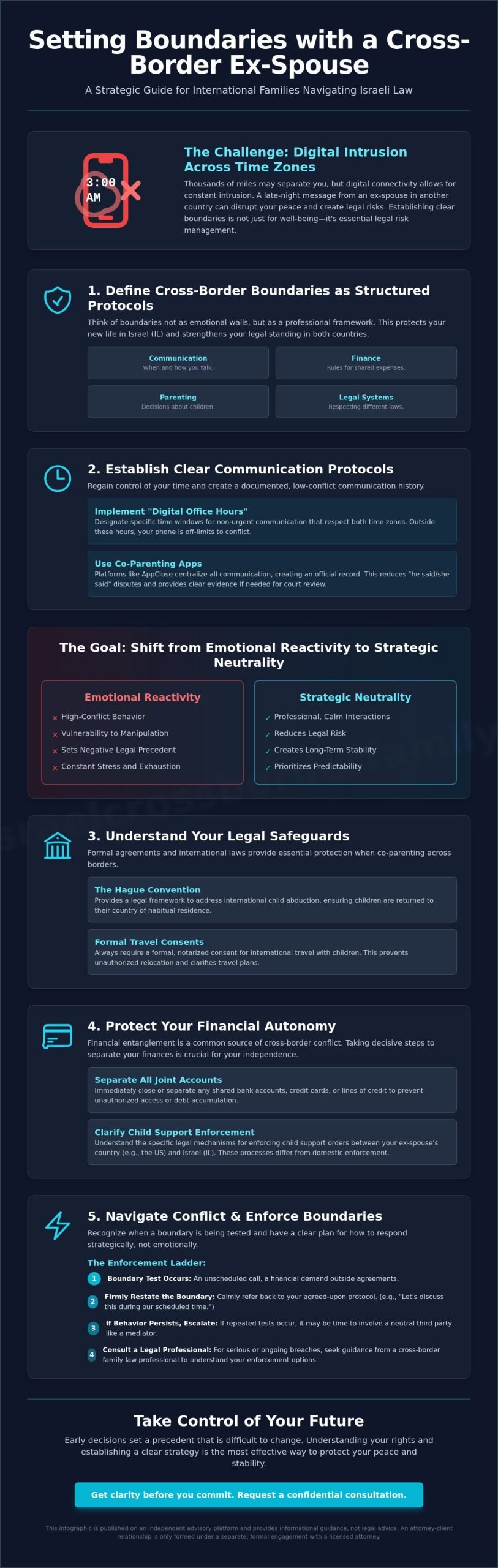
For many Anglo expats living in Israel, the local legal system feels unfamiliar and intimidating. It is easy to fall into a pattern of emotional reactivity when dealing with an ex-spouse who is in a different time zone. However, early decisions regarding how and when you communicate set a precedent that is difficult to change later. By adopting a stance of strategic neutrality, you treat your interactions like a professional arrangement rather than a personal conflict. This approach is essential for those managing a divorce for international families, as it prioritizes long-term stability over short-term emotional relief. Get clarity before you commit. Request a confidential consultation.
This article is published on an independent advisory platform (not a law firm) and does not constitute an attorney-client relationship. Legal services are only provided by licensed attorneys under a separate engagement.
Establishing Communication Protocols Across Time Zones
Effective communication is the cornerstone of setting boundaries with an ex-spouse in another country. When one parent resides in Israel (IL) and the other lives in a different jurisdiction, the physical distance often leads to intrusive digital habits that disrupt your daily life. You should establish “Digital Office Hours” that respect the time difference between both countries. This means designating specific windows where you are available to discuss matters related to the children or finances. Outside of these hours, your phone should not be a gateway for ongoing conflict.
Transitioning to specialized co-parenting apps is a strategic move to centralize documentation for future court review. As of 2026, platforms like AppClose require a subscription, costing $8.99 per month for mobile access. Alternatively, OurFamilyWizard offers plans ranging from the “Essentials” at $12.50 per month to the “Max” plan at $24.99 per month. These tools are superior to standard messaging because they create a permanent, unalterable record. They also encourage you to restrict communication to essential logistics such as health, education, and travel schedules.
Choosing the Right Communication Channels
Instant messaging apps are common in Israel (IL), but they often facilitate impulsive, emotional responses. Email provides a more formal structure and a clearer paper trail for legal evidence. You should avoid social media “friendship” with an ex-spouse entirely. It’s a high-risk liability that gives unnecessary insight into your private life. Additionally, disable “read receipts” on all platforms. Knowing exactly when a message was seen can fuel cross-border harassment claims or cause unnecessary anxiety for both parties.
Managing the 7-to-10 Hour Time Gap
The time difference between North America and Tel Aviv is significant. You must define what constitutes an “emergency” versus an “urgency.” An emergency involves immediate physical danger or a medical crisis. Everything else, including last-minute schedule changes, is an urgency that can wait for your designated office hours. Implementing a “24-hour rule” for non-emergency responses is a powerful tool. It allows emotions to cool and ensures your response is measured and strategic. This level of structure is vital in preventing misunderstandings that could lead to concerns regarding International Parental Child Abduction.
A shared digital calendar is another essential tool to prevent scheduling conflicts across borders. Maintaining these protocols helps you move from emotional reactivity to professional co-parenting. If you’re struggling to enforce these digital boundaries, it’s helpful to seek a professional review of your current communication plan. Get clarity before you commit. Request a confidential consultation.
This article is published on an independent advisory platform (not a law firm) and does not constitute an attorney-client relationship. Legal services are only provided by licensed attorneys under a separate engagement.
Co-Parenting Boundaries and International Custody Laws
Setting boundaries with an ex-spouse in another country requires a fundamental shift in how you view co-parenting. In domestic cases, informal flexibility is often encouraged to maintain harmony. However, when international borders are involved, this same flexibility can quickly become a legal liability. You must view every agreement through the lens of international compliance and risk management. This is particularly important when considering the Hague Convention on Child Abduction. With 103 parties currently signatory to the convention, it provides the primary legal framework for returning children to their place of habitual residence. Even if your assets don’t rival the largest divorce settlement in history, the procedural stakes for your family remain high.
Legal landscapes are also shifting globally. For instance, as of April 1, 2026, Japan’s Civil Code was amended to allow for joint parental authority after divorce, moving away from its previous mandatory sole custody system. These changes highlight why you cannot rely on outdated assumptions about foreign laws. Your boundaries must be clearly documented to ensure they’re enforceable across different jurisdictions.
Virtual Visitation: Setting the Stage
Virtual visitation should not be an open door to your private home life. You should define specific start and end times for video calls to prevent “virtual intrusion.” This occurs when a parent uses digital access to monitor your household or interrogate the child about your daily routine in Israel (IL). It’s vital to prohibit “coaching” or monitoring by the parent who isn’t participating in the call. The child needs a private space to bond with the parent living abroad without feeling scrutinized. Establishing these boundaries early helps maintain the “best interests of the child,” which remains the primary standard for courts in 2026.
Travel and Passport Boundaries
Clear travel protocols are essential for your peace of mind. You should specify which parent maintains physical possession of the child’s passport as a primary legal boundary. A common strategy is requiring the traveling parent to provide a full itinerary and a notarized travel consent at least 30 days before any international departure. These safeguards are vital for maintaining the integrity of international custody and relocation agreements. If you’re concerned about how these rules apply to your situation, you can request a review of your current travel protocols. Get clarity before you commit. Request a confidential consultation.
This article is published on an independent advisory platform (not a law firm) and does not constitute an attorney-client relationship. Legal services are only provided by licensed attorneys under a separate engagement.
Financial and Legal Autonomy in Different Jurisdictions
Establishing financial independence is a prerequisite for setting boundaries with an ex-spouse in another country. Many expats believe that moving to Israel (IL) creates a natural barrier to financial oversight, but the reality is much more complex. You should separate all joint accounts immediately to prevent unexpected withdrawals or credit liabilities that can occur across borders. It’s a common myth that living in a different country exempts an individual from their legal obligations. In fact, modern international agreements make it easier for authorities to track financial non-compliance than in previous decades.
The consequences for ignoring these boundaries are significant. For example, the US Department of State will deny or revoke the passport of any individual with over $2,500 in unpaid child support. As of May 2026, enforcement has become even more proactive, particularly for those with substantial arrears. This highlights why understanding the boundaries of enforcing child support orders is critical for your long-term autonomy. You don’t want to discover that a lack of formal boundaries has led to a revoked travel document or frozen assets during an international trip.
The Danger of Informal Financial Agreements
You should avoid “under-the-table” payments or performing financial favors, such as paying for local errands in exchange for a reduction in formal support. These informal arrangements often complicate official support calculations in Israel (IL) and can be used as evidence of a continuing, entangled relationship in court. If you provide financial support outside of a court-ordered agreement, it’s often viewed as a gift rather than a fulfillment of your obligations. Always maintain a clear paper trail for every cross-border currency transfer. Use bank transfers that provide time-stamped receipts rather than cash or informal apps to ensure every payment is documented.
Respecting Legal Jurisdictions
Legal boundaries function differently depending on the country. In the US, a common enforcement tool is a “contempt of court” charge, which can lead to fines or even arrest. In Israel (IL), a “stay of exit” order is a powerful mechanism that prevents an individual from leaving the country until certain legal or financial obligations are met. When an ex-spouse threatens legal action in their home country, your best defense is a clear understanding of which jurisdiction currently holds authority over your case. You can learn more about how cross-border advisory works to help you navigate these conflicting systems without falling into expensive legal traps.
If you are unsure how to separate your international financial ties safely, reach out for a strategic review of your situation. Get clarity before you commit. Request a confidential consultation.
This article is published on an independent advisory platform (not a law firm) and does not constitute an attorney-client relationship. Legal services are only provided by licensed attorneys under a separate engagement.
Navigating Conflict and Enforcing Boundaries Strategically
Conflict does not automatically dissipate once a divorce decree is signed. You should recognize “boundary testing” as a common phase in the first two years post-separation. During this period, an ex-spouse often attempts to gauge how much of your new life in Israel (IL) they can still influence. Setting boundaries with an ex-spouse in another country requires you to remain firm and predictable, even when faced with persistent provocation. This is the stage where you must decide whether a situation requires a mediator to refine your protocols or a cross-border legal professional to enforce existing orders.
One effective strategy for managing high-conflict interactions is the “Gray Rock” method. This technique involves becoming as uninteresting and non-responsive as a gray rock. You provide short, factual, and emotionless answers to all inquiries. By removing the emotional “payoff” an ex-spouse seeks through conflict, you often reduce the frequency of their intrusive behavior. For more visual guidance on managing these complex dynamics, you can visit the Israel Family Law YouTube channel.
When Boundaries are Repeatedly Violated
Documenting every instance where a protocol is ignored is essential for future use in Israeli or US family courts. You might experience “hoovering” across international lines. This is a psychological tactic where an ex-spouse uses emotional manipulation or manufactured crises to pull you back into a dysfunctional dynamic. You must identify when a violation transitions from a nuisance to a legal emergency. If there is a credible threat of abduction or a refusal to return a child following a visit, you must engage professional support immediately to protect your family’s safety.
Creating a Long-Term Strategy
The first 90 days of a cross-border separation are the most critical. This is the window where the foundation of your new dynamic is established. Decisions made during this time set a precedent for how the courts will view your co-parenting relationship in the future. As your children age, your communication protocols should include a “sunset clause.” This allows your requirements to evolve naturally as the children gain more independence and direct access to their own communication devices. Maintaining a long-term perspective helps you move from survival mode into a structured, peaceful future.
Every international family situation is unique and requires a tailored strategy. To ensure your protocols are robust enough to withstand the complexities of different legal systems, learn more about how structured advisory can help. Get clarity before you commit. Request a confidential consultation.
This article is published on an independent advisory platform (not a law firm) and does not constitute an attorney-client relationship. Legal services are only provided by licensed attorneys under a separate engagement.
Securing Your Future Across Borders
Success in a cross-border separation depends on your ability to transition from emotional conflict to strategic management. By establishing digital office hours and strictly adhering to international travel protocols, you protect both your daily peace and your long-term legal standing. Remember that setting boundaries with an ex-spouse in another country is an ongoing process of risk mitigation. This requires a deep understanding of how different legal systems, particularly those in Israel (IL) and the US, interact and enforce obligations.
The complexity of these multi-jurisdictional situations makes early, informed decision-making vital. Whether you are managing child support enforcement or navigating the nuances of the Hague Convention, having a structured plan reduces the potential for future litigation. Our advisory platform offers specialized expertise in US-Israel family law through practitioners licensed in multiple jurisdictions. We provide a neutral, risk-based approach designed to give you the confidence to move forward. Get clarity before you commit. Request a confidential consultation. You have the tools to build a stable, independent life for yourself and your children.
This article is published on an independent advisory platform (not a law firm) and does not constitute an attorney-client relationship. Legal services are only provided by licensed attorneys under a separate engagement.
Frequently Asked Questions
Can I stop my ex from calling the kids at 3 AM my time?
You can implement structured calling windows that align with your local time in Israel (IL). Setting boundaries with an ex-spouse in another country often starts with protecting the child’s sleep schedule. Most courts view 3 AM calls as disruptive and support the use of “Digital Office Hours” to maintain a stable environment. Establishing these windows early prevents digital intrusion from affecting your child’s well-being.
What should I do if my ex-spouse refuses to return the kids to Israel after a summer visit?
You should immediately seek assistance regarding the Hague Convention on the Civil Aspects of International Child Abduction. This is a legal emergency where time is a critical factor in restoring the child to their habitual residence in Israel (IL). With 103 parties to the convention as of 2022, there are established frameworks to handle these violations. Delaying action can complicate the jurisdictional arguments in your case.
Do I have to respond to every email from my ex’s foreign lawyer?
You are generally not required to communicate directly with a foreign legal representative. It’s often safer to have your own practitioner handle these interactions to avoid procedural mistakes or unintended admissions. Early responses to foreign lawyers can inadvertently establish jurisdiction in a country that may not be the most appropriate forum for your case. Get clarity before you commit to any direct correspondence.
How do I enforce a US boundary agreement if my ex now lives in Israel?
A US boundary agreement is not automatically enforceable in Israel (IL) and typically needs to be “domesticated” through the Israeli court system. This process relies on the legal principle of comity, where one country voluntarily recognizes the legal acts of another. Domesticating the order ensures that Israeli authorities can act if the boundaries are violated. Seeking clarity on this process early prevents significant enforcement delays.
Is it okay to block my ex-spouse on social media during a cross-border divorce?
Blocking an ex-spouse on personal social media is often a healthy step for emotional distance and risk management. However, you shouldn’t block them on the designated co-parenting apps or email channels required for logistics. Setting boundaries with an ex-spouse in another country means separating your personal life from necessary parental communication. This prevents your private activities from being used as evidence in a foreign or local court.
What is the best way to handle shared financial assets located in two different countries?
The most effective approach is to separate all joint accounts and establish independent financial structures in each jurisdiction. Multi-jurisdictional complexity makes shared assets a high-risk liability during a divorce. You should maintain a meticulous paper trail for every currency transfer to ensure compliance with both US and Israeli regulations. This proactive strategy reduces the chance of financial “surprises” that often occur across borders.
Can I change my child’s school without the other parent’s consent if they live abroad?
You typically cannot make major life decisions like changing a school unilaterally if you have joint parental authority. Even if the other parent lives abroad, they usually retain a right to be involved in significant education decisions. Proceeding without consent or a court order in Israel (IL) could be viewed as a violation of the other parent’s rights. This could negatively impact your standing in future custody hearings.
How do I manage emergency medical decisions when the other parent is in a different time zone?
Your co-parenting protocol should clearly distinguish between a life-threatening emergency and a non-urgent medical issue. In a true emergency, the parent physically present with the child in Israel (IL) should act immediately and inform the other parent as soon as possible. For non-emergencies, you should wait for a time that respects both time zones before making a decision. This prevents unnecessary conflict while prioritizing the child’s health.

Article by
Gabriel Lior
A Personal Journey That Became a Mission
The advisory was founded by an American father Gabriel Lior, LLB, MBA , global entrepreneur, and cross-border advisor who spent more than a decade navigating the Israeli family court system firsthand and now lives in Singapore with his son.
As a divorced parent in a cross-border family, Gabriel faced nearly every legal challenge a foreign parent can encounter in Israel — including child custody disputes, child support proceedings, property matters in Israel and abroad, false accusations, and complex immigration and relocation proceedings.
Over the years, he learned the hard way how difficult it is for non-Israeli parents to understand the system, identify the right legal strategy, and choose the right legal representation — especially when language, culture, and jurisdictional differences are involved. He also witnessed how foreign parents and new immigrants are often disadvantaged or taken advantage of by service providers and institutions simply because they lack local knowledge or fluency.
From Client to Advisor
To truly understand — and survive — the system, Gabriel pursued formal legal education in Israel, completing two Israeli law degrees, alongside a BA and MBA earned in the United States. This was never about becoming a practicing attorney, but about gaining a deep, structural understanding of how the system works — and where it breaks down for foreign parents.
This rare combination of:
Firsthand client experience
Israeli legal and US business education
International business and negotiation training
Decades of commercial execution
created a unique perspective – one that understands both sides of the table.
After years of litigation, persistence, and at times self-representation, he ultimately succeeded in securing custody of his son and relocating abroad through a rare legal victory in the Israeli Supreme Court — becoming one of the first fathers in Israel to do so under these circumstances.
Disclaimer
Important Disclaimer:
The information provided on this website and in its content is for general informational and educational purposes only and does not constitute legal advice, legal opinion, or legal representation.
Gabriel Lior is not licensed to practice law in Israel (nor is he interested in doing so) and does not provide legal services, despite having completed 2 Law Degrees. The services offered are advisory in nature and are intended to provide general guidance, strategic insight, and information regarding cross-border family law considerations.
No attorney-client relationship is formed by accessing this website, reading its content, or communicating with us.
Any decisions made based on this information are at your own discretion and risk. For legal advice specific to your situation, you should consult a licensed attorney in the relevant jurisdiction.
Where appropriate, we may refer clients to independent, licensed attorneys or professionals. Such referrals do not constitute legal representation and no liability is assumed for services provided by third parties.