This article is published on an independent advisory platform and does not constitute a law firm or an attorney-client relationship. Legal services are only provided by licensed attorneys under a separate engagement.
A family arrives at the airport for a long-awaited trip to New York, only to discover they cannot board because they lack the specific israel child custody international travel consent required by their court order. This scenario is a common fear for international families who must navigate two different legal systems simultaneously. We believe that a successful holiday requires a strategy where legal compliance is treated as a prerequisite to logistical planning.
It’s natural to feel overwhelmed by conflicting school calendars and the exhaustion of long-haul travel with children. You want to maximize family time without the shadow of a potential legal dispute hanging over your departure. This guide offers a comprehensive roadmap for navigating these multi-continental complexities. We’ll provide clarity on the essential documentation you need, explain the ₪41 apostille process, and offer a checklist designed to keep your travel plans both secure and stress-free.
Key Takeaways
- Learn how to formalize israel child custody international travel consent to ensure your holiday plans align with both Israeli and international border requirements.
- Identify the logistical gaps between the Israeli school calendar and US holiday schedules to maximize your family’s time together without schedule conflicts.
- Review the essential documentation checklist, including the six-month passport validity rule and the specific fees for obtaining an apostille in Israel.
- Understand the strategic importance of verifying your legal standing before committing to non-refundable travel expenses to avoid costly logistical errors.
- Explore the differences between simple tourism and the complex multi-jurisdictional planning required for families living between two legal systems.
Understanding the Challenges of Planning for Holidays and Vacations Across Continents
This article is published on an independent advisory platform and does not constitute a law firm or an attorney-client relationship. It provides informational and advisory content only. Legal services are only provided by licensed attorneys under a separate engagement.
International families don’t simply “book a flight.” For parents living between Israel and the United States, planning a holiday is a strategic operation that moves far beyond basic tourism. It requires a shift toward family-centric planning where every decision balances the emotional desire to visit home with the logistical realities of cross-border life. Securing the proper israel child custody international travel consent is the first step in ensuring that a trip meant for connection doesn’t result in a legal crisis at the border.
To better understand the practical side of this process, watch this helpful video regarding travel documentation:
The Complexity of Cross-Border Family Dynamics
Traveling across continents involves a wide range of stakeholders. You aren’t just coordinating with a co-parent; you’re managing expectations from extended family in the US, school systems in Israel, and international border authorities. The 7 to 10 hour time difference between Tel Aviv and American cities often leads to significant jet lag. This exhaustion can negatively impact family harmony and make it difficult to adhere to strict visitation schedules. Because of these variables, international families should ideally begin their planning 6 to 12 months in advance. Early coordination helps identify potential conflicts with Israeli school holidays or US summer breaks before they become points of contention.
Risk vs. Reward in International Travel
Before you commit to high-cost airline tickets, you must assess the stability of your current legal environment. It’s vital to seek clarity on your existing custody orders in both jurisdictions. This is particularly relevant when considering the Hague Convention on the Civil Aspects of International Child Abduction, which serves as the primary legal framework for international custody disputes. For those exploring international custody and relocation, understanding these risks early prevents expensive mistakes. Cross-border complexity is a multifaceted intersection of rigid legal frameworks and fluid logistical requirements. Making informed choices based on a clear strategy is the only way to protect your financial investment and your family’s peace of mind.
Legal Considerations: Israel Child Custody and International Travel Consent
This article is published on an independent advisory platform and does not constitute a law firm or an attorney-client relationship. Legal services are only provided by licensed attorneys under a separate engagement.
The legal landscape for traveling with children from Israel is governed by the principle of joint natural guardianship. This means that, regardless of the day-to-day living arrangements, both parents typically retain the right to decide on international travel. Securing formal israel child custody international travel consent is not just a courtesy; it’s a critical safeguard against being stopped at Ben Gurion Airport. A Notarized Travel Consent form serves as primary evidence that both guardians agree to the trip, detailing the destination, duration, and specific return date.
If a parent refuses to sign this consent, the traveling parent may need to file a motion in the Israeli Family Court. The current filing fee for a motion to modify or clarify travel rights is approximately ₪802 for claims with an annual value up to ₪50,000. The court’s primary focus is always the best interests of the child, but it also considers the rights of the non-traveling parent to maintain a consistent relationship. Existing custody orders in Israel often include “Stay of Exit” orders (Tzav Ikul) to prevent a child from being removed from the country without judicial approval. These orders must be temporarily lifted through a formal legal process before any international departure.
Navigating International Custody and Relocation Risks
The distinction between a temporary vacation and a permanent move is a frequent source of conflict in cross-border situations. A trip that extends beyond its agreed duration can quickly be reclassified as a relocation attempt. This ambiguity is why many parents find value in exploring international custody relocation strategies before they even book a flight. Common pitfalls in written agreements include vague return dates or failing to specify which court holds jurisdiction if a dispute arises while the child is abroad. Clear, specific language in your travel agreement reduces the risk of border disputes and provides security for both parents.
The Role of the Hague Convention in Travel
The Hague Convention is a multilateral treaty designed to protect children from the harmful effects of international abduction. It ensures that custody matters are decided in the child’s country of “habitual residence.” When a parent keeps a child abroad past the agreed return date, it may be viewed as “wrongful retention” under this treaty. The Israeli Ministry of Justice on International Child Abduction provides detailed guidance on how these laws are applied within Israel. To protect yourself, ensure your return date is legally documented and that you have a clear copy of the Hague Convention child abduction protocols. Get clarity before you commit. Request a confidential consultation.
Managing the Calendar: Bridging the US-Israel Holiday Gap
This article is published on an independent advisory platform and does not constitute a law firm or an attorney-client relationship. Legal services are only provided by licensed attorneys under a separate engagement.
Planning a trip between Israel and the United States is often a puzzle of misaligned dates. Israeli students enjoy long breaks during the High Holidays in autumn and a nearly three-week hiatus for Pesach. American students are typically in class during these times, focusing instead on Thanksgiving in November or a spring break that rarely aligns with the Hebrew calendar. These discrepancies make it difficult to find a window that respects the educational requirements of both countries. Negotiating these differences requires a proactive approach to obtaining israel child custody international travel consent, as travel dates must be precisely defined in any agreement to avoid school attendance issues.
The “Summer Paradox” presents the most significant hurdle. Many US schools conclude their academic year in late May or early June, while Israeli schools continue until late June or July. Conversely, many American schools resume in mid-August, just as Israeli families are entering the peak of their summer vacation before the September 1st start date. This leaves a very narrow window for cross-continental travel that doesn’t result in a child missing significant school time. Strategic families often choose to “split the difference” by alternating which major holiday is spent abroad each year.
Synchronizing Multi-Continental Schedules
Successful travel starts with a master calendar that overlays both jurisdictions. You should account for overlap periods where one child may be on break while the other is still in school. It’s also vital to plan for recovery time. A 10-hour flight across seven to ten time zones demands a “soft landing” period of two to three days. Without this buffer, jet lag can lead to exhaustion, making it difficult for children to adhere to the planned visitation schedule. Including these transition days in your written agreement prevents misunderstandings about when the actual “quality time” begins.
Cultural Sensitivity and Family Obligations
Managing the expectations of extended family is a delicate task. Relatives in the US may prioritize Thanksgiving or secular winter holidays, while family in Israel may view the Seder or Sukkot as non-negotiable. IL refers to Israel and requires specific cultural timing. Balancing these religious and secular priorities is essential for maintaining family harmony. When drafting a divorce or separation agreement, specify which parent has priority for specific holidays to avoid last-minute disputes. Clarity on these points ensures that both parents can honor their cultural traditions without legal friction.
The Essential Checklist for Cross-Border Vacations
This article is published on an independent advisory platform and does not constitute a law firm or an attorney-client relationship. Legal services are only provided by licensed attorneys under a separate engagement.
A successful trip across continents requires more than just a valid ticket. While previous sections focused on the legal framework and calendar alignment, this checklist addresses the practical steps necessary for a smooth departure. Securing your israel child custody international travel consent documents well in advance is the foundation of this process. Without these verified papers, even the most well-planned vacation can be halted at the border. You should also verify that both US and Israeli passports are valid for at least six months beyond your intended return date. Many families overlook this rule, leading to last-minute stress at the consulate or the airport.
Health and insurance coverage must also be addressed with a cross-border perspective. Standard Israeli kupat cholim coverage does not extend to the United States. You must secure comprehensive travel insurance that covers medical emergencies in both jurisdictions. Finally, establish a clear communication plan with your co-parent. Setting boundaries regarding daily call times or emergency protocols before you leave helps maintain harmony during the trip.
Documentation and Logistics
International families often navigate the requirements of dual citizenship. It is a legal requirement for Israeli citizens to enter and exit Israel using their Israeli passports. Ensure both the US and Israeli passports are updated and match the names on your travel consent forms. If your travel agreement was part of a divorce or separation for international families, keep a certified copy of the court order with your travel documents. You should also maintain a digital and physical emergency contact list that includes relatives and legal contacts on both continents.
Financial and Practical Planning
Moving between different banking systems can trigger security alerts. Notify your financial institutions of your travel dates to avoid frozen credit cards during multi-continent transactions. It is also essential to check for any outstanding “Stay of Exit” orders (Tzav Ikul) in the Israeli system. If an order exists, you may need to file a motion to temporarily lift it, which involves a filing fee of approximately ₪802 in the Family Court. If you require an apostille for your documents, the Ministry of Foreign Affairs charges a fee of ₪41 per document. Setting a firm “return to base” date is the final step. This ensures you satisfy both the legal requirements of your custody agreement and the attendance policies of your child’s school. If you have questions about these requirements, contact us for a strategic review.
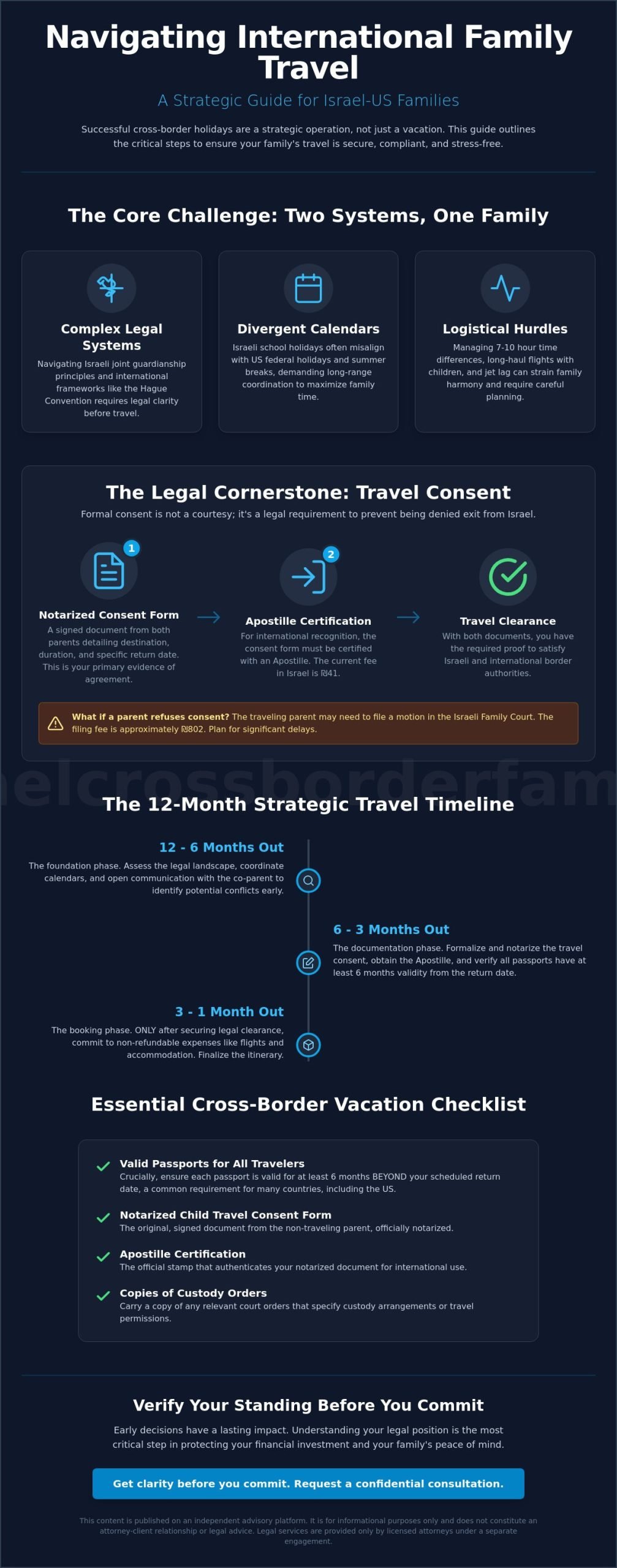
Getting Clarity Before You Commit: The Advisory Approach
This article is published on an independent advisory platform and does not constitute a law firm or an attorney-client relationship. Legal services are only provided by licensed attorneys under a separate engagement.
The process of securing israel child custody international travel consent should begin long before you search for flights. In a cross-border environment, the strategy is the most valuable asset you have. Many families make the mistake of purchasing non-refundable tickets before verifying their legal standing. With family flights between Tel Aviv and the US often costing upwards of ₪20,000, the financial risk of a travel dispute is significant. Strategic advisory differs from traditional legal representation because it focuses on identifying potential risks and creating a roadmap to avoid them before they escalate. Understanding how it works helps families transition from reactive stress to proactive planning.
Strategic advisory is distinct from legal representation. While an attorney handles the technical filings in the Family Court, an advisor helps you look at the broader context of your international life. This includes analyzing how your travel plans align with your long-term goals for residency or future relocation. Incorporating this expert guidance early is the best way to prevent the high costs of future litigation. By resolving potential conflicts in a neutral, educational setting, families can often reach agreements without needing a judge to intervene.
The Value of a Cross-Border Strategy
Early decisions regarding where you travel and for how long can dictate your ability to travel in the future. For example, choosing a destination that raises concerns for a co-parent can lead to the filing of a “Stay of Exit” order. Using risk-based decision-making allows you to select destinations and durations that satisfy both parents’ need for security. This builds trust and reduces the likelihood of legal friction. For visual guidance on these complex topics, the Israel Family Law YouTube channel offers additional insights specifically for the Anglo community in Israel.
Next Steps for International Families
Managing international travel is a marathon. The logistical and legal hurdles are manageable when you break them down into strategic steps. Reassurance comes from knowing that your documentation is in order and that your co-parenting agreement is robust enough to handle the complexities of two different legal systems. Taking these steps early allows you to focus on spending quality time with your children rather than worrying about border logistics. The goal is to move from a state of uncertainty to one of informed confidence. Get clarity before you commit. Request a confidential consultation.
Securing Your Family’s Global Future
Managing a multi-continental life between Israel and the United States requires a commitment to proactive planning. We’ve explored how aligning school calendars and securing the correct israel child custody international travel consent protects your financial and emotional investments. By addressing these cross-border complexities through a strategy-first approach, you can avoid the high-stress litigation that often follows poorly documented travel. Relying on a structured checklist ensures that passport validity, bank notifications, and court orders are handled well before you reach the airport.
Our specialized focus on US-Israel cross-border family dynamics provides a stable foundation for international families. We offer guidance for expats that bridges the gap between different legal systems and cultural expectations. This licensed expertise ensures that your travel plans remain compliant with both Israeli and international standards, allowing you to focus on family connections rather than legal friction. Complexity is manageable when you have a clear roadmap to follow. We look forward to helping you move forward with confidence.
Get clarity before you commit. Request a confidential consultation.
Frequently Asked Questions
Do I need a notarized letter to travel alone with my child to the US from Israel?
Yes, you generally need a notarized travel consent letter when traveling solo with a minor from Israel to the United States. This document provides formal evidence of israel child custody international travel consent and is often requested by border authorities to prevent international parental child abduction. While some parents rely on their custody agreement, a specific, notarized letter detailing the flight dates and destination offers the highest level of security.
How does the Hague Convention affect my family vacation?
The Hague Convention serves as a protective framework that ensures custody matters are decided in the child’s country of “habitual residence.” If a parent remains abroad with a child beyond the agreed return date, it may be classified as “wrongful retention” under this treaty. This legal mechanism allows the other parent to seek the prompt return of the child through the Israeli Family Court or the US legal system if a dispute arises.
Can I take my child on vacation if there is an active custody dispute in Israel?
Traveling during an active custody dispute typically requires either written consent from the other parent or a specific order from the Family Court. Israeli courts often place a “Stay of Exit” order on children during litigation to ensure they remain within the jurisdiction until a final decision is reached. You would likely need to file a motion and potentially provide a financial guarantee to temporarily lift such an order for a vacation.
What happens if my child’s US passport is expired but their Israeli one is valid?
Dual citizens are legally required to enter and exit Israel on their Israeli passports and enter the United States on their US passports. If the US passport is expired, your child will likely be denied entry to the United States even if their Israeli passport is valid. It’s essential to ensure both documents have at least six months of validity remaining before you finalize your travel plans to avoid being stopped at the border.
How far in advance should I notify my co-parent about international travel?
Most co-parenting agreements require a notification period of at least 30 to 60 days for international travel. However, the logistical complexity of cross-border trips suggests that beginning the conversation 6 to 12 months in advance is more effective. This longer window allows both parents to resolve potential conflicts regarding school schedules or religious holidays without the pressure of an impending departure date or the risk of non-refundable ticket losses.
Is a Stay of Exit order common for children of expats in Israel?
Stay of Exit orders (Tzav Ikul) are very common for children of international families in Israel, particularly during or after a divorce. These orders are used as a standard preventative measure to ensure that neither parent relocates the child permanently without consent. A clear travel agreement should define the exact process for temporarily lifting these orders to facilitate legitimate holiday travel while providing security for the non-traveling parent.
What should I do if my ex-partner refuses to sign a travel consent form?
If a co-parent refuses to sign the necessary documentation, you may file a motion in the Israeli Family Court to request judicial permission for the trip. The court filing fee for such a motion is approximately ₪802. The court will evaluate the request based on the best interests of the child and the likelihood of the child’s return to Israel after the vacation concludes, often requiring the traveler to provide some form of collateral.
How can I enforce a US travel schedule while living in Israel?
Enforcing a US travel schedule while residing in Israel requires the Israeli Family Court to recognize or domesticate the foreign order. It’s often more efficient to incorporate the US schedule directly into a court-approved Israeli custody agreement. This ensures that the israel child custody international travel consent is enforceable by local authorities and that both parents have a clear, legally binding understanding of their rights and obligations in both jurisdictions.

Article by
Gabriel Lior
A Personal Journey That Became a Mission
The advisory was founded by an American father Gabriel Lior, LLB, MBA , global entrepreneur, and cross-border advisor who spent more than a decade navigating the Israeli family court system firsthand and now lives in Singapore with his son.
As a divorced parent in a cross-border family, Gabriel faced nearly every legal challenge a foreign parent can encounter in Israel — including child custody disputes, child support proceedings, property matters in Israel and abroad, false accusations, and complex immigration and relocation proceedings.
Over the years, he learned the hard way how difficult it is for non-Israeli parents to understand the system, identify the right legal strategy, and choose the right legal representation — especially when language, culture, and jurisdictional differences are involved. He also witnessed how foreign parents and new immigrants are often disadvantaged or taken advantage of by service providers and institutions simply because they lack local knowledge or fluency.
From Client to Advisor
To truly understand — and survive — the system, Gabriel pursued formal legal education in Israel, completing two Israeli law degrees, alongside a BA and MBA earned in the United States. This was never about becoming a practicing attorney, but about gaining a deep, structural understanding of how the system works — and where it breaks down for foreign parents.
This rare combination of:
Firsthand client experience
Israeli legal and US business education
International business and negotiation training
Decades of commercial execution
created a unique perspective – one that understands both sides of the table.
After years of litigation, persistence, and at times self-representation, he ultimately succeeded in securing custody of his son and relocating abroad through a rare legal victory in the Israeli Supreme Court — becoming one of the first fathers in Israel to do so under these circumstances.
Disclaimer
Important Disclaimer:
The information provided on this website and in its content is for general informational and educational purposes only and does not constitute legal advice, legal opinion, or legal representation.
Gabriel Lior is not licensed to practice law in Israel (nor is he interested in doing so) and does not provide legal services, despite having completed 2 Law Degrees. The services offered are advisory in nature and are intended to provide general guidance, strategic insight, and information regarding cross-border family law considerations.
No attorney-client relationship is formed by accessing this website, reading its content, or communicating with us.
Any decisions made based on this information are at your own discretion and risk. For legal advice specific to your situation, you should consult a licensed attorney in the relevant jurisdiction.
Where appropriate, we may refer clients to independent, licensed attorneys or professionals. Such referrals do not constitute legal representation and no liability is assumed for services provided by third parties.