This article is published on an independent advisory platform (not a law firm) and must not imply an attorney-client relationship. Content provided is informational and advisory only, not legal representation or legal advice. Legal services are only provided by licensed attorneys under a separate engagement.
Imagine preparing for a long-awaited trip home to visit family, only to find yourself barred from boarding at Ben Gurion Airport due to an unforeseen legal filing. For many expats, the intersection of two distinct legal systems feels like a maze where one wrong turn leads to significant financial or personal restrictions. Navigating child support for us citizens in israel requires a strategic understanding of how international agreements interact with local religious and civil laws. You likely already feel the pressure of managing a life between two countries, and the added confusion of the Israeli court system can be overwhelming.
This guide offers the clarity needed to handle international support with confidence, specifically addressing enforcement mechanisms, calculation methods, and travel risks. We will explore the 2009 US-Israel Memorandum of Understanding, the impact of the 2017 Supreme Court revolution, and how to proactively manage “Stay of Exit” orders. For more visual guidance on these topics, you can view our resources at https://www.youtube.com/@IsraelFamilyLaw. Get clarity before you commit. Request a confidential consultation.
Key Takeaways
- Understand the 2009 Memorandum of Understanding that facilitates the reciprocal enforcement of support orders between the United States and Israel.
- Learn the specific criteria used to calculate child support for us citizens in israel, including how parental income and custody time influence the final amount.
- Identify the legal triggers for a “Stay of Exit” order to protect your freedom of movement and manage international travel risks effectively.
- Discover the procedural requirements for registering foreign court orders and the complexities involved in modifying them to fit the Israeli system.
- Gain strategic insights into the financial implications of relocation, focusing on the high costs of housing and education for international families.
This article is published on an independent advisory platform and does not constitute legal representation or legal advice. Legal services are only provided by licensed attorneys under a separate engagement.
The US-Israel Reciprocal Agreement: How International Support Works
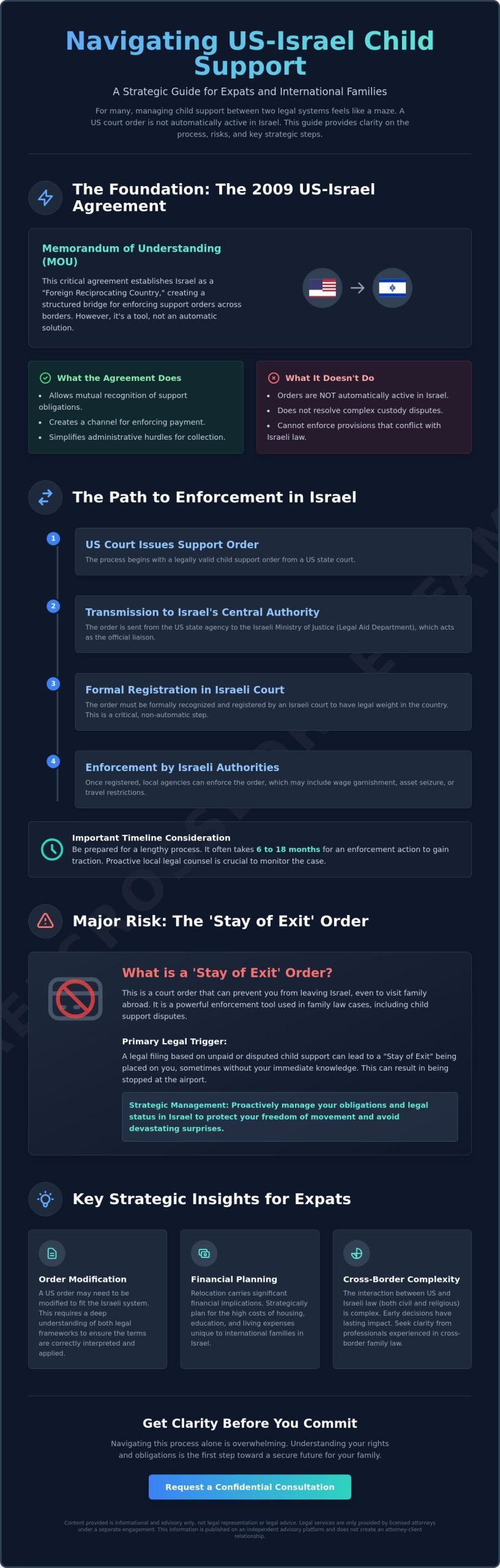
Since 2009, the legal landscape for American families in Israel has been governed by a specific Memorandum of Understanding (MOU). This agreement established Israel as a reciprocating country, creating a structured bridge for the recognition and collection of maintenance across borders. For those managing child support for us citizens in israel, this means that a support order issued by a US state court can, under specific conditions, be enforced by the Israeli authorities. However, many expats mistakenly believe that a foreign order is automatically active once they move. This is not the case. The order must be formally processed through the appropriate channels to have legal weight in the IL system.
The foundation of this cooperation rests on the principles found in The US-Israel Reciprocal Agreement: How International Support Works, which aligns both nations with international standards for family maintenance recovery. While the MOU streamlines the process, it does not bypass the need for local registration. Without formal recognition by an Israeli court, the local enforcement agencies cannot seize assets or place travel restrictions on a debtor.
To better understand how these international mechanisms function in practice, watch this helpful video:
What is a Foreign Reciprocating Country?
Being a Foreign Reciprocating Country (FRC) simplifies the administrative hurdles that once made cross-border support nearly impossible. The MOU allows for the mutual recognition of paternity and support obligations without requiring a completely new trial on the merits of the case. This status means that the US and Israel agree to provide each other with the same level of assistance they give their own citizens. However, the agreement has limitations. It primarily focuses on the collection of money. It doesn’t necessarily resolve complex disputes regarding custody or visitation rights, which are often handled under different legal frameworks. Strategy is required when a US order contains provisions that conflict with Israeli public policy.
The Role of the Central Authority
The Israeli Ministry of Justice, specifically the Legal Aid Department, serves as the Central Authority for these claims. When a support petition is transmitted from a US state agency to Israel, this department acts as the liaison. They facilitate the movement of documents and represent the interest of the reciprocating state in local proceedings. Despite this government-level cooperation, the process can be slow. It often takes 6 to 18 months for an enforcement action to gain traction. Local legal counsel is usually necessary to monitor the case and ensure that the Israeli court correctly interprets the nuances of the original US order, especially when dealing with child support for us citizens in israel who may have complex income streams. Get clarity before you commit. Request a confidential consultation.
This article is published on an independent advisory platform and does not constitute legal representation or legal advice. Legal services are only provided by licensed attorneys under a separate engagement.
How Child Support is Calculated in the Israeli Legal System
Israeli family law operates within a dual system where civil Family Courts and religious courts, such as the Rabbinical Court, share jurisdiction. For those managing child support for us citizens in israel, the calculation is not based on the fixed percentage tables common in many US states. Instead, the court evaluates the specific needs of the child alongside the financial resources of both parents. This process involves a distinction between absolute obligations under religious law and equitable contributions based on modern civil principles. Understanding these nuances is vital before you enter any formal agreement or litigation.
The system remains complex because it applies different rules based on the age of the child. While traditional religious law once placed the entire financial burden on the father, modern Israeli rulings have shifted the landscape for older children. When Enforcing or Modifying Foreign Support Orders in Israel, the authorities will examine how these local standards compare to your existing US order. If you’re unsure how your current arrangements fit into this framework, you may want to discuss your situation with an advisor who understands both systems.
Essential vs. Extra Support Costs
Israeli courts divide support into two main categories. “Essential Support” covers basic necessities like food, clothing, and health insurance. As of 2026, the verified minimum for these essential needs is between ₪1,400 and ₪1,600 per month per child. This baseline does not include “mador,” which refers to housing and household maintenance costs. Housing is typically calculated as a percentage of the rent or mortgage: 30% for one child, 40% for two children, and 50% for three or more. Costs beyond these basics, such as private lessons or summer camps, fall under “Din Tzedaka” (charity) and are shared proportionally by both parents based on their respective incomes.
The 2017 Supreme Court Revolution
A landmark 2017 Supreme Court ruling (HCJ 919/15) fundamentally changed how child support for us citizens in israel is handled for children aged 6 to 15. In cases of shared physical custody where both parents have similar incomes, the obligation to transfer support may be significantly reduced or even eliminated. The court now applies a gender-neutral formula for this age group, focusing on the parents’ proportional earnings and the actual time the child spends in each household. However, for children under the age of six, the father still maintains an absolute obligation to cover essential needs regardless of the mother’s income. It’s also critical to remember that the law protects the payer’s basic existence; a parent must generally be left with a self-support reserve of at least ₪5,500 per month after paying support. Get clarity before you commit. Request a confidential consultation.
This article is published on an independent advisory platform and does not constitute legal representation or legal advice. Legal services are only provided by licensed attorneys under a separate engagement.
Enforcing or Modifying Foreign Support Orders in Israel
Obtaining a child support order in a US court is often only the first step for international families. For those managing child support for us citizens in israel, the challenge lies in bridging the gap between a US judgment and local enforcement. A US order doesn’t automatically grant the Israeli Enforcement and Collection Authority the power to garnish wages or seize assets. To achieve this, the order must undergo a formal recognition process within the Israeli Family Court system. This procedure ensures the foreign judgment doesn’t contradict local public policy and meets the standards of the reciprocal agreement between the two nations.
The diplomatic foundation for these legal interactions is grounded in the long-standing relationship between the two countries. You can find more context on these bilateral ties through The ‘Stay of Exit’ Order: Navigating Travel Risks for US Citizens provided by the U.S. Department of State. While the government-to-government framework exists, the actual enforcement timeline for foreign orders typically spans 6 to 18 months. Strategic planning is essential to manage financial expectations during this period.
Registration and Recognition
To make a US support judgment enforceable, you must submit a formal application for recognition to the Israeli Family Court. This process requires specific documentation to prove the validity of the foreign order. You’ll need to provide:
- A certified copy of the original US court order.
- An apostille certification from the relevant US state authority to verify the document’s authenticity.
- A professional Hebrew translation of the entire judgment, certified by a notary.
- Proof that the responding party was properly served and had the opportunity to present their case in the US.
Once registered, the order carries the same weight as an Israeli judgment. You can learn more about cross-border enforcement and how the Israeli Enforcement Agency handles arrears and collection. One common complication arises when US support amounts significantly exceed typical Israeli standards; the court may scrutinize these orders closely before granting full recognition.
Modifying Support After Relocation
Life changes, and so do financial capabilities. A US citizen living in Israel may find that a support amount set years ago in America no longer reflects their current reality. Israeli courts can modify a foreign support order, but only if the applicant demonstrates a “Material Change in Circumstances.” This is a high legal threshold. It’s not enough to simply move; you must show a significant shift in income, the child’s needs, or the cost of living that wasn’t foreseeable when the original order was made.
The cost of living in Israel is estimated to be 30-40% higher than in the United States, which can impact the calculation of “extra expenses.” When filing for a modification, be prepared for court fees. For 2026, the fee for filing a modification to a custody or support matter is approximately ₪802 for claims with an annual value up to ₪50,000. For higher-value claims, a percentage-based fee applies. Avoid “forum shopping” or attempting to restart a case in Israel simply to get a better deal. Israeli judges are sensitive to jurisdictional integrity and may dismiss claims that appear to bypass existing US orders without merit. Get clarity before you commit. Request a confidential consultation.
This article is published on an independent advisory platform and does not constitute legal representation or legal advice. Legal services are only provided by licensed attorneys under a separate engagement.
The ‘Stay of Exit’ Order: Navigating Travel Risks for US Citizens
One of the most disruptive tools in the Israeli legal system is the “stay of exit” order, known locally as a Tzav Ikuv Yetzia Me’HaAretz. This order prevents an individual from leaving the country until a specific debt is settled or a legal obligation is secured. For those navigating child support for us citizens in israel, this isn’t just a theoretical possibility. It’s a common enforcement mechanism used to ensure that parents don’t relocate abroad to avoid their financial responsibilities. Even if you hold dual citizenship and travel on a US passport, the Israeli border police will block your departure if an active order exists in the system.
The risk is particularly high for expats who maintain professional or personal ties in the United States. A stay of exit order can remain in place until the child reaches age 18, or even 21 in some cases, unless specific legal steps are taken to lift it. Understanding how these orders are triggered is the first step in managing your freedom of movement while living in IL.
How Travel Bans are Issued
The “Hotsaa LePoal” (Enforcement and Collection Authority) is responsible for issuing these bans. While a reform effective January 1, 2026, has reduced the emphasis on criminal liability for non-payment, the use of civil enforcement tools like travel restrictions has remained robust. In many cases, a single missed payment or the accumulation of significant arrears can trigger an immediate application for a stay of exit. For US citizens who work remotely or travel frequently for business, the impact is immediate and severe. The court doesn’t always require proof that you intend to flee; the mere existence of a debt and the fact that you have a foreign center of life can be enough to justify the restriction.
Lifting or Preventing a No-Exit Order
Lifting a stay of exit order generally requires providing the court with a guarantee that child support will continue to be paid in your absence. This often involves finding two “guarantors” who are Israeli residents with stable incomes. These individuals sign a legal commitment to pay the debt if you don’t return to the country. Alternatively, the court may require you to deposit a security fund. This could be a cash sum equivalent to several months or even years of future support payments.
Because these requirements are so stringent, it’s vital to address travel risks early in the legal process. You can gain more insight into how these restrictions interact with parenting time by understanding international custody and relocation. If you’re concerned about your ability to travel for work or family reasons, you should seek a strategic review of your case to explore options for securing your exit. Get clarity before you commit. Request a confidential consultation.
This article is published on an independent advisory platform and does not constitute legal representation or legal advice. Legal services are only provided by licensed attorneys under a separate engagement.
Strategic Financial Planning for Single Parent Expats in Israel
The transition to a single-parent household is financially demanding, but managing this change as an expat in Israel introduces unique economic variables. Strategic planning for child support for us citizens in israel requires more than just a calculation of basic needs. It demands a thorough understanding of the local market, where the cost of living is estimated to be 30-40% higher than in the United States. A single parent in Israel may find that a monthly budget of 15,000 to 25,000 NIS is necessary to maintain a standard of living comparable to what they experienced abroad. Early decisions regarding housing and education will have long-term impacts on your financial health, making it essential to seek clarity before finalizing any cross-border move.
Relying on emotional litigation often leads to unpredictable outcomes and high legal fees. Instead, a strategy-based approach focuses on risk management and long-term stability. By addressing the specific needs of international families, such as travel costs for visiting US relatives and the high price of bilingual education, you can create a sustainable framework for your new life in IL.
Currency and Inflation Adjustments
One of the most overlooked risks in international support is currency volatility. If a support order is set in US Dollars but your expenses are in New Israeli Shekels (NIS), a shift in the exchange rate can suddenly leave you with a significant budget shortfall. It’s advisable to specify the currency in which support will be paid and to include linkage to the Israeli Consumer Price Index (CPI). This linkage is a standard feature in Israeli law that ensures the purchasing power of the support remains stable as local prices rise. Additionally, agreements should explicitly account for the “Anglo” lifestyle, which often includes costs for private schooling or specialized extracurricular activities that may not be covered by standard Israeli “Essential Support” definitions.
Seeking Clarity Before You Commit
Fixing a cross-border legal mistake is significantly more expensive and stressful than developing a sound strategy from the start. For those considering Separation for international families, the value of a confidential case review cannot be overstated. This process allows you to understand how child support for us citizens in israel will be viewed by both the Family Court and the Rabbinical Court before you enter the “Race for Jurisdiction.” Understanding these differences early helps you avoid the “tax traps” associated with the Oleh Chadash 10-year exemption and ensures that your support terms are enforceable in both jurisdictions. Get clarity before you commit. Request a confidential consultation.
This article is published on an independent advisory platform and does not constitute legal representation or legal advice. Legal services are only provided by licensed attorneys under a separate engagement.
Securing Your Family’s Future Across Borders
Managing the intersection of two legal systems requires a proactive rather than reactive mindset. You’ve seen how the 2009 MOU facilitates enforcement and how the 2017 Supreme Court ruling has modernized support for older children. Success in these matters depends on addressing travel risks like the “Stay of Exit” order before they disrupt your professional life. Strategic financial planning, including currency linkage and housing calculations, remains the best way to ensure long-term stability for your children.
Navigating child support for us citizens in israel is inherently complex, but you don’t have to face it without a clear roadmap. Early decisions regarding jurisdiction and court choice will define your financial experience for years to come. As an advisory platform for international families and expats, we specialize in US-Israel cross-border family law. Our expertise helps you bridge the gap between civil and religious systems with confidence.
Get clarity before you commit. Request a confidential consultation. You can build a secure future for your expat life through informed choices and risk-based strategy.
This article is published on an independent advisory platform and does not constitute legal representation or legal advice. Legal services are only provided by licensed attorneys under a separate engagement.
Frequently Asked Questions
Can a US child support order be enforced in Israel?
Yes, US child support orders are enforceable in IL through the 2009 reciprocal agreement between the two nations. This process is managed by the Israeli Central Authority within the Ministry of Justice. While the agreement facilitates cooperation, enforcement isn’t automatic. It typically takes 6 to 18 months for a foreign order to be registered and become active within the local enforcement and collection system.
What happens if a US citizen misses a child support payment in Israel?
Missing a payment triggers civil enforcement through the Enforcement and Collection Authority. Interest accrues on unpaid support at a statutory rate. A 2025 reform eliminated compound interest to prevent debts from “snowballing,” but persistent arrears can still lead to asset seizures or travel bans. It’s essential to address payment issues early to avoid the severe restrictions that the IL system places on debtors.
Does the Israeli Rabbinical court have jurisdiction over my child support case?
The Rabbinical Court can have jurisdiction if it is the first venue where a case is filed. This principle is known as the “Race for Jurisdiction.” While civil Family Courts are common for expats, religious courts can hear cases for Jewish couples. The legal framework and philosophy of religious courts differ from civil courts, making the choice of where to file a critical strategic decision for child support for us citizens in israel.
How is child support calculated if I have shared custody in Israel?
For children aged 6 to 18, support is calculated based on the proportional incomes of both parents and the division of parenting time. In shared custody cases, the monthly transfer may be reduced to reflect the parents’ shared costs. However, for children under the age of six, the father still has an absolute obligation to cover essential needs regardless of the mother’s income or the custody arrangement.
Can I be prevented from leaving Israel if I owe child support?
Yes, a “Stay of Exit” order can prevent you from leaving IL if you have significant child support arrears. This restriction, known as a Tzav Ikuv Yetzia Me’HaAretz, is a common enforcement tool. To lift the order, you typically must pay the debt or provide two stable Israeli guarantors who will be legally responsible for your payments if you don’t return to the country.
What is the 2017 Supreme Court ruling on child support?
The 2017 Supreme Court ruling (HCJ 919/15) established that child support for us citizens in israel for children aged 6 to 15 is a shared parental responsibility. Before this landmark decision, fathers were almost exclusively responsible for essential needs. The court now calculates support based on each parent’s proportional income and the actual time the child spends in each household. This shift promotes a more gender-neutral approach to shared parenting.
How do I modify my US child support order after moving to Israel?
Modifying a US order in IL requires proving a “Material Change in Circumstances” in the Family Court. This is a high legal threshold that goes beyond simply moving to a new country. As of 2026, the filing fee is approximately 802 NIS for claims with an annual value up to 50,000 NIS. You must demonstrate how your financial reality has shifted significantly since the original US judgment was issued.
Is child support in Israel linked to inflation?
Child support in IL is almost always linked to the Consumer Price Index (CPI) to protect its purchasing power from inflation. These adjustments are usually made every three months. This linkage ensures that payments keep pace with local price increases, which is vital given that the cost of living in IL can be 30% to 40% higher than in the United States. It applies to both basic essential support and extra expenses.

Article by
Gabriel Lior
A Personal Journey That Became a Mission
The advisory was founded by an American father Gabriel Lior, LLB, MBA , global entrepreneur, and cross-border advisor who spent more than a decade navigating the Israeli family court system firsthand and now lives in Singapore with his son.
As a divorced parent in a cross-border family, Gabriel faced nearly every legal challenge a foreign parent can encounter in Israel — including child custody disputes, child support proceedings, property matters in Israel and abroad, false accusations, and complex immigration and relocation proceedings.
Over the years, he learned the hard way how difficult it is for non-Israeli parents to understand the system, identify the right legal strategy, and choose the right legal representation — especially when language, culture, and jurisdictional differences are involved. He also witnessed how foreign parents and new immigrants are often disadvantaged or taken advantage of by service providers and institutions simply because they lack local knowledge or fluency.
From Client to Advisor
To truly understand — and survive — the system, Gabriel pursued formal legal education in Israel, completing two Israeli law degrees, alongside a BA and MBA earned in the United States. This was never about becoming a practicing attorney, but about gaining a deep, structural understanding of how the system works — and where it breaks down for foreign parents.
This rare combination of:
Firsthand client experience
Israeli legal and US business education
International business and negotiation training
Decades of commercial execution
created a unique perspective – one that understands both sides of the table.
After years of litigation, persistence, and at times self-representation, he ultimately succeeded in securing custody of his son and relocating abroad through a rare legal victory in the Israeli Supreme Court — becoming one of the first fathers in Israel to do so under these circumstances.
Disclaimer
Important Disclaimer:
The information provided on this website and in its content is for general informational and educational purposes only and does not constitute legal advice, legal opinion, or legal representation.
Gabriel Lior is not licensed to practice law in Israel (nor is he interested in doing so) and does not provide legal services, despite having completed 2 Law Degrees. The services offered are advisory in nature and are intended to provide general guidance, strategic insight, and information regarding cross-border family law considerations.
No attorney-client relationship is formed by accessing this website, reading its content, or communicating with us.
Any decisions made based on this information are at your own discretion and risk. For legal advice specific to your situation, you should consult a licensed attorney in the relevant jurisdiction.
Where appropriate, we may refer clients to independent, licensed attorneys or professionals. Such referrals do not constitute legal representation and no liability is assumed for services provided by third parties.